Fedorivsky Monastery: Remains of a Medieval Orthodox Monastery in Kyiv


Site at a Glance
- Rating
- 4.9
- Popularity
- Very Low
- Country
- Ukraine
- Primary era
- Medieval
- Eras represented
- Medieval
- Civilizations
- Kievan Rus
- Site type
- Religious
- Remains
- Monastery
On this page9 sections
History
The Remains of Fedorivsky Monastery are those of a medieval Orthodox male monastery in Kyiv, Ukraine, founded within the Kievan Rus state, a medieval East Slavic polity centred on Kyiv, during the twelfth century. Grand Prince Mstislav I Volodymyrovich, also known as Mstislav the Great, ruled Kyiv from 1125 to 1132 and established the monastery’s church in 1129. The church was dedicated to Saint Theodore Tiron, an early Christian martyr, after Mstislav’s baptismal name.
Foundation and dynastic role
The chronicle records the foundation of the church but does not explicitly state that a monastery was created at the same time. The monastery was already in existence by 1146, and a later life of Mstislav attributed its foundation to him. That year, the expelled Kyiv prince Igor Olgovich took the monastic schema there, a higher form of monastic commitment in Eastern Christianity involving stricter vows. In 1147, the people of Kyiv dragged Igor from the monastery and killed him.
Fedorivsky Monastery became the hereditary burial place of Mstislav’s descendants and was later known as “Votch” or “Otchiy,” terms meaning hereditary or ancestral. Mstislav himself was buried there, as were seven princes and members of the dynasty connected with him. These burials included Kyiv prince Izyaslav Mstislavich in 1154, Izyaslav’s wife in 1151, his brother Rostislav Mstislavich in 1167, Izyaslav’s son Yaropolk of Lutsk in 1168, and another brother, Vladimir Mstislavich of Dorogobuzh, in 1172. Mstislav Davydovich of Vyshhorod was buried there in 1187, followed by Izyaslav Yaroslavich “the Younger,” a great-grandson of the founder, in 1196.
Destruction and later survival
The monastery was probably damaged during the Mongol capture of Kyiv in 1240, after which its status is uncertain. It may have ceased functioning sometime later, although its walls survived for centuries. In 1259, King Daniel of Galicia removed the finest furnishings from its church for the Church of John Chrysostom in Kholm. As a great-great-grandson of Mstislav, he apparently regarded the dynastic connection as giving him the right to take them.
The ruins were shown on Athanasius Kalnofoysky’s 1638 plan of Kyiv, labelled as the Church of Saint Theodore Tiron with only its walls standing. They were probably also represented in Abraham van Westerfeld’s 1651 drawing. Foundations identified in 1838 at the corner of Volodymyrska and Zhytomyrska Streets were attributed to the monastery and included parts of the church and adjoining residential monastic buildings.
Archaeology and commemoration
Archaeological investigations led by S. R. Kilievich and V. A. Kharlamov between 1983 and 1985 exposed the church remains. Its ground plan was subsequently marked on the surface in red quartzite. The community of Saint George the Victorious later undertook responsibility for rebuilding the ancient church and caring for the “Princely Graves” memorial. A small Church of Saint George was built beside the Fedorivsky foundations in 2003. In 2011, its interior was decorated by Halyna Nazarenko and Iryna Kibets in the Petrykivka painting style, a Ukrainian folk-art tradition using brightly coloured floral and vegetal motifs. The remains are designated a Ukrainian cultural-heritage monument of national significance.
Remains
Setting and layout
The monastery stood in the southern part of Kyiv’s citadel, the City of Volodymyr, a fortified central district named for Prince Vladimir, near the Sophia Gates. The surviving archaeological remains lie in the area of present-day Volodymyrska Street. The principal church was a three-nave building supported by six piers, substantial vertical supports, and measured 28 by 19.5 metres. Its apses, rounded terminal spaces often associated with the altar, faced northeast. The foundations were 1.8 metres wide and widened to 2.2 metres around the apses. Wooden substructures were incorporated into them, preserving evidence of the building methods used in medieval Kyiv.
Principal church
The church’s central domed bay, the structural compartment carrying the dome, measured 6 by 5.7 metres. Its central apse had an internal diameter of 5.8 metres, while the two side apses each measured 3.1 metres. The walls used regular-course masonry without a recessed course or rubble infill, a technique identified as the first of its kind used in a Kyiv building. Thin bricks, approximately 27.5 to 30 by 21 to 23 by 4.5 centimetres, were laid in mortar containing crushed brick. Flat pilasters followed the internal divisions of the church on its façades. Inside, slate floor slabs were inlaid with smalt, coloured opaque glass used for mosaic work, and glazed ceramic tiles measuring 12 by 12 by 2 centimetres. Rich fresco painting decorated the church.
Later chapel and burials
During the thirteenth century, a side chapel with a circular apse was attached along the full length of the church’s south wall. Its foundation trench was 1.2 metres wide, and its walls were built from grooved bricks measuring 25.5 by 12 by 7.5 centimetres. Several burials were placed in sarcophagi made from the same type of grooved brick. Ornaments from valuable clothing were found with the remains and may connect the burials with members of the Mstislavichi, the branch of the Rurikid dynasty descended from Mstislav and his male-line descendants, or with their entourage. The 1838 excavations also revealed two small parallel walls running west to east, a third rounded wall, and a tomb of the same material attached to the southern wall.
Church of Saint George
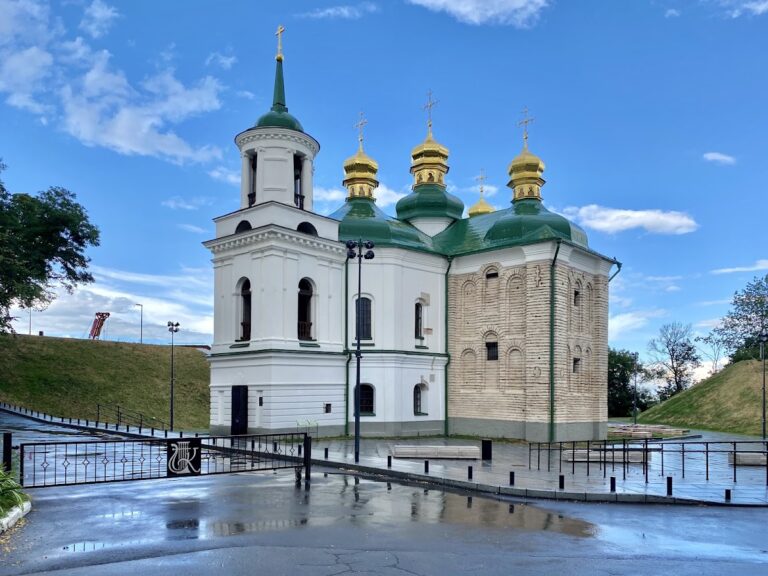
The small Church of Saint George stands beside the foundations of the Fedorivsky church. It preserves reputedly miraculous relics of apostles and saints as well as unique icons. Its interior received Petrykivka-style decoration in 2011, linking the modern church’s visual character with a Ukrainian decorative tradition while remaining beside the archaeological remains of the medieval monastery.
Nearby sites