Mereworth Castle: A Palladian Country House in the United Kingdom
Site at a Glance
- Popularity
- High
- Country
- United Kingdom
- Primary era
- Early Modern
- Eras represented
- Medieval, Early Modern
- Civilizations
- British, English
- Site type
- Domestic
- Remains
- Elite Residence
On this page7 sections
History
Mereworth Castle is a Palladian country house in the United Kingdom, built from 1723 to 1725 for John Fane, 7th Earl of Westmorland, to a design by architect Colen Campbell. Palladian architecture draws on the classical forms and proportions associated with Italian Renaissance architect Andrea Palladio. Despite its name, Mereworth Castle is a country house, not a fortified castle.
The medieval manor and new house
A fortified manor stood on the site by 1332, when its owner received formal permission to add battlements. The manor later passed to Francis Fane (1580–1629), 1st Earl of Westmorland, through his mother, Mary Neville, Baroness le Despenser in her own right. Mary was the only daughter and heiress of Henry Nevill, 6th Baron Bergavenny.
In 1723, John Fane commissioned Campbell’s design for a new house, and building work began that year. Construction was completed in 1725.
Later ownership and uses
The house passed by inheritance to the Barons Oranmore and Browne, members of the Anglo-Irish peerage, and became their family seat. In 1926, the 3rd Lord Oranmore and Browne also became Baron Mereworth, joining the two titles, which have remained united since. The house was sold in 1930 and later served as a prisoner-of-war camp during the Second World War.
Artist Michael Lambert Tree owned Mereworth Castle during the 1950s and 1960s. He had inherited it from his uncle Peter Beatty, who died on 26 October 1949. Mahdi Al-Tajir acquired the property in 1976.
The house, its surrounding pavilions, and its lodges are Grade I listed, the highest listed-building category in England, reserved for buildings of exceptional interest.
Remains
House and grounds
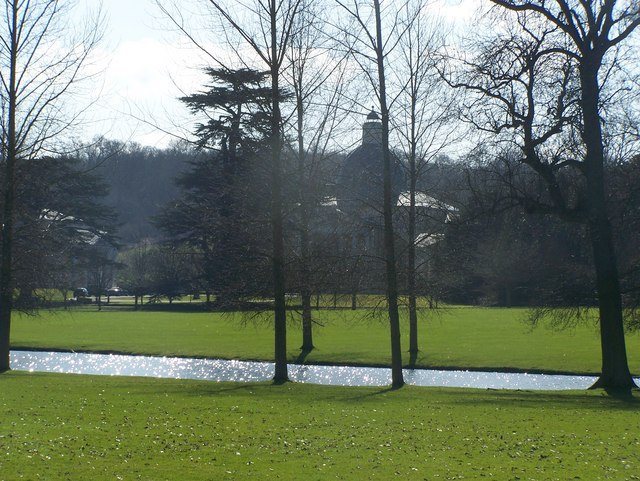
The Palladian house stands in a landscaped park and valley, with several pavilions and lodges around it. Campbell’s design closely reproduces Palladio’s Villa Rotonda near Venice. The Wateringbury Stream runs through the grounds, and at their eastern end it powered a fulling mill, which used mechanical power to clean and thicken cloth.
Interior decoration
Giovanni Bagutti is credited with the interior plasterwork, while Francesco Sleter is credited with fresco paintings, made on wet plaster.
Painted view
A 1746 capriccio by Francesco Zuccarelli and Antonio Visentini depicts Mereworth Villa. A capriccio is an imaginative view that may combine real and invented architectural or landscape features.