Coldrum Long Barrow: An Early Neolithic Chambered Tomb in Kent


Site at a Glance
- Rating
- 4.6
- Popularity
- Low
- Country
- United Kingdom
- Primary era
- Stone Age
- External website
- Open
- Eras represented
- Stone Age
- Civilizations
- Unclassified
- Site type
- Burial
- Remains
- Burial Mound
On this page10 sections
History
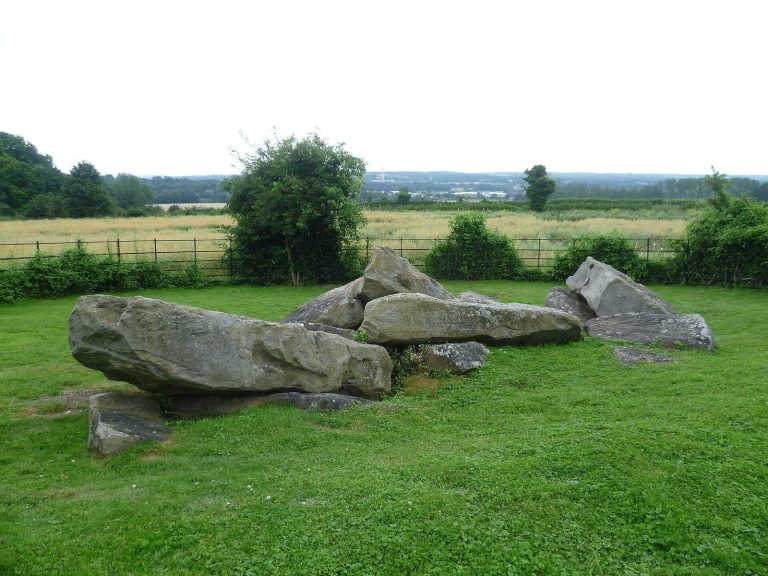
Coldrum Long Barrow, also called the Coldrum Stones and Adscombe Stones, is a ruined chambered long barrow in the United Kingdom, near Trottiscliffe in Kent. Pastoralist communities probably built it during the fourth millennium BCE, in the Early Neolithic, the period when agriculture and herding spread through Britain after contact with continental Europe. Coldrum belongs to the Medway Megaliths, a regional group of large-stone monuments along the River Medway and the North Downs, and is the best-preserved surviving example of that group.
Early Neolithic tomb
The monument probably served as a collective tomb, although its wider purpose remains uncertain. Medway long barrows may have been communal monuments used for ancestor veneration, ritual activity, territorial claims, or gatherings along routes followed by herding communities. Human remains were placed inside the chamber on at least two occasions during the Early Neolithic. The earliest deposits date to approximately 3980–3800 BCE or 3960–3880 BCE, while later deposits probably began around 3730–3540 BCE or 3670–3560 BCE. These dates belong to the burials and do not necessarily date the construction of the monument itself.
At least seventeen people were represented among the remains, including adults, younger people, and children. Some bones had been carefully dismembered after death, possibly following excarnation, in which a body is exposed so that the flesh is removed before burial, or after an earlier burial and later rearrangement. Three skulls show injuries, including two unhealed wounds to the forehead and one healed depressed fracture. The bones provide no diagnostic evidence of cannibalism. Isotope analysis indicates a mainly terrestrial diet rich in animal protein, with freshwater river or estuarine foods becoming more important over time.
Ruin and later disturbance
After the Early Neolithic, Coldrum fell into ruin. Neglect, agriculture, and later disturbance damaged the mound and its stone setting. Deliberate destruction may have taken place in the late thirteenth or early fourteenth century, perhaps during Christian efforts to remove a non-Christian monument or through organized treasure hunting, but neither explanation is certain. Later inhabitants may also have removed chalk and stone for building material.
Local tradition connected Coldrum with a battle and the burial of a “Black Prince.” Another tradition claimed that the stones could never be counted correctly. The battle story may have been shaped by antiquarian theories linking the area with the fifth-century Battle of Aylesford. Reports from an investigation in 1857 mentioned Anglo-Saxon pottery, and later work confirmed that some pottery from the monument belonged to the Anglo-Saxon period. Local accounts also referred to earlier finds of skulls, including a claim that a skull recovered during unauthorized digging was reburied in Meopham churchyard.
Antiquarian study and modern interpretation
Interest in Coldrum increased during the nineteenth century. Mark Noble, Beale Poste, Thomas Wright, J. M. Kemble, A. L. Lewis, Flinders Petrie, George Payne, and George Clinch produced or attempted early descriptions and surveys. Several early investigators misidentified the monument as a stone circle, a Celtic monument, or a Druidic temple rather than a long barrow.
F. J. Bennett began excavation on 16 April 1910 and recovered human bones, skull fragments, a flint tool, and pottery. Work continued in August and September with E. W. Filkins and other antiquarian investigators. Bennett argued that the human remains belonged to victims of human sacrifice in fertility rites, but that interpretation was later rejected as unsupported. John H. Evans stated that there was no way to determine whether sacrifice had occurred.
Filkins excavated again from September 1922 until at least 1926, exposing the surviving sarsens and finding further human remains. The remains came into the possession of Sir Arthur Keith, a museum conservator at the Royal College of Surgeons, and those recovered from the monument were reburied in Trottiscliffe churchyard between 1939 and 1945. Filkins’s work was extensive, but it did not adequately record the stone holes, packing stones, or their relationship to the mound.
In the early twenty-first century, Michael Wysocki led a new examination of the remains using osteological study, Bayesian radiocarbon modelling, and carbon and nitrogen isotope analysis. Published in 2013, the results revised the minimum number of individuals to seventeen and clarified the sequence of burial, diet, injuries, and treatment of the bodies after death.
The Coldrum Stones passed to the National Trust in 1926 and were dedicated as a memorial to the Kentish prehistorian Benjamin Harrison. A commemorative plaque incorrectly called the monument a stone circle. The National Trust continues to manage the site. Pagan activity has taken place there since at least the late 1980s, including meditation, prayer, rites of passage, seasonal observances, and rituals associated with ancestry and “earth energy.” Roharn’s Grove holds Druidic rites at the monument, and a Wiccan handfasting took place there around 2000. Other Pagan ceremonies have expressed opposition to the Channel Tunnel Rail Link and hydraulic fracturing in the United Kingdom. Since the early twenty-first century, the Hartley Morris Men have met at Coldrum at dawn every May Day for dances and a “sing up the sun” ceremony. Ribbons have been tied to trees on the northern side, and by early 2014 some trunks carried probable Heathen carvings of the names Thor and Odin in the Elder Futhark alphabet.
Remains
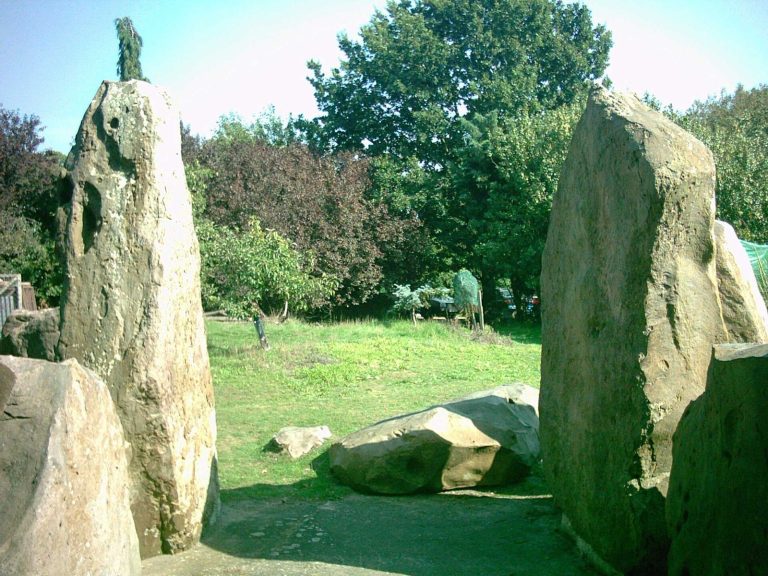
Coldrum originally consisted of a low earthen mound, a sarsen-stone burial chamber, and an enclosing arrangement of about fifty local sarsens, including stones marking the mound’s edge. The mound had a sub-rectangular, truncated-wedge plan, measuring about 20 metres from end to end, 15 metres across its eastern end, and 12 metres across its western end. It stood on the crest of a small ridge beside the North Downs, at the edge of a large lynchet scarp, and faced east towards the River Medway. Its axis also points towards the North Downs and the Medway Valley.
Burial chamber and mound
Sarsen chamber
The surviving inner chamber is approximately 4 metres long and 1.68 metres wide, although it may originally have been larger. Its internal height was at least 1.98 metres. Two large slabs form the northern side, while a single slab about 3.45 metres long forms the southern side. An upright end stone, or orthostat, closes the western end. It is about 1.37 metres wide, 2.4 metres deep, and 0.30 metres thick. A broken slab lies at the eastern entrance, and another largely rectangular slab at the foot of the slope may have belonged to the chamber’s eastern end.
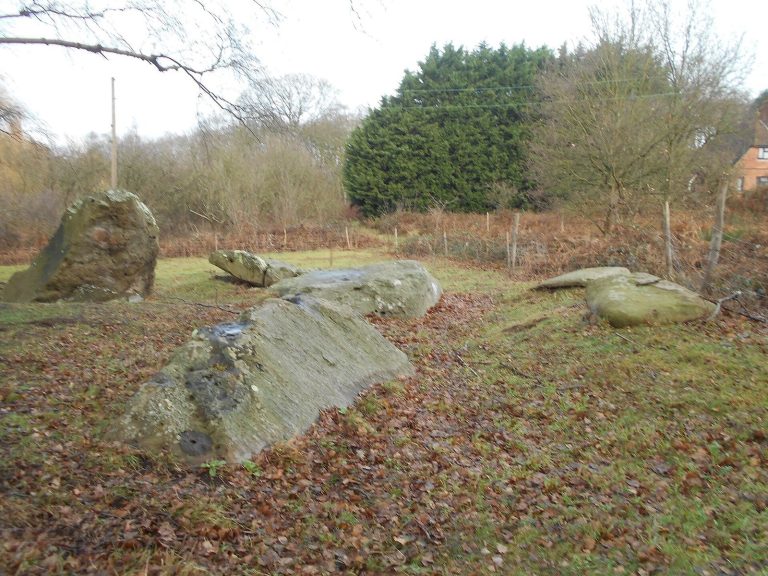
Flint masonry originally packed around the chamber and supported the sarsens. Much of this packing was replaced by cement during twentieth-century repairs, and concrete foundations were added during Filkins’s excavations to support the chamber stones. A stone facade may once have stood before the entrance, perhaps with a portal stone above the chamber. Several large slabs lying down the eastern slope may be fragments of that arrangement, although their identification remains tentative. The chamber may also have been divided by slabs across its middle, an interpretation based partly on comparisons with other British long barrows.
Earthen mound and kerb
The mound now survives as an earthwork undulation about 0.46 metres high. It was higher at its western end in the nineteenth century, but much of the material was removed during the 1920s to expose the sarsens. A quarry ditch probably surrounded the original mound, with the kerb-stones now lying within it. Northern kerb-stones are mostly straight-sided, while those on the southern side are smaller and more irregular. A supplementary dry-stone wall may have been built from ironstone quarried from the Folkestone geological beds.
Concave abrasion and polishing marks on a western central kerb-stone and a southeastern kerb-stone probably resulted from sharpening flint or other stone axe blades. The tools may have been prepared for cutting and shaping wooden levers and supports used to raise the megaliths. The eastern side has largely collapsed. Stones that once helped support the mound lie at the bottom of the slope, although some of the sarsens there may instead have been collected from nearby fields and placed by farmers.
Burials and associated finds
Two separate deposits of human bones were found inside the chamber, each placed on a stone slab, with one deposit higher than the other. Some bones bear cut marks, including two thigh bones, two hip bones, and one skull. The marks are consistent with careful removal of ligaments during dismemberment rather than violent hacking. Ceramic sherds and other occupational debris lay over some of the bones. Flint tools and small quantities of pottery, including Anglo-Saxon pottery, were also recovered from the chamber.
Landscape and archaeological setting
Coldrum lies northeast of Trottiscliffe, about 500 metres from the prehistoric track known as the Pilgrims’ Way. A possible additional east-west barrow occupies a hollow roughly 400 metres to the north, while large sarsen blocks south of the monument may be remnants of another destroyed chambered tomb. Both identifications remain uncertain. The monument takes its name from nearby Coldrum Lodge farm, which has since been demolished.