Menaggio Castle: A Fortified Stronghold on Lake Como


Site at a Glance
- Rating
- 3.1
- Popularity
- Very Low
- Country
- Italy
- Primary era
- Medieval
- Eras represented
- Medieval
- Civilizations
- Holy Roman Empire
- Site type
- Military
- Remains
- Castle
On this page7 sections
History
Menaggio Castle was a military fortress in Menaggio, Italy, overlooking the Sinagra stream and the surrounding area of Lake Como. Its origins are linked by some scholars to a feudal grant made in 934 by Hugh of Provence, the tenth-century ruler who became king of Italy, to the Milanese Gerardo Castelli. On this interpretation, the original fortress probably dates from the tenth century.
Medieval Origins and Conflict
The castle is certainly documented by the twelfth century, when Menaggio sided with Milan in the Ten Years’ War, a conflict between Milan and Como over political control around Lake Como. Como forces attacked the castle in 1124. For most of its history, the fortified complex belonged to the Castelli family.
Sixteenth-Century Attacks and Demolition
From 1516, forces of the Republic of the Three Leagues repeatedly attacked the castle. This Alpine political confederation corresponded broadly to the modern Swiss canton of Graubünden. Its forces burned Menaggio in 1518 and captured and damaged the fortress in 1523. These attacks began a period of abandonment that ended with the castle’s definitive demolition in 1620.
Later Ownership and Historical Memory
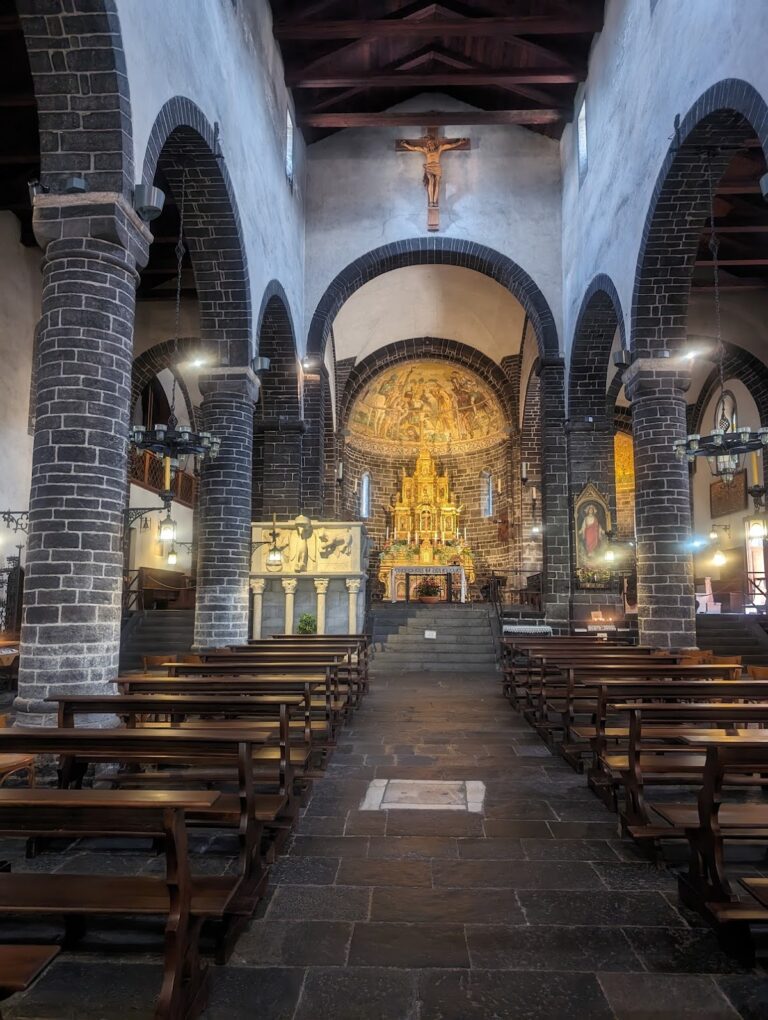
Between the beginning of the seventeenth century and 1776, the site belonged to Cinzio Calvi, the referendary of Como, an official who presented or transmitted matters to a governing authority. Calvi built the Church of San Carlo on the castle ruins. Menaggio Castle is also mentioned several times in the works of Paolo Giovio, an Italian Renaissance historian and writer whose writings recorded historical events and notable places.
Remains
The castle occupied a height above the Sinagra stream. Probably during the twelfth century, the fortress gained four corner towers and a circuit of walls that enclosed the settlement and extended down to the lakeshore. The surviving traces consist of the entrance, probably situated at what is now Largo Fossato, sections of the surrounding walls, and two bas-reliefs set into the exterior walls of two houses near the Church of San Carlo.
Fortifications and Settlement Walls
The wall circuit formed the principal defensive enclosure, joining the elevated castle area to the lakeshore and incorporating the settlement. Four corner towers probably strengthened the complex during its twelfth-century development. Portions of the surrounding walls remain, preserving part of the relationship between the fortress, the settlement, and the lake.
Entrance and Surviving Reliefs
The entrance was probably located at Largo Fossato, where its position relates to the surviving defensive traces. Near the Church of San Carlo, two bas-reliefs are embedded in the exterior walls of separate houses. These elements survive within the later built fabric associated with the former castle site.