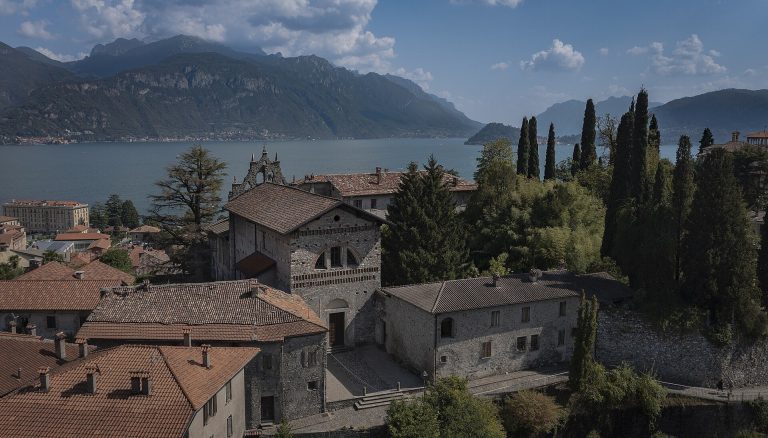
San Giacomo: A Romanesque Catholic Church in Bellagio, Italy


Site at a Glance
- Rating
- 4.6
- Popularity
- Medium
- Country
- Italy
- Primary era
- Medieval
- Eras represented
- Medieval, Early Modern
- Civilizations
- Duchy of Milan, Holy Roman Empire, Spanish
- Site type
- Religious
- Remains
- Church
On this page11 sections
History
San Giacomo is a Catholic church dedicated to Saint James in Bellagio, Italy, on the shore of Lake Como. Built between the late eleventh and early twelfth centuries by the Maestri Comacini, medieval stoneworkers and builders associated with the Lake Como region, it is a Romanesque church belonging to the Diocese of Como. Later alterations have made its precise original dating difficult to establish.
Medieval Origins and Early Records
The church was created during the Romanesque period, an architectural style known for massive masonry, rounded arches, apses, and restrained geometric decoration. Its builders, the Maestri Comacini, were renowned for this type of construction in the Lake Como area. The first known description of San Giacomo dates from the 1580 pastoral visit of Feliciano Ninguarda, Bishop of Como. The account was later discussed by the historian Santo Monti.
Parish Foundation and Baroque Transformation
In 1657, San Giacomo was canonically elevated to a prepositural parish, meaning a parish headed by a provost, an ecclesiastical official with authority over the parish. Pietro Antonio Bello, a notary of the Curia of the Diocese of Como, drew up the instrument establishing the change. The new parish territory was separated from that of the mother church of San Giovanni, while patronage was assigned to the Sfondrati family.
After becoming a parish, the church complex was transformed into an eighteenth-century Baroque ensemble. It retained this appearance until early twentieth-century restoration campaigns attempted to recover its earlier Romanesque character.
Twentieth-Century Restoration and Protection
Restoration began in 1904 under the architect Perrone. The work included reconstructing two apses and restoring the building’s Romanesque appearance. In the same year, a ministerial decree declared San Giacomo a national monument. The church and its contents also have protection as an Italian cultural asset. In 1990, the bell tower was restored and the plaster covering the church and tower was removed.
Remains
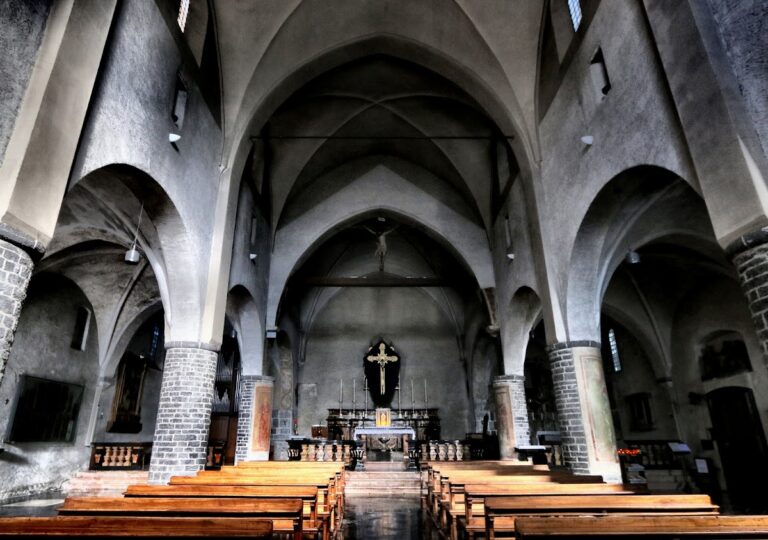
San Giacomo has a rectangular plan with three aisles, built chiefly from gray Moltrasio stone, a material widely used around Lake Como. Granite from erratic boulders in the Lario mountains was used for the capitals and column bases. The surviving complex combines the Romanesque structure with later Baroque alterations and furnishings that reflect the church’s long religious history.
Facade and Romanesque Exterior
The facade is crowned by a frame of blind arches, decorative arches that do not form openings, and includes an oculus, or circular window, together with single-light windows above the only portal. Three apses survive from the original building. Their exteriors are decorated with double-ring blind arches, dentils, and pilasters. The entrance hall preserves four capitals and representations of the Evangelists from the primitive church.
Bell Tower
The bell tower stands on the left side of the facade. It began as a defensive tower belonging to the communal-period walls on the northern side of the church. The earlier tower reached approximately to the height of the church roof. Its upper section was rebuilt during the seventeenth century, while eighteenth-century alterations gave the tower its present appearance. The plaster was removed during the 1990 restoration.
The tower contains five bells cast in 1849 by the Pruneri foundry of Grosio in Valtellina. Together they form a tuned diatonic major scale in D3 and are arranged for Ambrosian-style ringing, the traditional method associated with the ecclesiastical and cultural area of Milan and Lombardy.
Interior Art and Sculptures
The interior contains two fifteenth-century panels, one from the Umbrian school and one from the Lombard school, along with Romanesque sculptures and paintings from the late sixteenth and seventeenth centuries. Among the later works are a nineteenth-century Deposition of Jesus in the Tomb, made under the inspiration of Perugino, and the sixteenth-century Madonna delle Grazie, attributed to Vincenzo Foppa. A sixteenth-century sculpture from the Spanish school, also representing the Deposition, stands beneath the Perugino-inspired painting. The church also preserves a painting from the school of Moretto. Perugino and Moretto were Italian Renaissance painters, while Vincenzo Foppa was a leading Lombard painter.
Apses and Chapels
The three apses contain, from left to right, the Chapel of Saint Ursula, a gilded wooden altarpiece above the tabernacle, and the Chapel of Saint Anthony. The Chapel of Saint Ursula contains a mosaic made by the Castemari firm of Venice in the early twentieth century. The gilded altarpiece was made by Domenico Pini, a sculptor from Bellagio.
The Chapel of Saint Anthony contains another Castemari mosaic, which replaced a fresco damaged by humidity. Its altar dates from 1985 and was made by the Sampietro firm from slabs of Musso marble. Antonio Pino executed the upper part of the high altar.
Ambo and Baptistery
The ambo, a raised platform used for proclaiming readings or preaching, was reconstructed during Perrone’s restoration. It incorporates twelfth-century Romanesque capitals from the primitive church. Symbols of the Evangelists dating from the eleventh century, formerly part of the old ambo, were recovered from the wall of the bell tower.
The baptistery was reconfigured during the church’s restoration, and its present arrangement dates from 1986. Its Venetian-school mosaic depicts the Baptism of Christ as represented in a painting by Bergognone in the Basilica of San Giovanni Battista at Melegnano. The support for the baptismal font was made by the sculptor Daverio of Bergamo.
The Dead Christ
San Giacomo preserves a seventeenth-century figure of the dead Christ made in Spain. Tradition holds that the figure belonged to a Spanish settlement at Pian di Spagna and was carried into Lake Como during a flood of the Adda River. Fishermen from Bellagio are said to have found it and placed it in the church for veneration. The figure is carried in procession every Good Friday.