Church of San Giorgio: A Medieval Parish Church in Varenna


Site at a Glance
- Rating
- 4.7
- Popularity
- Very Low
- Country
- Italy
- Primary era
- Medieval
- External website
- Open
- Eras represented
- Medieval
- Civilizations
- Unclassified
- Site type
- Religious
- Remains
- Church
On this page15 sections
History
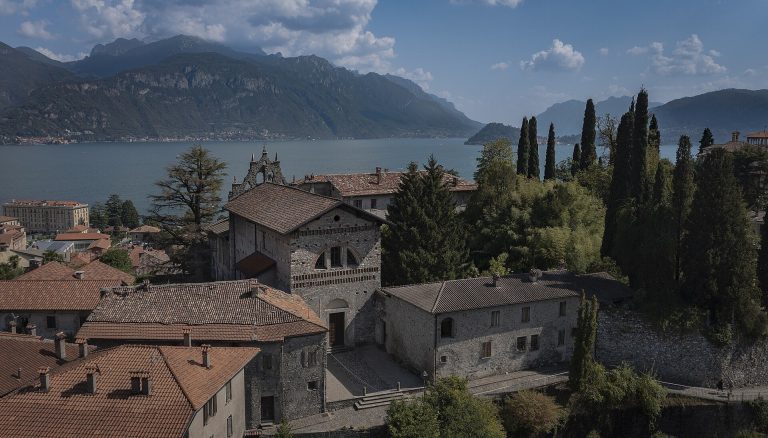
The Church of San Giorgio is a Roman Catholic parish church in Varenna, Italy, built in the thirteenth century in the Gothic tradition. It stands in the center of the town on Piazza San Giorgio and belongs to the Archdiocese of Milan. The present building replaced a twelfth-century structure, although it remains uncertain whether an earlier medieval religious building occupied the site before it.
Medieval construction
The church appears to have been built in three stages. During the first decades of the thirteenth century, builders erected the stone pillar shafts and the perimeter walls. A later phase, probably in the closing years of that century, added the brick walls, the arches of the nave, and the brick upper parts of the pillars. The evidence of different materials preserves the interruption between these stages.
The building is broadly dated to the thirteenth and fourteenth centuries, while the first certain documentary reference comes from 1313. In the fourteenth century, the original wooden roof was replaced by masonry vaults, changing the structure of the church while retaining evidence of its earlier form. These phases place San Giorgio within the medieval architectural traditions of Lombardy, the northern Italian region where Gothic church building developed distinctive local forms.
Later alterations and restoration
The sacristy and bell tower were added during the second half of the fifteenth century. The tower was altered in 1653, and further changes affected the church complex during the seventeenth and eighteenth centuries. These interventions introduced later elements into a building whose main structure remained medieval.
Restoration campaigns in the second half of the twentieth century revealed the church’s Gothic character and led to its recognition as an example of medieval Lombard architecture. A 2001 campaign concentrated on the roof, where repeated leaks had damaged the plaster. The church’s artistic contents include works dating from the thirteenth through the eighteenth centuries, reflecting the long religious use of the parish building.
Artistic history and devotional use
A late-fifteenth-century polyptych, or multi-panel altarpiece, was repeatedly listed as the high-altar altarpiece between 1566 and the beginning of the seventeenth century. Two panels showing Saint Lucy and Saint Anthony were stolen in 1977. Another important work, a sixteenth-century triptych of the Virgin and Child between Saint Martin and Saint George, came from the nearby Church of San Giovanni Battista before being installed in a side chapel at San Giorgio.
The triptych was attributed to “Sodoma,” the established nickname of the Renaissance painter Giovanni Antonio Bazzi, and Giorgio Pudelko also advanced that attribution at the suggestion of the collector Venier, who donated the work. It was later assigned instead to an unknown sixteenth-century Lombard painter because of stylistic connections with traditions associated with Leonardo, Zenale, and artists from Brescia. Claudio Fociani and Ede Palmieri restored the triptych.
Remains
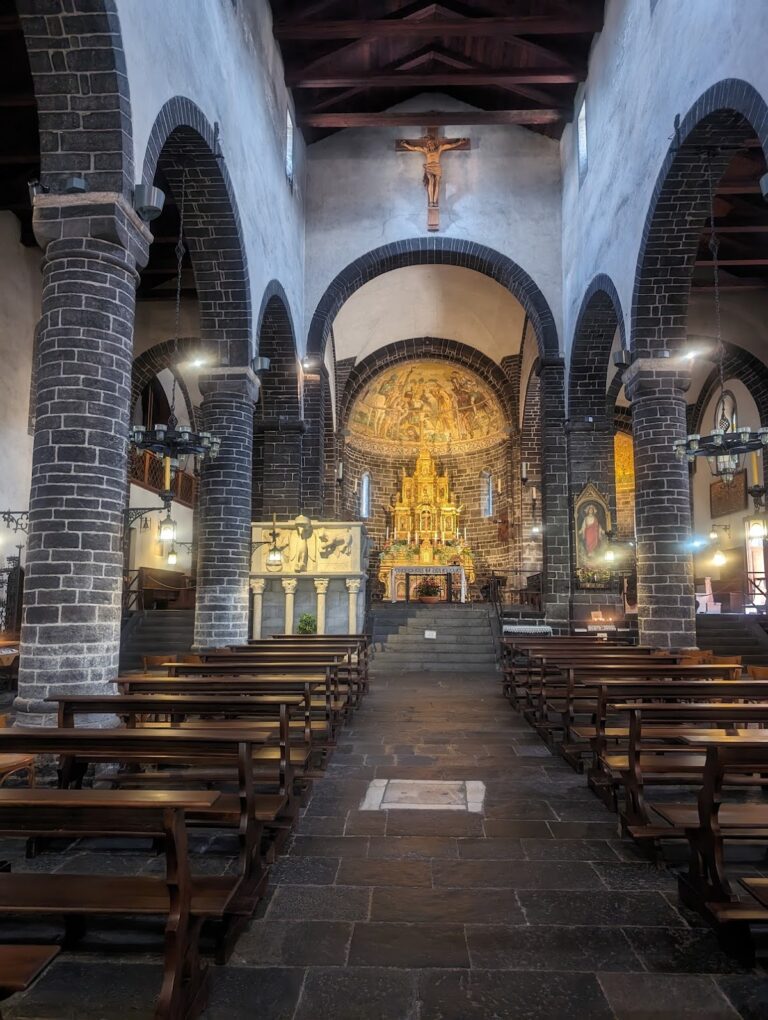
The church has a rectangular Gothic plan without a transept, meaning that its spaces extend lengthwise rather than forming a cross-shaped layout. Its gabled facade reflects the division of the interior into three naves, with the central nave rising above the two side naves. A large glazed oculus, or circular window, occupies the center of the facade.
Structure and medieval fabric
Naves and vaults
Two rows of three circular pillars support the vaults of the central nave. Each pillar rests on a square base, and its lower section is built of stone while the upper section is made of brick. The side-nave vaults are carried externally by conical corbels, projecting supports set into the perimeter walls. These supports create the suspended vault arrangement described for the lateral spaces.
The interior is divided into four bays, each illuminated by a single lancet, a tall narrow window with a pointed arch. Two side chapels open beside the central apse. Traces of earlier small, narrow round-arched windows remain, dating approximately from the end of the thirteenth century. The former wooden roof is also represented by its cornice and by the attachment points preserved in the walls; the timber covering was replaced by masonry vaulting in the fourteenth century.
Facade and entrance
The facade’s three-part composition corresponds to the three interior naves. Beside the central doorway is a fresco of Saint Christopher, represented as the protector of ferrymen. The circular oculus above it provides the principal geometric focus of the facade, while the surviving brick and terracotta masonry preserves the materials used in the church’s later medieval building phases.
Paintings and sculpture
Frescoes
Thirteenth-century frescoes survive inside the church. On the counterfacade, the interior wall opposite the main facade, a fifteenth-century Last Judgment includes a monumental Beelzebub devouring the souls of the damned. The columns beside the high altar carry figures identified as Pope Gregory the Great on the right and Queen Theodelinda on the left. Gregory I was a major Christian theologian, while Theodelinda was a Lombard queen associated with the conversion of Lombard rulers to Christianity, an association that explains her local representation.
The rear wall of the right-hand chapel contains a thirteenth-century series of saints and bishops. The figures are framed by alternating floral decorations and crosses, creating a repeated ornamental pattern across the wall.
The Baptism of Jesus
The left-hand chapel contains Sigismondo de Magistris’s 1533 panel painting The Baptism of Jesus. Its date appears in a painted false inscription in the upper left. Saint John the Baptist pours water over the kneeling Christ, who is accompanied by two angels. Behind them, a mountainous landscape rises beneath the dove of the Holy Spirit, placed between two peaks. In the predella, the horizontal lower section beneath the main images, Saint John the Evangelist and Saint George flank the Virgin and Child.
Sculptures and later devotional works
The church preserves a late-fifteenth-century wooden Deposition, a representation of Christ being taken down from the cross, together with stone and marble sculptures from the fourteenth and fifteenth centuries. A sixteenth-century Crucifix is placed at the top of an arch. A late-seventeenth-century Madonna of the Rosary and a carved confessional made by Giovanni Albiolo in 1690 represent later additions to the church’s devotional furnishings.
Altarpieces and wooden furnishings
Late-fifteenth-century polyptych
Thirteen wooden panels survive from the late-fifteenth-century polyptych. The partly gilded principal panel shows the enthroned Virgin and Child attended by musical angels. The remaining panels depict Saints Stephen, Nicholas, Ambrose, George, Jerome, Lawrence, Bernard, Catherine of Alexandria, John the Baptist, Eustace, Agnes, and Apollonia. Together, the panels preserve the arrangement and wide range of saintly figures associated with the former high-altar ensemble.
Sixteenth-century triptych
The triptych in the right-hand chapel consists of three oil paintings on wood that were later transferred onto canvas. Its carved wooden frame uses classical motifs, and an inscription on the reverse records restoration by the Porta brothers in 1960. The central panel shows the Virgin and Child. The Virgin, dressed in purple, sits with her legs slightly crossed on a wooden throne beneath a green hanging cloth, while the naked Child stands upright in her arms with his head turned to the left.
Saint Martin occupies the left panel and Saint George the right. Both saints face toward the center and hold swords. Martin covers a poor man with his cloak, while George, clad in shining armor, tramples a dragon. A shared celestial background connects the three panels, although their assembly is considered possibly forced because of inconsistencies in perspective and details such as sharply cut arches and a frame that overlaps the central subject.
The sacristy retains eighteenth-century furnishings, completing the sequence of later additions that surrounds the medieval structure and its earlier works of art.