Melrose Abbey: Scotland’s First Cistercian Abbey
Site at a Glance
- Rating
- 4.5
- Popularity
- Medium
- Country
- United Kingdom
- Primary era
- Medieval
- External website
- Open
- Eras represented
- Medieval, Early Modern
- Civilizations
- Kingdom of Scotland
- Site type
- Religious
- Remains
- Monastery
On this page16 sections
History
Melrose Abbey is a Cistercian monastery in Melrose, United Kingdom, founded in 1136 by King David I of Scotland in the Gothic manner. It was Scotland’s first Cistercian abbey and became the mother church and chief house of the order in Scotland until the Reformation. Its first monks came from Rievaulx Abbey in North Yorkshire, whose community had been established from Cîteaux, the principal foundation of the Cistercian reform.
Foundation and medieval development
David I initially intended the new abbey to stand at Old Melrose, the site of an earlier monastery. The Cistercians judged that land unsuitable for farming and selected the present location instead. The church was dedicated to the Virgin Mary on 28 July 1146. The abbey belonged to the Diocese of Glasgow and was governed by an abbot until 1541, when a series of commendators took control. A commendator was an administrator who held a monastery’s revenues and authority without necessarily living as a monk.
David I granted the abbey the lands of Melrose and Eildon, other properties, and fishing rights on the River Tweed. Later Scottish monarchs expanded these possessions. The community eventually included about 100 monks as well as the abbot and other senior officials. Its churches included those at Cavers Magna, Dunscore, Ettrick, Hassendean, Mauchline, Melrose, Ochiltree, Tarbolton, Westerkirk, and Wilton.
The Cistercians were a reform branch of Western Christian monasticism that stressed austere communal life, farming, and obedience to the Benedictine Rule. At Melrose, they introduced new agricultural methods and sold wool through major ports in northern Europe. Sheep granges, or agricultural estates managed for the abbey, were established at Penshiel, Hartside, Edmundston, and Friardykes in the Whiteadder catchment. Their expanding activity produced disputes with tenants of the Earl of Dunbar and with the Morville lords of Lauderdale, whose interests were affected by the abbey’s grazing and livestock. In 1164, Dryburgh Abbey transferred Colmslie and adjoining woodland to Melrose.
A settlement gradually grew around the monastery. During one famine, the abbey fed 4,000 starving people for three months. Waltheof of Melrose, David I’s stepson and a former prior of Kirkham, served as abbot from 1148 to 1159. His leadership gave the community a reputation for holiness and learning comparable to that of Fountains and Rievaulx, helping establish Melrose as Scotland’s leading abbey. His tomb in the chapter house later became a destination for pilgrims. The Chronicle of Melrose Abbey also preserves an early account of the agreement made at Runnymede in 1215 in association with Magna Carta.
War and destruction
Melrose stood on the principal route from Edinburgh to southern Scotland, a position that exposed it to military attack. In 1322, the army of Edward II of England attacked the town and destroyed much of the abbey. Robert the Bruce ordered rebuilding, with Sir James Douglas acting as the project’s principal financial auditor.
Richard II of England’s army burned the abbey in 1385. The attack took place partly in the context of Melrose’s support for Clement VII, the Avignon Pope, and the retreat of Robert II of Scotland’s army towards Edinburgh. Reconstruction continued for roughly a century and remained unfinished when James IV visited in 1504.
The abbey suffered further severe damage in 1544 during the English campaigns intended to force a marriage between the infant Mary, Queen of Scots, and Henry VIII’s son. The destruction was never fully repaired and helped bring about the decline of the monastery as a working religious community. The last abbot, James Stuart, an illegitimate son of James V, died in 1557, and the last monk died in 1590. On 29 September 1549, an English soldier found a pyx, a container for consecrated Communion bread, suspended above the high altar and gave it to the Earl of Rutland.
Melrose endured another military assault when Oliver Cromwell’s troops bombarded the abbey during the Wars of the Three Kingdoms, the conflicts that destabilised the kingdoms of England, Scotland, and Ireland in the seventeenth century. Marks from the cannon fire remain on parts of the walls. The abbey was formally disestablished in 1609. In 1618, part of the church was adapted as a parish church for the surrounding town, and it remained in use until a new town church was built in 1810.
Burials, preservation, and interpretation
Alexander II and other Scottish kings and nobles were buried at Melrose. Tradition also holds that the heart of Robert the Bruce, Robert I of Scotland, was buried in the abbey church, perhaps after being brought back from a crusade with the body of Lord Douglas in 1330 or 1331. Robert the Bruce led the successful Scottish struggle for independence. A small metal plaque once marked the supposed location of the heart, although the remaining body of the king lies at Dunfermline Abbey.
In 1996, excavation uncovered a conical lead container and an engraved copper plaque. The plaque stated that a lead casket containing a heart had been found beneath the chapter-house floor in March 1921. Examination revealed a recognisable human heart preserved in thick black liquid. Since no other heart burial at Melrose is known, it was presumed to be Robert the Bruce’s, but no DNA testing was attempted and the identification cannot be proved conclusively. The container was reburied beneath a memorial stone at the abbey on 22 June 1998. The chapter house was an unusual place for a royal heart burial, since high-status burials generally took place beside the altar.
A stone coffin removed from the aisle of the south chancel in 1812 was also associated speculatively with Michael Scot, the philosopher whom later tradition sometimes described as a wizard. The occupant was not securely identified. In the early nineteenth century, Sir Walter Scott, then Sheriff-Depute of Roxburghshire, supervised extensive repairs to preserve the ruins, with financial support from the Duke of Buccleuch. The duke transferred the ruins to the state in 1918. Melrose Abbey is now maintained by Historic Environment Scotland as a scheduled monument.
Remains
Plan and surviving fabric
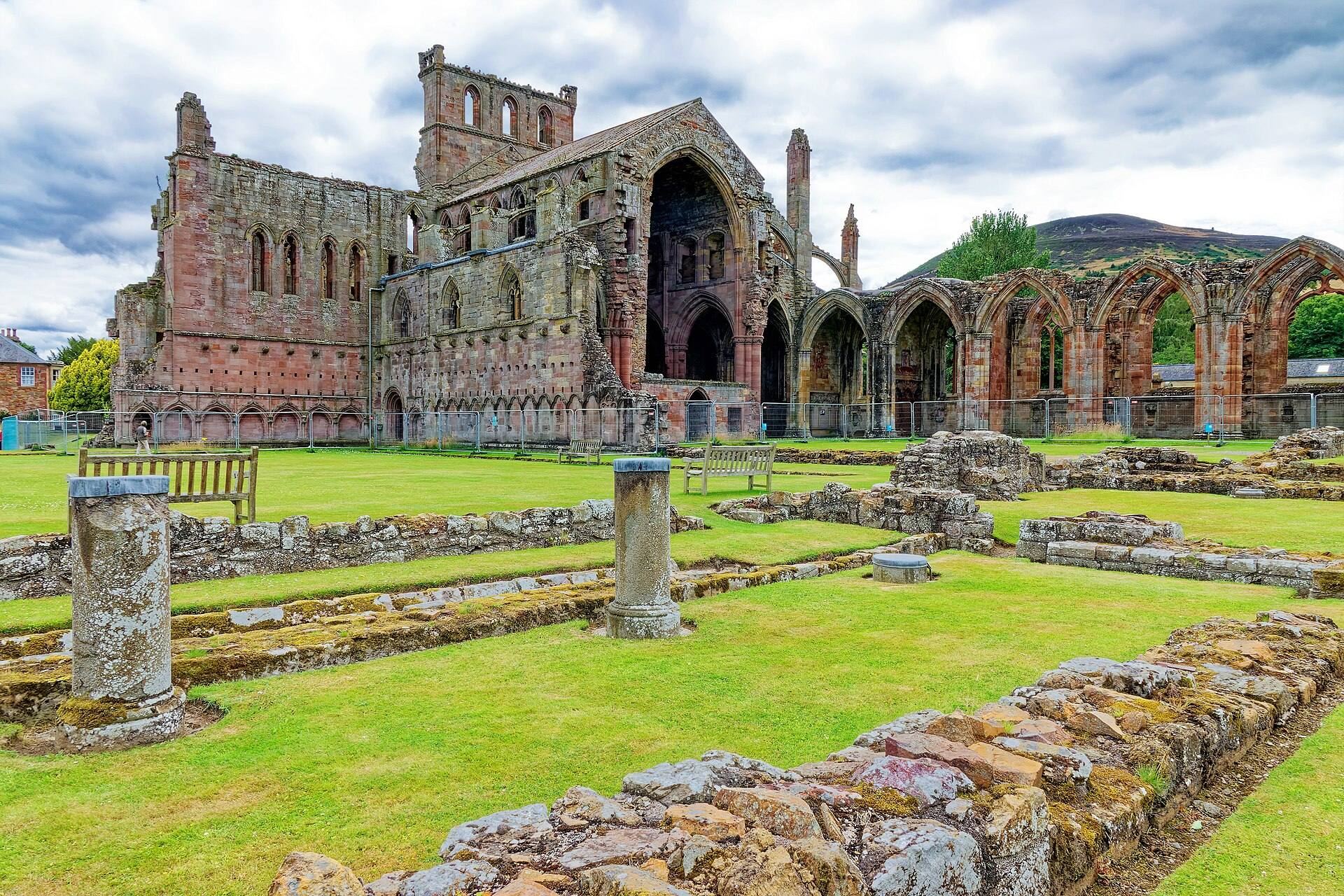
Melrose Abbey was laid out on a traditional east-west axis with a plan described as a St John’s Cross. The eastern end of the church was completed in 1146, while other parts of the complex were added during the following fifty years. The western part survives largely as foundations, whereas the eastern section remains comparatively well preserved. The northern cloisters have also been reduced to foundation level.
Church and eastern section
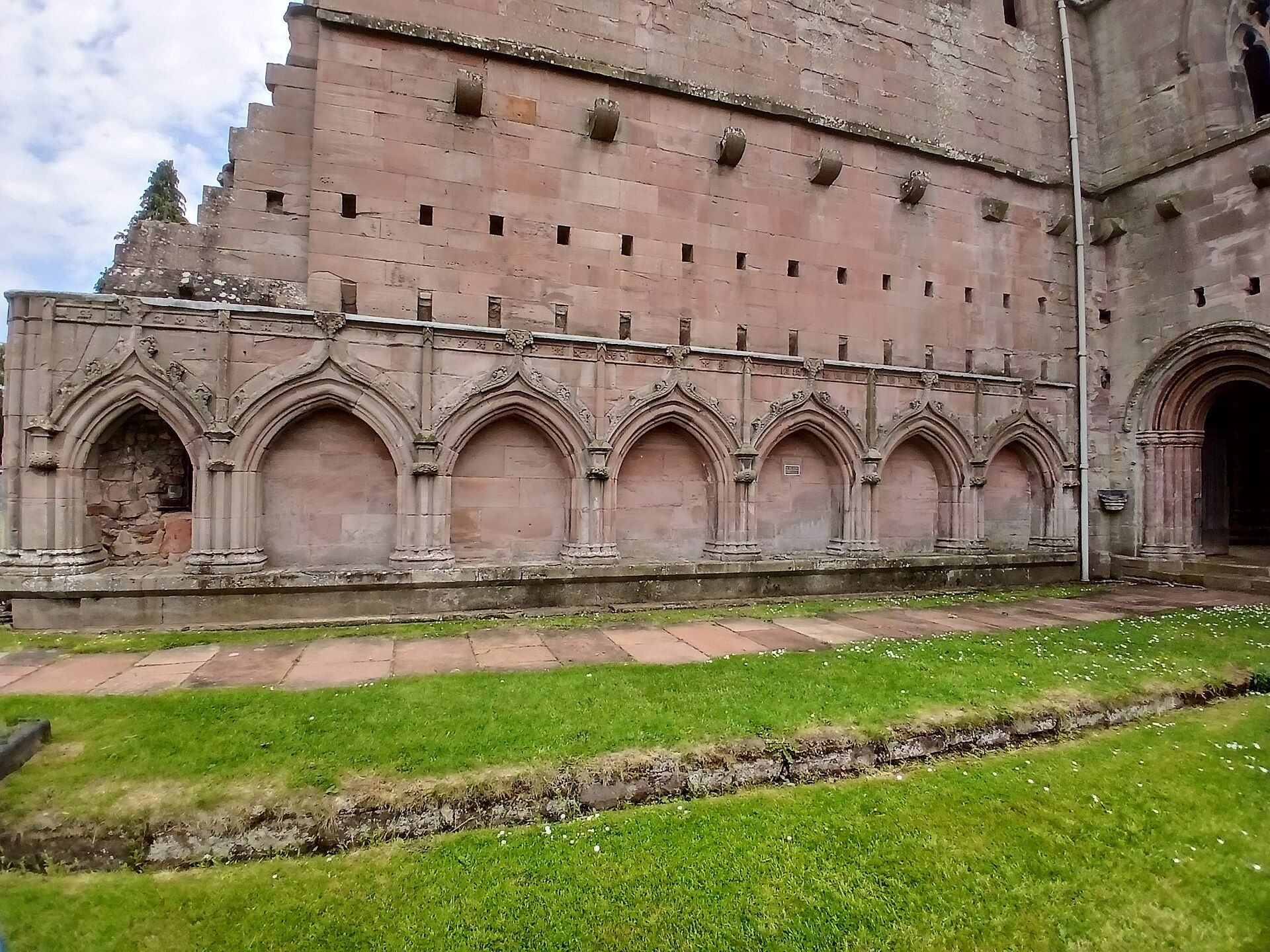
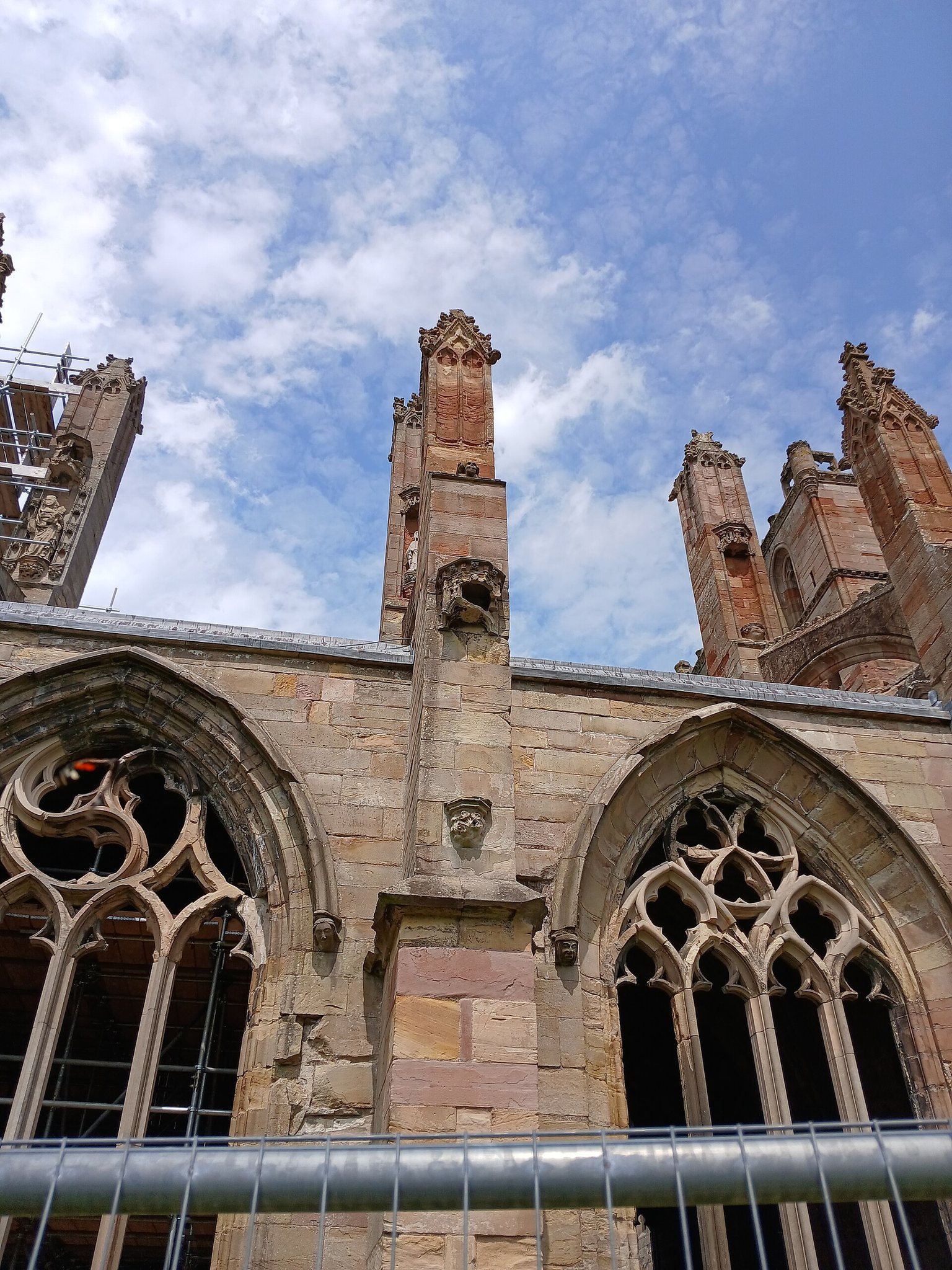
The surviving eastern fabric forms the best-preserved part of the medieval abbey. Its walls contain abundant carved decoration, including figures of saints, dragons, gargoyles, and plants. One gargoyle represents a pig playing bagpipes. Melrose is also described as the only Scottish abbey retaining some of its original floor tiles.
Western buildings and cloisters
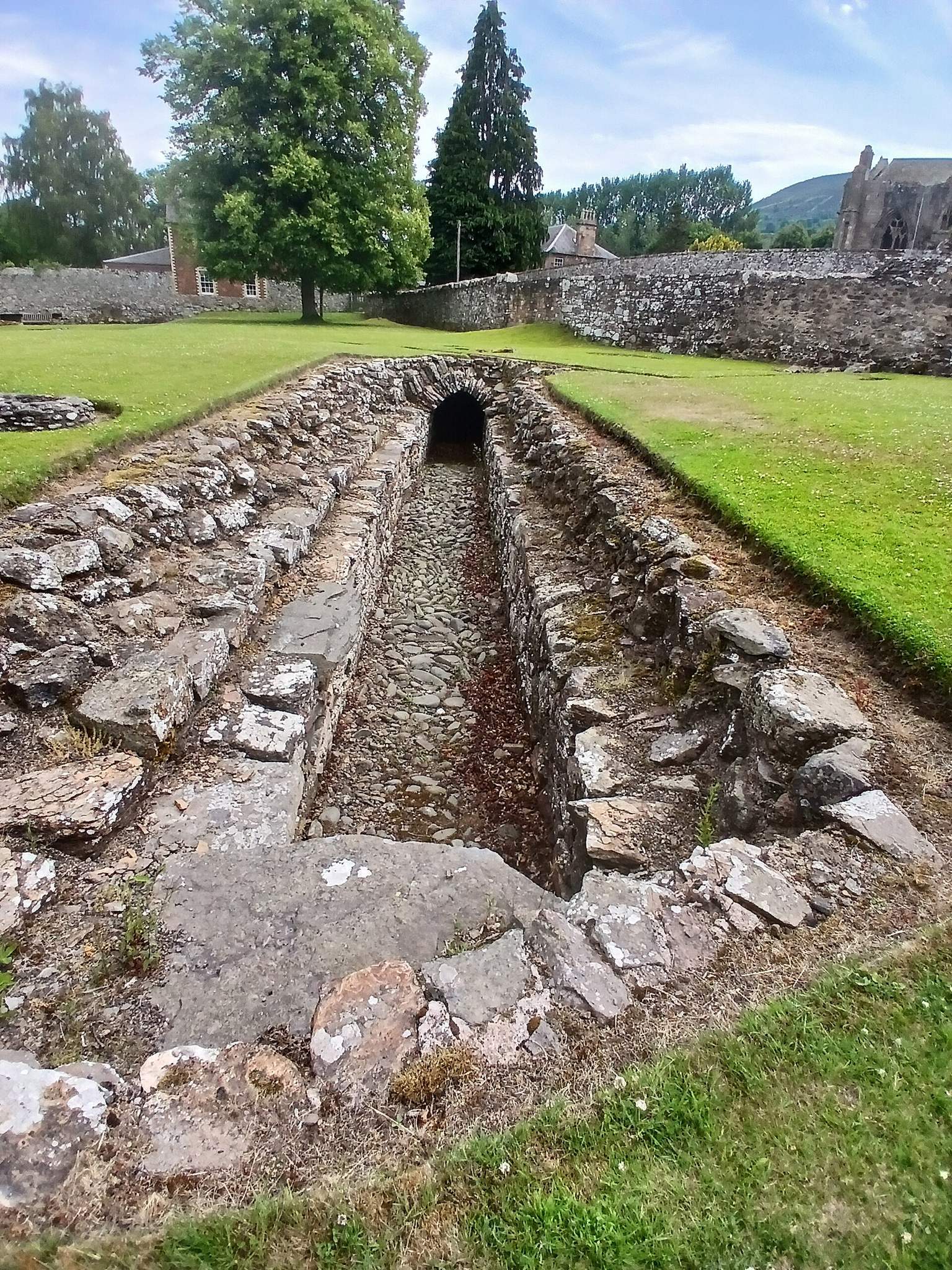
The western part of the complex is represented almost entirely by foundations, which preserve the outline of buildings that once extended the abbey beyond its better-preserved eastern end. The northern cloisters likewise survive at foundation level, allowing their former position within the monastic complex to be traced.
Crossing vault
A plain vault was inserted at the church crossing in 1618 when part of the abbey was adapted for parish worship. This alteration removed the original ribbed vaulting from the central section.
Chapter house and burials
Chapter house
The chapter house was the room where the monastic community met for reading, discipline, and administrative business. It was also the place associated with the lead container linked to Robert the Bruce’s supposed heart. After the container was reburied in 1998, it lay beneath a memorial stone at the abbey.
South chancel coffin
A stone coffin was exhumed from the aisle of the south chancel in 1812. Its occupant was not securely identified, although tradition connected it with Michael Scot. The coffin forms part of the evidence for the abbey’s use as a burial place for prominent figures.
Later structures and grounds
Sixteenth-century structure
A structure dating from 1590 survives within the abbey complex and is maintained as a museum. It belongs to the period when the monastery was declining as a religious institution but remained an important local site.
Graveyard
A graveyard serving the local community extends south and southeast of the abbey. Most of its gravestones date from the nineteenth century.
Cannon damage and carved details
The walls retain marks attributed to the bombardment by Oliver Cromwell’s troops. Elsewhere, carved figures, animals, gargoyles, and plant forms preserve the decorative character of the medieval fabric. An inscription by the master mason John Morow appears on one of the abbey stairways. Its meaning is “Keep in mind, the end, your salvation,” and the phrase later became the motto of the town of Melrose.