Dryburgh Abbey: A Premonstratensian Monastery in Scotland


Site at a Glance
- Rating
- 4.6
- Popularity
- Low
- Country
- United Kingdom
- Primary era
- Medieval
- External website
- Open
- Eras represented
- Medieval, Early Modern, Modern
- Civilizations
- British, Kingdom of Scotland
- Site type
- Religious
- Remains
- Monastery
On this page17 sections
History
Dryburgh Abbey is a Premonstratensian abbey in the United Kingdom, founded nominally in 1150 in the late twelfth-century architectural period. It stood beside the River Tweed near Dryburgh in the Scottish Borders and belonged to the Diocese of St Andrews. The Premonstratensians, also known as Norbertines, were a Roman Catholic order of canons regular who followed an austere Augustinian-style rule while combining communal religious life with preaching and teaching.
Foundation and early endowment
The foundation was agreed on 10 November 1150 between Hugh de Morville, Constable of Scotland, and canons regular from Alnwick Abbey in Northumberland. As Constable, Hugh held a senior royal military and administrative office. The canons and their first abbot, Roger, arrived at Dryburgh on 13 December 1152, making Alnwick the abbey’s mother house.
Hugh de Morville endowed the new community with the lands of Dryburgh, including forests, grasslands, waters, and fishing rights at Berwick. He also gave churches and lands at Mertoun, Channelkirk, and Asby, along with income from the mills of Saltoun and Lauder. His wife, Beatrice de Beauchamp, added income from the church at Bozeat in Northamptonshire and lands at Roxburgh. King David I confirmed her gifts and allowed the abbey to take timber freely from his forests for construction.
In 1164, Dryburgh transferred Colmslie and adjoining woodland between the Leader and Gala Waters to Melrose Abbey. Hugh de Morville entered the abbey church as a canon around 1162 and died there that year. His son Richard continued as patron, but he also founded other religious institutions, including the hospital of St Leonard near Lauder and Kilwinning Abbey. The division of patronage and resources among these foundations contributed to Dryburgh’s relative poverty.
Expansion and financial pressure
By the closing years of the twelfth century, the community had attracted enough novices to become overcrowded. It established colonies at Carrickfergus and Drumcross under the patronage of John de Courcy, Earl of Ulster. Political instability in thirteenth-century Ulster meant that neither colony prospered in the long term.
A major rebuilding programme began at the start of the thirteenth century. Stone construction advanced slowly because the abbey’s income was insecure, while disputes over land ownership and tithes led to legal proceedings. In April 1221, a papal legate stayed at Dryburgh to adjudicate these disputes. Building continued into the 1240s and created heavy debts.
On 21 April 1242, David de Bernham, Bishop of St Andrews, permitted Abbot John to appoint canons as vicars in the churches supported by the abbey. Their income could then help meet debts arising from construction and other necessities. In 1246, Pope Innocent IV granted a forty-day indulgence on the anniversary of the abbey’s consecration to encourage visitors to give alms. He also suspended requirements that would have placed pensions and benefices on the abbey’s revenues, and protected the monastery, its property, and its canons from legal redress.
Abbot John was eventually forced to resign because of ineffective financial management. On 13 January 1255, Pope Alexander IV ordered that most of the abbey’s income be directed towards repayment, leaving only enough for daily expenses. Finances improved slowly in the following decades, although Dryburgh remained poorer than neighbouring monasteries with more extensive grazing lands.
Patronage and the Wars of Independence
After Hugh de Morville’s male line ended in 1196, patronage passed through his granddaughter’s inheritance to the Lords of Galloway and later to the families of Roger de Quincy and John I de Balliol. Their competing obligations diluted support for Dryburgh. The de Quincys nevertheless granted the abbey a fishing at Mertoun Loch, a burgage at Haddington, and lands at Gledswood near Bemerside. Dervorguilla of Galloway was at Dryburgh in 1281 to settle English lands on her son, the future King John Balliol.
During the Wars of Scottish Independence, a conflict between the Scottish crown and English attempts to control Scotland, the abbots of Dryburgh, Jedburgh, Melrose, and Kelso submitted to Edward I of England on 28 August 1296. Edward ordered Dryburgh’s lands restored on 2 September. Sir Henry de Percy stayed at the abbey with his retinue in 1310.
Before 21 October 1316, the abbot and canons expelled two members who refused to acknowledge Robert the Bruce as king. Edward II of England rewarded the expelled canons with the rent and fishery of the abbey at Berwick. Robert the Bruce used Dryburgh as a base in July 1316 while conducting raids into Northumberland.
Burning, rebuilding, and fifteenth-century recovery
In August 1322, Edward II’s retreating army looted and burned Dryburgh Abbey. Rebuilding followed with grants from Robert the Bruce and other nobles, although Robert gave Dryburgh considerably less assistance than Melrose. Walter Stewart, 6th High Steward of Scotland, transferred his rights from Maxton church and four acres of his land to the abbey. In 1326, Bishop John de Lindsay of Glasgow confirmed the canons’ possession of Maxton church so that its income could support reconstruction.
Further assistance came from Sir Andrew Murray, Patrick de Dunbar, Earl of March, Sir William Abernethy, and other donors. During periods when English and Scottish control changed, the abbey retained Scottish possessions and continued to receive income from them. Sir William de Felton, Sheriff of Roxburgh and Keeper of Roxburgh Castle, bought and granted the abbey a substantial burgage at Roxburgh.
Richard II’s invasion of the Scottish Borders caused a second major burning and sacking in 1385. Assistance then came from Robert Stewart, Earl of Fife, Archibald Douglas, 3rd Earl of Douglas, Walter Trail, Bishop of St Andrews, and other influential patrons. King Robert III granted the canons the substantial income-producing possessions of the Cistercian nuns of South Berwick, whose house had also been destroyed in 1385.
Dryburgh recovered and flourished during the fifteenth century. Around 1420, Archibald Douglas, 4th Earl of Douglas, granted it income from Smailholm parish church. In 1429, he asked the pope to confirm the grant and to include the hospitals of St Leonard of Lauder and Smailholm.
Fire, contested leadership, and commendators
An accidental fire destroyed the abbey in 1443. In 1461, the canons sought protection from Pope Pius II, indicating that they could not finance the necessary repairs. The loss of Robert Stewart, Duke of Albany, as a patron in 1420 and the forfeiture of the Black Douglas lands in 1455 had weakened the abbey’s financial and political support.
From the later fifteenth century, local canons and outsiders contested the abbacy through expulsions, papal refusals, and royal intervention. Walter Dewer, elected abbot in 1461, appears to have been the last prelate chosen by the canons. The alienation of the monastery’s lands began during his abbacy.
From 1509, Dryburgh was administered through commendators. A commendator was a secular cleric who held an abbey’s revenues and administrative rights, often without taking part fully in its spiritual life. The commendators included Andrew Forman, Bishop of Moray and a diplomat of James IV; James Ogilvie; David Hamilton, Bishop of Argyll; James Stewart; Thomas Erskine; John Erskine; David Erskine; and William Stewart.
Destruction and the end of monastic life
English forces under Edward Seymour, Earl of Hertford, burned the town of Dryburgh and the abbey on 7 November 1544, and set fire to the abbey again in 1545. Thomas Erskine resigned the commendatorship in 1548, possibly because Dryburgh was expected to contribute to the ransom demanded after his capture at Dover. John Erskine held the office until 1556, when he was succeeded by his nephew David Erskine.
The Scottish Reformation of 1560 ended the abbey’s monastic life by preventing the admission of new canons. The community declined from eight members under Subprior David Erskine to four in 1580 and two in 1584. By June 1600, David Erskine reported that all the canons had died. In 1604, the remaining possessions were incorporated into the Lordship of Cardross, held by John Erskine, Earl of Mar. Henry Erskine later held the titular commendatorship.
Preservation and commemoration
David Steuart Erskine, 11th Earl of Buchan, bought the land in 1786. He sought to preserve the ruins and created a large garden, while also adding features of his own, including a stone bearing the date 1150 and an obelisk south of the abbey. The ruins later became a place of burial and commemoration. The Earl of Buchan was buried in the former sacristy in 1829, Sir Walter Scott in 1832, and Field Marshal Earl Douglas Haig in 1928.
Dryburgh Abbey is protected as a scheduled monument, a legally protected archaeological or historic site considered nationally important. Its surrounding landscape is included in the Inventory of Gardens and Designed Landscapes in Scotland. The ruins and associated memorials, including Scott’s tomb and Haig’s headstone, are collectively designated as a Category A listed building, a designation for exceptional national or international architectural or historic importance.
Community life and local tradition
The canons combined religious services with agricultural work, household duties, reading, and copying books. Their day was organized around Matins, Prime, Tierce, Sext, Nones, Vespers, and Compline, the fixed services traditionally held from night through evening. After Prime, the community met in the chapter house for a reading from the order’s rules, while the prior judged and punished transgressors.
Meals normally consisted of two dishes, with an additional sweet dish called a pittance on certain occasions. Canons worked in the fields, especially in autumn, sometimes from early morning until after Vespers while reciting prayers at the appointed hours. They slept in their habits because the dormitory beds had no sheets.
A local tradition describes the ruins as the home of a benevolent spirit called Fat Lips. According to the legend, a woman whose lover died in the 1745 Jacobite rising lived in the ruined abbey and said that a small man in iron boots tidied her cell.
Remains
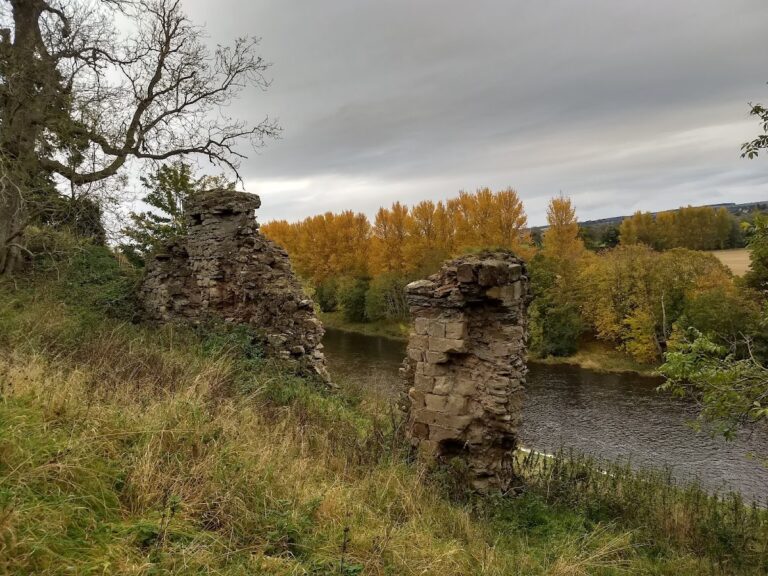
Dryburgh Abbey occupies a bend beside the River Tweed near Dryburgh. The surviving site includes the ruined abbey, a cemetery, and a designed landscape. The church was begun first, especially at its eastern end where the high altar stood, followed by the south transept and the eastern range of the cloister, a covered walkway enclosing an open court. The abbey as a whole survives in ruins, while the monastic and service buildings preserve the most complete surviving fabric.
Church and cloister buildings
Abbey church
The eastern doorway is a characteristic example of late twelfth-century architecture. The choir and the chapels in the north transept were completed later in the architectural style of the early thirteenth century. The transept, the crosswise arm of a church crossing the nave or choir, formed part of the church’s developing plan. The eastern end contained the high altar and represents the first principal phase of construction.
Chapter house and eastern range
The entrance to the chapter house is another characteristic late twelfth-century feature. The chapter house was the room where the canons heard the rule of their order and conducted administrative business. Its position within the eastern range placed it among the principal communal buildings beside the cloister.
Monastic and service buildings
The monastic and service buildings form the most complete surviving part of the ruined complex. Their remains preserve the architectural fabric associated with the abbey’s communal and practical life, including the spaces that supported worship, administration, household work, and agricultural activity.
Grounds and memorials
Former sacristy and commemorative burials
The former sacristy contains the burial of David Steuart Erskine, 11th Earl of Buchan, who died in 1829. The grounds also contain the tomb of Sir Walter Scott, who was buried there in 1832, and the headstone of Field Marshal Earl Douglas Haig, buried there in 1928. These memorials form part of the later commemorative use of the ruined abbey.
Designed landscape and later additions
After acquiring the property in 1786, the Earl of Buchan established a large garden around the ruins. He also installed a stone inscribed with the date 1150 and an obelisk south of the abbey. These features belong to the later designed landscape rather than to the medieval construction of Dryburgh Abbey.
The site is traditionally associated with Saint Modan, described as a follower of Columba of Iona. The surrounding landscape, cemetery, ruined buildings, and later memorials together preserve the physical setting in which the abbey’s medieval remains and post-medieval commemorative features are found.
Nearby sites