Megali Magoula: A Bronze Age Settlement and Tomb Site in Greece
Site at a Glance
- Popularity
- Very Low
- Country
- Greece
- Primary era
- Bronze Age
- Eras represented
- Bronze Age, Classical
- Civilizations
- Ancient Greek, Mycenaean
- Site type
- Military
- Remains
- Fortified Town
On this page13 sections
History
Megali Magoula is a prehistoric settlement and tomb site on a limestone hill near Galatas in Greece. Its summit supported a flourishing settlement in the Middle Helladic period, and the site later saw renewed occupation and fortification. The Middle and Late Helladic periods are successive phases of the Bronze Age in mainland Greece; Mycenaean culture is especially associated with the later period.
Bronze Age settlement
Megali Magoula was occupied early, and its Middle Helladic settlement may have been connected with Kolonna, an archaeological site on Aegina. The small number of Late Helladic pottery fragments from the summit does not establish whether the acropolis was occupied then or whether its upper deposits were removed later.
The excavations at Megali Magoula have informed the view that Mycenaean culture began in some regions during the Middle Helladic period, before the Late Helladic phase. The Saronic Gulf has consequently been considered an important center of Mycenaean culture and a possible place of origin. Evidence from the wider region includes a sanctuary discovered on Methana in 1990, where more than 150 clay figurines and a child burial were found. Other Mycenaean sites include Aegina and Pano Fanari.
Later occupation
The site was reoccupied in the Late Classical period, when a new enclosure was built. Its acropolis defenses remained in use during the Hellenistic period. Tomb 2, which had been robbed in antiquity, was also reused in the Hellenistic period.
Excavation and interpretation
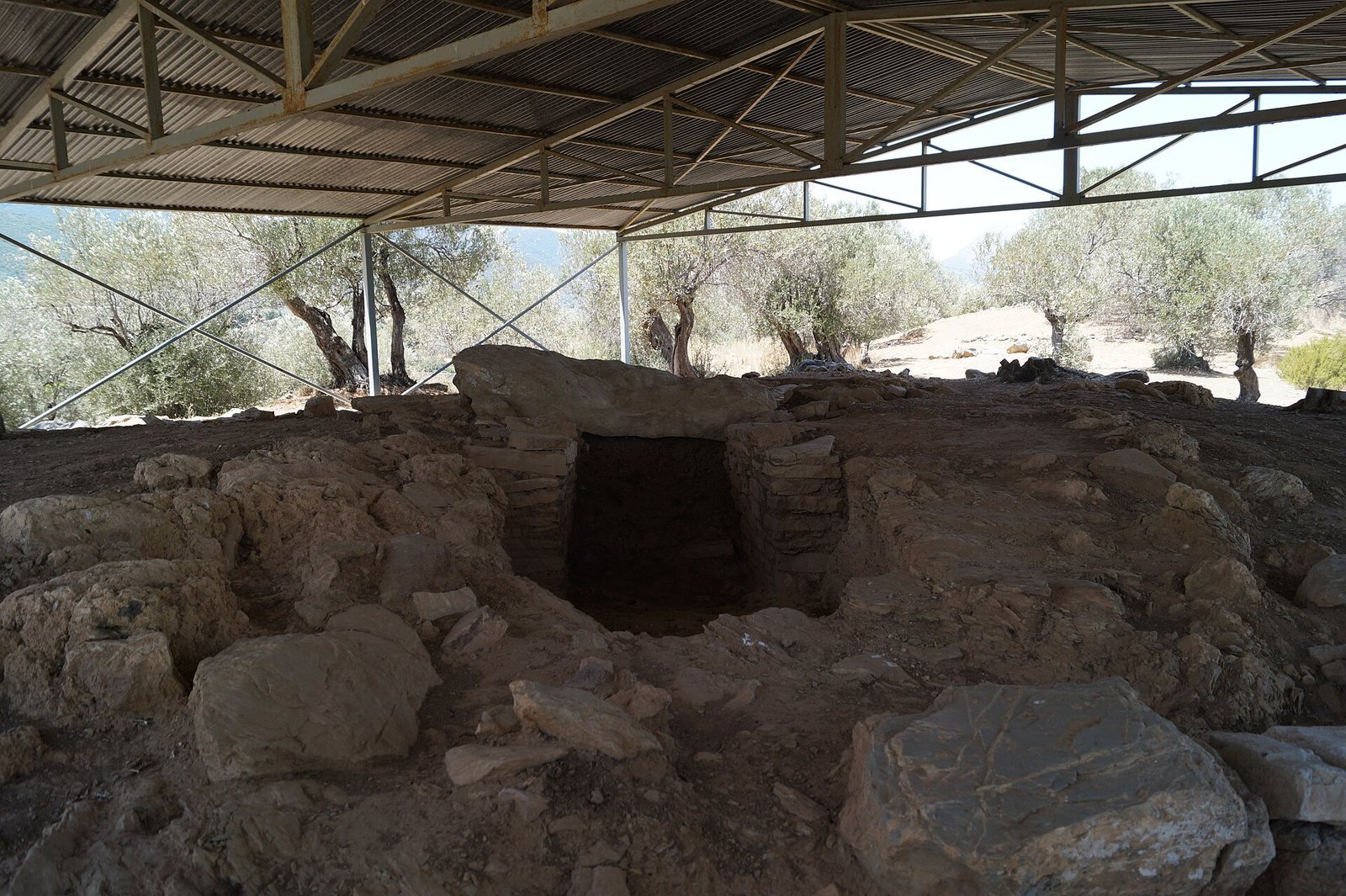
In the early 1990s, local nature and culture enthusiast Stavros Kouvaris noticed a prominent boulder on the hill and alerted Greek archaeologist Eleni Konsolaki-Giannopoulou. Excavations led by Konsolaki-Giannopoulou in 1995–1997 and 1999–2000 revealed the acropolis and three circular, domed tombs. The boulder proved to be a cover stone above the entrance passage to the largest tomb.
Tombs 1 and 2 had been robbed in antiquity. The size of Tomb 1 has prompted the suggestion that it may have been built for a local ruler. At a conference in Methana on 2 July 2006, Konsolaki-Giannopoulou proposed that it might be the tomb of Theseus, the legendary Greek hero whose myths connect him with King Minos, the Minotaur, and Crete. Some of the site’s finds are displayed in the Archaeological Museum of Poros.
Remains
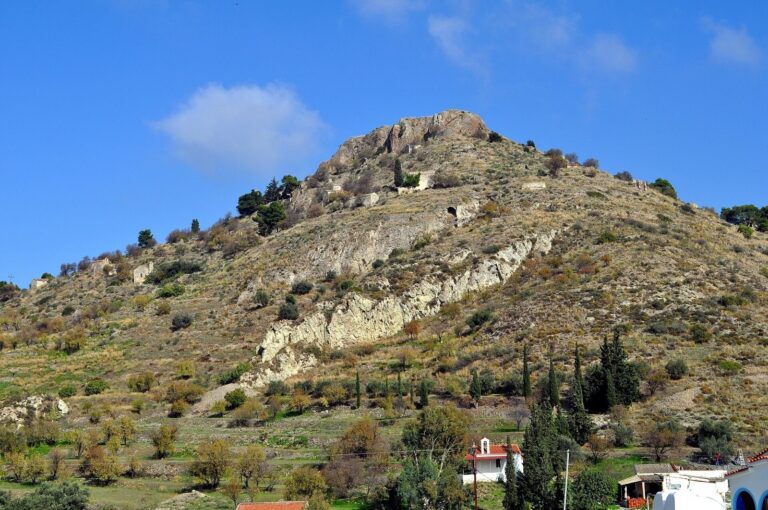
The site occupies a limestone hill about 70 metres high, stretching roughly 800 metres from west to east and 250 metres from north to south. It lies about 2 kilometres west-northwest of Galatas and about 2 kilometres from ancient Troezen, opposite Poros and Kalavria. A small natural harbor is about 150 metres north of the hill. The acropolis, the fortified high point of the settlement, stands at the summit above the Gulf of Poros and the two straits between the Peloponnese mainland and Kalavria. The three tombs lie west of the acropolis.
Settlement and fortifications
Middle Helladic settlement
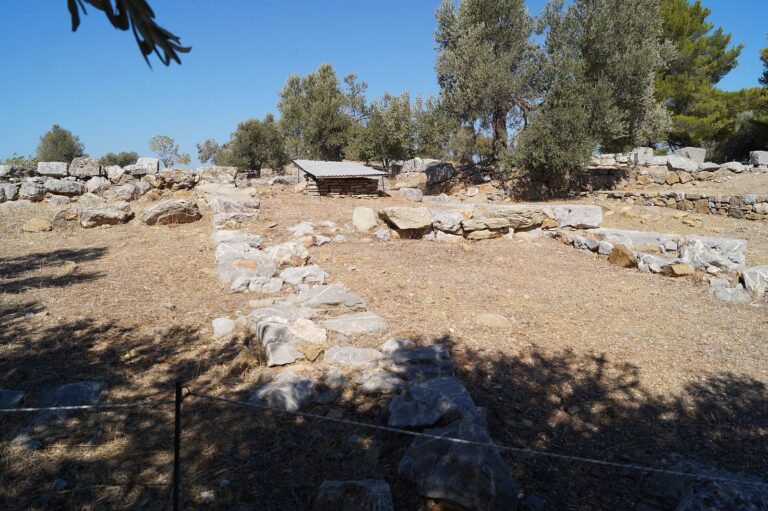
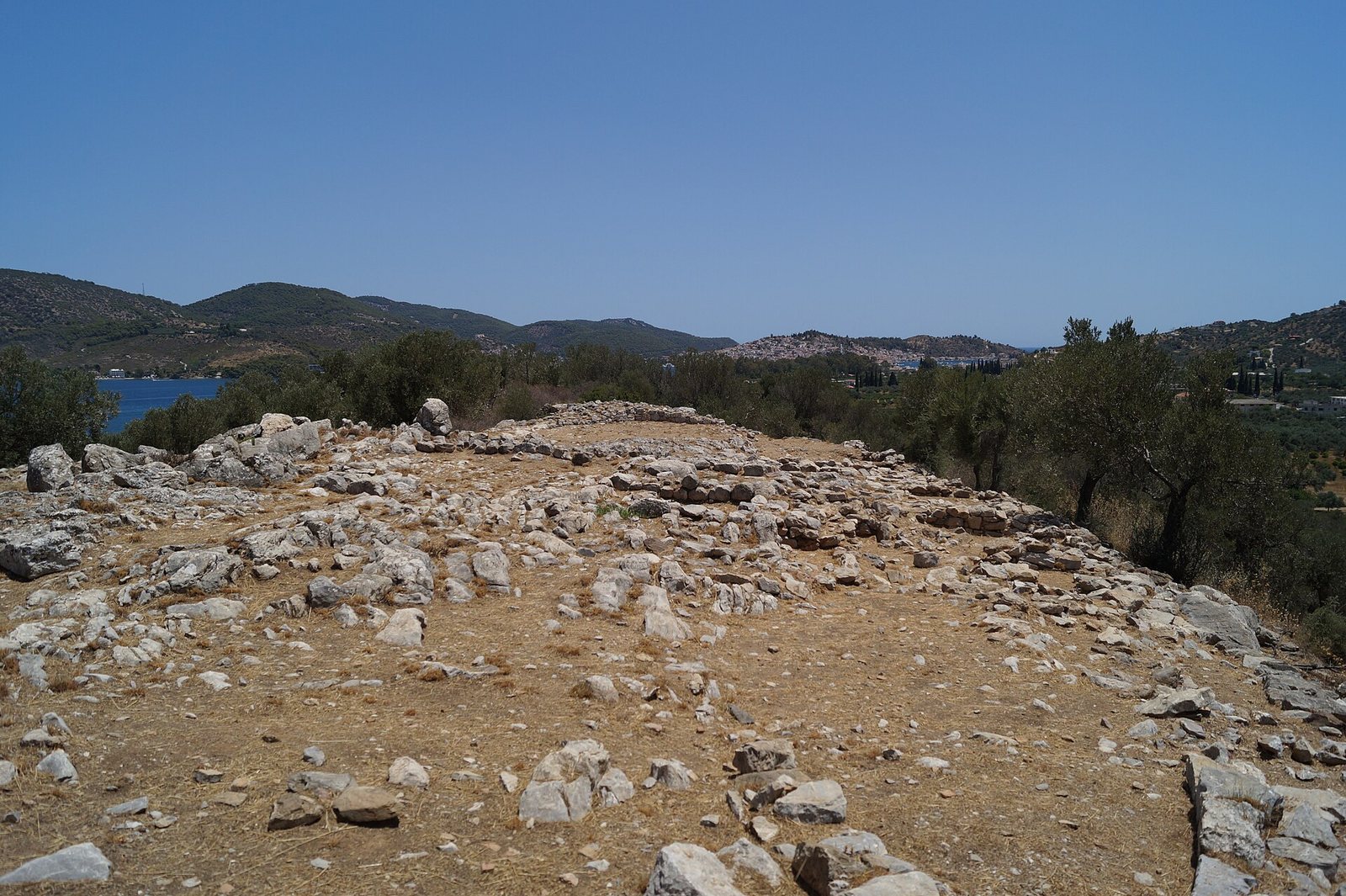
The settlement occupied about 0.1 hectares at the hilltop. An elliptical enclosure of unworked stones surrounded it, probably with an upper section made from unfired mudbrick; its entrance was on the north. House remains lay within the enclosure and on the northern and southern slopes. Beneath the floor of one acropolis house, a child had been buried. Most of the pottery from the settlement belongs to the Middle Helladic period.
Later enclosure
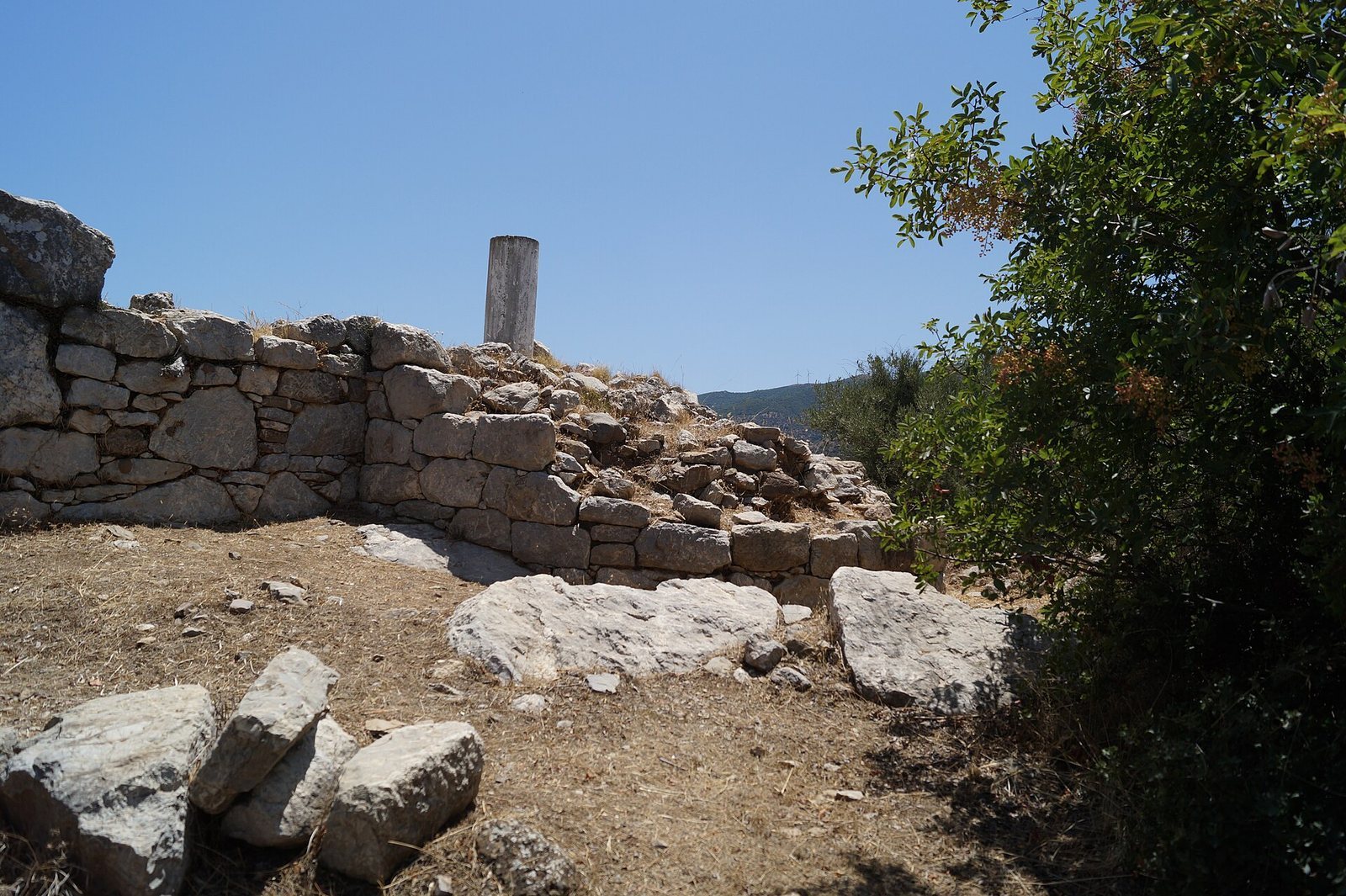
The later enclosing wall was built from dressed stones and had a round tower at each end, to the west and east.
Tholos tombs
Tomb 1
About 200 metres northwest of the acropolis, Tomb 1 has a circular chamber 11.40 metres in diameter and was probably about 11 metres high. Unworked-stone walls reinforced both sides of the approach passage. The facade and entrance doorway used Cyclopean masonry, construction with very large stone blocks, with smaller stones filling the gaps. One of at least two original cover stones remains. Large blocks formed the lower part of the chamber, while smaller, flat stones were used above; pebbles covered the floor. A mound about 45 metres across covered the tomb, supported by a perimeter wall of unworked stones. Its construction recalls the Cyclopean tomb at Mycenae, built around 1500 BCE.
Offerings from the tomb include pottery vessels, jewelry of gold, faience and glass, stone arrowheads, and three terracotta bull figurines. These objects date to 1450–1190 BCE, or Late Helladic IIB–IIIB. Pottery dating from Middle Helladic III to Late Helladic I also came from the mound soil.
Tomb 2
Tomb 2, about 133 metres northwest of the acropolis, is beneath a protective roof and measures 3.80 metres across. Its entrance begins with a hole cut into the rock in front of the doorway; the chamber was also cut into the rock as far as the lintel. Flat stones set in clay form the passage and chamber, and pebbles cover the floor. Finds include Late Helladic II pottery and a lentoid seal, a small, lens-shaped object. Pottery dating from Middle Helladic III to Late Helladic I, probably originally from a mound, was also recovered.
Tomb 3
About 100 metres northwest of the acropolis, Tomb 3 was constructed entirely above ground and measured 3.90 metres across. Its door jambs and the lowest course of the dome survive; the dome was probably made from lighter materials such as wood and clay. Finds include fragments of cups and goblets dating from Middle Helladic III to Late Helladic II, a tongue-shaped bronze dagger, and a Type A bronze sword. The tomb is considered the oldest tholos tomb in the eastern Peloponnese.
Other finds
Finds from the site also include a Canaanite amphora and arrowheads made of obsidian and bronze.