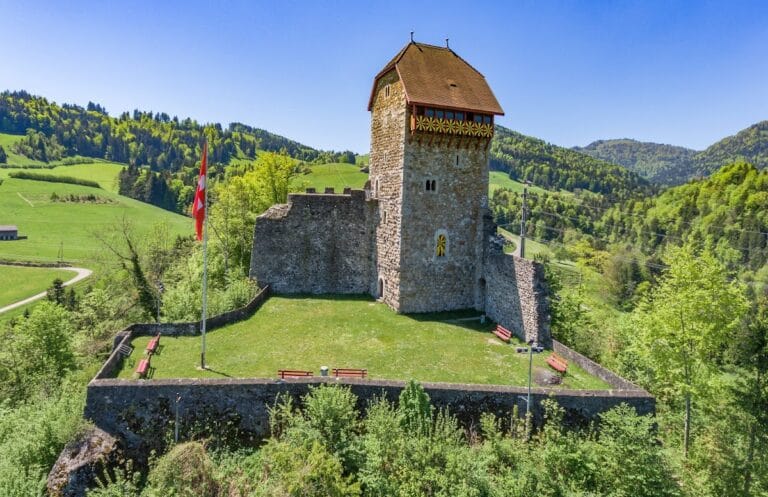
Niederwindegg Castle: Medieval Administrative Seat in Switzerland


Site at a Glance
- Rating
- 4.8
- Popularity
- Very Low
- Country
- Switzerland
- Primary era
- Medieval
- External website
- Open
- Eras represented
- Medieval
- Civilizations
- Habsburg, Holy Roman Empire
- Site type
- Military
- Remains
- Castle
On this page7 sections
History
Niederwindegg Castle, also known as Unterwindegg Castle, was a medieval administrative seat in Switzerland between Schänis and Ziegelbrücke. It governed the Gasterland, the historical region later known as the Lordship of Windegg, although its exact construction date is unknown.
The Windegg Lords and the Gasterland
The name Niederwindegg distinguished this castle from Oberwindegg, which stood two kilometres farther south on the opposite side of the plain. Records from 1220 and 1229 mention Hartmann von Windegg and Diethelm von Windegg, but they do not establish whether these men were connected with Niederwindegg, Oberwindegg, or Windegg Castle near Wald in the canton of Zurich.
In 1230, Hartmann the Elder, Count of Kyburg, gave his property in the Gaster area, including its toll station and castle, to his wife Margaretha of Savoy. The toll station stood below the castle, between the mountain and the course of the Linth. An official of the Habsburg administration, a major ruling dynasty in medieval Central Europe, was based at the castle in 1285. From about 1288, he also governed the Glarus valley.
Fortification and War
When Glarus joined the Swiss Confederation in 1352, the larger administrative district divided, and the castle again administered only the Gaster district. As tensions increased between the Confederation and Austria, the fortress was strengthened in 1359 and 1384 under Vogt Eglof von Ems. A vogt was an appointed official responsible for governing a territory on behalf of a superior authority.
After the Weesen massacre of 1388, the conflict turned into open warfare. Vogt Arnold Burchi, a citizen of Rapperswil, had taken part personally in the violence at Weesen. During the Swiss Confederates’ subsequent punitive campaign, Weesen was burned, while Niederwindegg Castle survived the siege that followed.
Decline and Archaeological Investigation
In 1406, the Niederwindegg administrative district of Gaster was pledged to Count Friedrich VII of Toggenburg. In 1486, Gaster became a joint dominion of Glarus and Schwyz within the Swiss Confederation and thereafter was called the Lordship of Windegg.
After 1486, the castle was no longer occupied by the vogt and probably began to decay. Its masonry may have been quarried for the tower of the collegiate church at Schänis, and the ruins probably continued to provide building stone afterward. In 1955, Jakob Grüninger carried out exploratory drilling at the site. The work raised the possibility of a Roman watch post, but resolving that question would require a careful large-scale archaeological investigation.
Remains
Ridge-top Layout
Niederwindegg was a rock castle built at about 507 metres above sea level on a Nagelfluh ridge above the road. Nagelfluh is a conglomerate rock made of rounded stones cemented together, and the ridge provided a naturally defensible foundation. The complex followed a northeast-southwest axis.
Fortified Enclosure and Residential Building
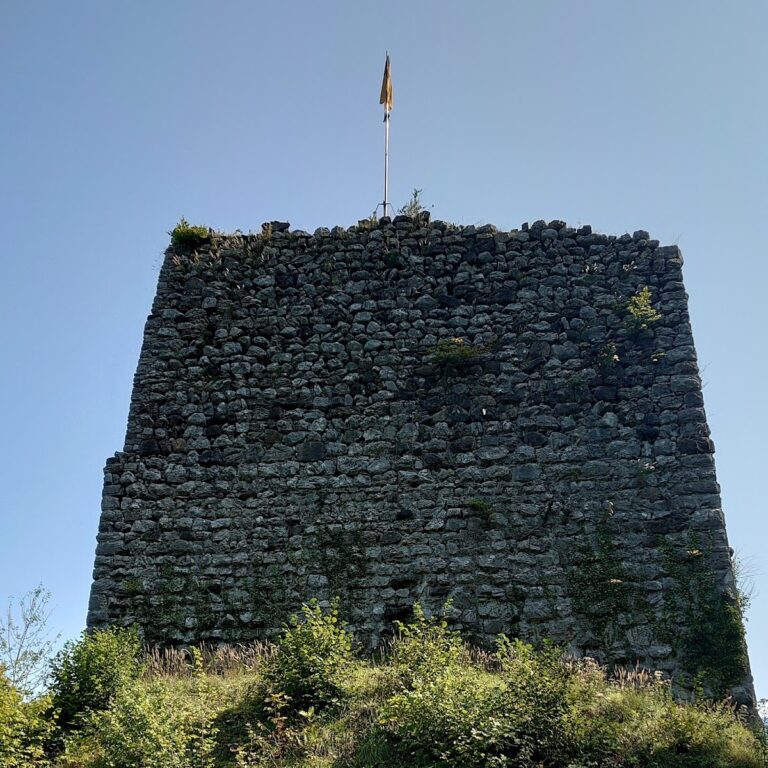
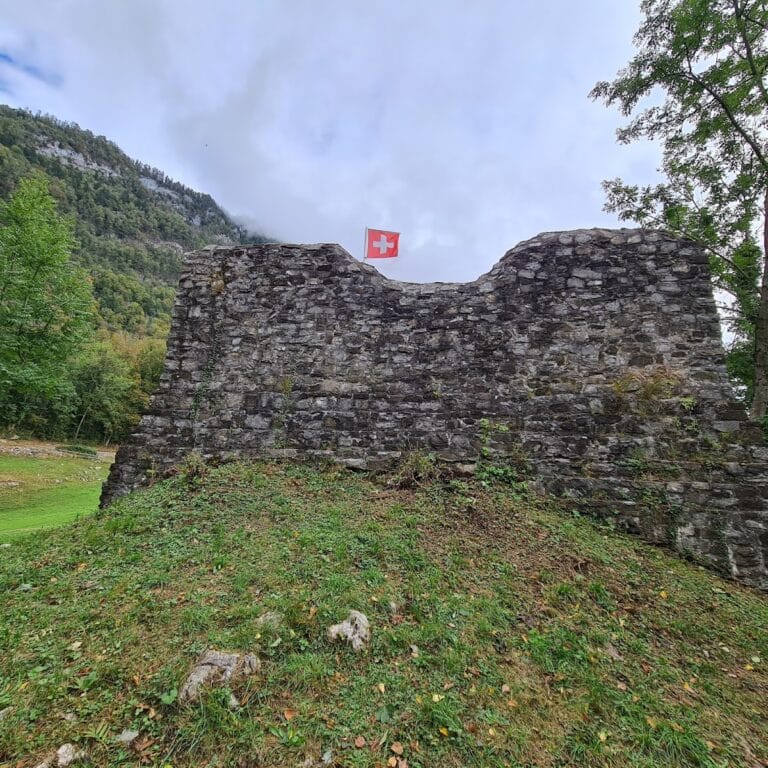
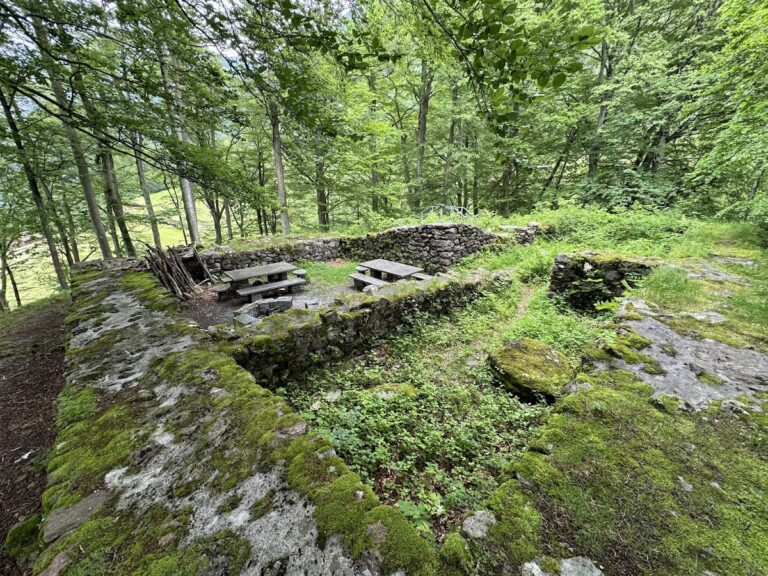
The fortified enclosure occupied the northeastern, mountain-facing part of the site, where the rock could be climbed only from that side. Today the ruin consists almost entirely of an approximately eight-metre-high protective wall along the eastern side, with only a few other wall fragments visible.
A rectangular palas was separated from the fortified enclosure by an artificial neck ditch. The palas was the principal residential and representative building of a medieval castle, containing the lord’s living and ceremonial rooms.
Nearby sites