Margarethenschanze: A Medieval Fortification in Germany


Site at a Glance
- Rating
- 4.8
- Popularity
- Very Low
- Country
- Germany
- Primary era
- Medieval
- Eras represented
- Medieval
- Civilizations
- Unclassified
- Site type
- Military
- Remains
- Wall
On this page4 sections
History
Margarethenschanze, also called Einfelder Burg, is a probable ninth-century medieval fortification in Neumünster, Germany. It stood beside Einfelder See as part of a defensive system along the Limes Saxoniae, a medieval frontier zone associated with the boundary between Saxon and Slavic territories.
Together with Wittorfer Burg, about 7 kilometres to the south, and a fortification at Borgdorf, about 8 kilometres to the northeast, Margarethenschanze helped defend Saxon territory along this frontier. Its isolated position and difficult access also made it a place of protection and refuge for inhabitants threatened by Slavic forces. From the site, armed forces could monitor or block the nearby medieval route running north to south between Einfeld and Nortorf.
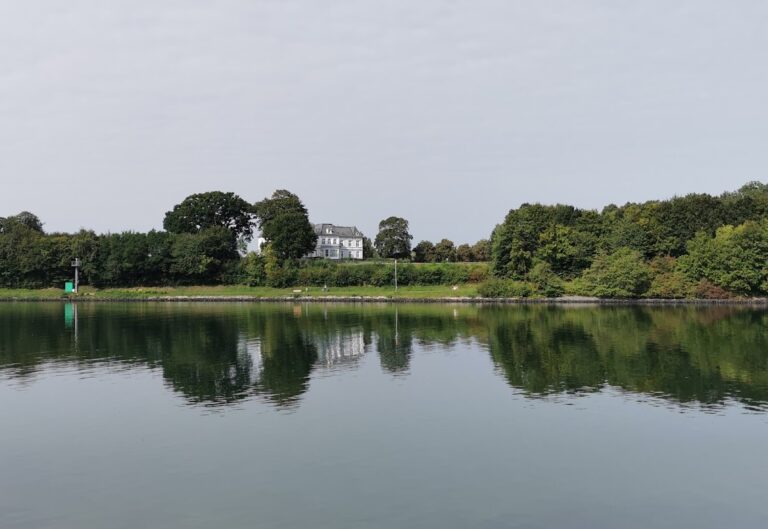
Margarethenschanze lies in Neumünster’s Einfeld district, directly beside Einfelder See. The grounds are under landscape protection administered by the city of Neumünster.
Remains
Ring-wall enclosure
Margarethenschanze is a lowland fortification, meaning an enclosure built in low-lying terrain, with a ring wall surrounding an approximately circular area about 90 to 100 metres in diameter. The enclosure stands around 1.5 metres above the surrounding fields, while the surviving wall rises as much as 4 metres. Its remaining sections are clearly visible and lined with oak trees. A gap approximately 30 metres wide interrupts the wall on the western side.
The interior is an open, grass-covered area. Constructed paths run along the wall and across the enclosure, while the surviving earthworks preserve the broad form of the fortified site.
Wetland setting
The fortification occupied the western shore of Einfelder See. The Ellhorn lowland and smaller marshes to the west and north supplied natural protection, and access to the enclosure passed through marshland near the lakeshore. These wetlands formed part of the site’s defensive setting alongside the ring wall.