Mausoleum of Saladin: An Ayyubid Tomb in Damascus
Site at a Glance
- Rating
- 4.6
- Popularity
- Low
- Country
- Syria
- Primary era
- Medieval
- Eras represented
- Medieval, Early Modern
- Civilizations
- Ayyubid, Ottoman
- Site type
- Religious
- Remains
- Tomb
On this page10 sections
History
The Mausoleum of Saladin is an Ayyubid burial monument in Damascus, Syria, built in the late twelfth century beside the Umayyad Mosque. Saladin, the Muslim ruler and military leader who founded the Ayyubid dynasty, became famous for defeating Crusader forces at the Battle of Hattin in 1187 and recovering Jerusalem. His tomb became part of the historical landscape of Old Damascus and remains associated with the dynasty he established.
Foundation under the Ayyubids
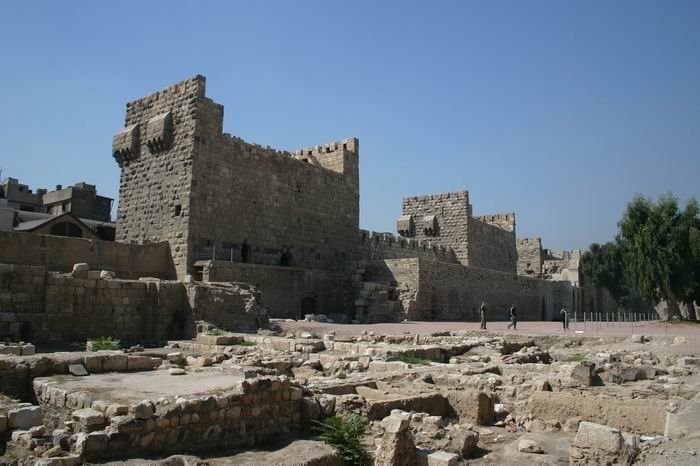
Saladin died in 1193 and was first buried in the Damascus Citadel. His body was transferred two years later to a new tomb in the al-Kallasa quarter, near the Umayyad Mosque. His son al-Afdal purchased a house there and established a domed burial monument for his father in 1195. The mausoleum is also dated to 1196, three years after Saladin’s death.
In 1196, Saladin’s son al-Aziz Uthman ordered the construction of the Aziziyya Madrasa, an institution of Islamic religious learning, to the east of the dome. The school was joined to the tomb and became institutionally associated with the mausoleum. Together, the burial monument and madrasa formed the original complex.
Ottoman and modern transformations
During the Ottoman period, the tomb walls were covered with blue glazed ceramic tiles. The madrasa later declined, and part of its structure fell into ruin. In the early twentieth century, Ziya Pasha, the Ottoman governor of Damascus, ordered the ruined section to be converted into a garden and incorporated into the tomb grounds.
The courtyard was restored and maintained during the 2000s. The complex also acquired later memorial associations. Its courtyard contains the graves of Abd al-Rahman al-Shahbandar, a Syrian nationalist leader assassinated by agents of the occupation on 6 July 1940, and Yasin al-Hashimi, who twice served as prime minister of Iraq and died in Damascus on 27 January 1937 after coming there following a British-backed coup against him.
Three other graves belong to Ottoman aviators whose aircraft crashed over Syrian lands. Sadiq Bey and Fethi Bey were among the first aviators to land in Damascus in January 1914. Their intended journey toward Palestine and Cairo ended when their aircraft crashed near Tiberias, while Nuri Bey’s aircraft crashed at Jaffa. Damascus residents chose to bury the aviation pioneers in the city rather than transfer Sadiq Bey and Fethi Bey to Istanbul, and Nuri Bey was buried beside them.
An anecdote connects the mausoleum with the aftermath of the First World War. After General Henri Gouraud entered Damascus, he is said to have addressed Saladin’s tomb in language recalling the medieval Crusades, declaring that the Europeans had returned to Syria and challenging the sultan to rise and witness their arrival. A memorial to Saladin by Abdullah al-Sayyid was later installed near the main entrance of the Damascus Citadel, close to the mausoleum grounds.
Remains
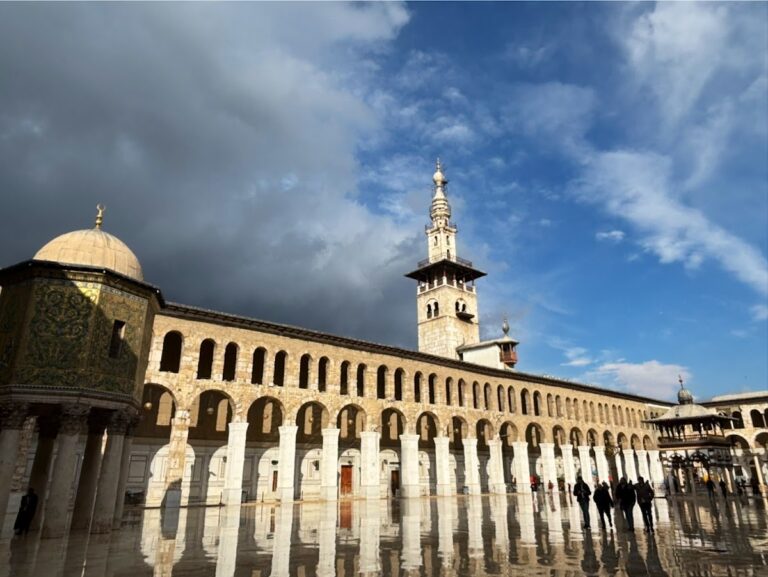
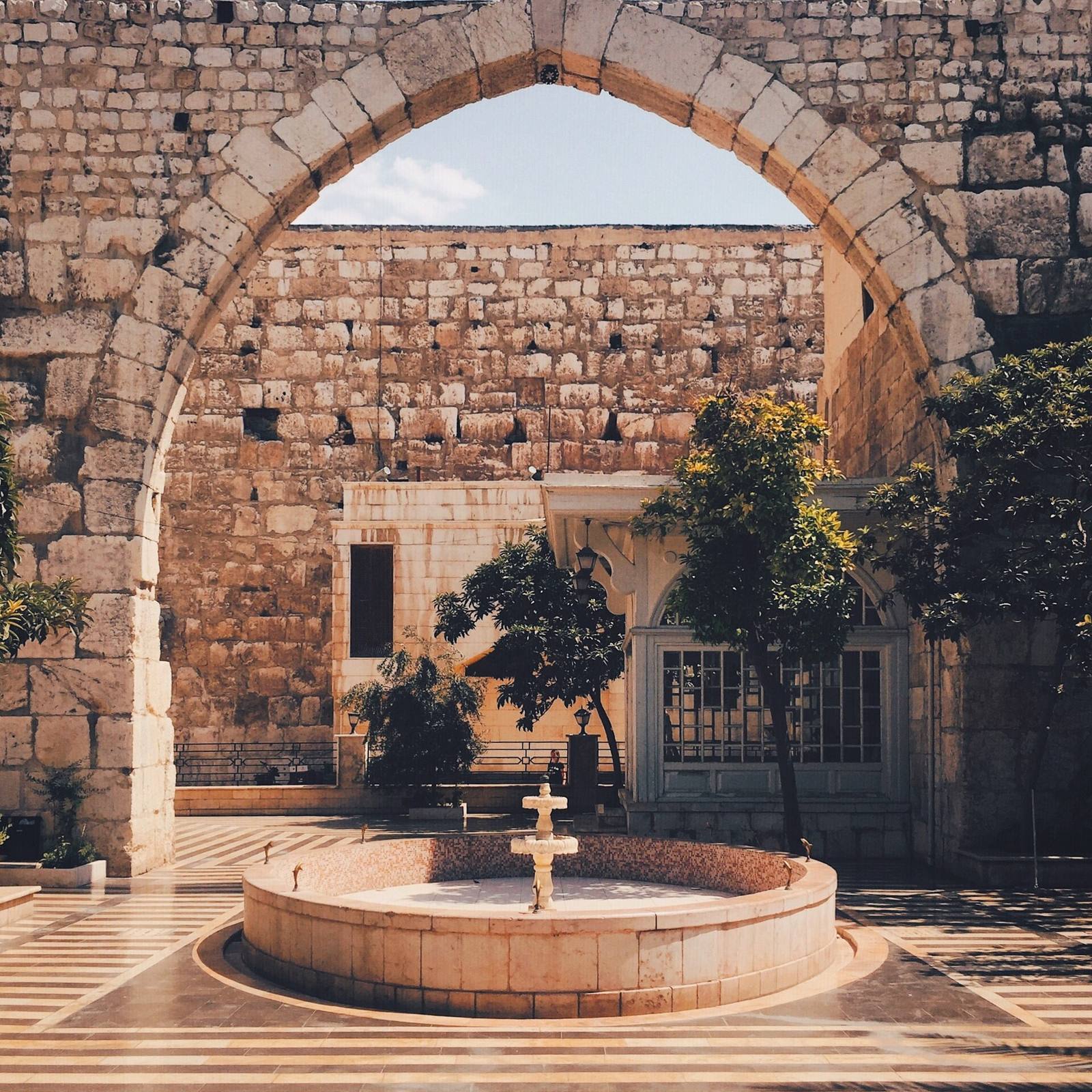
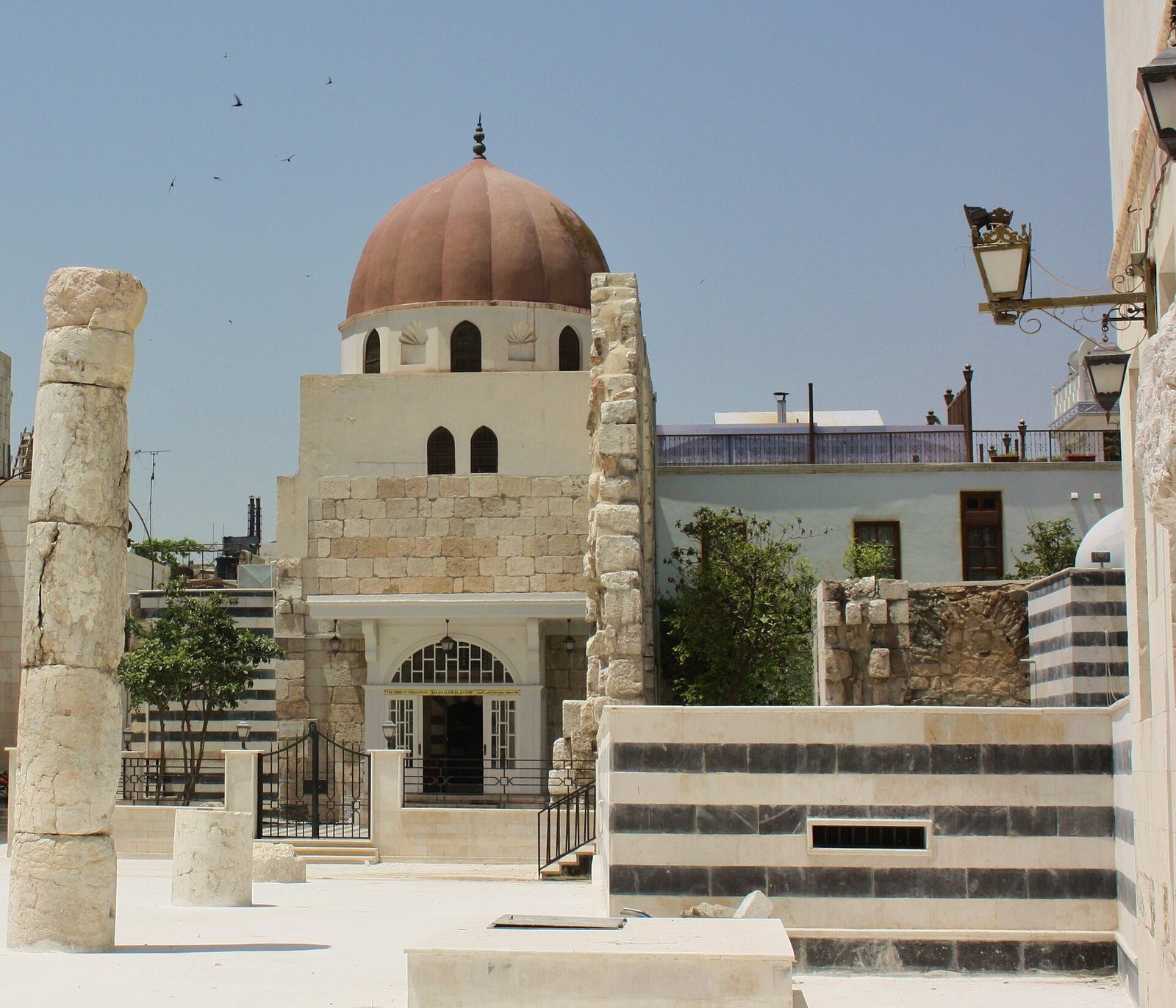
The mausoleum is a relatively simple Ayyubid structure crowned by a ribbed dome. It stands beside the left side of the Umayyad Mosque within the former Aziziyya Madrasa complex. A paved courtyard garden surrounds the building, with a pool, fruit trees, and the area that once formed part of the madrasa garden.
The tomb and its decoration
Saladin’s sarcophagus
Saladin’s sarcophagus is carved from walnut and carries Ayyubid ornament and inscriptions. It is said to contain his remains. Beside it stands a second sarcophagus of marble, which is empty. Ottoman Sultan Abdulhamid II commissioned the marble coffin in the late nineteenth century as a homage to Saladin, and German Emperor Wilhelm II later restored it.
Faience tile panels
The walls are faced with blue Ottoman-period faience, a glazed ceramic used for architectural decoration. The largest complete arched tile panel in Damascus measures about 475 centimetres wide and 238 centimetres high. Its varied tiles form a Damascene composition with vegetal ornament. Below it, a horizontal transom panel above a window carries geometric designs and is framed by repeated floral motifs. It measures 65 by 80 centimetres.
Former madrasa and courtyard
Aziziyya Madrasa remains
Only limited parts of the Aziziyya Madrasa survive beside the mausoleum. These remains include a mihrab, the prayer niche indicating the direction of Mecca, several columns, and an arch near the tomb. The eastern entrance arch now forms part of the garden area, preserving a physical link with the former educational institution.
Later commemorative features
The courtyard contains five additional graves, including those of al-Shahbandar, al-Hashimi, and the three Ottoman aviators. A gilded bronze wreath once rested on the marble sarcophagus after being placed there by Wilhelm II. It was later removed by either Faisal I, the first king of Iraq, or T. E. Lawrence, the British officer and writer associated with the Arab Revolt, and was subsequently deposited in the Imperial War Museum.