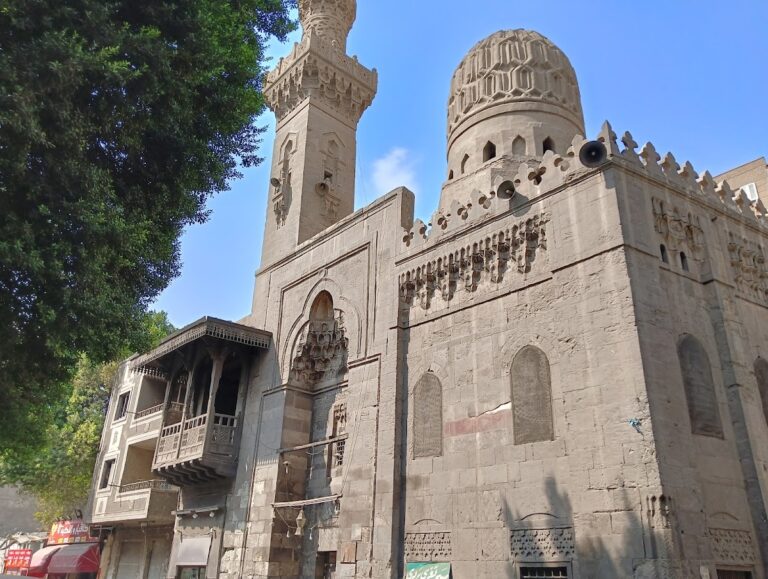
Mausoleum of Imam al-Shafi’i: A Major Sunni Shrine in Cairo


Site at a Glance
- Rating
- 4.7
- Popularity
- Low
- Country
- Egypt
- Primary era
- Medieval
- External website
- Open
- Eras represented
- Medieval
- Civilizations
- Ayyubid, Mamluk
- Site type
- Religious
- Remains
- Tomb
On this page12 sections
History
The Mausoleum of Imam al-Shafi’i is a funerary monument in Cairo, Egypt, built over the grave of Imam al-Shafi’i during the Ayyubid period. Al-Shafi’i was a major Sunni theologian, jurist, and scholar whose teachings formed the basis of the Shafi’i school of Sunni Islamic law. He traveled to Cairo in 813, taught at the Mosque of Amr ibn al-As, and died in Egypt in 819.
The Burial Place and Ayyubid Foundation
Al-Shafi’i was buried in the cemetery of the Ibn Abd al-Hakam family in al-Qarafa al-Sughra, an area now known as the City of the Dead. His child, Ibn Abdulhakim, performed the burial. The grave remained the focus of later building activity and became the center of a major Sunni religious foundation.
In 1176, Salah al-Din Ayyubi, known in English as Saladin, established a Sunni madrasa, or institution for religious learning, and a turbah, a funerary foundation or tomb complex, near the grave. This was the first establishment on the burial site. In 1178, he commissioned a carved wooden cenotaph, a commemorative funerary monument, to stand over al-Shafi’i’s grave.
The foundation formed part of Ayyubid efforts to consolidate Sunni Islam in Egypt after the fall of the Shi’i Fatimid Caliphate and to remove traces of Shi’ism. Its establishment also reflected an internal Sunni dispute between Shafi’i Asharites and Hanbalis. The madrasa therefore served both as a place of religious learning and as an expression of the religious policy of the new dynasty.
The Mausoleum of Sultan al-Kamil
After the death of the mother of Sultan al-Kamil, al-Kamil built a mausoleum near her burial place and al-Shafi’i’s grave in 1211. He also constructed a dome and an enclosing building over the area and the grave. Much of the present structure dates from this phase, and the monument may have provided a place of entombment for al-Kamil and his family while enhancing the prestige of his dynasty.
Mamluk and Ottoman-Period Alterations
The building was altered and restored under the Mamluk sultan Qaytbay. His work included repairs to the dome, changes to decorative elements, and restoration of the prayer niches. Further renovations took place under Sultan Qansuh al-Ghuri between 1501 and 1516. In 1772, the Ottoman-period governor Ali Bey al-Kabir directed another restoration campaign.
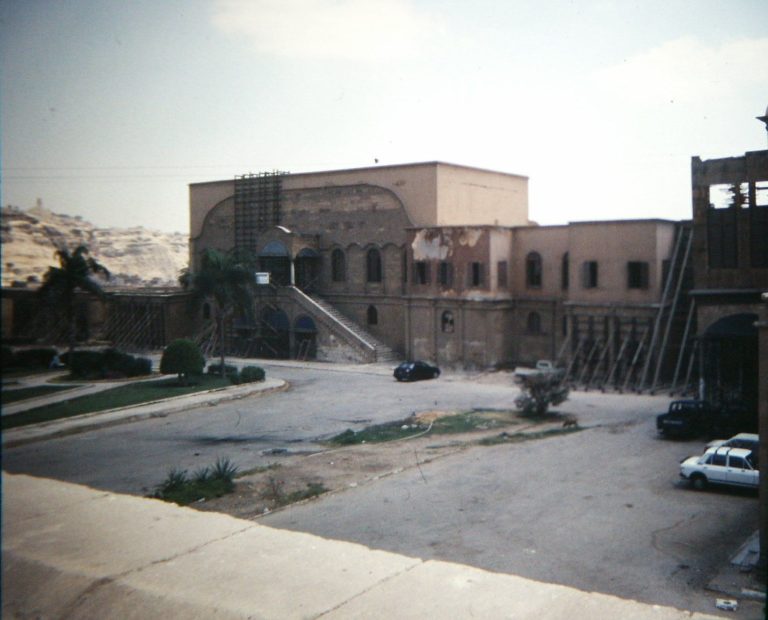
Conservation begun in 2016 responded to centuries of exposure and weathering. The work concentrated especially on the dome and included repairs to cracks, damaged fixtures, and deteriorated stucco and masonry on the exterior and interior. An updated drainage system and new lighting were also installed. The mausoleum remains dedicated to al-Shafi’i and institutionally associated with Islam and the Shafi’i school of Sunni jurisprudence.
The monument forms part of Historic Cairo, which was inscribed as a UNESCO World Heritage Site in 1979. The listed area covers 12.79 hectares and carries identification number 89-003.
Remains
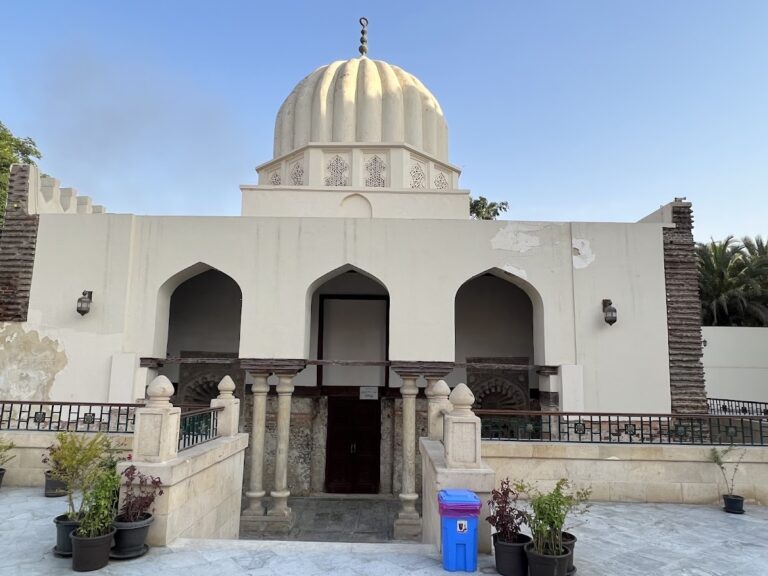
The mausoleum is a large square structure with a stone base measuring approximately 15 metres on each side. The interior square is also described as having sides 15 metres long. Exceptionally thick walls carry the large wooden dome, while the building’s single entrance is placed on its northeastern side.
Dome and Exterior
Wooden Dome
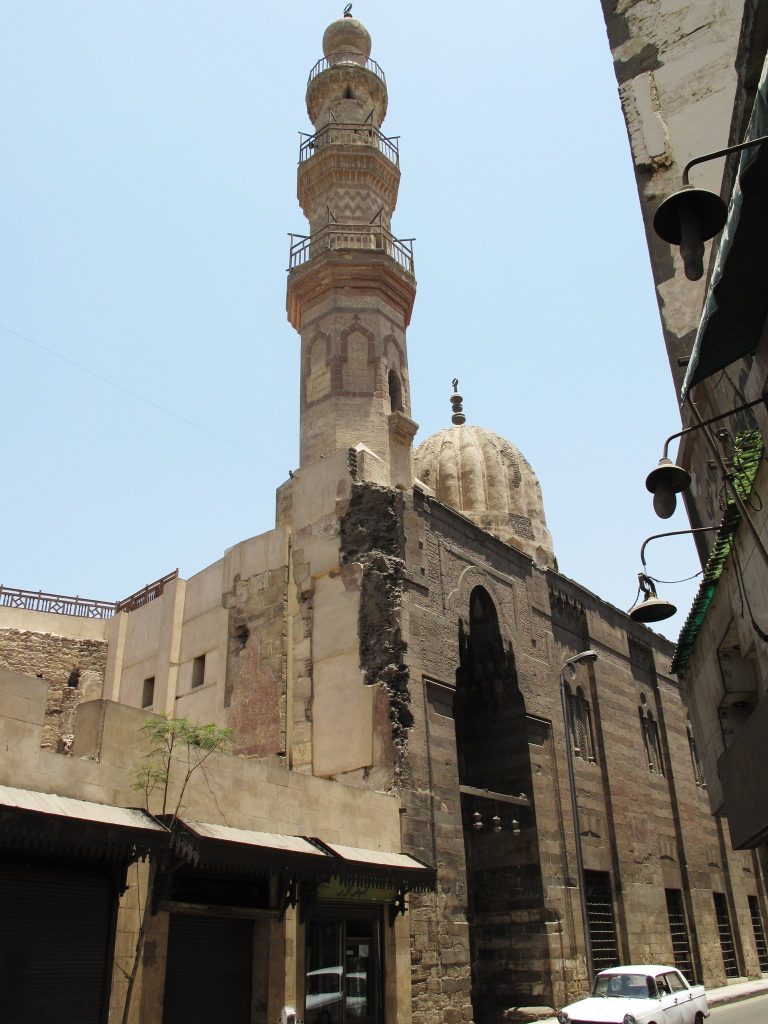
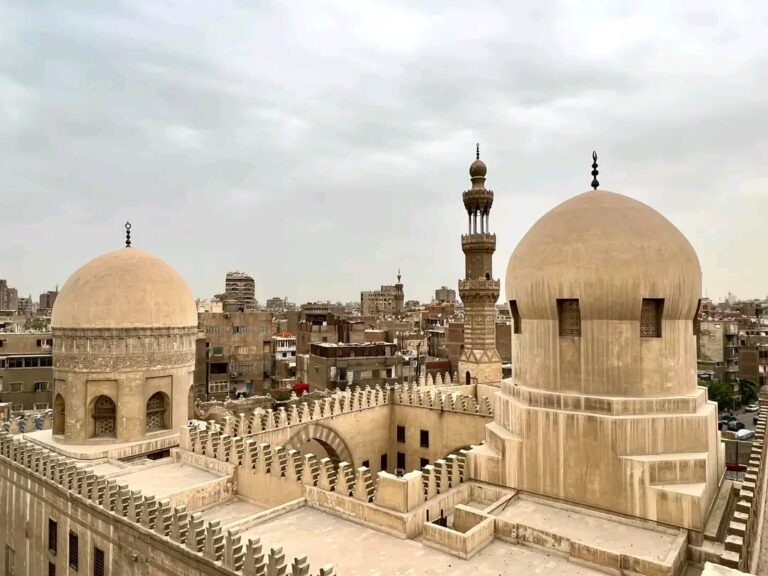
The dome is made of wood and covered with lead. It is described as a double wooden dome and as one of Egypt’s earliest wooden domes. Its construction was completed under Sultan al-Kamil, while Qaytbay later repaired or renewed it and added decorative elements. A copper boat crowns the dome; it is reportedly filled with birdseed, a feature associated with the earlier Fatimid architectural tradition.
The dome has a tall, rounded profile rather than the more pointed form attributed to earlier Fatimid domes. Its transition zones contain muqarnas, three-dimensional stepped or cellular ornament used to connect architectural forms. Here, broken arches are arranged in three tiers containing five, seven, and three niches. This arrangement represents an important stage in the development of Ayyubid architecture.
Entrance and Exterior Decoration
The small entrance passage occupies the thickness of the northeastern wall. Two doors close the passage. The outer door has two silver-covered leaves, while the inner door has two leaves, each approximately 98 centimetres wide and 3 metres high.
Extensive stucco decoration covers the exterior. The ornament includes carved colonnettes, geometric patterns, and tessellations, with some elements described as Andalusian in style. On the southeastern side, three large prayer niches occupy the wall, with the central niche wider than the other two. Qaytbay restored all three and added Ayyubid-style muqarnas to the interior of the dome.
Interior and Funerary Monuments
Interior Fittings and Inscriptions
Inside, a wooden frieze runs along the walls, and wooden beams formerly supported lamps. Quranic inscriptions include the Throne Verse and a saying attributed to the Prophet Muhammad about a future scholar from the lineage of Abd Manaf, applied to al-Shafi’i. Other inscriptions record foundation or restoration work carried out on the monument.
Four Cenotaphs
Four wooden cenotaphs stand inside the mausoleum. They commemorate Imam al-Shafi’i, the mother of Sultan al-Kamil, Sultan al-Kamil, and members of the Abd al-Hakam family, who had hosted al-Shafi’i.
Al-Shafi’i’s Cenotaph
Al-Shafi’i’s cenotaph is rectangular and has a pyramidal cover richly decorated with inscriptions. It is regarded as the only surviving wooden funerary structure from Salah al-Din’s construction on the tomb. Its texts identify al-Shafi’i through his genealogy and state that he was born in 150 AH and died in 204 AH on Friday, the last day of Rajab. They also record that he was buried on the same day after the afternoon prayer.
The cenotaph was made in 1178, corresponding to 574 AH, by the woodworker Ubayd al-Najjar ibn Ma’ali. Its carved decoration contains Quranic verses, accounts of al-Shafi’i’s life, the woodworker’s name, geometric panels, tessellations, and other geometric forms executed in an Ayyubid style. The inscriptions use Kufic and Naskhi, two historic styles of Arabic calligraphy.