Mausoleum of Bivede Sultan in Bakhchisaray: A Funerary Monument
Site at a Glance
- Popularity
- Very Low
- Country
- Ukraine
- Primary era
- Medieval
- Eras represented
- Medieval
- Civilizations
- Golden Horde
- Site type
- Religious
- Remains
- Tomb
On this page4 sections
History
The Mausoleum of Bivede Sultan in Bakhchisaray, Ukraine, is a funerary monument associated with Bivede Sultan and generally dated by its architectural form to the late 14th or early 15th century. Its formal name and exact construction date are uncertain. Construction during the Horde period, an era of Mongol-Tatar political power in the region, is also possible.
Architectural traditions
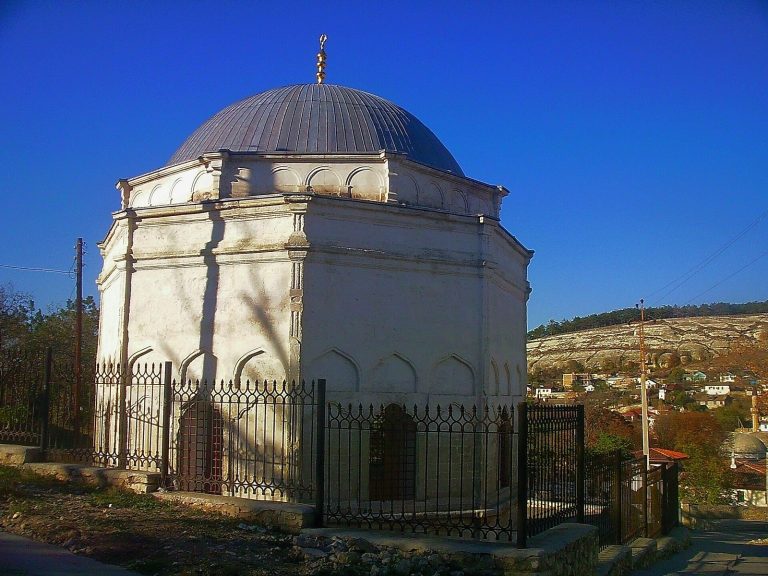
The mausoleum’s square form is linked to older Crimean Tatar architecture. By contrast, mausoleums of the later Crimean Khanate, a Tatar polity centered in Crimea, were polygonal. Comparable square buildings, including mosques in eastern Crimea, date from the 13th to the early 16th century.
Eski-Yurt and modern conservation
The mausoleum stood within a cemetery precinct in Eski-Yurt, near the lower course of the Churuk-Su River. In the 1950s, the surrounding land was allocated for residential development and is now privately owned.
Minor restoration took place in the late 1990s, and further work was considered necessary after archaeological investigation. Ukraine designates the mausoleum a national-level cultural heritage monument. Following Russia’s 2014 annexation of Crimea, Russian authorities also designated it a cultural heritage site of federal significance.
Remains
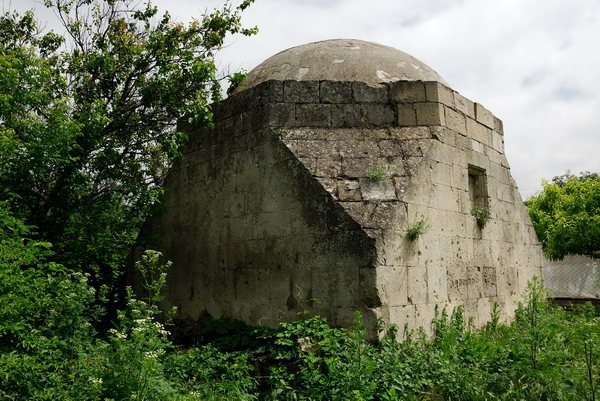
The mausoleum is a small square-plan building, measuring 5.3 by 5.3 metres and standing 7.2 metres high. Its walls are faced with carefully dressed dark-grey limestone blocks set in regular courses. The substantial blocks give the modest-sized structure a monumental appearance.
At about halfway up the walls, sloping sections change the square form into a regular octagon. A hemispherical dome rises above it on pendentives, curved surfaces that carry a dome over a differently shaped space. Part of the dome has collapsed.
A small rectangular window sits high in the north wall, and the entrance is on the south side. The entrance portal is largely lost. Part of it was lost in the 1970s, and one pier survives with a semicircular niche.
A carved slab above the entrance identifies the woman as Ben-Yude Sultan, daughter of Acağan Bey, and says that Muhammed Shah Bey, son of Muhammed Bey, commissioned the tomb for his mother. Bey was a Turkic title for a ruler or notable, with rank varying according to time and context.
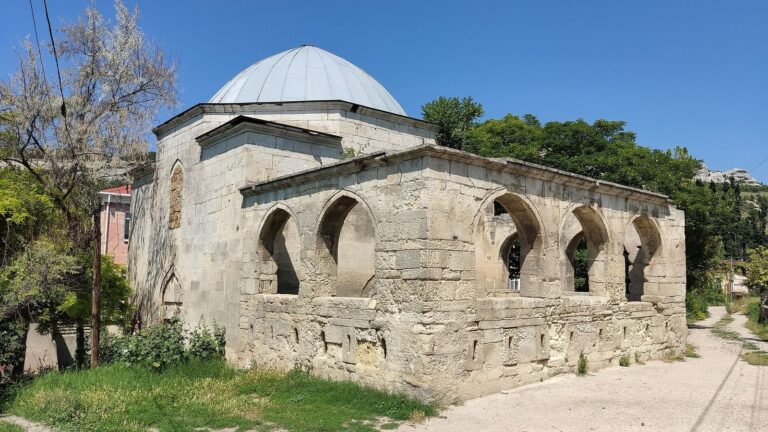
The closest comparison in form is the mausoleum of Ahmed Bey, whose wall slopes are horizontal and whose crown is faceted rather than hemispherical. A similar mausoleum survives in Ayvovoye village in Bakhchisaray district.