Matsuo-dera Temple: A Tendai Buddhist Temple in Osaka


Site at a Glance
- Rating
- 4.2
- Popularity
- Low
- Country
- Japan
- Primary era
- Early Modern
- External website
- Open
- Eras represented
- Medieval, Early Modern
- Civilizations
- Ashikaga shogunate, Tokugawa
- Site type
- Religious
- Remains
- Monastery
On this page12 sections
History
Matsuo-dera Temple is a Tendai Buddhist temple in Japan, located in Izumi, Osaka, whose foundation tradition dates to 672. Its mountain name is Amida, and its principal image is Nyoirin Kannon, a form of the bodhisattva of compassion associated with the fulfillment of prayers.
Foundation and Early Religious Development
According to tradition, the mountain ascetic En no Gyoja practiced at the site for seven days in 672. He obtained a sacred tree, carved an image of Nyoirin Kannon, and placed it in a small hall. En no Gyoja is a semi-legendary figure traditionally regarded as the founder of Shugendo, a Japanese tradition combining Buddhist, Shinto, and mountain practices.
Taicho later revived the temple and invited the Gongen associated with Kumano, Zao, and Hakusan. Gongen refers to a Buddhist manifestation of a kami, or sacred Japanese presence, within the syncretic religious traditions of premodern Japan. During the Heian period, Matsuo-dera became associated with a miraculous episode involving a monk from Kawachi Province who lived there. The episode appears in the Nihon Ojo Gokurakuki and the Konjaku Monogatarishu.
Medieval Growth and Political Patronage
In the medieval period, Matsuo-dera served as a center for studying both Shingon and Tendai Buddhism. Shingon is an esoteric Buddhist tradition centered on ritual, mantra, and mandala practice, while Tendai embraces the broad Mahayana Buddhist tradition associated with the Chinese Tiantai school.
During the Kamakura period, Minamoto no Yoritomo protected Matsuo-dera as a place for prayers. The temple reached its greatest prosperity from the Nanbokucho period through the Muromachi period, when Matsuo-dera Castle was established within the temple complex. Tradition describes an estate yielding 7,000 koku, more than 300 monastic residences, and several thousand warrior monks. A koku was a historical measure of assessed agricultural production, while warrior monks were armed religious personnel serving and defending powerful monasteries. These figures have not been confirmed by documentary evidence.
The Southern Court and Later Destruction
Matsuo-dera maintained close connections with the Southern Court, the imperial court based in Yoshino during the fourteenth-century division between rival Northern and Southern Courts. In 1336, Emperor Go-Daigo issued an imperial directive designating the temple as a place of prayer, and the Southern Court is said to have repeatedly ordered prayers there.
After the Northern and Southern Courts were reunited, Ashikaga Yoshimitsu and successive Muromachi shoguns are said to have protected the temple’s estates because of its religious role. In 1577, Oda Nobunaga issued a prohibition order promising protection for Matsuo-dera. Four years later, during Nobunaga’s campaign against Mount Koya, Matsuo-dera and the other buildings on Mount Amida were attacked and burned.
Rebuilding and Modern Religious Affiliations
Matsuo-dera was revived in 1602 with support that included the donation of a main hall by Toyotomi Hideyori, a leader of the Toyotomi house and the son of Toyotomi Hideyoshi. The present main hall dates from 1606, during the Momoyama period. In the Edo period, the temple had 13 subtemples. Anti-Buddhist policies during the Meiji period reduced this number to two surviving subtemples.
The temple remains associated with several pilgrimage traditions. It is site 21 in the Izumi Saigoku Thirty-Three Sacred Sites, belongs to the sacred sites connected with En no Gyoja, and is the place of Jurojin in the Nankai Seven Lucky Gods pilgrimage. Jurojin is one of the Seven Lucky Gods and is associated with longevity. Matsuo-dera is also sites 78 and 79 in the Izumi Eighty-Eight Sacred Sites, with site 79 associated with one of the surviving subtemples.
Matsuo-dera’s main hall and other property are protected as designated cultural properties of Osaka Prefecture. The temple precincts are a designated prefectural historic site, and its yamamomo and camphor trees are designated prefectural natural monuments.
Remains
The surviving temple complex combines a Momoyama-period main hall with the remains of Matsuo-dera Castle, a medieval fortified element established during the temple’s period of greatest prosperity. The precincts also contain two old trees associated with the temple, one estimated at 200 to 250 years old and the other at approximately 700 years old.
Temple Buildings and Castle
Main Hall
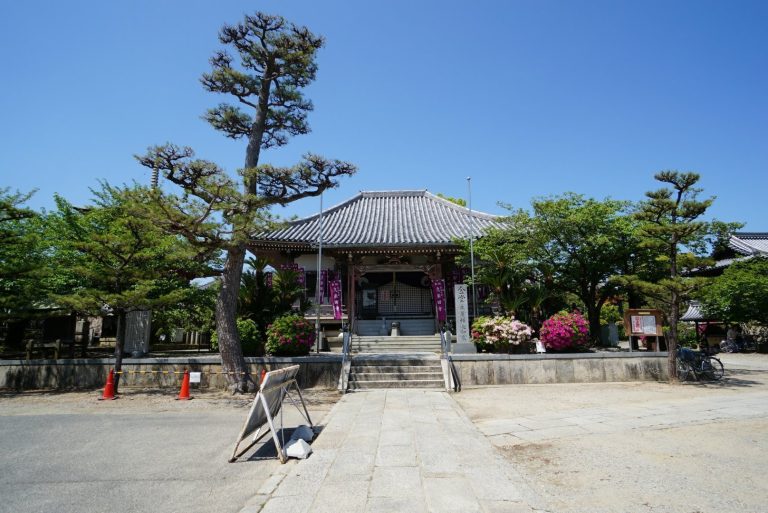
The main hall is a single building dating from 1606, when Matsuo-dera was being restored after its destruction in 1581. Its construction belongs to the Momoyama period, and the building forms the principal surviving architectural focus of the temple.
Matsuo-dera Castle
Matsuo-dera Castle was constructed within the temple complex during the medieval period, when Matsuo-dera was at the height of its prosperity. The castle represents the defensive and military dimension of a powerful medieval religious institution, alongside the temple’s role as a center of Buddhist study and prayer.
Old Trees
Yamamomo Tree
A yamamomo tree associated with Matsuo-dera is estimated to be between 200 and 250 years old. It is protected as a prefectural natural monument.
Camphor Tree
A camphor tree associated with the temple is estimated to be about 700 years old. Like the yamamomo, it is protected as a natural monument of Osaka Prefecture.