Jōten-ji Temple: A Rinzai Zen Temple in Hakata, Japan


Site at a Glance
- Rating
- 4.2
- Popularity
- Low
- Country
- Japan
- Primary era
- Medieval
- Eras represented
- Medieval, Modern
- Civilizations
- Japanese, Kamakura shogunate
- Site type
- Religious
- Remains
- Monastery
On this page15 sections
History
Jōten-ji Temple is a Rinzai Zen temple in Hakata, Fukuoka, Japan, founded in 1242 by the monk Enni Ben’en after his return from Song China. It belongs to the Tōfuku-ji branch of the Rinzai tradition, a major Japanese Zen school associated with disciplined meditation and the use of kōans, or paradoxical questions, in training. The temple bears the honorary mountain name Banshōsan and became a government temple, formally recognized and supported by the authorities, in 1243.
Foundation and Zen transmission
Enni traveled to China in 1235, where he studied Zen under difficult conditions, and returned to Japan in 1241. Dazaifu deputy governor Muto Sukeyori invited him to Hakata, while the Chinese merchant Xie Guo Ming and other Song merchants provided substantial assistance for the temple’s establishment. Enni’s journey brought more than religious teachings. He also returned with methods associated with making udon, soba, yōkan, and manjū.
Tradition connects Enni with the transmission of the manjū-making method to a tea-house owner during one of his begging rounds near the temple. A monument at Jōten-ji preserves this association by reproducing the inscription from a sign that Enni gave to the tea-house owner.
Local traditions and maritime connections
The origin of Hakata Gion Yamakasa is traditionally dated to 1241. According to the tradition, Enni was carried through Hakata on a float while prayers were offered against a plague, which was then successfully dispelled. The event links the temple’s early history with one of the city’s enduring religious and civic traditions.
Jōten-ji was also among the intended destinations of the fourteenth-century Shinan ship, which carried cargo from Ningbo to Hakata along a final section of the historic Maritime Silk Route. The vessel sank near the Korean coast in bad weather and was discovered nearly seven centuries later. Wooden cargo tags identified a Jōten-ji subtemple among the intended recipients. The principal destination was Tōfuku-ji in Kyoto, which required rebuilding materials and replacement artifacts after serious fire damage; Hakozaki Shrine in Hakata also had cargo aboard.
Another monument at the temple commemorates Mitsuda Yazaemon, who traveled to Song China with Enni and returned with methods associated with textile production, musk, somen, gold leaf, and vermilion production. The grounds also contain a monument concerning the history of a Fukuoka domain military unit and a grave or grave monument associated with Kawakami Otojirō, regarded as a pioneer of modern Japanese theatre.
Urban division of the compound
Jōten-ji’s historical layout changed in 1963, when the relocation of Hakata Station led to a land-readjustment project. A municipal road was cut through the temple grounds, dividing the compound into northeastern and southwestern sections and altering the continuity of the temple precinct.
Remains
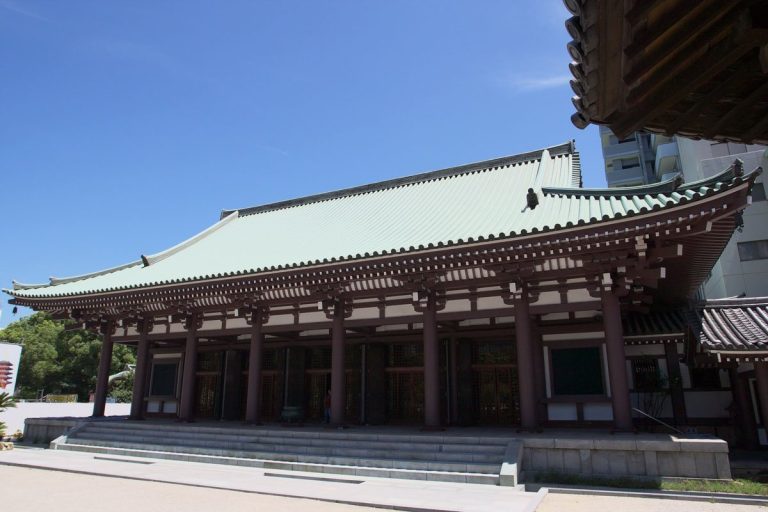
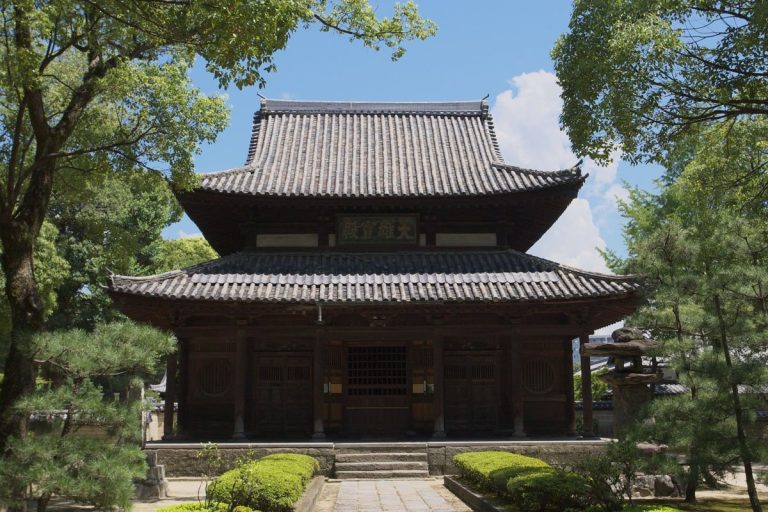
Jōten-ji’s surviving compound is divided by Jōtenji-dōri into northeastern and southwestern sections. The Buddha Hall, known as Kakukō-den, and the main gate stand in the southwestern area, while the main hall and cemetery lie in the northeastern area. The abbot’s quarters and Founder’s Hall are also part of the compound, with the stone garden Sentōtei extending in front of the abbot’s quarters.
Temple buildings and garden
Buddha Hall and main gate
The Buddha Hall, Kakukō-den, occupies the southwestern section together with the main gate. These buildings form part of the temple’s principal western grouping within the divided precinct.
Main hall and associated buildings
The main hall stands in the northeastern section, alongside the cemetery. The abbot’s quarters and Founder’s Hall complete the principal group of temple buildings, while Sentōtei, a stone garden, extends before the abbot’s quarters.
Hakata Sennen Gate and Jōtenji-dōri
Hakata Sennen Gate
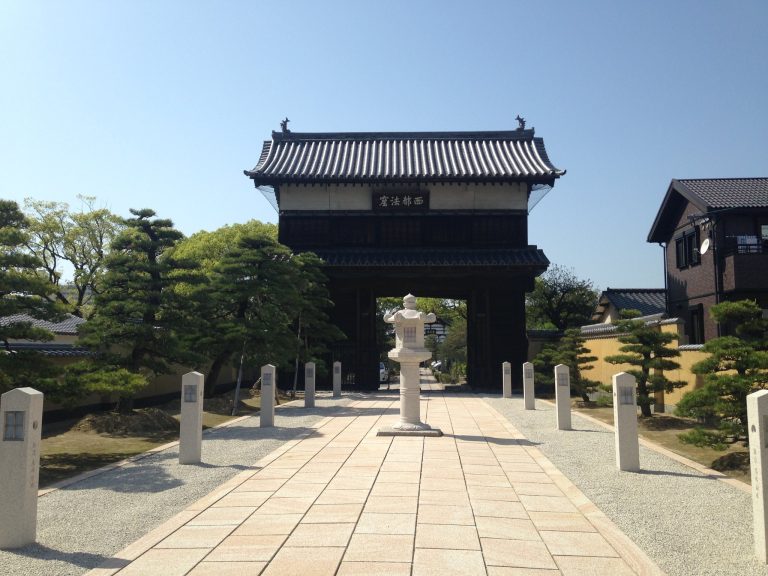
The Hakata Sennen Gate was completed on March 28, 2014, at the entrance to Jōtenji-dōri Avenue. Built of wood as a four-legged gate with a tiled roof, it was modeled on the historic Tsuji-no-dōkuchi Gate shown in old documents. Its height and width are each approximately 8 metres. The plaque was written by the chief priest of Dazaifu Tenmangū, a major Shinto shrine in Dazaifu dedicated to Sugawara no Michizane, who is revered as Tenjin, the deity of learning.
Garden-like avenue
The approximately 150-metre stretch of Jōtenji-dōri between the temple grounds contains pine and maple trees together with naturally shaped stones arranged to give the street a garden-like appearance. The avenue forms the approach associated with the Hakata Sennen Gate while passing between the two sections of the compound.
Monuments and cemetery remains
Food and festival monuments
Stone monuments on the grounds commemorate the origins of udon and soba, the transmission of the manjū-making method, and the origin of Hakata Gion Yamakasa. The manjū monument includes a reproduction of the inscription on the sign presented by Enni to a tea-house owner.
Mitsuda Yazaemon monument
The cemetery contains a monument associated with Mitsuda Yazaemon, who accompanied Enni to Song China. His actual grave is at Shōfuku-ji, while Jōten-ji preserves the commemorative monument within its own precinct.
Kawakami Otojirō memorial
A grave or grave monument associated with Kawakami Otojirō stands in the cemetery. He is described as a pioneer of modern Japanese theatre, giving the temple grounds a memorial connection beyond their Zen Buddhist history.