Kongō-ji Temple: A Shingon Buddhist Head Temple in Japan

Site at a Glance
- Rating
- 4.2
- Popularity
- Low
- Country
- Japan
- Primary era
- Medieval
- External website
- Open
- Eras represented
- Medieval, Early Modern
- Civilizations
- Kamakura shogunate, Tokugawa, Toyotomi regime
- Site type
- Religious
- Remains
- Monastery
On this page21 sections
History
Kongō-ji Temple is a Shingon Buddhist head temple in Kawachinagano, Japan, traditionally founded during the Tenpyō era, around 729–749, under Emperor Shōmu. The emperor is said to have commissioned the priest Gyōki to establish it. Kongō-ji belongs to the Omuro school, a major branch of Shingon Buddhism historically connected with the imperial monastery of Ninna-ji. The temple is formally known as Amanosan Kongō-ji and is traditionally linked with a legend that one of the 84,000 stupas associated with the Indian emperor Ashoka fell at the site.
Foundation and Heian revival
After its early foundation, Kongō-ji is said to have fallen into ruin. It was revived near the end of the Heian period by Akan, a Buddhist monk associated with Mount Kōya. His restoration received the support of Emperor Go-Shirakawa and the emperor’s sister, Hachijō-in Akiko. In 1180, the local warrior Minamoto no Sadahiro donated land, allowing the Main Hall and Miei Hall to be rebuilt. Kongō-ji then became Hachijō-in’s prayer temple, a place where religious rites were performed for the welfare of its patron.
Two of Hachijō-in’s attendants entered Akan’s religious community. Daini no Tsubone, also known as Jōkaku-ni, and Rokujō no Tsubone, also known as Kaku’a-ni, became his disciples and served successively as abbesses. Four consecutive abbesses came from the imperial household. Kongō-ji also served as a prayer temple for Gishūmon’in, Shunkamon’in and her mother, and Kayōmon’in. Since women of every social class were allowed to worship there, unlike at Kōyasan, where women were excluded, the temple became known as “Women’s Kōyasan.”
The Southern Court at Kongō-ji
By the end of the Kamakura period, Kongō-ji is said to have possessed nearly 100 sub-temples. Its connection with Emperor Go-Daigo brought it into the political struggles of the Nanboku-chō period, a fourteenth-century civil conflict between rival Northern and Southern imperial courts. Together with nearby Kanshin-ji, Kongō-ji became one of the principal bases of the Southern Court, the faction associated with Go-Daigo and his successor Go-Murakami. On October 1, 1336, Go-Daigo designated the temple an imperial prayer temple.
During the conflict, Kongō-ji served both political and military purposes. From October 1354 to December 1359, Emperor Go-Murakami maintained a temporary imperial residence at the sub-temple Mani-in. The refectory functioned as the administrative seat, known as Amano-den. In March 1354, the Northern Court’s retired emperors Kōgon, Kōmyō, and Sukō, together with the former Crown Prince Naohito, were transferred from Kananō in Yamato Province to Kanzō-in. Kōmyō returned to Kyoto in 1355, while Kōgon, Sukō, and Naohito were returned in February 1357.
Kongō-ji was also associated with important religious scholars and ritual specialists. Monkān, a monk, painter, and ritual protector closely connected with Go-Daigo and Go-Murakami, lived at the temple. Zen’e, its academic head and a noted copier of Buddhist texts, became Monkān’s disciple and was regarded as his foremost student. Monkān died at Kongō-ji’s Daimon Ojō-in on November 21, 1357.
Go-Murakami moved his temporary court to Kanshin-ji in December 1359. The following year, an attack by Hatakeyama Kunikiyo, a commander of the Northern Court, burned more than 40 sub-temples at Kongō-ji. In 1373, Emperor Chōkei used the temple as a temporary imperial residence. He was forced to leave after Kusunoki Masanori, a Southern Court figure who supported peace and had defected to the Northern Court, attacked and occupied the temple.
Economic growth and early modern rebuilding
From around 1432, Kongō-ji sold Amano sake and also generated income from rice, charcoal, and timber. In 1514, it still held approximately 70 to 90 sub-temples. The patronage of Oda Nobunaga and Toyotomi Hideyoshi brought further prosperity, and by the end of the Edo period the temple controlled an estate assessed at 307 koku, a historical measure of agricultural yield.
Toyotomi Hideyori ordered extensive repairs and improvements from 1605. Work included the Main Hall, tahōtō, refectory, and temple gate, while the Five Buddhas Hall and Yakushi Hall were rebuilt. A Goma Hall for ritual implements, the Mani-in Study, and buildings connected with the guardian shrines of Mikumari and Ni’u Kōya were also constructed. In 1700, repairs were undertaken again on the order of the shogun Tokugawa Tsunayoshi, with Okabe Nagayasu, lord of Kishiwada, acting as overseer. The Gumonji Hall and Founder’s Hall were built during this phase.
Modern conservation and historical status
The Meiji government’s policy of separating Buddhism and Shinto, together with measures directed against Buddhism, reduced the number of Kongō-ji’s sub-temples. Mani-in, Kanzō-in, and Kisshō-in remain. Major disassembly and repair work carried out from 2009 to 2017 included the Main Hall, tahōtō, bell tower, and principal sculptural group. Investigation and conservation of the sculptures led to their designation as National Treasures in 2017.
The Kongō-ji precinct was designated a National Historic Site in 1934, and the protected area was expanded in 2011. The temple is also part of the Japan Heritage story “A Town Encountering the Middle Ages: A Treasure House of Medieval Cultural Heritage Protected for a Thousand Years.” Its holdings include especially important documentary material connected with the Nanboku-chō period and the Kusunoki family.
Remains
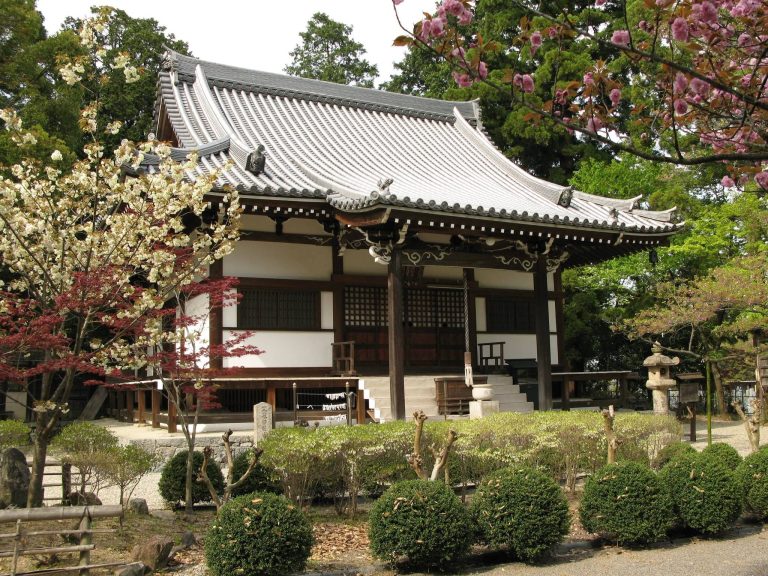
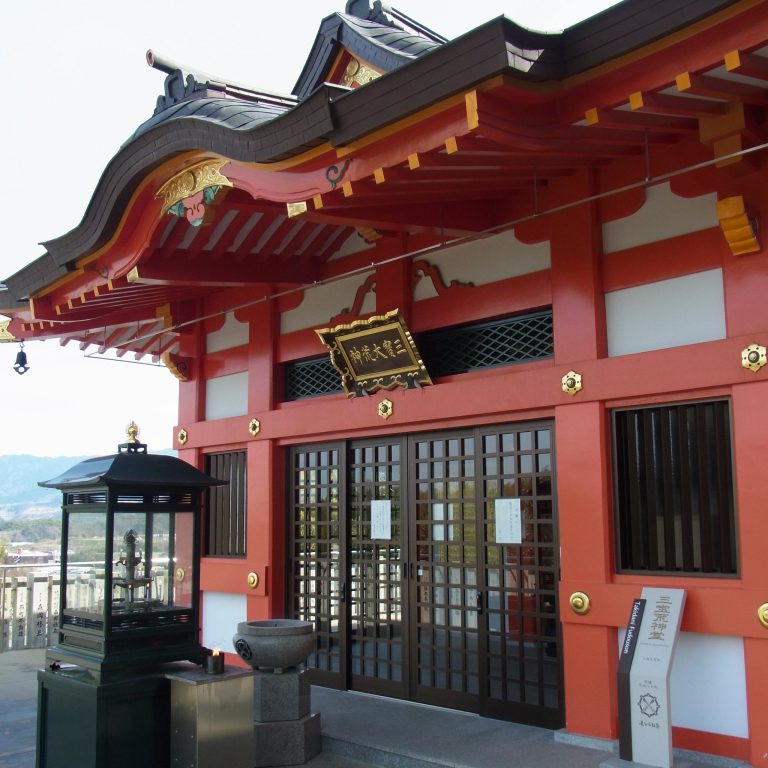
Kongō-ji’s precinct combines buildings from the Kamakura period, the Nanboku-chō period, the late Heian period, and later rebuilding campaigns. The principal group includes the temple gate, Main Hall, refectory, tahōtō, bell tower, Miei Hall, Five Buddhas Hall, and Yakushi Hall, together with sub-temples and buildings associated with guardian shrines. The structures preserve varied forms of traditional Japanese timber construction, including irimoya roofs, which combine hipped and gabled sections, and roofs covered with rounded ceramic tiles.
Entrance and central buildings
Sanmon gate
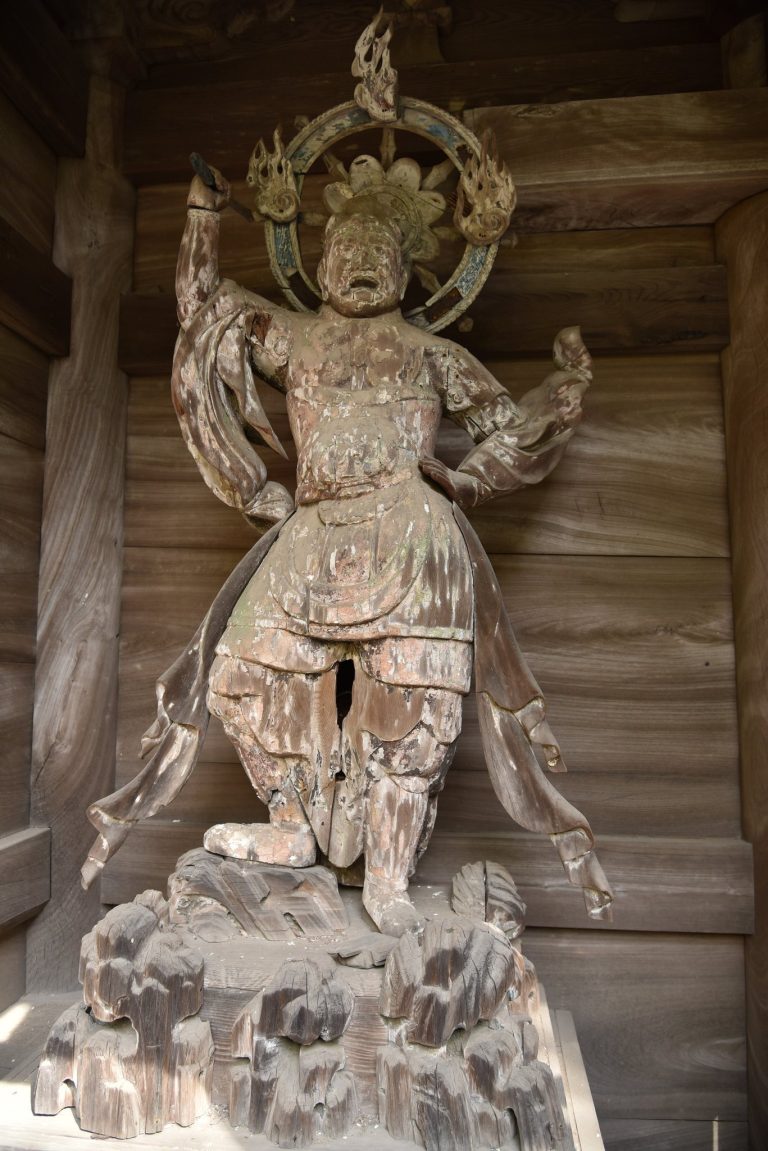
The main approach passes through the Sanmon, a red-painted, three-bay rōmon, or gate with an upper storey. The gate has an irimoya roof covered with hongawara tiles and dates from the Kamakura period, between 1275 and 1332. Two wooden standing images of the Niō guardians, dated 1279, are located inside it.
Main Hall
The Main Hall, or Kondō, was built in 1320. It is a seven-by-seven-bay building with a one-bay entrance canopy and an irimoya roof covered with hongawara tiles. Inside are seated wooden images of Dainichi Nyorai, the central cosmic Buddha of Shingon Buddhism, Fudō Myōō, a protective deity associated with immovable resolve, and Trailokyavijaya, a deity who subdues the three worlds.
The three sculptures were made over approximately 50 years and form a group associated with the Sonshō Mandala of Esoteric Buddhism. The seated image of Dainichi Nyorai dates from around 1180 and is 313.5 centimeters high. The seated Fudō Myōō dates from 1234 and measures 201.7 centimeters, while the seated Trailokyavijaya is 230.1 centimeters high. Part of the group is attributed to Gyōkai, a disciple of the Kamakura-period sculptor Kaikei. Ink writing found inside the sculptures during modern investigation identified the date and maker of the Fudō Myōō.
Tahōtō
The tahōtō stands in front of the Main Hall. Originally built during the late Heian period, between 1086 and 1184, it is described as the oldest structure at Kongō-ji, the oldest tahōtō in Japan, and the oldest wooden building in Osaka Prefecture. It has undergone substantial restoration, including work in 1606 and 1607, and carries a cedar-shingle roof.
The tower houses an early Kamakura-period wooden seated image of Dainichi Nyorai on a lotus pedestal. Its halo contains 37 kebutsu, or manifestations of the Buddha. The image dates from 1172–1192 and measures 80.4 centimeters in height, or 116.5 centimeters with its halo.
Bell tower
The bell tower stands behind the Main Hall and dates from the Kamakura period. Its lower section has a flared hakamagoshi, an expanded enclosure characteristic of some Japanese towers, and it is covered by an irimoya roof with hongawara tiles.
Jiki-dō refectory
The refectory, or Jiki-dō, was built between 1333 and 1392. During the Nanboku-chō period it served as Amano-den, the administrative seat of Go-Murakami’s temporary court. The building has seven bays across its front and three bays in depth. Its irimoya roof is covered with hongawara tiles, and a nokikarahafu, a projecting curved gable, rises above the entrance.
Western halls and religious images
Miei Hall
At the western end of the precinct, the Miei Hall, Five Buddhas Hall, and Yakushi Hall are arranged from north to south. Each has a square plan and a hipped roof. The Miei Hall was rebuilt in 1606 and is a four-by-four-bay structure with a cypress-shingle tented roof. It has a one-bay canopy at the front and a two-bay canopy at the rear. On the east side, a moon-viewing stage beneath a curved karahafu gable is attached to the hall, while the west side connects with the image hall.
The Miei Hall contains an image of Kōbō-Daishi, also known as Kūkai, the founder of Shingon Buddhism. The image is said to have been drawn by Prince Takaoka and brought from Kōyasan by Akan.
Five Buddhas Hall
The Five Buddhas Hall contains wooden seated images of the Five Great Buddhas from the Heian period. These figures represent central beings in Esoteric Buddhist doctrine. The hall’s principal image for the Shin Saigoku Thirty-Three Kannon pilgrimage is a standing image of Senju Kannon, a form of Kannon associated with compassion.
Yakushi Hall
The Yakushi Hall is another square, hipped-roof structure within the western group. Its associated Buddhist figure is Yakushi, a Buddha connected with healing.
Paintings, manuscripts, and ritual objects
Painted screens and Buddhist works
Kongō-ji’s National Treasure folding screens consist of a pair of six-section screens from the mid-sixteenth-century Muromachi period. They depict landscapes of the four seasons in ink and color on paper with gold-leaf backgrounds. Each screen measures 147.0 by 313.5 centimeters. The pair is traditionally identified as ritual equipment used in the kanjō initiation ceremony of Esoteric Buddhism.
Other associated works include a Heian-period painting of Kōbō-Daishi on silk and Kamakura-period paintings of Kokūzō Bosatsu, the Five Secrets Mandala, and the Sonshō Mandala. Kongō-ji also preserves a Heian-period Lotus Sutra scroll written in gold on dark blue paper, dated 1148 and attributed to Fujiwara no Motohira. Additional Heian-period works include two Hōkyōin-darani scrolls and a scroll concerning Fugen’s practices and vows.
Engishiki transcriptions
Two temple-held transcriptions of the Engishiki, a court compilation produced between 905 and 927, date from 1127. Since the original compilation has been lost, these are the oldest surviving copies. One consists of three scrolls containing volume 12 and fragments of volumes 14 and 16. The other is a single scroll containing volumes 9 and 10, including a register of Japanese shrines.
Manuscripts and documentary evidence
The temple preserves 12 Kamakura-period volumes of the Nirvana Sutra, each carrying a postscript by Emperor Go-Murakami dated 1359. It also holds a copy of the seventh-century Chinese novel You Xian Ku, produced in the early 1320s. Measuring 25.5 by 16.2 centimeters, the copy contains a note about the transmission of Japanese readings.
A letter in the handwriting of Kusunoki Masashige expresses a wish to help defend Kongō-ji when an attack by the Kamakura shogunate was rumored after a failed attempt to seize control from the military government. The temple’s holdings also include a collection of 4,461 volumes, 24 booklets, and two sheets of Buddhist scriptures.
Metalwork, lacquer, and furnishings
A straight, double-edged, unsigned ceremonial sword from the early Heian period was transmitted at Kongō-ji. Its hilt is shaped like a three-pronged Buddhist ritual pestle. The blade is 62.2 centimeters long and 3.3 centimeters wide, with an 11.1-centimeter tang. It is accompanied by a black-lacquer mounting from the Kamakura period and is currently held at the Kyoto National Museum.
Associated ritual objects include a Kamakura-period gilt-copper censer measuring 36.0 centimeters in total length. Its handle is 2.1 centimeters wide, while the vessel is 8.1 centimeters high and 10.3 centimeters in diameter. The lid, probably added later, bears a Japanese morning-glory design, and the censer is held at the Tokyo National Museum.
A lacquered wooden box with gilt-bronze fittings, dated 1320, was used for ordination documents. It measures 36.3 by 12.7 by 14.0 centimeters and is held at the Nara National Museum. A smaller Heian-period lacquer box measures 27.4 by 41.2 by 19.0 centimeters. Its exterior depicts sparrows in a field using makie-e, lacquer decoration made with sprinkled metal powders, while its interior shows branches and plum blossoms. A Heian-period sutra box with a lotus design in makie-e is held at the Tokyo National Museum.
Other associated objects include a set of haramaki and hizayoroi armor from the Muromachi and Nanboku-chō periods, a Kamakura-period cupronickel mirror decorated with flowers and birds, and a Kamakura-period three-legged butterfly-shaped table. The table has lotus arabesques, raden inlay made with shell, metal fittings, and a semicircular top. It is 45.5 centimeters high, and its top measures 38.5 by 21.3 centimeters.
The temple’s associated cultural holdings also include a standing wooden image of Yakushi Nyorai, a bronze stupa associated with Qian Hongchu, and armor traditionally linked with members of the Kusunoki family. An Asuka-period bronze standing image of Kannon Bosatsu associated with Kongō-ji is held at the Nara National Museum. Many other buildings and architectural components have cultural-property status, and 12 structures were registered as tangible cultural properties in 2017.