Marinid Tombs: A Royal Necropolis in Fez, Morocco


Site at a Glance
- Rating
- 4.4
- Popularity
- Medium
- Country
- Morocco
- Primary era
- Medieval
- Eras represented
- Medieval
- Civilizations
- Almohad, Marinid
- Site type
- Burial
- Remains
- Necropolis
On this page10 sections
History
The Marinid Tombs in Fez, Morocco, are the remains of a royal necropolis associated with the Marinid dynasty, a Sunni Muslim dynasty that ruled Morocco during the medieval period. The tombs are generally attributed to the fourteenth century, when the Marinids used the hill above the old city as a burial ground and part of a wider royal landscape.
The Marinid capital and hilltop palace
The Marinids conquered Fez in 1250 and made it their capital. In 1276 they established Fes el-Jdid, a fortified palace-city beside Fes al-Bali, the existing old city. Before or during the development of Fes el-Jdid, they established a fortified palace on the hill north of Fes al-Bali. The site was known as al-Qula and is now called the Hill of the Marinids.
The hilltop palace included a mosque and a bathhouse. Its date and attribution remain uncertain. The complex, or an earlier predecessor, may have been associated with the Almohad caliph Muhammad al-Nasir, who ruled from 1199 to 1213. Alternatively, construction may have taken place after 1287, around the time the Marinids created the walled Mosara Garden north of Fes el-Jdid.
Development of the royal cemetery
A royal cemetery eventually developed on the hill. Burials may have taken place in the area as early as the eleventh and twelfth centuries, possibly in connection with the nearby Bab Guissa Cemetery. The Marinids generally used the royal necropolis at Chellah, outside Rabat, until the mid-fourteenth century.
After the Marinid sultan Abu Inan died in 1358, he was buried in the Grand Mosque of Fes el-Jdid. His successors, beginning with Ibrahim ibn Ali, were then buried in the necropolis on al-Qula hill, apart from one ruler who was again buried at Chellah. Burials on the hill continued from 1361 to 1398 and resumed at the end of the dynasty in 1465, when Abd al-Haqq II was buried there.
The site is the second most important known burial place of Marinid sultans after the royal necropolis at Chellah. The dynasty’s founder, Abu Muhammad Abd al-Haqq I, was not buried here. He was buried near Tafirtast, close to the place where he fell in battle in 1217.
Known burials and later condition
The rulers probably buried in the area include Abu Salim Ibrahim, who died in 1361; Abu al-Abbas Ahmad II, who died in 1393; Abu Faris Abd al-Aziz II, who died in 1396; Abu Amir Abdallah, who died in 1398; and Abu Muhammad Abd al-Haqq II, the last Marinid sultan, who died in 1465.
Two tomb stelae found near the site in the twentieth century identify other Marinid burials. One commemorates the young princess Zineb, who died in 1335, while the other belonged to Abu Ali al-Nasir, a high Marinid official who died at the beginning of the fourteenth century. Both stelae are preserved at the Dar Batha Museum in Fez.
Very few parts of the former palace complex survive after centuries of quarrying and later construction. As of 2014, the tomb site had not undergone comprehensive archaeological excavation. The site is currently neglected, and calls have been made for intervention by Morocco’s Ministry of Culture and the relevant urban-development agency to protect the remains from vandalism and restore them.
Remains
The Marinid Tombs occupy a hill above and north of Fez’s old city. The hill overlooks Fes al-Bali, while the surrounding slopes, particularly to the north and east, contain the extensive Bab Guissa Cemetery. The surviving remains combine parts of a former palace with a royal necropolis and other structures. Their arrangement reflects an enclosed funerary landscape, although the original palace plan cannot be securely reconstructed.
Palace and defensive remains
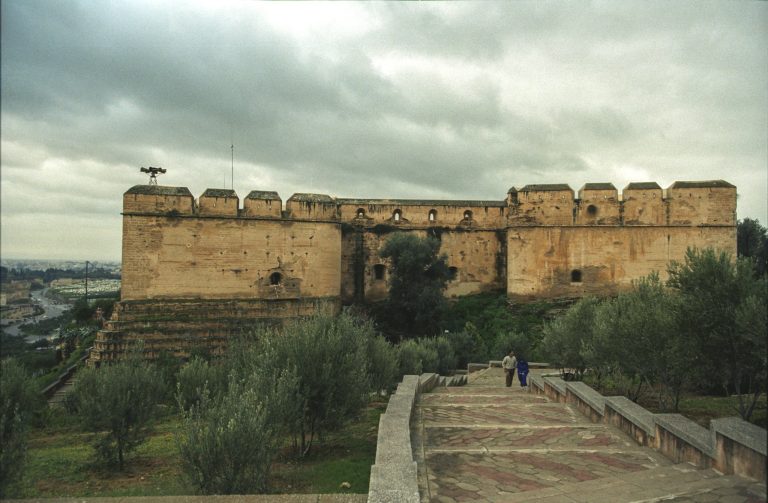
The former palace complex included a mosque, whose remains contain a mihrab, a prayer niche indicating the direction of Mecca. It also included a hammam, or bathhouse. Sections of surviving walls are attributed to the twelfth century and are described as among the oldest defenses of the old city. These include the Kawkab Tower, which was formerly used as a quarter for people with leprosy.
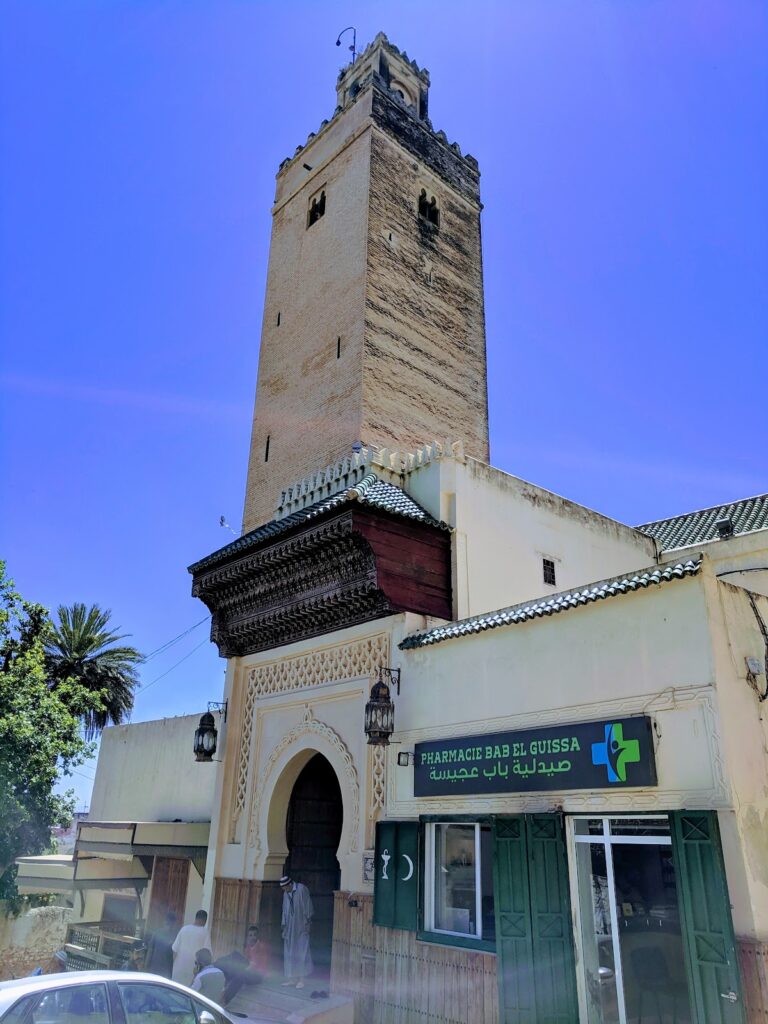
The nearby Bab Guissa, an Almohad gate built in the thirteenth century, gives its name to the surrounding cemetery. Together, the gate, cemetery, hilltop defenses, and palace remains form the wider archaeological setting of the necropolis.
Royal mausoleums
The two large mausoleums
Two tall rectangular mausoleums remain visible at the center of the surviving tomb group. Each stands on a rectangular base and has a large horseshoe-arch entrance. Their occupants are unknown, but their monumental scale suggests that they may have been intended for members of the royal family.
Nineteenth-century photographs show that both mausoleums formerly had pyramidal wooden roofs covered with green tiles. Fragments of carved stucco and Arabic inscriptions survive on the walls. Leo Africanus, a sixteenth-century traveler and chronicler, described the tombs as richly decorated and adorned with lavish, colorful marble epitaphs. His account preserves an important impression of the monuments but does not identify their occupants.
The smaller domed mausoleum
A smaller domed mausoleum, or qubba, stands behind and slightly north of the two larger structures on lower ground. It has a square base, and each of its four walls opens through a horseshoe arch. Its occupant and its possible connection with the Marinid dynasty remain unknown.
The building was formerly covered by a twelve-sided dome supported by four squinches, structural devices that carry a dome or polygonal upper section above a square room. The dome had disappeared by the time Georges Marçais described it in his 1954 study. The mausoleum stands within a square enclosure, with a second rectangular enclosure attached to its eastern side. Parts of both enclosing walls survive, and the eastern enclosure may have served as a forecourt.
Enclosed funerary landscape
The necropolis was probably enclosed by a wall, giving it the form of a rawda, an enclosed funerary garden or private cemetery in Islamic tradition. The arrangement of the smaller mausoleum and its enclosures has been compared with the Rawda mausoleum in the Alhambra at Granada and with the Marinid mausoleum in the Sidi Abu Madyan complex at Tlemcen. Both comparisons concern fourteenth-century monuments and help place the surviving layout within the architectural traditions of that period.