Marienrode Priory: A Historic Monastic Complex in Hildesheim, Germany


Site at a Glance
- Rating
- 4.7
- Popularity
- Low
- Country
- Germany
- Primary era
- Early Modern
- External website
- Open
- Eras represented
- Medieval, Early Modern, Modern
- Civilizations
- Holy Roman Empire
- Site type
- Religious
- Remains
- Monastery
On this page16 sections
History
Foundation and Cistercian transformation
Marienrode Priory is a historic monastic complex in Hildesheim, Germany, founded on 22 May 1125 by Berthold I von Alvensleben, Bishop of Hildesheim. The settlement was then known as Baccenrode. The institution began as an Augustinian monastery, whose religious communities followed traditions associated with Saint Augustine.
In 1259, Marienrode became a Cistercian monastery and a daughter house of Riddagshausen within the Cistercian filiation of Morimond. This institutional lineage defined the monastery’s relationship to other houses in the order. In the same year, Bishop Johann I of Brakel expelled the existing monks and nuns because of alleged moral decline. Cistercians then resettled the site and gave it the name Marienrode, formally associated with the Latin name Monasterium Novalis Sanctae Mariae.
By about 1250, the monastery had also established a branch in Hanover known as the Marienröder Hof. This establishment continued until the Reformation, extending the priory’s activities beyond its main settlement. The village of Marienrode later developed around the monastery.
From secularization to an estate
Marienrode was secularized in 1806, ending its existence as a religious house at that time. In 1807, the estate became part of the domain of the Kingdom of Westphalia under Jérôme Bonaparte, who ruled the Napoleonic kingdom. It was leased to the Calenberger official Süllow on 1 May 1807 and purchased by Finance Minister Carl August von Malchus on 25 February 1812. Malchus later received the title Count of Marienrode.
After the Battle of Leipzig in 1813, George III, elector and later king of Hanover, granted the estate for life to Lieutenant General and chief forester Carl Baron von Beaulieu-Marconnay. Following his death in 1855, ownership passed to his widow, Henriette von Egloffstein, and then to a succession of tenants. Christian Eberhard Meyer administered Marienrode from 1818 to 1850 and was buried there.
The former monastery continued to function as an estate and farm for much of the modern period. After 1945, some of its buildings housed displaced persons from Silesia and East Prussia. Some of these residents remained until the monastic community was re-established, while farming continued at the complex until 1987.
War, memory, and renewed monastic life
During the Nazi period, part of the grounds near the Egloffstein burial site was used as a cemetery for Russian and Polish forced laborers. The grave of a Polish field chaplain was moved to Marienrode’s Catholic cemetery in the 1960s. The remaining partly Orthodox graves were later levelled at the direction of the Catholic parish council, a change that forms part of the site’s difficult twentieth-century history.
The Diocese of Hildesheim acquired the former monastery in 1985. At the initiative of Bishop Josef Homeyer, previous residents and estate tenants were pressured to leave in 1986 so that the complex could be extensively renovated and converted for monastic use. On 5 May 1988, ten Benedictine nuns from Saint Hildegard Abbey in Eibingen re-established a religious community at Marienrode. The community became an independent priory in 1998 and belongs to the Beuronese Congregation, a congregation of Benedictine monasteries.
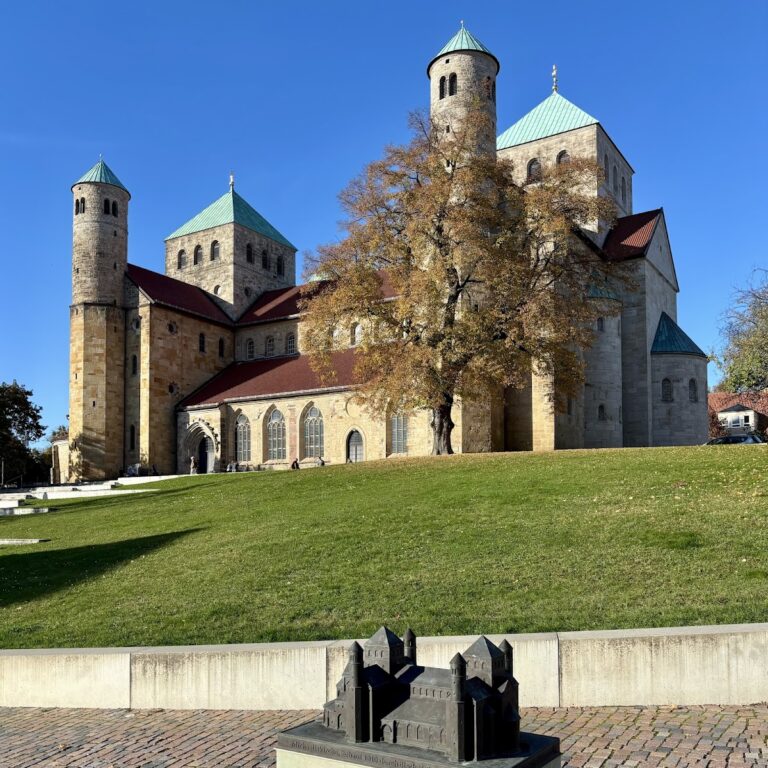
Saint Michael’s Church serves as the priory’s Catholic parish church. The nuns’ daily life is organized around common prayer and work. Their activities include organizing retreats and spiritual exercises, operating a book and art shop, and providing sacristan and organist services. Marienrode was incorporated into Hildesheim in 1974, while the surrounding 3.2-square-kilometre Marienrode Monastic Landscape retains recognition as a historic cultural landscape of statewide importance. It has been a landscape-protection area since 2013, and its classification within Lower Saxony’s historic cultural landscapes dates from 2018.
Remains
Church and convent
Saint Michael’s Church
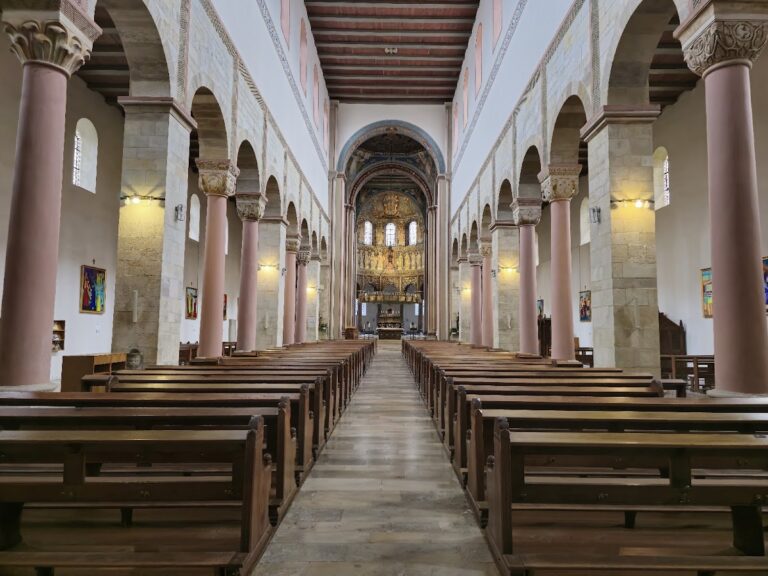
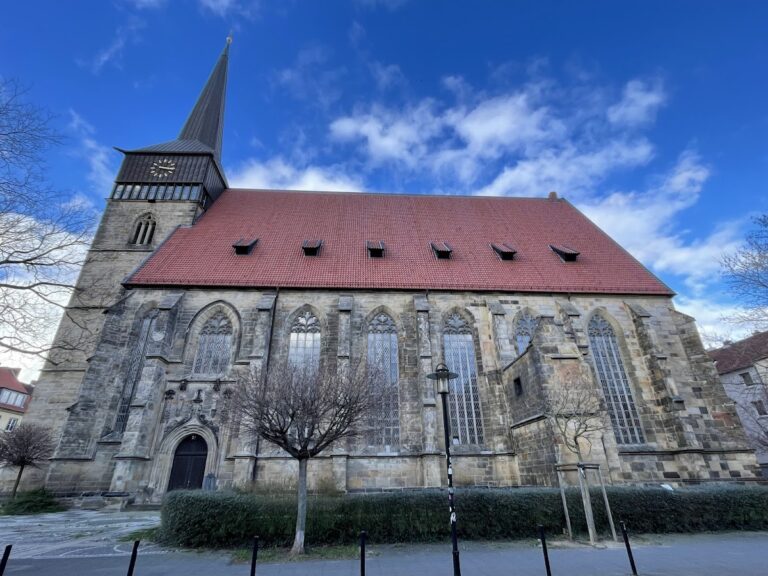
Saint Michael’s Church forms the historical center of the complex. The foundation stone of the present building was laid in 1412, and the Gothic three-aisled church was completed in 1462. Gothic architecture is a medieval style associated with features such as pointed arches and an emphasis on verticality. A Baroque ridge turret, a small roof-top tower often used for a bell, was added in the eighteenth century.
The interior contains two notable Baroque altars dating to approximately 1750, as well as a Gothic sandstone sculpture of Saint Mary made in 1460. An organ from the middle of the eighteenth century adds another surviving element from the church’s later period. The building continues to serve as the Catholic parish church of the priory.
Convent buildings
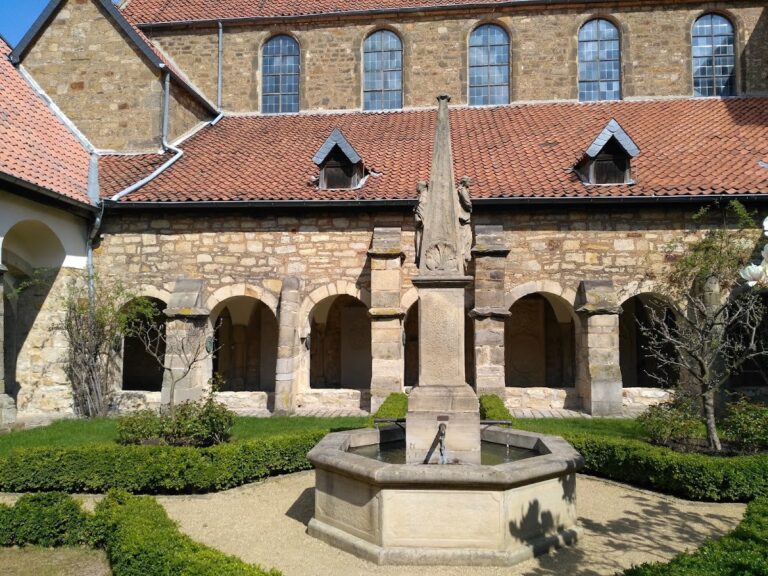
The convent buildings were renewed in restrained Baroque forms between 1717 and 1729. Most of the present monastery buildings are constructed of sandstone. Arranged in three wings north of Saint Michael’s Church, the convent encloses a simply designed cloister courtyard. A notable pigeon tower stands within the inner court. Together, these buildings preserve the spatial organization of the renewed early-modern convent.
Estate courtyard and religious buildings
Estate courtyard
The former estate courtyard contains buildings from several stages of its agricultural use. A large passage barn occupies the north side, and its eastern archway bears the date 1722. The western and southern estate buildings carry inscriptions dated 1686, 1736, 1739, 1742, and 1791, reflecting the long sequence of construction and alteration within the estate.
Saint Cosmas and Damian
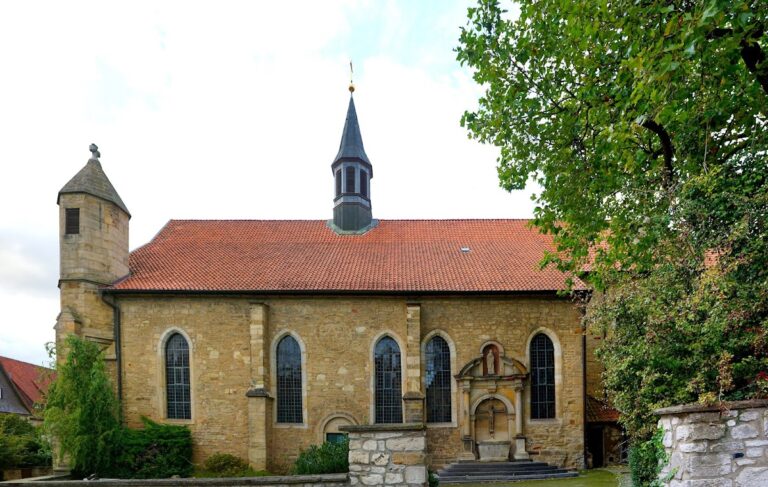
At the edge of the estate stands Saint Cosmas and Damian, a small former gate chapel and pilgrimage church built in 1792–1793. It was converted into a Protestant church in 1830 and serves Protestant residents of Marienrode, Neuhof, and Hildesheimer Wald. Its altar dates from 1835, while its organ comes from the late eighteenth century. In keeping with Cistercian tradition, the building has a ridge turret rather than a tower.
Former village school
The former village school was operated by the priory and built in 1716. Its presence reflects the monastery’s institutional role in the surrounding settlement, which developed around the complex before Marienrode became part of Hildesheim.
Landscape and commemorative features
Mill and avenue
The Marienrode windmill was built in 1839 and operated as a mill until 1939. It is reached from the village by a tree-lined avenue of approximately 200-year-old lime trees with historic paving. The mill and avenue form part of the surviving landscape associated with the former estate.
Fishpond
A large fishpond south of the village was laid out by the Cistercians during the Middle Ages. It remains a physical reminder of the monastic landscape and of the practical arrangements that supported the former religious house.
Egloffstein burial site
Near the former western entrance to the estate is a shared grave for Henriette von Egloffstein and her three daughters from her first marriage, Caroline, Julie, and Auguste. The daughters belonged to the Weimar circle associated with Johann Wolfgang von Goethe. A newer cemetery lies east of the village, while the Catholic cemetery also contains the relocated grave of a Polish field chaplain.
Nearby sites