Maribor Cathedral: Seat of the Archdiocese of Maribor
Site at a Glance
- Popularity
- Medium
- Country
- Slovenia
- Primary era
- Medieval
- Eras represented
- Medieval, Early Modern, Modern
- Civilizations
- Austria-Hungary, Duchy of Styria, Habsburg, Holy Roman Empire
- Site type
- Religious
- Remains
- Cathedral
On this page21 sections
History
Maribor Cathedral is the seat of the Roman Catholic Archdiocese of Maribor, in Slovenia. The date of its Romanesque construction is uncertain, but the church is first recorded in 1248 as a church dedicated to St Thomas the Apostle. Romanesque was the European architectural style that preceded Gothic architecture.
The medieval parish and church
Maribor’s parish is first mentioned in 1189 and probably emerged through the division of an earlier Kamnica–Maribor parish. Corradus, also called Konrad, was parish priest that year and remained in office in 1243. Kamnica is thought to have become a vicariate, a church district served by a vicar. Its priest probably moved permanently to Maribor after 1193 and by 1220 at the latest; a vicariate was established at Kamnica by 1367.
In 1248 the church was named for St Thomas. A record from 1254 names both St Thomas and St John the Baptist, and the church was consecrated that year. From 1399 its recorded dedication was to St John alone. One proposed explanation links this change to an earlier baptistery dedicated to St John. It belonged to the church of St Martin at Kamnica and probably stood nearer the Drava River, rather than on the cathedral site. The dedication may have passed to the newer church after the baptistery was demolished.
Maribor then lay in the Drava March, a frontier territory of the Holy Roman Empire. Its margrave, or border-territory governor, was Otokar III of Styria, a member of the Traungau dynasty. Records naming several priests and a deacon indicate that Maribor was already an established settlement. It was described as a market town in 1209.
From parish church to cathedral
Fires in the 16th century damaged the church, brought down parts of its ceiling, and made a new roof necessary. Baroque alterations followed, adding side chapels and altars. The medieval cemetery served many prominent Maribor families before it was discontinued in the late 18th century.
On 4 September 1859, Bishop Anton Martin Slomšek transferred the episcopal seat from St Andrä to Maribor, and the church became a cathedral. It remains the seat of the archdiocese and serves as the parish church of both the Maribor–St John the Baptist parish and the Maribor University Parish.
Preservation and twentieth-century change
In the late 19th century, disagreement over the cathedral’s condition and suitability divided those who wished to retain it from those who proposed replacing it with a new church. The preservation campaign associated with Bishop Jakob Stepišnik and historian Ignacij Orožen prevailed. Re-Gothicization, the alteration of an older building to give it a more consistently Gothic appearance, began in 1885. The work caused serious losses: ten of the church’s thirteen altars were removed and destroyed. In the early 20th century, the Imperial-Royal Central Commission, a Habsburg body responsible for preserving historic monuments and artworks, objected to removing the Baroque St Nicholas altar unless it went to the diocesan museum. It also required the Gothicizing work to stop. The cathedral reopened and was reconsecrated in 1890.
During the Second World War, replacement bells installed between the wars were taken away, and Allied bombing at the end of the conflict destroyed the presbytery’s original stained-glass windows. From around 1960, changes following the Second Vatican Council reshaped the interior and the arrangement of the altar area.
Slomšek and the cathedral
Slomšek died in 1862 and was first buried in a chapel at Maribor’s old cemetery. When that cemetery closed in 1941, his remains were transferred to the Franciscan church. On 7 October 1978, during Bishop Maksimilijan Držečnik’s tenure and in connection with Slomšek’s beatification process, they were moved to the cathedral, first to a crypt beneath the presbytery. After his beatification, they were placed in the Slomšek Chapel.
In spring 1939, Cvetana Priol, a Slovene Catholic laywoman later styled a Servant of God, made a devotional self-offering to Jesus in the chapel as a “victim of love,” a phrase for religious self-dedication rather than literal sacrifice. Pope John Paul II prayed at Slomšek’s tomb on two visits. During his second visit to Maribor, on 19 September 1999, he beatified Slomšek.
Remains
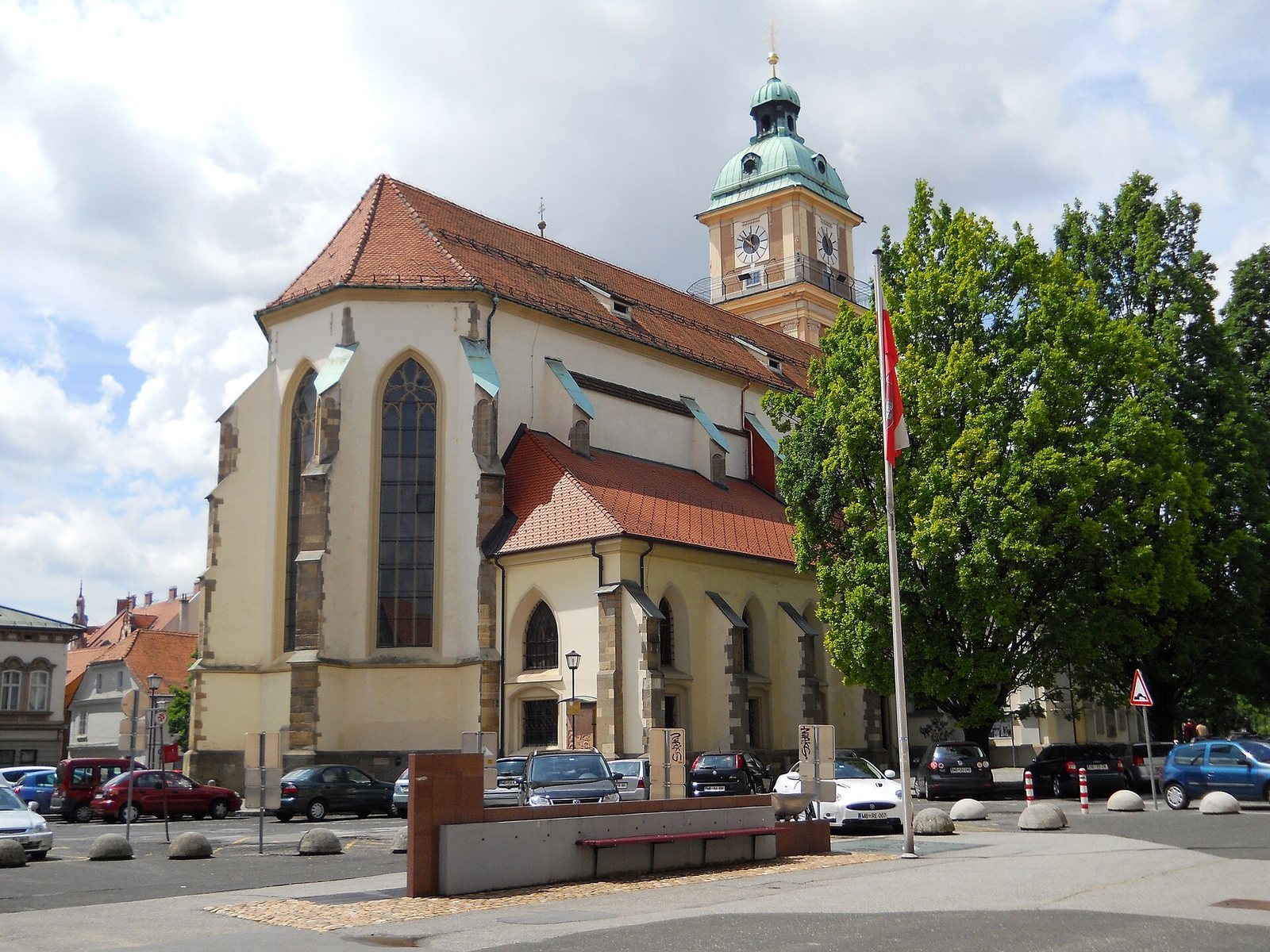
The cathedral stands near the middle of Slomšek Square, in the geometric centre of Maribor’s old town. The bishop’s palace is close by, and the wider complex includes a seminary, a later theology-faculty extension, diocesan and theology libraries, a bookstore, and the diocesan archive. The church’s core is Romanesque, with Gothic, Baroque, and 20th-century alterations. Its walls combine roughly worked stone with dressed grey and yellow sandstone from the Slovenske Gorice Hills, a hilly region in northeastern Slovenia.
Medieval structure and layout
Romanesque core
The original church was a single-nave basilica, a long church space centred on a main nave. It extended from the site of the present Gothic arch separating the nave from the presbytery, the area around the main altar, to the choir loft. The building measured 28.75 metres long by 22.75 metres wide, and its central nave probably reached about 12 metres in height. The surviving Romanesque fabric includes a vault, or curved ceiling, at the eastern end of the north aisle and a projecting cornice resting on the aisle’s three eastern supports.
Gothic expansion and vaulting
In the 13th century the church expanded to three aisles, with four arches on each side between the central nave and the side aisles. The north and south rows of arches do not align: the north row sits farther back, contributing to irregularities in the central nave’s ceiling. Arches were blocked and reopened during later work, doors were inserted and removed, and a pillar at the southeast corner was demolished and rebuilt.
The Gothic choir was enlarged and raised around 1400. The south aisle was raised and vaulted in 1442, and the north aisle received its ceiling around 1467. The central nave was raised in 1520 to bring it into closer alignment with the taller choir; the side aisles remain about six metres high. The church’s curved ceilings have several patterns. Art historian France Stele distinguished six types, from a simple cross vault, formed by intersecting arches, in the sacristy to an elaborate net vault with intersecting ribs in the nave. The bays become more irregular toward the arch before the choir. In the north aisle, carved angels holding instruments of Christ’s Passion rest on projecting wall supports called corbels.
Chapels, tower, and cemetery remains
St Francis Xavier Chapel
The two side chapels were built in 1714–15 and consecrated between 1724 and 1727. St Francis Xavier’s Chapel has a Baroque altar dated 1716 and stucco decoration from the same period. Its windows, designed by Stane Kregar and made by Zagreb’s Staklo company in 1967, depict the Flood and the Holy Spirit.
Slomšek Chapel
The former Chapel of the Holy Cross, now the Slomšek Chapel, contains a Baroque altar by Jožef Holzinger dated 1775 and frescoes painted that year by Josef Adam Mölk. Slomšek’s tomb is in the chapel. Its stained-glass windows, installed by Marko Jerman between 1996 and 1999, portray Slomšek teaching Blaž and Neža, his time as bishop in Maribor, his beatification, and his place among the saints. Another window depicts Saints Cyril and Methodius. A statue of Slomšek by Zajec, dated 1878, stands in the presbytery.
Bell tower
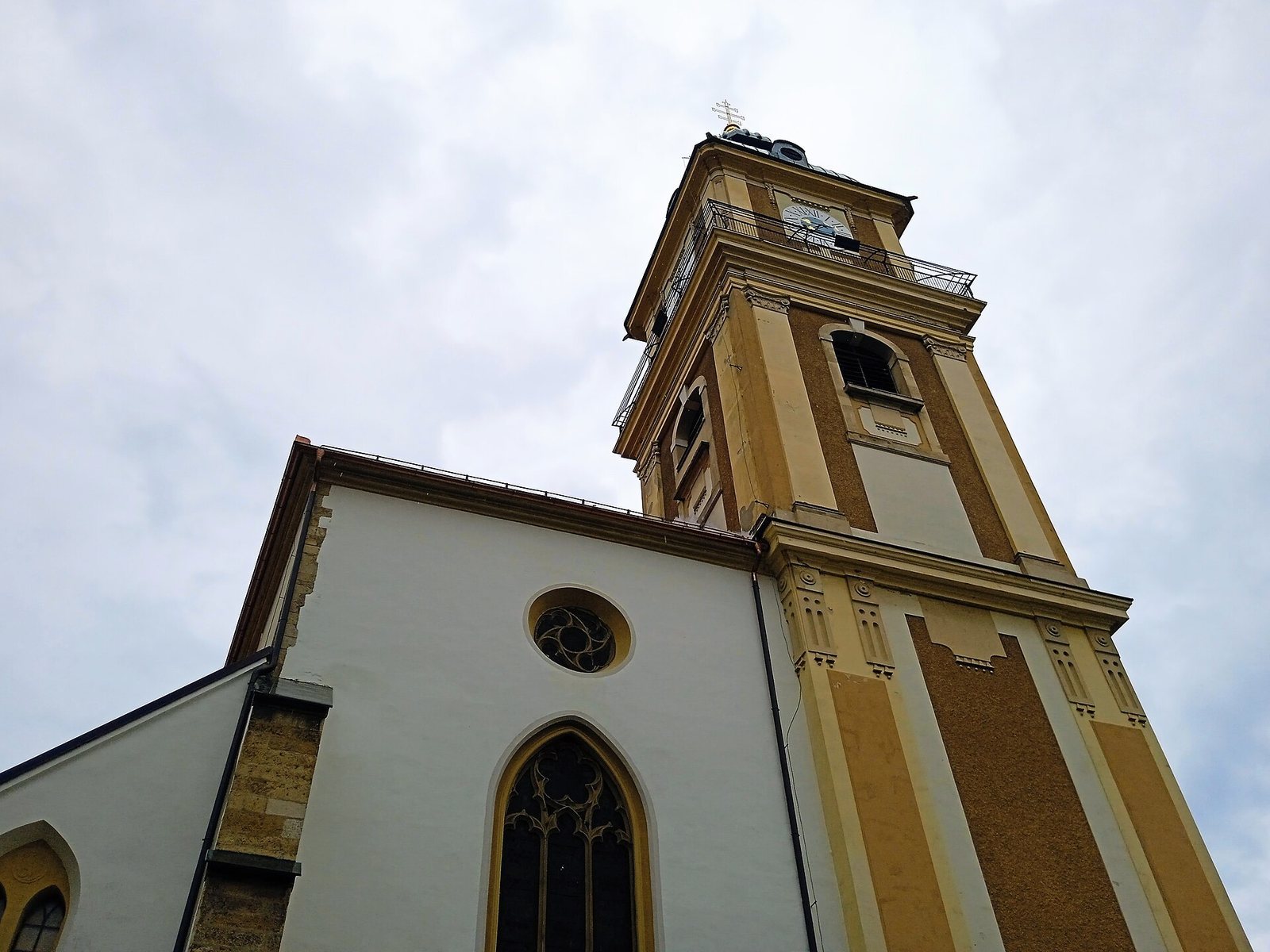
Built onto the church in the first half of the 14th century, the tower incorporated a city watchtower. Its bell stage, the part of the tower where bells hang, was added in Renaissance style in 1623–24; Paolo Porta is credited with the 1623 design. After a lightning strike and fire, the tower was lowered by 19 metres in 1792 and rebuilt in a Neoclassical style. It now stands 57 metres high and holds four bells. The surviving older bell, dedicated to St John the Baptist, was cast in 1651, weighs about 1.6 tonnes, and sounds E-flat. Two other original bells were melted down during the First World War, and the largest, weighing 3,880 kilograms, broke while ringing for King Peter I on 20 August 1921. Four replacement bells acquired between the wars were taken away during the Second World War. In 1989, the Grassmayr foundry in Innsbruck cast three bells weighing 2,300, 900, and 530 kilograms. Together with the older bell, the four sound C, E-flat, F, and A.
The tower also served as a lookout for fires and other dangers. A watchman lived in a small apartment at its top and warned the town by striking the bells. The city closed the lookout in 1933 and dismissed its last fire lookout, Antonija Weiss.
Former cemetery
The cemetery wall was taken down in 1797, and some of its gravestones were built into the church’s exterior walls. A cemetery lantern also survives as a reminder of the burial ground.
Interior furnishings
Presbytery and altar area
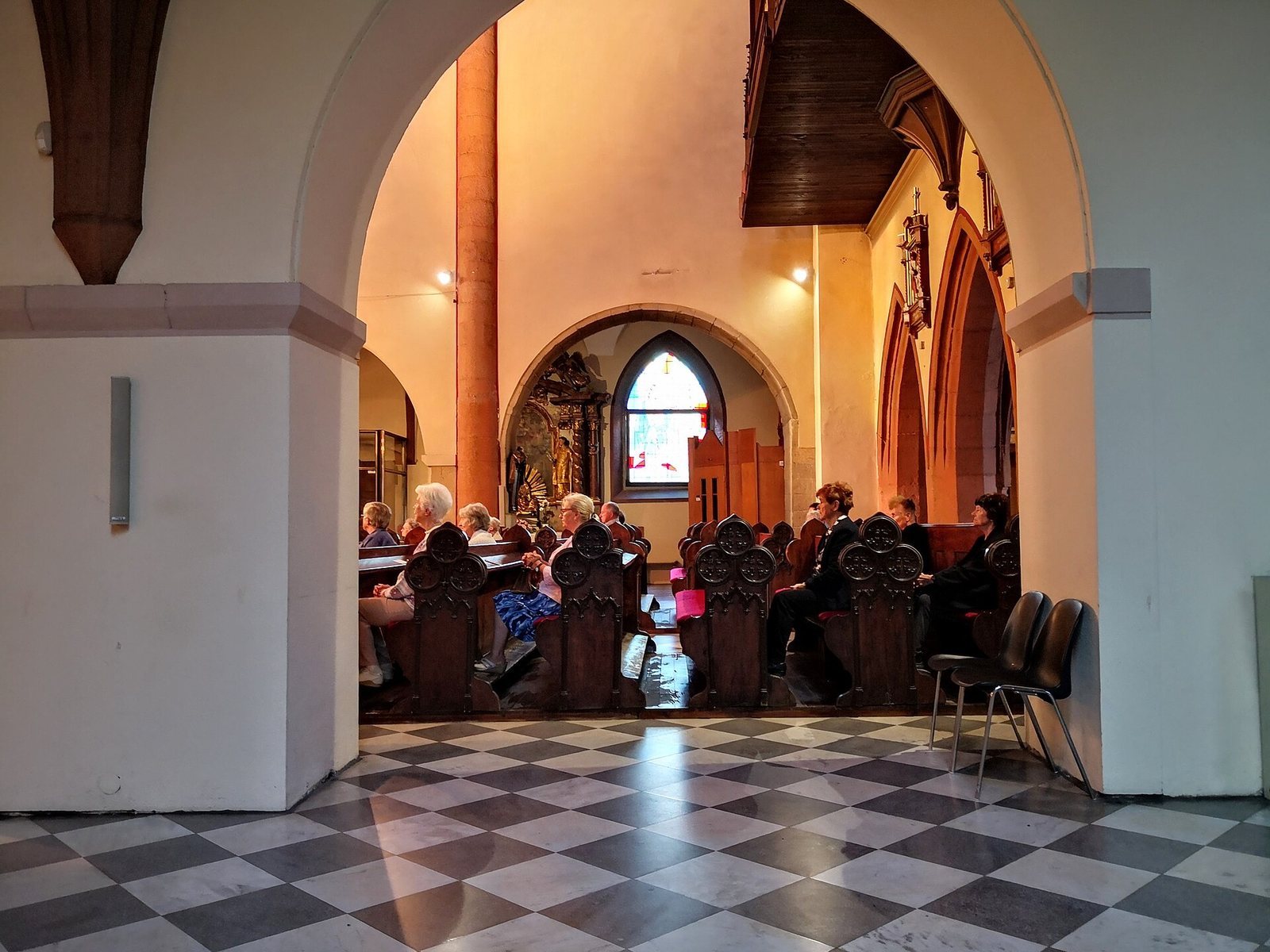
A large arch divides the nave, the church’s main space, from the presbytery and the area used by the congregation. Baroque alterations changed the presbytery windows into rectangular openings divided into two horizontal tiers; new glass was also installed in windows high in the central nave. The church then had fourteen altars. The present main altar was brought from Austrian Styria. A 17th-century Baroque main altar was later removed during Stepišnik’s episcopate and transferred to the parish church of the Holy Cross at Heiligenkreuz am Waasen, where it remains. Its painting of the Baptism in the Jordan is now displayed near the Baroque pulpit. A later Neo-Gothic main altar, part of the Gothic Revival, was also transferred to Austrian Styria.
A new altar was installed in 1978. Made by the Žmuc metalworking workshop to Jože Kregar’s design, it received reliefs by sculptor Gabrijel Kolbič in 1981. A new reading and preaching stand, called an ambo, and a bishop’s seat were also made. The stained-oak episcopal throne from 1891 stands against the north wall, left of the main altar. Slomšek’s own throne was removed in 1891 and did not survive. Wooden choir stalls by Jožef Holzinger, completed in 1771, carry reliefs showing episodes from the life of St John the Baptist.
Pulpit and nave furnishings
The wooden Baroque pulpit, by an unknown maker, is the church’s oldest Baroque feature and survived the 19th-century Gothicizing campaign almost intact. Its low carved railing has grapevines, leaves, and clusters. Wooden figures of the four Evangelists and the apostles Peter and Paul occupy shallow niches between its supports. Gilding decorates the canopy, which is topped by a large angel. A statue of the Risen Saviour faces the nave from the arch before the presbytery.
Three metal chandeliers in the central nave date to the late 17th century. The city’s butchers’, bakers’, and goldsmiths’ guilds donated them to the parish church. A Baroque copy of Rubens’s Descent from the Cross, based on the painting in Antwerp Cathedral, hangs on the south-aisle wall. The 17th-century painting of the Baptism in the Jordan is displayed on the north-aisle wall.
Side-aisle altars and sculpture
The south aisle contains the Baroque altar of St Florian, dated 1699 and attributed to Franc Krištof Reiss. In the north aisle, the Sacred Heart altar is a multi-panel Gothic Revival structure dated 1898. Bishop Mihael Napotnik donated it, and Maribor stonemason Karl Kocijančič made its marble altar table. A Rosary altar dated 1904 has another altar table by Kocijančič; its older Crucifix statue may once have stood in the cathedral cemetery. A statue of Mary dates to about 1500.
Stained glass
Stane Kregar made the stained-glass windows that replaced those destroyed by wartime bombing. The windows date to 1961 and 1969, and one serves as a memorial to Pope John Paul II’s visit to Maribor.
Organs
The first organ, made in 1586 by a craftsman named Uroš, served the town parish. Lenart Ebner built a replacement in 1859, and its case survives. A larger organ made by Josip Brandl’s Maribor workshop in 1907–09 followed. Cathedral choir director Franc Trop and organist Rudolf Wagner prepared its specification, and Bishop Napotnik blessed it as a gift from the cathedral chapter, the body of clergy attached to the cathedral.
The present organ was built in 1981 by Walcker of Murrhardt, Germany, and blessed by Bishop Kramberger. Its keys work by mechanical action, while electromagnetic controls operate its stops, which select sets of pipes. The instrument uses the restored 1859 Neo-Gothic Ebner case, adapted with a smaller organ division behind the choir screen.
Exterior memorial
Opposite the cathedral’s main entrance stands a separate monument to Slomšek. Erected in 1991 to a design by Marjan Drevo, it depicts him seated on an episcopal throne with a crosier. His episcopal coat of arms appears on the back of the throne.