Maria Santissima Annunziata: A Marian Sanctuary in Pedara, Italy

Site at a Glance
- Rating
- 4.3
- Popularity
- Very Low
- Country
- Italy
- Primary era
- Early Modern
- Eras represented
- Early Modern, Modern
- Civilizations
- Italian, Kingdom of Sicily, Spanish
- Site type
- Religious
- Remains
- Sanctuary
On this page13 sections
History
Maria Santissima Annunziata is a Marian sanctuary in Italy, on a hill north of Pedara, whose present building dates from the late sixteenth century. Dedicated to the town’s patroness, it is a filial church subordinate to the Basilica of Santa Caterina, Pedara’s mother church, and belongs to the Archdiocese of Catania and its eleventh vicariate. The sanctuary remains the principal center of local Marian devotion and a destination for pilgrimages.
The first parish church
On 15 June 1388, Simone del Pozzo, bishop of Catania, granted the inhabitants of Pedara permission to build their first parish church under the title of the glorious Virgin Mary, Mother of God. The proposed site was a place called Trinconelli or Trinconello, where a cistern stood. Giovanni da Catania became the church’s first parish priest in 1390.
The 1388 grant does not establish the exact location of the church or explicitly name a Marian dedication. A document from 1422, however, refers to a church of Saint Mary of the Annunciation in the district of Pedara, surrounded by a new lava flow. This makes Annunziata a likely original title, although the precise location of the first church remains uncertain.
Eruptions and the development of the present church
The first church was probably surrounded by the lava flow of 1408. Further eruptions, particularly those of 1536 and 1537, encouraged the inhabitants to move downhill. This relocation produced the districts now known as San Biagio and Matrice. In 1547, the inhabitants began constructing a new parish church dedicated to Saint Catherine of Alexandria. Saint Catherine became a co-patron of Pedara alongside the Annunciation, and the new church’s high altar was dedicated to the Annunciation.
Toward the end of the sixteenth century, Ludovico Pappalardo built the present Annunziata church on land belonging to his estate. The family held rights of burial and patronage, privileges that his descendants exercised at least until the nineteenth century. After the earthquake of 1693, Diego Pappalardo directed the rebuilding, which was completed in 1695.
Nineteenth- and twentieth-century changes
In 1810, Giovanni Papalardo of the Pappalardo family raised the vaulted ceiling and added the large chapel near the apse. He also enriched the interior with wall projections and a sequence of columns supporting the horizontal entablature. During the second half of the nineteenth century, probably in 1888, the church was enlarged with a right-hand nave. This work was probably connected with the construction of the ceremonial processional structure used for the external feast of the Madonna. The structure remained in that nave until 1935, while the left-hand nave was added in 1908.
In 1935 and 1936, the masonry ensemble of the high altar replaced an earlier wooden altar. In 1936, the part of the right-hand nave that had held the processional structure and ceremonial candle towers was cleared. These changes helped establish the interior arrangement that survives today.
The church also contains the mortal remains of Giuseppina Faro, who lived from 1847 to 1871. Known locally as Blessed Peppina, she was a woman from Pedara regarded as having died in an odor of sanctity. Her tomb increased pilgrimages to the church, and her beatification process is still in progress.
Sanctuary status and religious observances
In 1971, Guido Luigi Bentivoglio, archbishop of Catania, elevated the church to the status of a diocesan Marian sanctuary, a shrine formally recognized by the bishop of the diocese. It had already long served as a destination for pilgrims. Theft occurred at the church during the 1970s, including incidents in 1974 and 1975. A painting of the Crucifixion was damaged during one of these incidents. The historic crucifix associated with the sanctuary was permanently returned to the church of San Vito in 1989 and replaced with a new wooden work.
The principal observance falls on 25 March, the feast of the Annunciation, the Christian event in which the angel Gabriel announces to Mary that she will bear Jesus. On that day, the statue representing the Annunziata is displayed for veneration throughout the day. The patronal feast takes place on the second Sunday of September and the following Monday, with processions, decorated candle structures, and Marian floats. The octave, held on the third Sunday of September, includes the traditional veiling of the statue.
Remains
Facade and approach
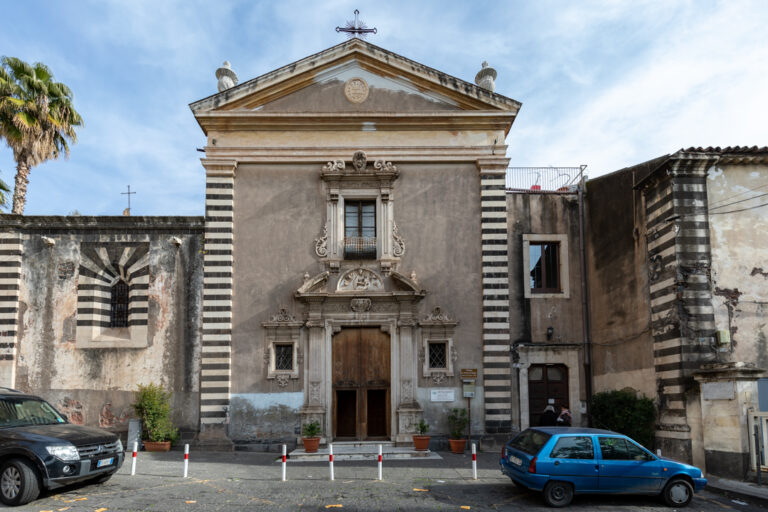
The broad facade reflects the church’s division into a central nave and two lateral naves. Pilasters and portals organize its front, with the central portal forming the principal architectural feature. Its vertical ribs are made from blocks of lava stone, and a broken pediment contains a window. Above the portal is a white-stone coat of arms belonging to the descendants of Diego Pappalardo. The family acquired baronial status during the eighteenth century and shortened its surname from Pappalardo to Papardo.
A white-stone bell tower rises above the pediment. Small effigies of the apostles Peter and Paul flank it, and the tower predates the later rearrangement works. The church is reached by a broad staircase of lava stone built in 1958 and 1959. Before its construction, the street level was higher, and the road formed an overpass in front of the gate that closed the churchyard and the entrance to the cemetery.
Nave and vaulted decoration
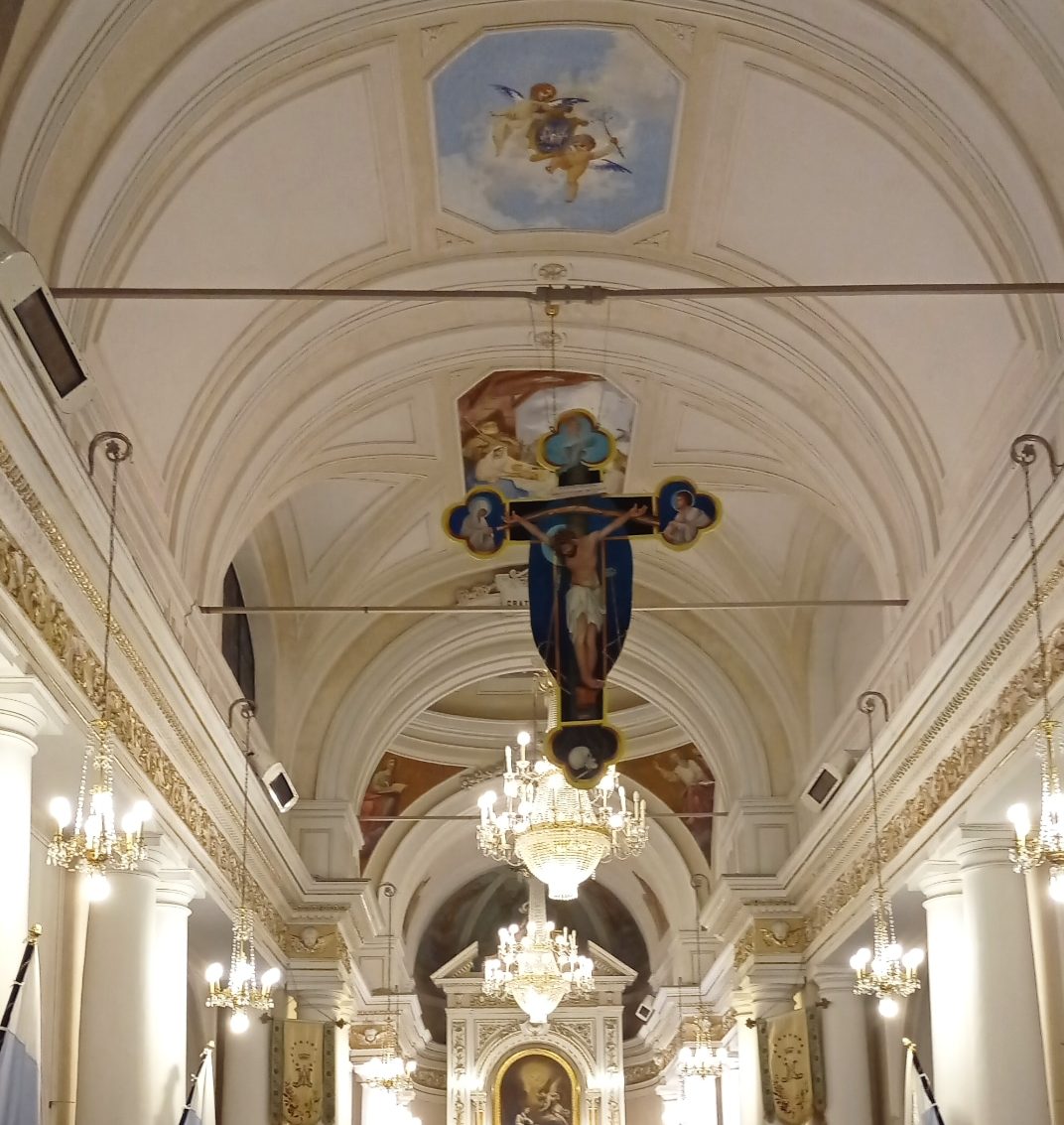
The interior follows a basilical plan, with a central nave flanked by two lateral naves and ending in a single apse. Rows of columns attached to pillars separate the central space from the side naves, and arches divide the bays. The central vault carries three painted panels. They depict the Visitation, Mary’s visit to Elizabeth, two angels holding a Marian monogram, and the Nativity of Jesus, the birth of Christ.
Central vault and apse
A false dome stands before the presbytery, the area surrounding the high altar. Frescoes of the four Evangelists decorate its base, while painted angels holding Marian symbols fill its interior. The small vault over the presbytery depicts the messianic prophets Isaiah and Haggai. In the curved vaulted surface above the apse, four angels surround the masonry high-altar ensemble, whose stucco decoration dates from 1935 and 1936.
High altar and Annunciation group
The high altar contains a statue group representing the Annunciation in a niche concealed by a chestnut-wood door. The patron’s statue is brought out only on 25 March and during the external patronal celebrations in the second week of September. At other times, a canvas of unknown date and authorship depicting the Annunciation hangs in front of the chestnut doors.
Side-nave altars
Right-hand nave
The principal altar in the right-hand nave was formerly dedicated to Saint Francis of Paola. It now contains a statue of Saint Joseph made from Roman cardboard, a molded material used for devotional statuary, dating from the early twentieth century. The first altar along this nave is dedicated to the Crucifix. Until the thefts of 1974 and 1975, a Crucifixion painting stood above it. The painting was defaced and damaged during one of the incidents and is now in the church of Madonna della Stella.
After the historic crucifix was returned to San Vito in 1989, the sanctuary received a new wooden crucifix made in the workshops of Ortisei. Statues of the Sorrowful Virgin and the apostle John, produced by the same workshops, accompany it. The earlier crucifix, possibly dating from the sixteenth century, had been kept at the sanctuary before its return. The second altar in the right-hand nave was built in 1936 by a person from Pedara who had moved to Calabria. Dedicated to the Ecce Homo, it contains a small papier-mache devotional statue.
Left-hand nave
The left-hand nave is dedicated to the Sacred Heart of Jesus, whose image stands above its principal altar. Its other altars are dedicated to the Blessed Virgin Mary of Mount Carmel and Saint Francis of Paola. The Mount Carmel altar contains a nineteenth-century painting by Giuseppe Zacco, a painter from Catania, showing the Virgin giving the habit of the order to Saint Simon Stock, who is traditionally associated with the Carmelite order.
The Saint Francis of Paola altar contains a painting of the saint breaking a coin before Ferdinand I, king of Naples. Before the thefts of the 1970s, this altar was dedicated to the Found Blessed Sacrament. The right-hand nave formerly also housed the processional structure used for the Madonna’s external feast and the large decorated candle structures used in Sicilian religious celebrations. They remained there until 1935.