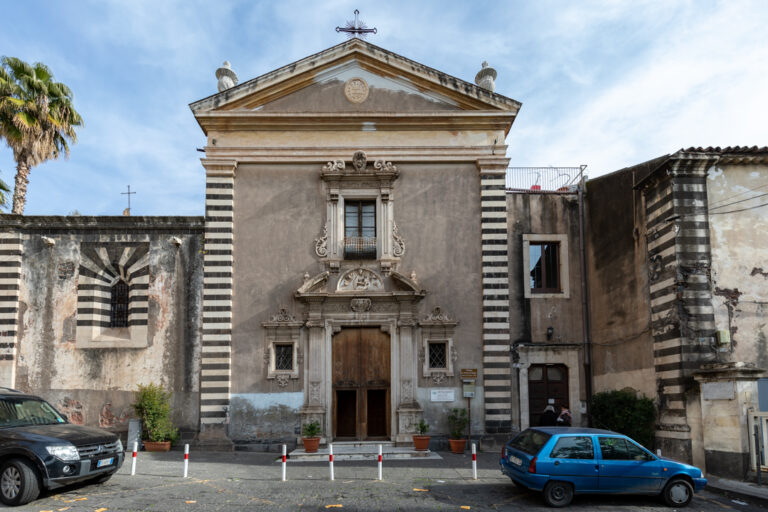
Sanctuary of Maria Santissima di Valverde: A Baroque Marian Sanctuary in Sicily


Site at a Glance
- Rating
- 4.6
- Popularity
- Low
- Country
- Italy
- Primary era
- Early Modern
- Eras represented
- Medieval, Early Modern
- Civilizations
- Kingdom of Sicily, Spanish
- Site type
- Religious
- Remains
- Sanctuary
On this page8 sections
History
The Sanctuary of Maria Santissima di Valverde is a Roman Catholic sanctuary in Valverde, Italy, consecrated in 1296 and now identified with Baroque architecture. Dedicated to Santa Maria and belonging to the Diocese of Acireale, it became a major center of Marian devotion in Sicily.
Origins and foundation tradition
Tradition places the sanctuary’s origin in June 1038, during the final period of Arab rule in Sicily. A traveler from Catania named Egidio was passing through Vallis Viridis when the brigand Dionisio attacked him. According to the foundation story, Dionisio heard a voice attributed to the Virgin Mary, converted, and later became a hermit.
The Virgin was then said to have appeared to Dionisio three more times. She instructed him to organize a pilgrimage with the priests and faithful of Aci, identified the site where the sanctuary should be built, and miraculously revealed a spring whose water was needed for construction. Tradition dates the building of the first sanctuary to 1038 to 1040 and connects its funding with money Dionisio had gained through brigandage.
Dionisio’s historical identity remains uncertain. He has been conjectured to have been a former soldier in the army of George Maniakes, a Byzantine military commander active in the eleventh century, who fled to the area after an act of treachery and later became a brigand. The story also holds that the Arab authorities allowed the sanctuary as an exception after a payment. Although Christian worship was generally tolerated under Arab rule, the construction of new churches and the expansion of Christian religious practice were normally opposed.
Medieval consecration and rebuilding
The early chronology of the church is uncertain. The primitive church cannot have been built before the second half of the thirteenth century, while a final rebuilding is dated to 1607. The sanctuary was enlarged during the sixteenth century and later took on the form associated with its Baroque reconstruction.
The church was consecrated in 1296 in the presence of Frederick III of Aragon, the medieval king of Sicily. This ceremony placed the sanctuary within the religious and political history of medieval Sicily, while its Marian cult continued to draw devotion from communities across the island.
Earthquake and Augustinian administration
The Val di Noto earthquake of 11 January 1693, a major Sicilian earthquake that destroyed or severely damaged many buildings in the southeast, badly affected the sanctuary. The roof and apse suffered particularly severe damage. On 5 April 1694, the Discalced Augustinians, a reform branch of the Augustinian order, established themselves among the ruins. On 26 April 1697, Archbishop Andrea Riggio of Catania granted them full authority over the parish, shaping the sanctuary’s institutional history after the disaster.
The sanctuary’s cult extended throughout Sicily. At Enna, the Virgin of Valverde was traditionally regarded as the city’s first patron until 1412, when that status passed to the Virgin of the Visitation. A traditional account links the Enna devotion with the Christianization of a place formerly occupied by an important temple of Ceres, the Roman goddess associated with agriculture and grain. In this story, St. Pancras stopped a proposed sacrifice and prayed for rain.
Continuing devotion
The principal festival at Valverde traditionally lasts three days and culminates on the last Sunday of August. At Enna, a procession traditionally carries the Virgin’s image from the sanctuary to the cathedral and then returns it.
In 1970, unknown perpetrators stole the crown that decorated the Marian icon in a sacrilegious theft. A replacement crown was made and restored to the image in 1971. On 24 August 1990, Pope John Paul II inaugurated a Marian Year at the sanctuary to commemorate the 950th anniversary of the Virgin’s apparition to Dionisio.
Remains
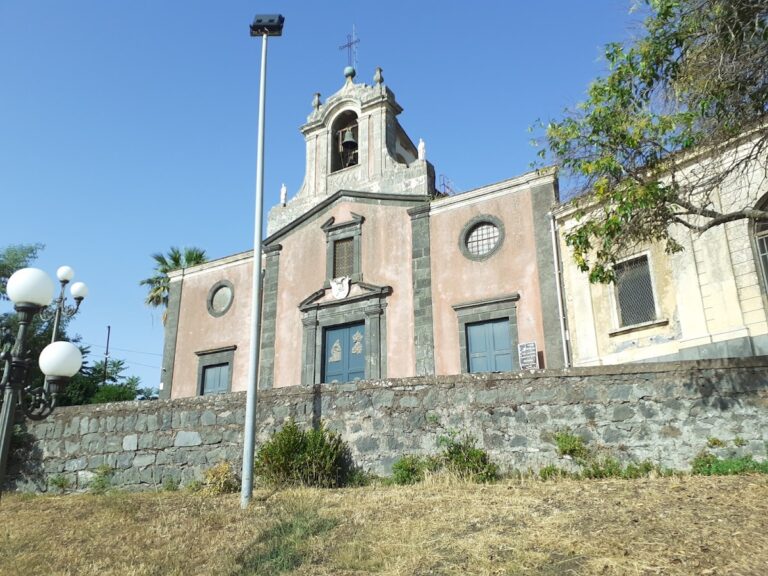
The surviving sanctuary presents a Baroque architectural composition shaped by eighteenth-century reconstruction. That rebuilding added a portico and substantially changed the facade, following the damage caused by the 1693 earthquake to the roof and apse. The exterior portal is formed from white stone and carries the coat of arms of the Riggio princes above it.
Interior chapels and memorials
The interior contains altars dedicated to Our Lady of the Rosary, Our Lady of Mount Carmel, the Holy Family, the Most Holy Crucifix, St. Augustine, and St. Nicholas of Tolentino. A funerary monument commemorates Luigi Riggio Branciforte and his wife, Caterina Gravina, adding a memorial element to the church’s interior.
Altar of Our Lady of Valverde
The altar enclosing the pillar associated with the image of Our Lady of Valverde is set apart from the main altar. Executed in the Baroque style, it is made of polychrome marble. The pillar remained intact when the surrounding sanctuary was severely damaged by the 1693 earthquake.
Tradition places the appearance of the Marian image on the pillar in August 1040. Dionisio was said to have seen an intense ray of light followed by a cloud bearing the Virgin surrounded by angels. The image is venerated as acheiropoietic, meaning believed to have been produced miraculously rather than by human artistic work, and is classified as an Eleusa image, a Marian type showing an intimate relationship between the Virgin and the Christ Child.