Basilica of St. Sebastian: A Baroque Church in Acireale
Site at a Glance
- Popularity
- Medium
- Country
- Italy
- Primary era
- Early Modern
- Eras represented
- Medieval, Early Modern, Modern
- Civilizations
- Crown of Aragon, Italian, Kingdom of Sicily, Kingdom of the Two Sicilies, Spanish
- Site type
- Religious
- Remains
- Basilica
On this page27 sections
History
The Basilica of St. Sebastian is a Roman Catholic Baroque church in Acireale, Sicily, Italy. A local confraternity began building it in 1609, and construction was completed during the seventeenth century. Its development followed an earlier place of worship dedicated to Saint Sebastian, a Christian martyr invoked for protection against plague.
Origins and expansion
The predecessor oratory was founded in the fifteenth century after the plague of 1466. It stood on the site now occupied by the church of Sant’Antonio di Padova and was regarded as Acireale’s oldest church. After the town escaped severe effects from the island’s 1577 plague, devotion to Saint Sebastian increased, prompting the confraternity to plan a larger church.
The new building received financial support from the municipality as well as offerings from worshippers. Saint Sebastian was proclaimed a co-patron of Acireale. On 13 July 1652, an agreement between the confraternities of Saint Sebastian and Saint Anthony led to the earlier church buildings being dedicated to Saint Anthony of Padua.
Earthquake and rebuilding
The 1693 Val di Noto earthquake, a major earthquake in southeastern Sicily, brought down the choir, sacristy, and oratory. Reconstruction was especially extensive between 1695 and 1699. The church was then substantially renovated between 1699 and 1705, taking the form that followed this rebuilding.
Afterward, Pietro Paolo Vasta was commissioned to restore the painted decoration. He received the commission in preference to Venerando Costanzo, whose painting of the Conversion of Cromatius was in the right transept. By 1704, the crypt had already served for about a decade as the home of the Academy of the Zelanti, a learned society devoted to scholarship and culture.
Church status and devotion
At the beginning of the nineteenth century, seven confraternities associated with the church were consulted about its elevation to collegiate status. A collegiate church is served by a chapter of canons. The church received that status by papal bull on 20 November 1924. In December 1990, Pope John Paul II granted it the honorific title of minor basilica. It remains an active church in the Diocese of Acireale, the area administered by a bishop.
The annual feast of Saint Sebastian, Acireale’s co-patron, is held on 20 January. Devotees traditionally carry the saint’s statue through the town on a silver processional platform.
Remains
The surviving Baroque church combines a sculpted, multi-level exterior with an interior arranged on a cross-shaped plan. Its main worship space, side and apsidal chapels, crypt, and museum rooms beside the sacristy form distinct parts of the complex.
Exterior
Façade and statues
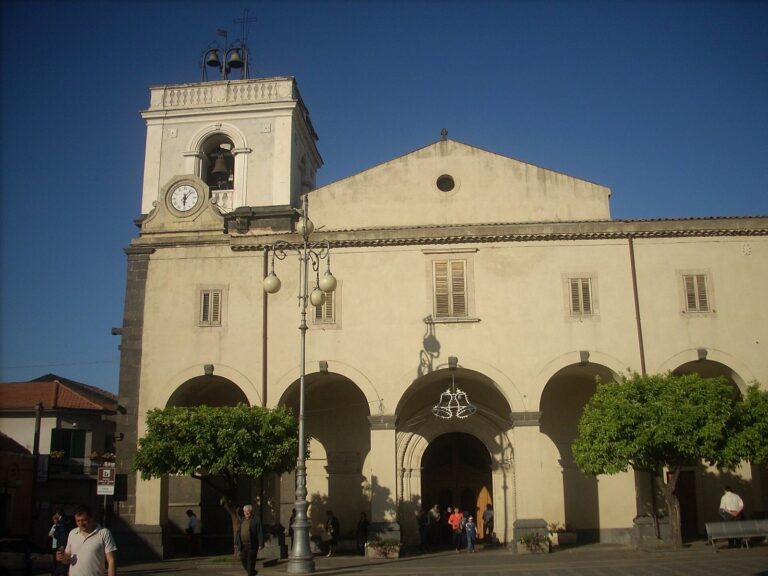
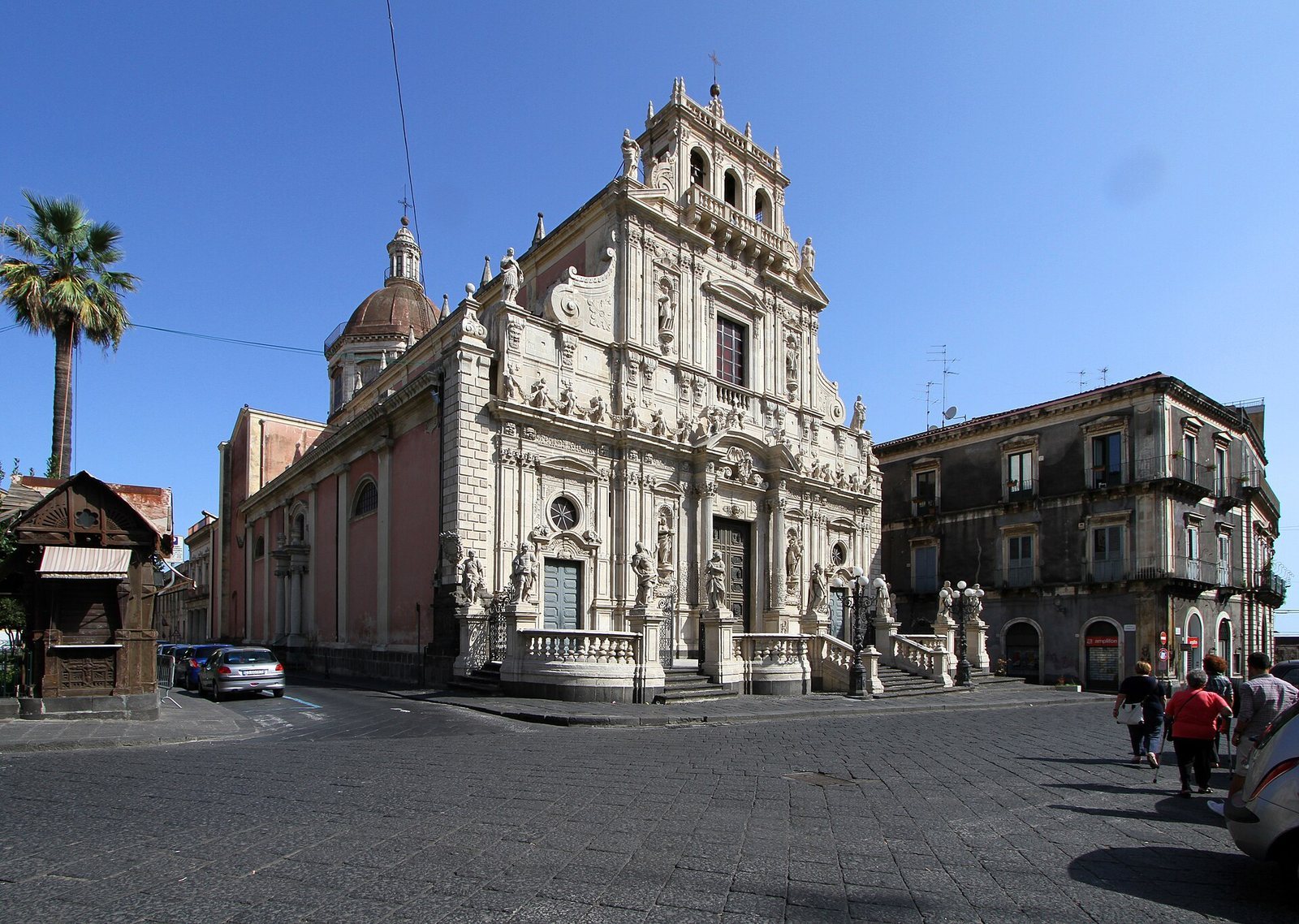
The façade is built from white stone from Syracuse and was designed by Angelo Bellofiore, with inlaid work by Diego and Giovanni Flavetta. Completed between 1705 and 1715, its tiers carry a frieze of fourteen childlike figures holding garlands, along with statues, masks, pinnacles, scroll-like forms, brackets, and patterned ornament. Statues of Saints John the Baptist and Christopher flank the central portal. Saints Gervase, Lawrence, Vitus, and Protase occupy niches on the second tier, while Saints Cosmas and Damian stand beside the bell-loggia above.
Balustrade and entrances
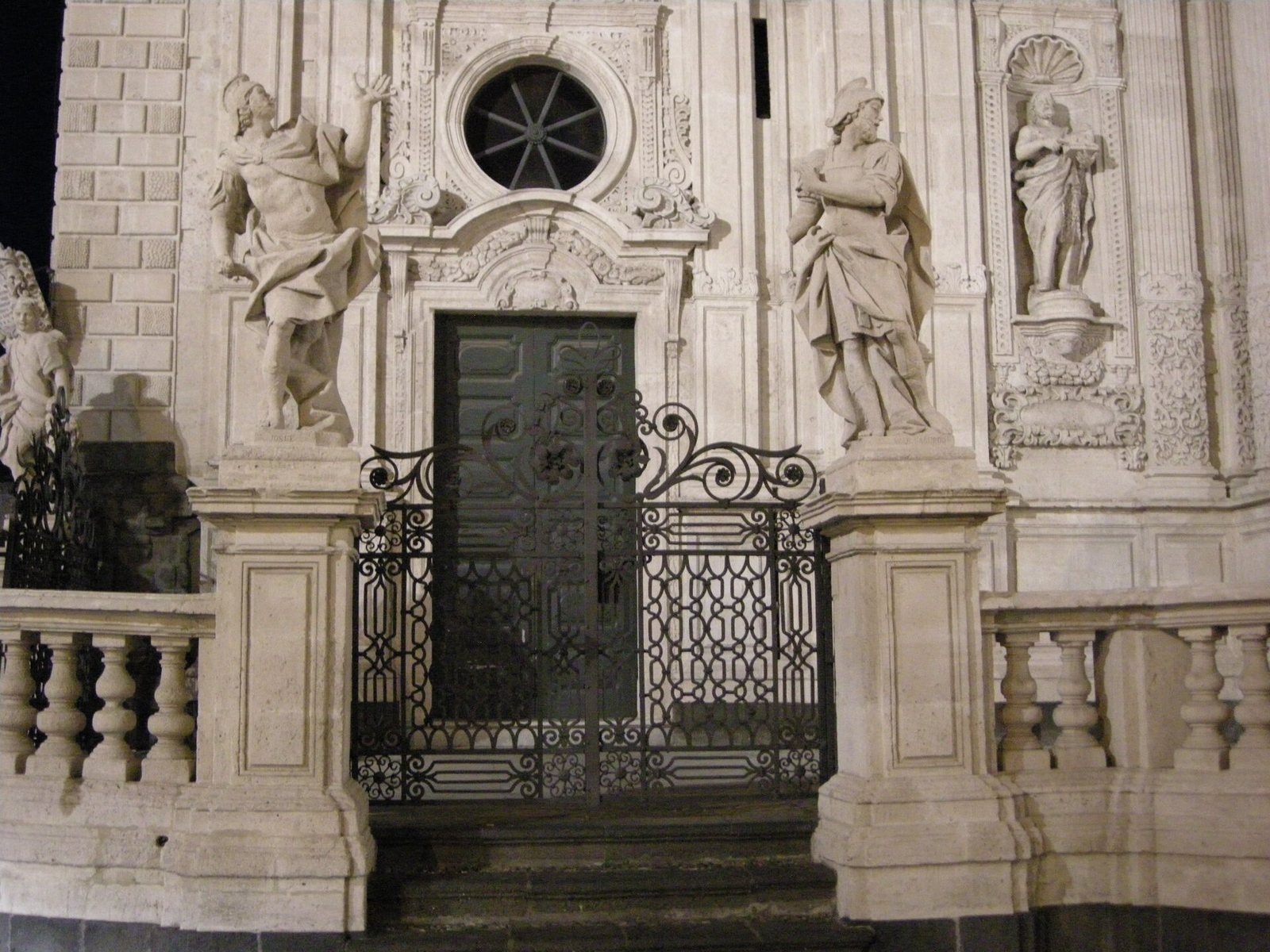
A stone balustrade, or railing, in front of the façade was made in 1754 by Giovan Battista Marini to a design by Vasta. Its ten statues represent David, Jonah, Joshua, Eleazar, Moses, Aaron, Malachi, Joseph the Just, Daniel, and Samson. Salvatore Paradiso completed the metal gates of the atrium in 1848. The bronze reliefs on the central door were designed by the French artist Gustave Doré in 1893.
Interior arrangement and decoration
Main space and sanctuary
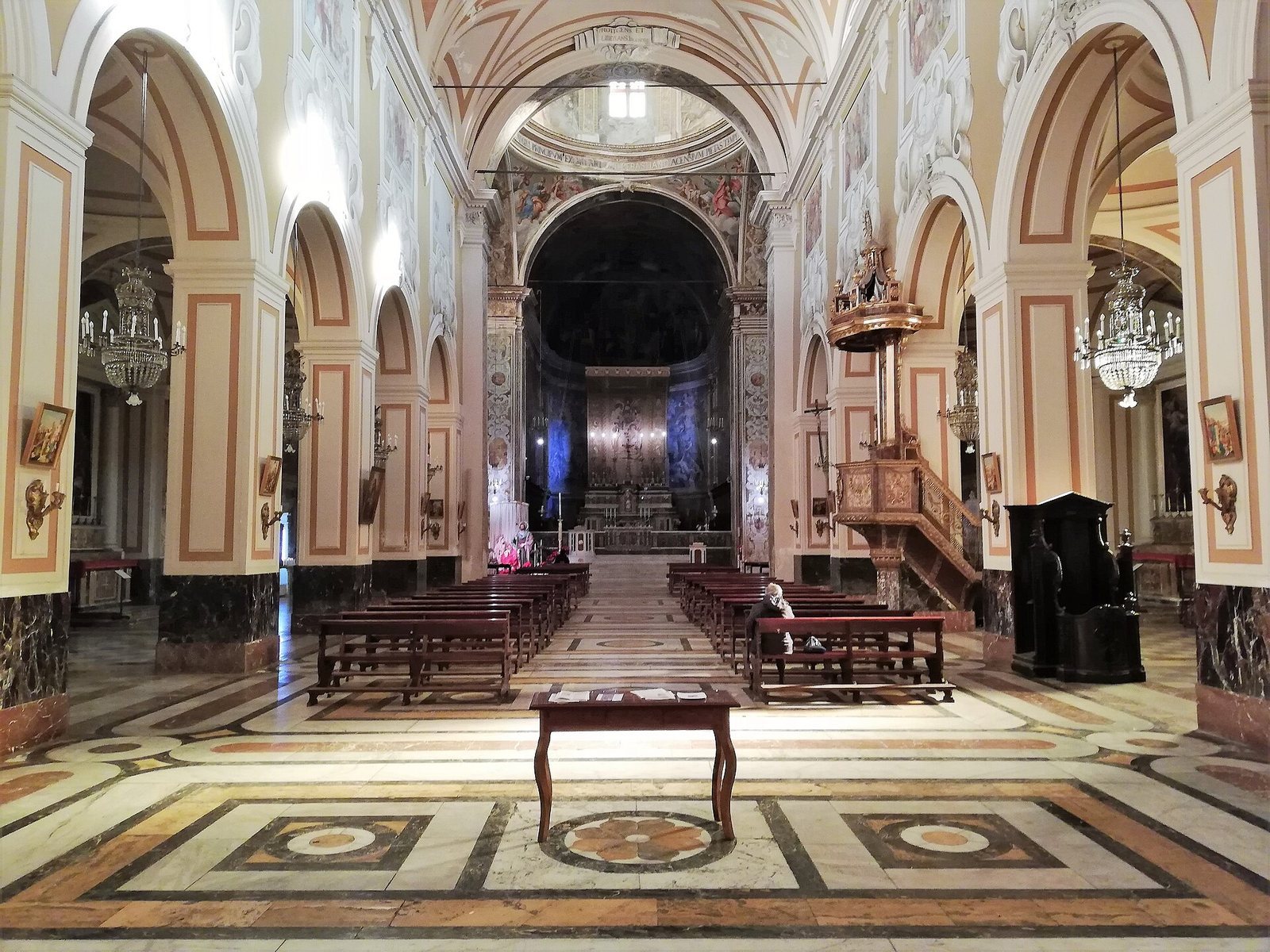
The church’s interior has a central nave, or main hall, and two aisles divided by pillars. A dome rises over the crossing, where the lengthwise space meets the crosswise arms. The raised presbytery, the sanctuary area around the main altar, connects to the transept floor by seven steps. Two marble lecterns stand there, one on the right and a higher one on the left.
Dome and crossing
Francesco Mancini Ardizzone painted the dome’s interior with the Ascension of Our Lord. In 1745, Vasta decorated the spaces below the dome with Old Testament scenes and painted the four major prophets, Ezekiel, Daniel, Isaiah, and Jeremiah, on the curved surfaces that support the dome above the crossing.
Choir and apse paintings
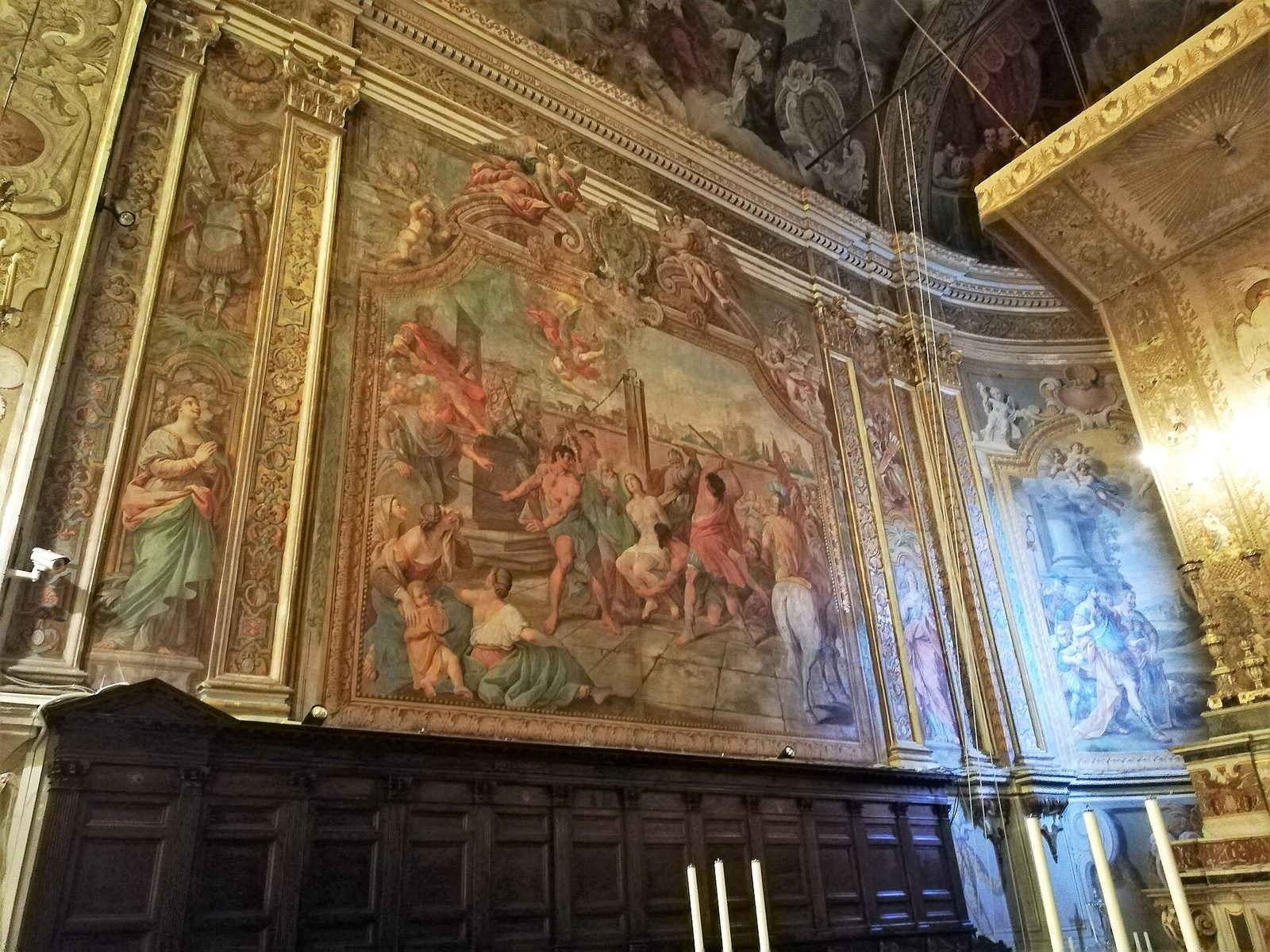
The choir once held frescoes by Baldassare Grasso, which the 1693 earthquake destroyed. Vasta’s replacement cycle, painted in 1733–34, includes the Glory of Saint Sebastian in the choir vault and Saint Sebastian kneeling before Pope Caius, a third-century bishop of Rome, in the half-dome above the apse. Other scenes show the saint’s martyrdom by arrows, help from pious women, his meeting with Diocletian, and his second martyrdom and death.
Frescoes in the nave
Work in the central nave around 1960 brought fifteen frescoes to light beneath whitewash. They were restored and depict episodes from the life of Saint Sebastian. Paolo Leonardi Pennisi attributed their style to Costanzo.
Side aisles
Right aisle
The six bays along the right aisle contain chapels, entrances, and the sacristy doorway. The Chapel of Saint John the Baptist and the Chapel of Saints Cosmas and Damian each have a nineteenth-century painting by Antonino Bonaccorsi. Farther along, a side entrance has a biblical scene above it, while a wooden pulpit stands against a pillar. The Chapel of the Holy Trinity contains a 1742 painting by Vasta and Vito d’Anna, showing the Trinity with Saints Mark the Evangelist, Jerome, and Liborius. A further biblical scene is set above the entrance to the sacristy.
Left aisle
The Chapel of the Coronation of the Virgin contains an altarpiece by Matteo Ragonisi. It shows the Virgin crowned by the Trinity among Saint Joseph, Saint Sebastian, Saint Fabian, Saints John the Evangelist and Luke, John the Baptist, Francis of Assisi, Philip Neri, Ignatius of Loyola, Charles Borromeo, Lawrence, Anthony of Padua, and other saints. The aisle also contains the Chapels of Our Lady of Sorrows and the Souls in Purgatory; the latter has a 1946 painting of the Madonna and the souls by Francesco Patanè.
The fourth bay is the Chapel of Saint Cajetan, with a painting by Pietro Paolo Vasta and Alessandro Vasta of the Virgin and Child among Saints Cajetan of Thiene, Francis de Sales, and Lucy. The fifth bay has a side entrance with an external portal and a biblical scene above it. In the sixth bay, the Chapel of Ecce Homo, referring to the presentation of Christ after his scourging, has a statue in a niche above the altar.
Transept
Paintings and vaults
In the left transept, Vasta’s 1732 fresco shows the Apparition of Christ to Saint Sebastian in the House of Nicostratus, a Roman official. It is his first dated and signed work for the church’s restored decoration. The transept also contains Francesco Mancini Ardizzone’s Burial of Saint Sebastian in the Catacombs and Ascent of Jesus to Calvary, painted between 1899 and 1901. The vaults carry an Allegory of Faith on the right and a Glory of the Holy Shroud on the left, above the Chapel of the Pietà. Francesco Patanè also painted frescoes in the transept between 1899 and 1901. A painting of the Conversion of Cromatius by Costanzo is in the right transept.
Chapel of Saint Sebastian
The chapel in the right transept has a neoclassical altar and Michele Vecchio’s painting Saint Sebastian in Glory. The painting conceals a recess containing the statue of the saint, which is carried in the annual procession.
Chapel of the Pietà
The left transept chapel has a neoclassical altar and a 1742 painting by Vasta. A glass urn holds a copy of the Holy Shroud made in 1644. The Holy Shroud is traditionally believed to have wrapped Jesus after his crucifixion.
Apsidal chapels
Chapel of Jesus and Mary
The right apsidal chapel, dedicated to Jesus and Mary, has a concave altar with pairs of twisted columns and a painting by Alessandro Vasta. Scenes from the life of the Virgin cover the walls. Alessandro d’Anna signed and dated the frescoes to 1771.
Chapel of the Blessed Sacrament
The left apsidal chapel, dedicated to the Blessed Sacrament, has an altar with paired twisted columns and statues. Vasta and Vito d’Anna painted its cycle of scenes from the life of Christ in 1738.
Crypt, museum, and processional platform
Crypt
The underground crypt was originally used to prepare, preserve, and bury bodies. It now houses a museum collection that includes paintings and wooden statues, among them Matteo Desiderato’s Saint Paschal Baylon. The crypt also serves as a venue for conferences and concerts.
Treasury Museum
The Treasury Museum occupies rooms beside the sacristy. Its first room, the sacristy, contains works made in Sicily, including an eighteenth-century wax figure of the Child Mary, Vasta’s panel painting The Risen Christ, Matteo Desiderato’s Four Saints and Our Lady of Sorrows, and Giovanni Lo Coco’s Madonna of the Letter. A large cabinet made in 1811 holds a small silver throne in the Rococo style, an ornate decorative style of the eighteenth century, made in 1767.
The museum’s second and third rooms contain offerings made to Saint Sebastian, reliquaries shaped like arms, sacred vessels, and a solid-gold display vessel set with diamonds. Some of the vessels came from the nearby churches of the Odigitria and San Crispino. The collection also includes jewelry placed on the saint’s statue for the feast and vestments richly embroidered in gold. Other works associated with the basilica include Lo Coco’s canvases Holy Family and Madonna of the Letter, both from the first two decades of the eighteenth century.
Silver processional platform
Vasta was commissioned in 1756 to design a new platform for the statue of Saint Sebastian. It has six wooden columns clad in chased silver. The Lo Giudice brothers of Messina undertook the silverwork, which was completed in the nineteenth century by the Acireale chaser Ambra.