Marbäck Church: A Medieval Church in Sweden
Site at a Glance
- Popularity
- Very Low
- Country
- Sweden
- Primary era
- Medieval
- Eras represented
- Medieval, Modern
- Civilizations
- Swedish
- Site type
- Religious
- Remains
- Church
On this page13 sections
History
Medieval origins
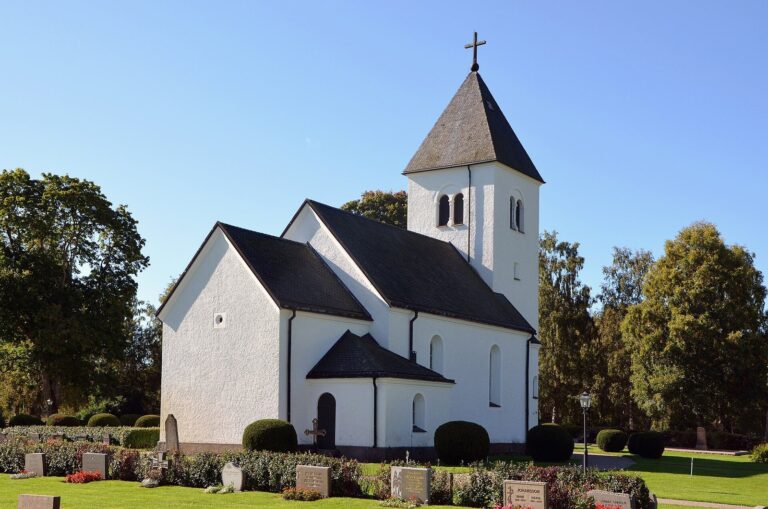
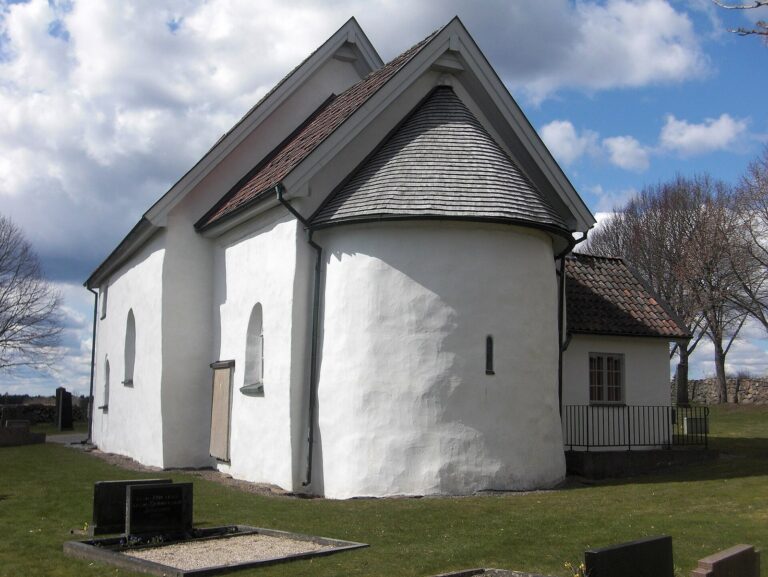
Marbäck Church is a stone church in Marbäck, Sweden, probably built in the 12th century and later given a Neoclassical character, a style drawing on ancient Greek and Roman forms. It may also have been consecrated in the 12th century. The original church had a nave, the main body of the building, and a chancel ending in an apse, a rounded or polygonal recess.
Nineteenth-century transformation
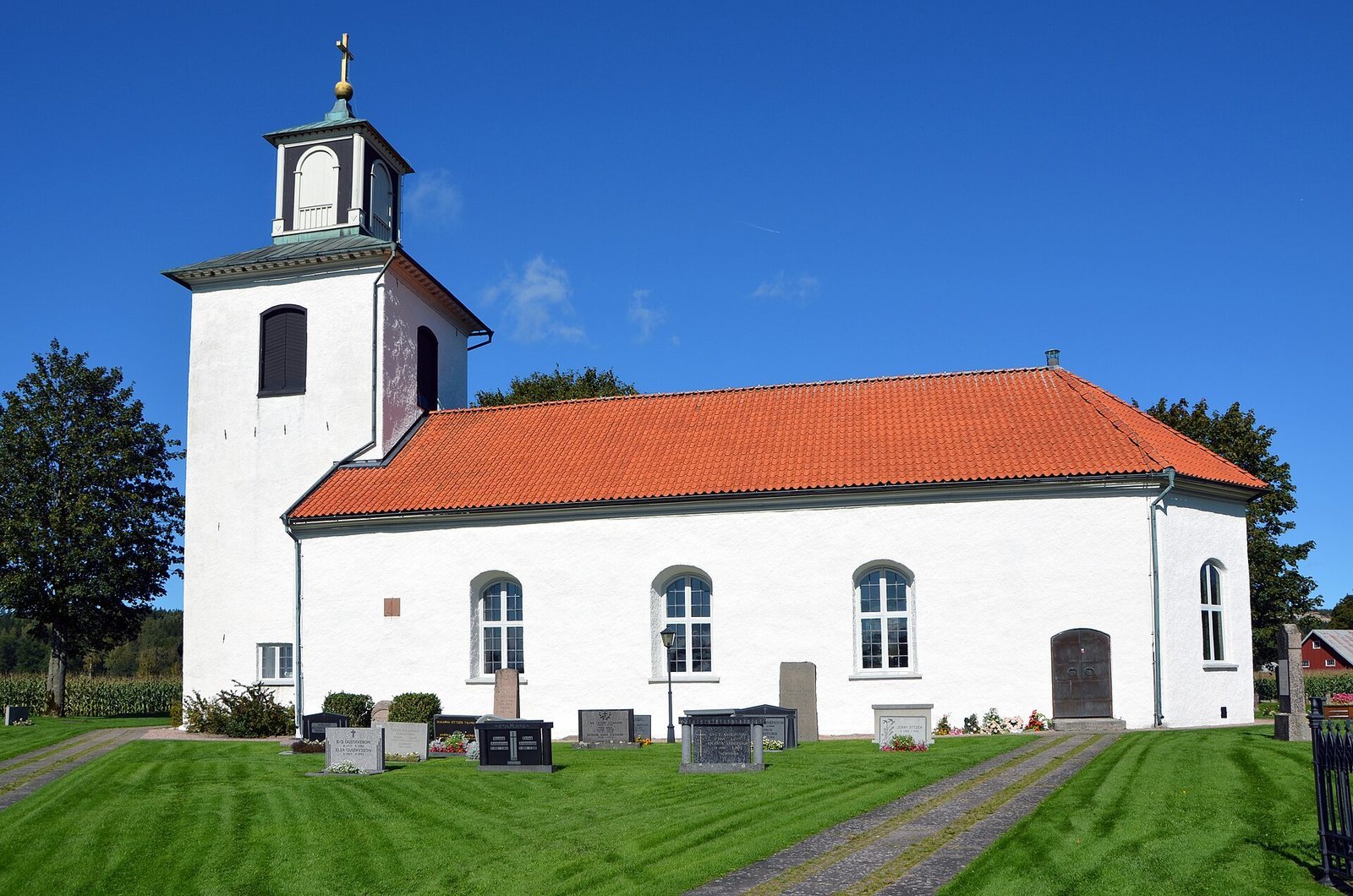
A major extension in the early 1820s lengthened the church eastward. The small windows were replaced by the larger openings in use today. The western tower was built in 1844, completing the changes that gave the building its Neoclassical character.
Twentieth-century changes and church affiliation
Restoration in 1922 brought a new floor, pews based on an older design, and a new sacristy door. Two chancel windows received antique glass in 1937; heating followed in 1939 and electric lighting in 1943. The wooden triumphal cross was removed from the church in the 1820s, deposited at Borås Museum around 1900, and returned in 1948.
A renovation in 1950 included repainting the pews and removing the first row. The chancel received a new floor, the altar rail was shortened, and the interior and exterior were repainted. The pulpit was given a new color scheme, while the interior was repainted in warmer tones. A warm-air heating unit was installed in 1957. In 1965 the facade was renovated, and the tower-roof cross was repainted and regilded.
During an interior renovation in 1976, two rear rows of pews were removed and cupboards for outerwear and church furnishings took their place. A textile cupboard was added to the sacristy, electric heating was installed in the vestibule and gallery hall, and a brass safety rail was fitted along the gallery front. An access ramp was also installed at the churchyard entrance. The tower was replastered in 1981, the facade was renovated in 1991, and the roof tiles were relaid in 2002.
Marbäck Church belongs to the Church of Sweden, an Evangelical Lutheran church. It was part of Marbäck Parish until 2006, when it became part of Åsunden Parish. Since 2010 it has belonged to the Diocese of Skara; previously, it was within the Diocese of Gothenburg.
Remains
The stone church is arranged around a rectangular nave, a three-sided chancel at the east end, and a tower at the west. A sacristy stands north of the chancel. Its surviving features include white-plastered walls, historic furnishings, and a vaulted burial chapel beneath the chancel floor.
Building and interior
Exterior and layout
The church’s white-plastered walls have windows with shallow, curved tops. The nave and sacristy have single-layer clay-tile roofs, while copper covers the tower roof and its lantern, a raised structure on the roof. A gilded cross on a sphere stands above the lantern.
Interior
A smooth-boarded wooden ceiling, shaped like a long barrel, covers the interior and is painted light gray-green. Beneath the chancel floor is a burial chapel with a vaulted ceiling.
Furnishings and fittings
Baptismal font
The sandstone baptismal font dates to the 12th century and stands 83 centimetres high. It is made of two joined parts and was carved by Andreas, a master stone carver. His name is known from two other fonts he signed, originally from Gällstad and Finnekumla churches and now held by the Swedish History Museum. The font’s cylindrical bowl has a sloping underside, a band of linked rings around its body, and raised molding. Upward-pointing scales form a wreath beneath the bowl. The round, sloping foot has raised molding, curling acanthus-leaf decoration, and downward-pointing leaves. A central drainage hole, probably part of the original font, is now plugged.
Triumphal cross
A 15th-century wooden triumphal cross hangs on one of the church’s long walls. A triumphal cross is a large crucifix associated with the boundary between the nave and chancel.
Pulpit and bell
The pulpit stands against the north wall. Its body and overhead sounding board, the canopy above the speaker, are round. A local parishioner known as the Carpenter in Sträckås made it in 1840. The large bell is of a standard late-medieval type.
Altarpiece and organ
Artist Wilhelm Sjölander of Marbäck made the altarpiece in 1922 and gave it to the church. The church’s first organ was replaced that year by an instrument from Nordfors & Co, which used air pressure to transmit the key action. The current mechanical-action organ, installed in 1968, uses linkages to transmit the keys’ movement. Made by Tore Lindegren, it has 15 stops controlled by two hand keyboards and a foot pedal. Its decorative facade was made for the earlier organ and does not produce sound.