Manoir de Saussey: A Seventeenth-Century Manor House in France

Site at a Glance
- Rating
- 3.8
- Popularity
- Very Low
- Country
- France
- Primary era
- Early Modern
- External website
- Open
- Eras represented
- Early Modern
- Civilizations
- French
- Site type
- Domestic
- Remains
- Manor House
On this page8 sections
History
Manoir de Saussey is a historic manor house in France, largely built between 1608 and 1747 in the architectural traditions associated with the reigns of Henri IV and Louis XIII. It replaced an earlier castle whose location is unknown and is regarded as one of the oldest manor houses in southern Coutançais.
The Saussey fief
The estate originated as a fief, a landed holding held within a feudal relationship. The ancient Saussey family appears in thirteenth-century charters and retained the fief until the fifteenth century. On 26 April 1412, Landry de Saucey, an esquire, made a formal declaration of his lands and obligations to the king of France for holdings in the parishes of Saussey and Orval. In 1419, during the later phase of the Hundred Years’ War, he swore allegiance to Henry V of England, then the English king.
By about 1467, the fief depended on the County of Mortain. It passed through marriage to the de la Roque family, whose member Pierre de Laroque, husband of Florence du Saussey, Lady of Saussey, was recorded in 1482. Members of the same family appeared in records in 1505 and 1506. In 1548, marriage transferred the fief to the de Pellevé family. Around 1591–1595, they exchanged it with Guy Le Cointe, an advocate of the king at the Coutances bailiwick, a territorial jurisdiction administered by a royal or seigneurial official.
Rebuilding and divided ownership
When Guy Le Cointe made his formal declaration of the fief to the king on 6 June 1608, the manor was already in ruins. The residence was subsequently rebuilt, with much of the present complex taking shape between 1608 and 1747. Before 1632, the fief passed to Le Cointe’s nephew, Charles Le Moyne. On 7 February 1645, Le Moyne exchanged the fief with Charles Belin, lord of Lingreville and sieur of Ardennes and other places. A sieur was a French seigneurial title associated with ownership or lordship of a domain. Le Moyne retained the non-feudal domain, including the manor, its houses, and its dovecote, a building for keeping pigeons. From this exchange until the French Revolution, the manor and the fief had separate owners.
Through the marriage of Élisabeth Le Moyne, Charles Le Moyne’s daughter and heir, the manor passed to Charles de Mary de Bactot, sieur du Bosc. It remained with the de Mary de Bactot family until the early nineteenth century. Jacques Nicolas Louis de Mary de Bactot, a son of the owners and parish priest of Champ-du-Boult from 1776, was expelled from his parish and returned to the family residence. In 1793, he married his housekeeper, Marie-Thérèse Vauvert. They had three children, including two daughters who never married.
Nineteenth-century estate and charitable workshop
On 9 January 1821, Pauline de Mary de Bactot, daughter of Jean-François de Mary de Bactot and the legally separated wife of Victor-François Poulain de Nerville, sold the estate to Jean-Charles Laville, a physician in Saussey. The property included the manor and farm buildings, agricultural and wooded land, gardens, and a co-ownership right in a lime kiln, which produced lime for construction or agriculture. The estate covered 11 hectares, and Laville began leasing it in 1822.
Laville’s daughter, Clémence Laville, wife of Dr Auguste Tanquerey, inherited the property. It then passed to his granddaughter, Marie-Élisabeth Tanquerey. In 1891, Marie-Élisabeth established an ouvroir, an institution devoted to charitable or productive work, at the manor. Three nuns of the Congregation of Mercy of Saint-Sauveur-le-Vicomte operated the workshop, which continued until 1930.
Twentieth-century changes and museum use
Marie-Élisabeth Tanquerey died at Coutances on 9 January 1930. The estate was sold on 11 March that year to Paul Robin-Prévallée of Coutances, who divided it into two lots. M. Tardif acquired the farm, while Robert Viel, a farmer at Valognes, acquired the manor in 1932. Viel sold it on 26 July 1943 to Joseph Carron, who installed a cinema in the vaulted hall.
Roger Monmélien and Jacques Langelier, a collector and antiquarian from Caen, acquired the property in 1960. After Monmélien’s death in 1993, Langelier opened a museum for his collections of faience, glassware, and nativity scenes. The manor now houses four museums devoted to nativity scenes, glassware, old faience, and Norman furniture, preserving the building’s later use as a place of collection and display.
Remains
Buildings and gardens
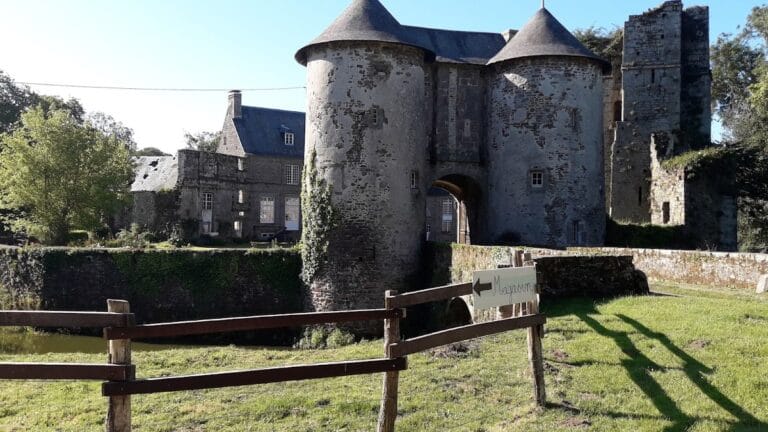
Manoir de Saussey stands within a large enclosed domain at the end of a long covered avenue, approximately 100 metres northeast of Saint Martin’s Church. The church and presbytery lie to the southwest. A double arched gateway provides access from the former Loges manor at Orval; it was reassembled at Saussey around 1990.
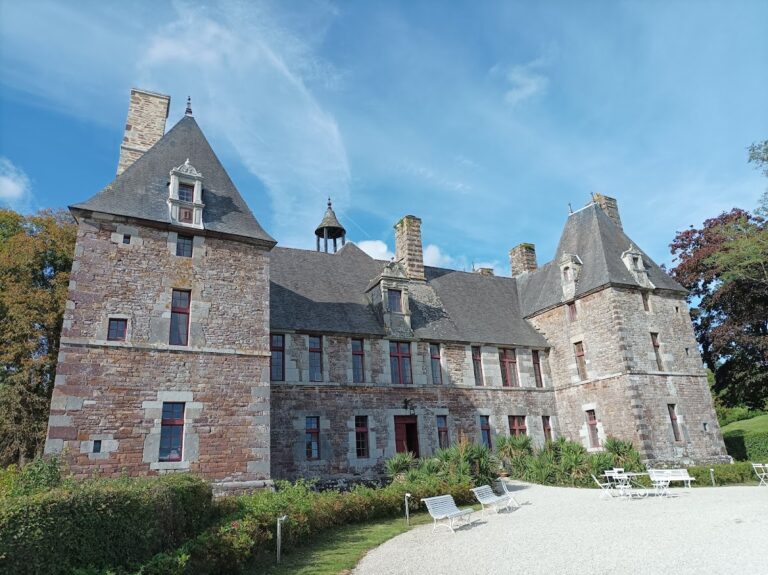
The buildings are arranged around a courtyard, with the farm and lower courtyard separated to the west. Tall slate roofs, chimneys, and a wing returning at a right angle give the residence its characteristic Henri IV and Louis XIII appearance. The complex has undergone few changes since the seventeenth century. The front facade has ridge finials and dormer windows with hooded roofs. The farm includes a sixteenth-century building and an old barn.
Formal French gardens extend around the complex. The gardens north and south of the main residence date from the eighteenth century, while the garden exit has a seventeenth-century wrought-iron gate. The estate also includes features associated with its agricultural history, including the farm buildings and the former lime-producing arrangements referred to in the nineteenth-century property description.
Museum collections
The glass museum occupies a slightly sunken, barrel-vaulted room on the ground floor of the oldest wing. A barrel vault is a continuous curved ceiling. The collection includes glassware dating from the first to the fourth centuries, glass-paste eyes from an Egyptian mummy, amulets, glass pistols probably dating from the eighteenth century, and glassware from various origins dating from the sixteenth to the nineteenth centuries.
The French and Italian nativity-scene collection is housed in the east–west wing, the most recent wing of the manor. It includes seventeenth- and eighteenth-century pieces, among them an eighteenth-century Neapolitan nativity scene from Amalfi Cathedral. The faience collection, consisting of glazed pottery, originated from Forges-les-Eaux and includes nineteenth-century popular wares known as “cul-noir,” a type characterized by dark coloration on the lower part of the vessel. The Norman furniture collection includes chests and other furniture dating from the sixteenth and seventeenth centuries.
Nearby sites