Château de Gavray: A Medieval Fortress in Normandy


Site at a Glance
- Rating
- 4.1
- Popularity
- Very Low
- Country
- France
- Primary era
- Medieval
- Eras represented
- Medieval
- Civilizations
- English, Kingdom of Navarre, Norman
- Site type
- Military
- Remains
- Castle
On this page15 sections
History
Château de Gavray is a ruined medieval fortress in France, south of Gavray in Normandy. Developed under Norman rulers on lands associated with William the Conqueror, it is documented in 1091 and was strengthened in the Romanesque period by Henry I of England. Its position made it a defensive strongpoint for the Cotentin and later drew the attention of the kings of England, France, and Navarre.
Norman and English stronghold
Gavray was the seat of a viscounty by 1042, meaning a territorial district governed by a viscount under a count or duke. After William the Conqueror’s death, the administration of the Cotentin passed to his younger son Henry. Gavray served as one of the area’s defensive centers, and Henry reinforced the castle in 1091. After becoming king of England in 1100 and duke of Normandy in 1106, following Robert Curthose’s defeat at Tinchebray, he strengthened the enclosure walls again in 1123.
Henry II later improved the defenses with several additions, including a barbican, an advanced fortified work protecting an entrance. In 1203, John of England reinforced the fortress further. Robert de Trégoz was then its captain. The castle’s military importance reflected Gavray’s position on the southern margins of the Cotentin, where control of the surrounding valleys supported the defense of Norman territory.
French royal control and fourteenth-century changes
Philip Augustus, the regnal name of Philip II of France, captured Gavray during the French conquest of Normandy. In 1204 the fortress entered the royal domain, transferring it from the dukes of Normandy to the French monarchy. Philip entrusted its command to the Gascon captain Hugues de Botignac because Norman loyalty was considered uncertain.
Under the grand bailliage of the Cotentin, a major royal judicial and administrative district, the fortress received repairs to its buildings and roofs during the fourteenth century. Its chapel was also restored. In 1324 Blanche of Burgundy was transferred to Gavray after ten years of detention at Château-Gaillard in connection with the Tour de Nesle affair. She was later allowed to retire to Maubuisson Abbey.
Navarrese possession and the siege of 1378
At the beginning of the Hundred Years’ War, a long conflict between the English and French crowns over control of France and the French succession, Gavray was held by Navarre. Jeanne of Navarre had received the fortress as compensation in 1328, and her son Charles the Bad, Charles II of Navarre, strengthened it around the middle of the fourteenth century. Gavray became one of the strongest fortresses in Normandy and one of the favored residences of the king of Navarre.
In spring 1378, Bertrand du Guesclin and Admiral Jean de Vienne acted for Charles V of France during the reconquest of Navarrese positions in Normandy. They besieged Gavray and built a fortified siege position, known as a bastide, outside the fortress. The garrison surrendered through hunger in May. After the capture, the castle was dismantled, and its keep and much of its ramparts were lost.
English occupation and later royal recovery
English forces reoccupied Gavray in 1417. They strengthened the fortifications, built a new keep, and installed a garrison of 70 men. In 1449, during the Norman campaign, Arthur de Richemont and Jacques of Luxembourg besieged the castle. Charles VII’s artillery supported the attack, but the fortress resisted for a week despite three successive assaults.
Gavray returned to the French royal domain after the siege, although Breton forces captured it in 1467 and French troops recovered it the following year. Its successive holders were the dukes of Normandy until 1204, the kings of France from 1204 to 1328, the kings of Navarre from 1328 to 1449, and the kings of France again from 1449 until the seventeenth century. Captains associated with the fortress included Fernando d’Ayens, who also governed the Cotentin, Jehan de Couvran, Andrew Trolopp, and Jacques of Luxembourg.
Ruin and archaeological preservation
The castle was already completely ruined by 1615. Louis XIII’s declaration of Nantes, issued on 31 July 1626 on the advice of Cardinal Richelieu, ordered the demolition of fortifications that were not on the frontier or considered important to the kingdom. Gavray was dismantled in this context.
Excavations carried out from 1982 to 1990 showed that the fortress continued to be occupied during the seventeenth century. It was later abandoned and used as a source of building stone. The remaining structures were restored and consolidated in 2001, preserving the ruin and its archaeological evidence.
Remains
The ruins occupy a sandstone-and-puddingstone hill, with puddingstone being a conglomerate formed from rounded stones cemented together. The hill is isolated on three sides south of the former town of Gavray and overlooks the Sienne and Bérence valleys. This elevated position commands the southern margins of the Cotentin and explains the fortress’s defensive placement.
Fortress plan and defensive walls
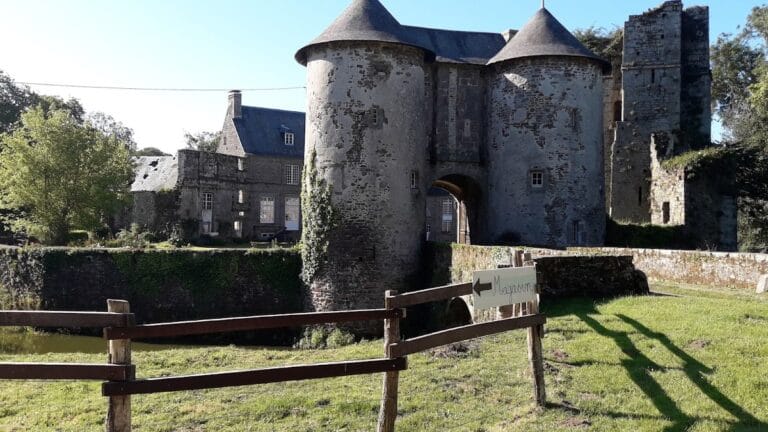
The castle followed a large triangular defensive plan preceded by a barbican. Its irregular curtain wall, the main enclosing wall between towers, was flanked by three circular towers and two horseshoe-shaped towers. The keep was attached to the curtain wall rather than standing separately. Historical references also mention a drawbridge and a cistern, a structure used to store water.
Northern defenses
The northern front faced the town and was regarded as the side most exposed to attack. Four round or semicircular towers defended this part of the enclosure. Their arrangement formed the principal concentration of flanking defenses along the threatened approach.
Southern rampart
The southern front looked toward the Bérence valley and was less heavily defended. A surviving section of its rampart rises more than 6 metres high, providing one of the clearest surviving portions of the enclosing defenses.
Keep and internal features
Round tower
A large round tower built at the beginning of the twelfth century under Henry I survives among the ruins. Its date places it within the early phase of the fortress’s major Norman strengthening and connects it with the period when Gavray served as a defensive center for the Cotentin.
Later keep
The fourteenth-century keep survives as a levelled square base. The structure belonged to the later development of the fortress, including the period when Charles the Bad strengthened Gavray as a Navarrese stronghold. The keep was subsequently lost during the dismantling that followed the French capture of 1378, while its base remains identifiable.
Bailey and grain storage
The location of the bailey, the enclosed area within a castle, can still be identified. Traces of a grain silo also survive. The silo helped the defenders maintain provisions during a siege and relates directly to the fortress’s military use. Together, these features clarify the organization of the interior beyond the curtain wall.
Architectural character
The combination of a keep attached to the curtain wall and irregular flanking towers has been compared with Château d’Arques. The arrangement has also been interpreted as a possible link between the Romanesque keeps of Gisors and Château-Gaillard, placing Gavray within the development of medieval fortified architecture in Normandy.