Château de Regnéville: A Medieval Fortress Protecting a Norman Harbour



Site at a Glance
- Rating
- 4.3
- Popularity
- Low
- Country
- France
- Primary era
- Medieval
- Eras represented
- Medieval, Early Modern
- Civilizations
- French, Kingdom of Navarre, Norman
- Site type
- Military
- Remains
- Castle
On this page13 sections
History
Château de Regnéville is a medieval fortress in France, at Regnéville-sur-Mer, founded in the twelfth century to protect the harbour at the mouth of the Sienne. Its occupation may reach back to the ninth century, during the Norman invasions, while predecessor buildings may have stood there in the eleventh century. The fortress is mentioned by 1141 among the possessions of the successors of William, Duke of Normandy, and its foundation is probably associated with Henry I Beauclerc, king of England and duke of Normandy.
A fortress of the Norman and English rulers
Regnéville guarded a dry harbour that became one of the most active ports in the Cotentin from the Middle Ages until the seventeenth century. Merchants using it could reach the regional fairs at Agon, Gavray, Coutances, and Montmartin. The castle watched the sea, controlled access to the Sienne, and helped defend the inland region. The dukes of Normandy and the kings of England kept the fortress and harbour in the royal domain because they contributed to the control of Lower Normandy.
King John, the English ruler from 1199 to 1216, used the site to protect English merchants landing at Regnéville and established the nearby fair of Agon for their benefit. After continental Normandy became part of France in 1204, Philip Augustus, the French king Philip II, retained Regnéville in the royal domain.
Navarrese ownership and the Hundred Years’ War
In 1327, Joan of France received Regnéville and several other Norman castles as part of her dowry when she married the Count of Évreux. The fief passed to the Navarrese dynasty in 1336. In 1349, Charles the Bad, the king of Navarre, inherited his father Philip III of Navarre’s Norman possessions. The castle was probably rebuilt during this period, perhaps using material from Montchaton Castle, which had been destroyed in 1360. Much of the surviving fabric belongs to the extensive rebuilding and remodelling carried out in the fourteenth and fifteenth centuries.
Charles the Bad’s supporters later allied with the English and used a number of Norman castles, including Regnéville, against Charles V, king of France from 1364. French forces led by the Duke of Burgundy and Bertrand du Guesclin, a prominent commander and constable of France, captured the fortress in early May 1378 after an expedition ordered in March. Charles VI returned the lands to Charles of Navarre after Charles V’s death in 1380, but in 1404 Charles III of Navarre ceded Normandy to the French king, bringing Regnéville back into the royal domain.
The English seized the castle again in March 1418 under the Duke of Gloucester. Its garrison numbered about fifty men, and the occupation generated local hostility, including attacks on English soldiers and hostile public statements. In 1425, part of an English fleet gathered at Regnéville for an operation against the fortified abbey of Mont-Saint-Michel. In 1435, Hue Spencer held both the captaincy of the castle and the office of bailiff of the Cotentin, a senior administrative and judicial position. He made Regnéville his residence until 1448.
Recapture and decline as a military stronghold
On 19 September 1449, after a six-day siege, the constable of Richemont, Arthur III, Duke of Brittany, and his army recaptured Regnéville for the French. About one hundred citizens of Coutances and peasants from Regnéville assisted the attack. The assault badly damaged the seaward side of the fortress. After the English defeat at Formigny in 1450 and their expulsion from Normandy, the castle was restored. The Hundred Years’ War, the prolonged struggle between the English and French crowns that shaped control of Normandy, ended three years later.
Medieval garrisons were usually small. In 1448 and 1449, the English force at Regnéville comprised six men-at-arms and fourteen archers, with their pay guaranteed by the current sovereign, whether French, Navarrese, or English. The arrangement depended on concentrated fortifications and continuous wall-walks along the curtain walls. Three small cannons, known as couleuvrines, were made for the castle at the beginning of the fifteenth century. Each fired a stone ball weighing four pounds. During the second half of the fifteenth century, Regnéville gradually lost its military role.
From royal domain to seigneurial residence
After the Hundred Years’ War, the castle remained in poor condition. Charles of Berry, the younger brother of Louis XI, held it temporarily, and Breton troops occupied it in 1469 during the War of the Public Weal, a revolt by powerful nobles against the authority of the French crown. In 1486, Charles VIII transferred the castle and its domain to his chamberlain Jean du Mas because he needed money.
A powerful storm later caused serious damage. Restoration began in 1582 under Roulland de Gourfaleur, who substantially altered the lower courtyard and had its moats dug again. Daniel de La Touche, Sieur de la Ravardière and a Huguenot, owned the castle from 1594 to 1603. Isaac de Piennes, lord of Bricqueville-sur-Mer and Bricqueville-la-Blouette, then bought the fief. From Regnéville, he took part in a Protestant conspiracy intended to raise Normandy as a diversion during the royal siege of La Rochelle in 1628.
Henri de Piennes, Isaac’s son, fought in the royal Catholic army during the siege and helped obtain his father’s pardon. The castle nevertheless suffered severe storm damage in 1630 and was dismantled in 1637 on the orders of Cardinal Richelieu, chief minister of Louis XIII. Gunpowder packed into the keep caused an explosion that split the tower through its full height along the spiral staircase. The dismantling ended the site’s military function. The castle was then used for residence and agriculture, and extensive remodelling continued during the seventeenth and eighteenth centuries. The lords of Piennes lived there until the eighteenth century.
Industrial and archaeological afterlives
In the mid-nineteenth century, Victor Bunel installed a mechanical marble sawmill in the former lower courtyard. In 1860, the Parisian actress Sarah Félix settled at the castle and established an oyster-farming business with a partner. Known as “Les Huitrières de Regnéville,” the enterprise sold its production in Paris.
The Département de la Manche acquired Château de Regnéville in 1989. The lower-courtyard remains and grounds entered the register of historic monuments that year, while the keep ruins and the upper-courtyard remains and grounds were classified in 1991. Excavations from 1991 to 1993 partly exposed the foundations of the upper courtyard. Restoration begun in 1994 has aimed to recover the appearance of the lower courtyard at the end of the sixteenth century, during Roulland de Gourfaleur’s period of rebuilding.
Remains
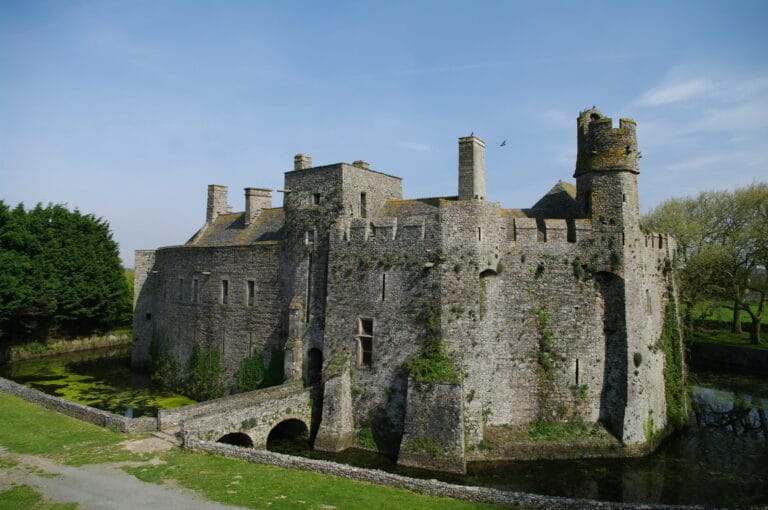
Château de Regnéville occupied a quadrilateral beside the road running along the sea, near the church and at the edge of the Sienne estuary. The eastern upper courtyard formed the principal fortified enclosure, while the western lower courtyard faced the harbour. Sections of the curtain walls survive, including masonry incorporated into houses built against the enclosure. The present ruin combines surviving medieval fabric, later domestic and agricultural alterations, archaeological foundations, and continuing conservation work.
Upper courtyard and keep
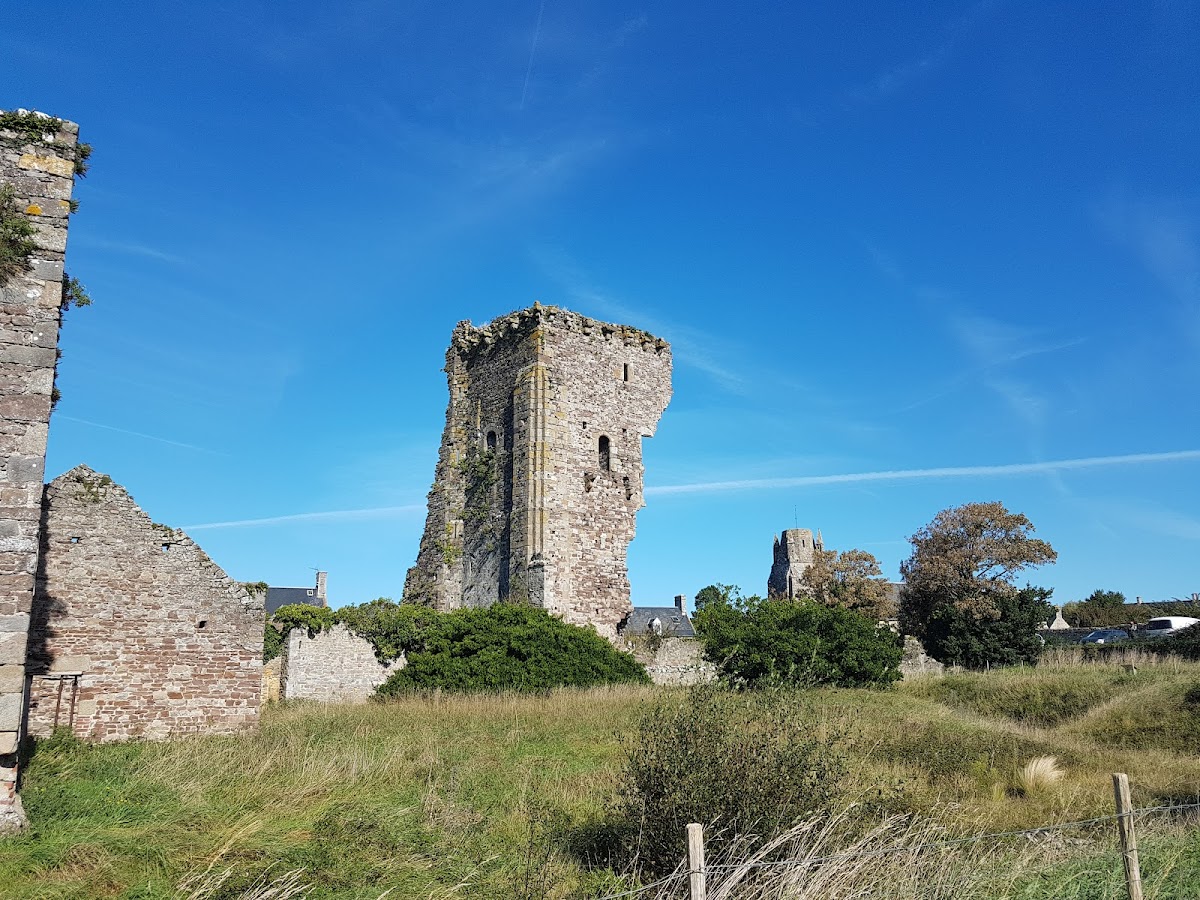
Excavations between 1991 and 1993 partly revealed the foundations of the eastern upper courtyard. Its rectangular main tower stood at the north-eastern corner of the enclosure, and two of its four sides remain. The keep was about twenty metres high, with walls more than three metres thick, four storeys, and three vaulted levels. Its square plan and corner buttresses have an archaic appearance for the fourteenth century and recall Romanesque keeps at Caen, Falaise, and Norwich.
Keep staircase and defensive fittings
A spiral staircase connected the storeys. Rebuilt in the sixteenth century, it remains visible within the ruined tower. A ground-floor cellar stored supplies, while machicolations, projecting openings used to attack enemies below the walls, once crowned the keep. Only one corner of these defensive features survives. In the sixteenth century, Roulland de Gourfaleur opened bays in the western and southern sides. They led onto a balcony supported by two large pairs of double granite corbels, of which two substantial supports remain visible.
Seventeenth-century destruction
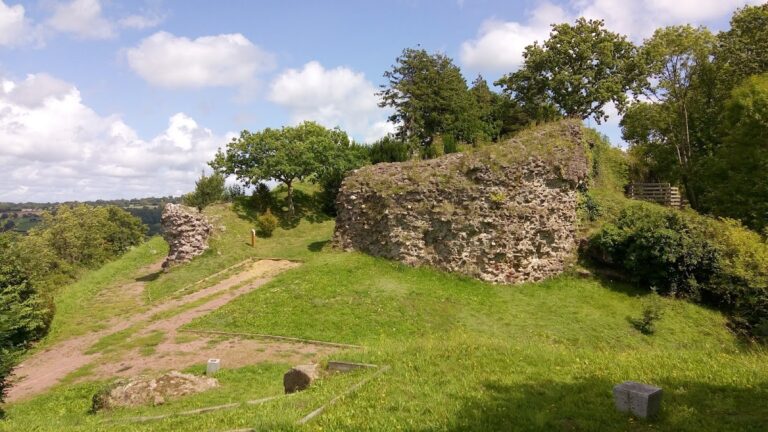
The 1637 explosion split the keep from top to bottom along the line of the spiral staircase. A large block of masonry was thrown onto the wall of the neighbouring cemetery. The fractured tower remains one of the clearest physical traces of the castle’s dismantling under Richelieu.
Lower courtyard and residential buildings
The western lower courtyard faced the harbour and originally contained the royal residence of Charles the Bad. Its buildings traditionally included stables and service areas, while fifteenth-century estimates also identify private residences belonging to Jehan Louvet and Thiphaigne. The Cour à Tot and the building called the Chapel House formed parts of the Louvet residence.
Rebuilt northern wing
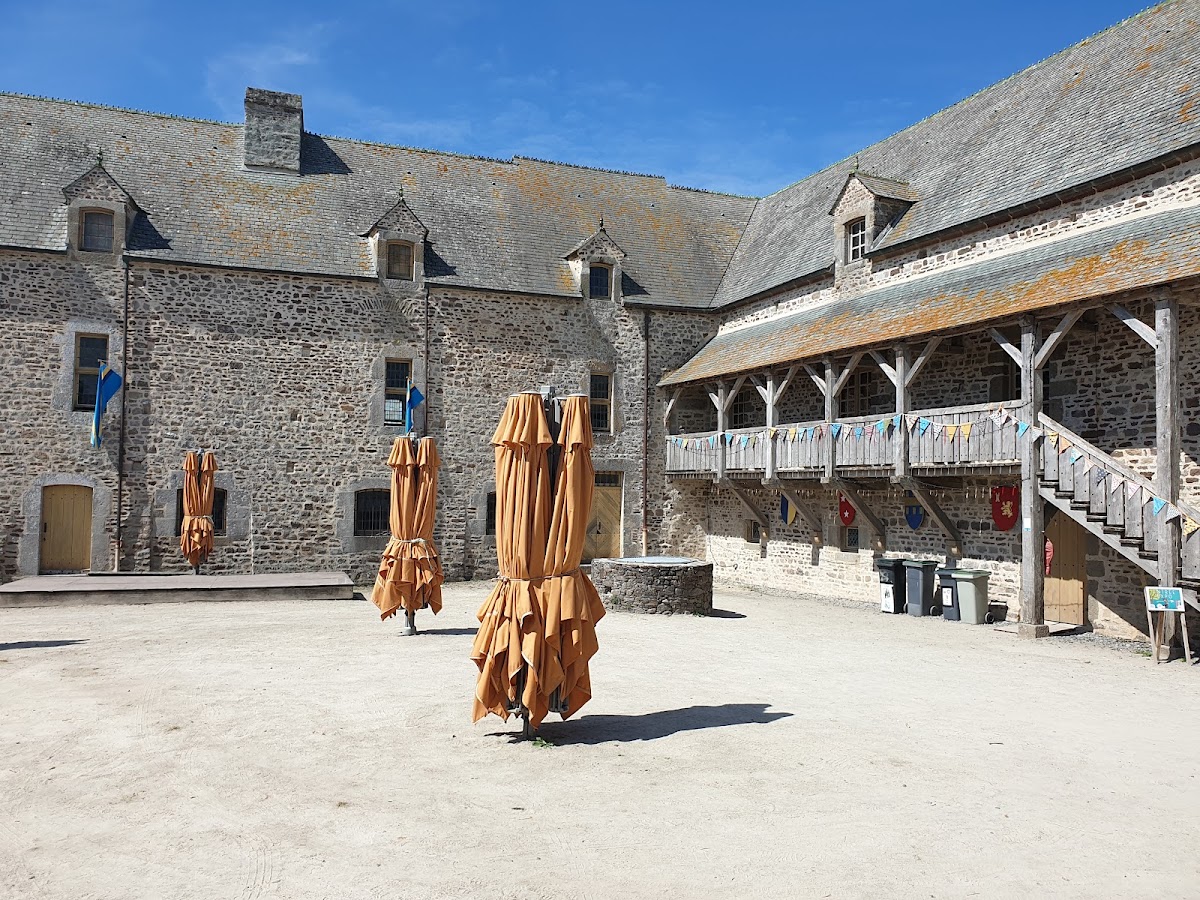
The lower courtyard suffered damage during the 1449 siege and a later fifteenth-century fire. Roulland de Gourfaleur began rebuilding it in 1582, and further major reconstruction followed the dismantling of 1637. The courtyard-facing front of the northern wing was rebuilt with two first-floor doors opening onto the interior. A large gallery behind the doors was reached by an external staircase.
Sea Gate and harbour entrance
The fourteenth-century Sea Gate served Regnéville’s former harbour. It was built above an earlier harbour installation consisting of a strand or road where vessels could be drawn up at low tide. The gate is attributed to Robert Porte, bishop of Avranches, chancellor to the king of Navarre, and lifelong guardian of Regnéville Castle.
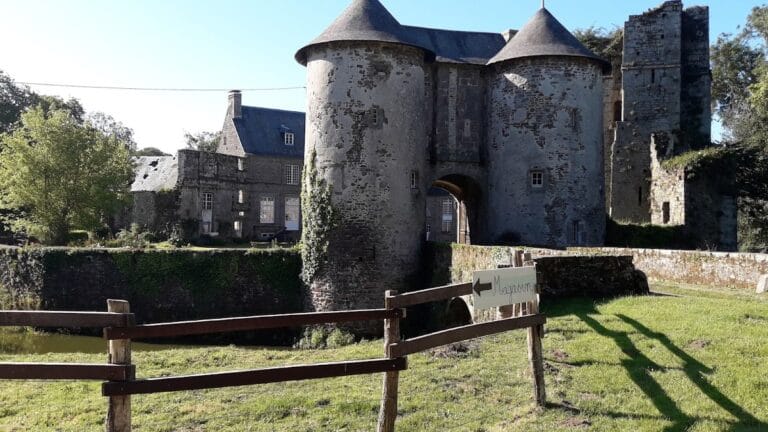
The entrance was altered several times and included a sequence of drawbridges and fixed bridges. A small stone gatehouse at ground level formed the first fortified entry, and part of one jamb survives. The earliest drawbridge may have separated pedestrian passage from the route used by riders and carts. Together with the surviving curtain walls, the Sea Gate preserves the connection between the fortress and the harbour it was built to protect.
Nearby sites