Madonna dello Splendore Sanctuary: A Catholic Shrine in Giulianova
Site at a Glance
- Country
- Italy
- Primary era
- Early Modern
- Eras represented
- Early Modern, Modern
- Civilizations
- Italian, Kingdom of Naples, Spanish
- Site type
- Religious
- Remains
- Sanctuary
On this page16 sections
History
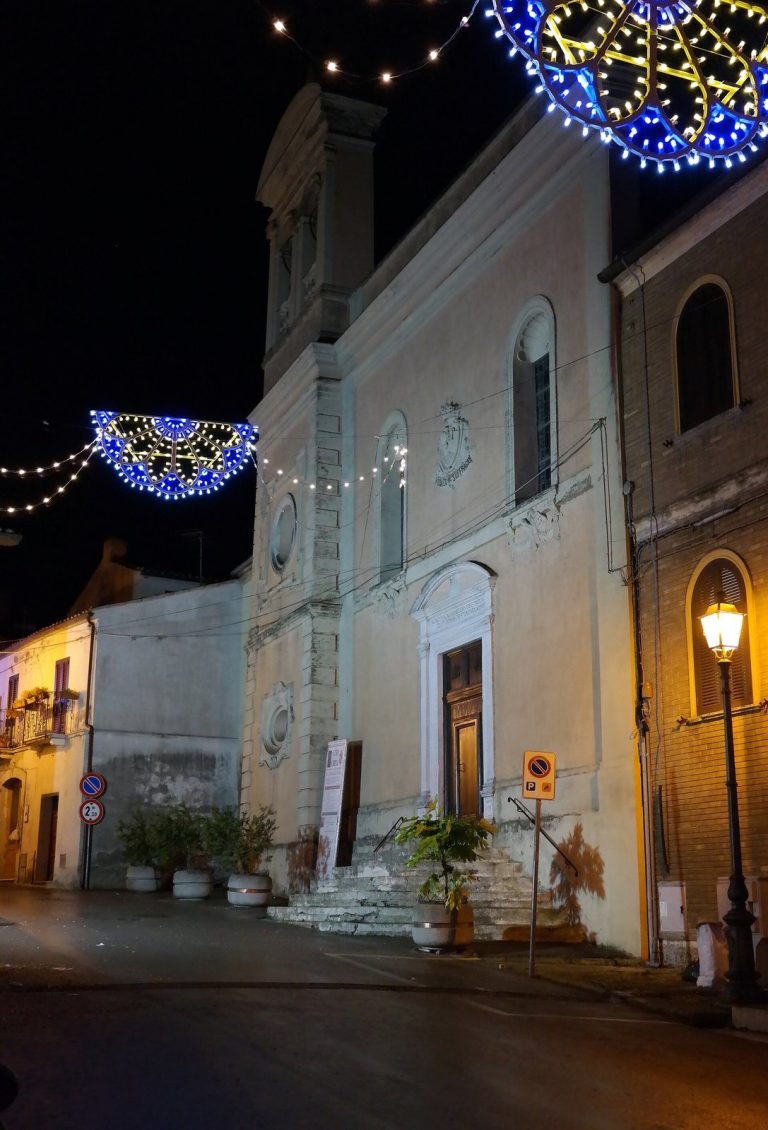
The Madonna dello Splendore Sanctuary is a Catholic pilgrimage shrine in Giulianova, Italy. Its construction is placed in the 1520s, and its church later acquired a neo-Romanesque façade, a modern revival of Romanesque architecture. The sanctuary lies in the Diocese of Teramo-Atri and is served by Capuchin friars, members of a branch of the Franciscan order. Its history is closely connected with a tradition of an apparition of Mary and the emergence of a spring.
Apparition tradition and early churches
The apparition is traditionally dated to 22 April 1557, but the date comes from a chronicle written in the 1670s by Pietro Capullo, a monk of the Celestine order. Capullo may have confused the apparition with the date of an old portico built to mark the end of the War of the Tronto, a regional conflict near the Tronto River. Since construction of the sanctuary is placed in the 1520s, the apparition may instead belong to the late 15th century, around the time nobleman Giulio Antonio I Acquaviva d’Aragona founded Giulianova.
Capullo’s story describes a farmer named Bertolino resting beneath an elm on a hill north of Giulianova. A dazzling light appeared, and Mary, known in Catholic devotion as the Madonna, and the infant Jesus appeared seated in the tree. She told Bertolino that she had chosen Giulianova as a place of veneration and instructed him to ask its rulers to build a church on the hill. After the Acquaviva court first rejected his request, a second apparition assured him he would be believed. When a courtier struck Bertolino, the Virgin, according to the chronicle, paralyzed the man’s hand and took away his speech. The governor, court, clergy, and townspeople then went with Bertolino to the hill. There, the Virgin appeared again and a spring emerged at the foot of the elm.
During the second half of the 16th century, a confraternity, a devotional religious association, used a small chapel in Giulianova dedicated to the Virgin of the Rosary. In 1559, the Acquaviva family donated land outside the town walls to the Capuchins, who built a church dedicated to St Michael the Archangel.
Religious life and changing uses
In March 1807, Celestine monks left their old abbey after religious institutions were suppressed under Napoleon. In September 1847, Ferdinand II, king of the Two Sicilies from 1830 to 1859, authorized the Capuchins to live there. The Holy See confirmed the arrangement through Berrettini, bishop of Teramo.
Piedmontese laws suppressed the Capuchin community in 1866, but the sanctuary was not entirely abandoned. A confraternity devoted to the Madonna dello Splendore, founded in 1826, helped sustain its religious life. By this period the old monastery had become a civil hospital. When Capuchins later returned, they were given rooms within it.
Twentieth-century changes
In 1927, land beside the sanctuary was purchased for a new convent. Its foundation stone was laid on 28 August. From 1938 to 1965, the convent housed students attending a classical secondary school, which emphasized classical languages and humanities. A small seraphic seminary, an institution for forming candidates for the Franciscan orders, operated there from 1968 to 1971.
The church had previously received Baroque decoration at the direction of the Acquaviva dukes. Between 1937 and the mid-1950s, it underwent extensive changes, and its 17th-century decoration was stripped away. Improvement work began in 1986 and included the façade. From 1989 to 1992, the surrounding grounds were renovated and a devotional shrine was rebuilt around the spring. Work during the 1990s and 2000s adapted convent spaces for the Splendor Art Museum and the convent library, while retaining rooms for the Capuchin community.
Remains
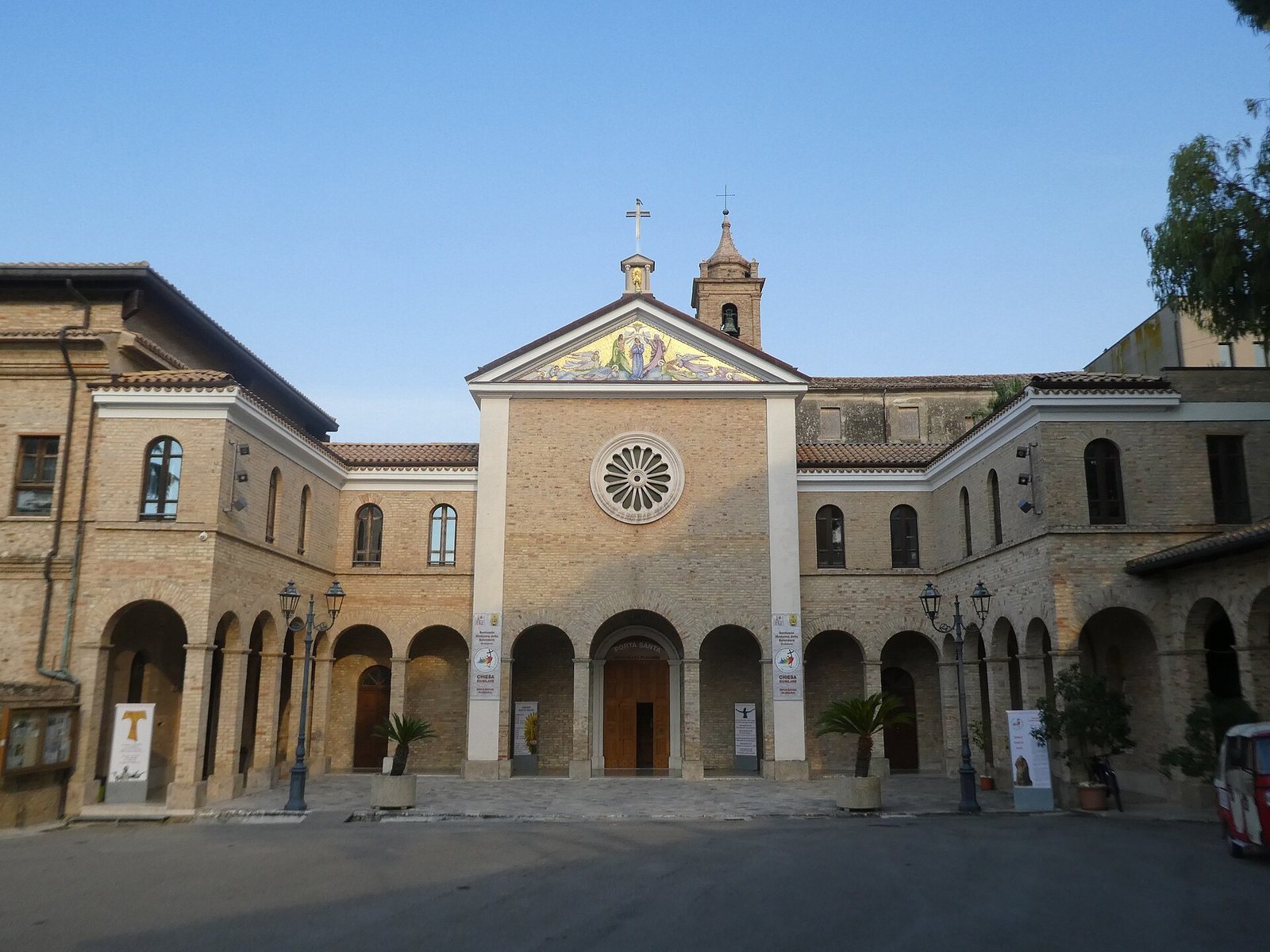
The complex brings together the church and adjoining convent with gardens, the spring and fountain, the Splendor Art Museum, and the convent library. The church has a Latin-cross plan, shaped like a cross with a longer central arm, and a neo-Romanesque façade. The former Capuchin church dedicated to St Michael stood on the site now occupied by Casa Maria Immacolata.
The church
Façade and murals
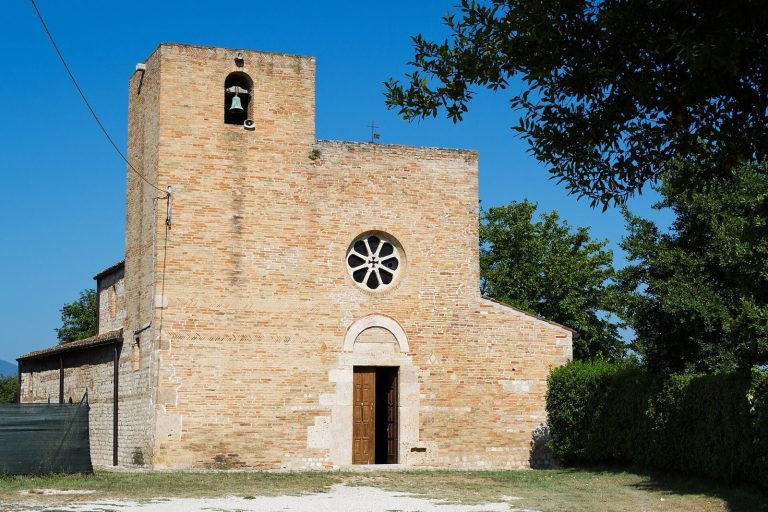
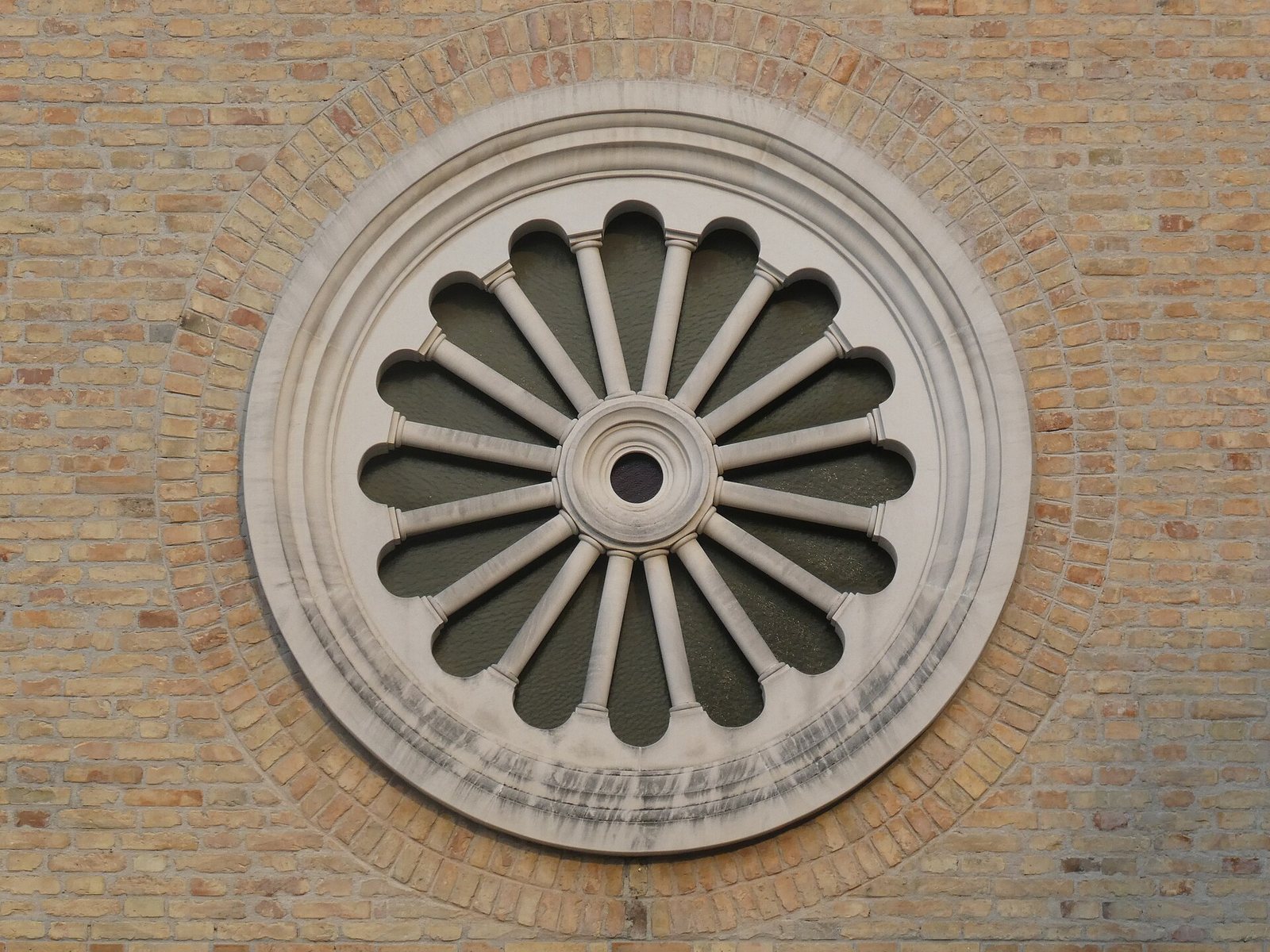
The church’s gabled façade has a central rose window, a circular window with radiating divisions, above an entrance portico formed by round arches. Large murals cover the interior. Alfonso Tentarelli painted them in 1954 to a design by Father Giovanni Lerario.
Main altar and statue
At the main altar stands a wooden statue, painted in several colors, of the Madonna and the blessing Child. Its maker is unknown, and it probably dates to the first half of the 15th century. The statue may have come from the medieval city of Castel San Flaviano. On 15 August 1914, a gold-plated silver crown chased by the Migliori family was placed on the Madonna’s head. Around 1950, the statue was set within rays representing divine light and positioned above a tree trunk recalling the elm in the apparition tradition.
Paintings
Four oil paintings by Giacomo Farelli, once placed on the church’s side altars and now kept in the choir, depict the Immaculate Conception, the Annunciation, the Nativity of Jesus, and the Assumption of Mary. The sacristy holds a painting of the Virgin and Child in Glory with Saints Peter, Paul, Dorothea, and Francis. Although it was once attributed to the 16th-century Venetian painter Paolo Veronese, it is now identified as a 17th-century copy. The work belonged to the ducal gallery and was donated by Duchess Giulia Colonna.
Wooden tabernacle
A wooden tabernacle, a cabinet for the consecrated host, is decorated with ebony inlays. Made between 1720 and 1723, it is attributed to the Capuchin craftsmen Fra Serafino da Nembro, Fra Michele della Petrella Tifernina, and Fra Stefano da Chieti. It came from the suppressed Convent of San Michele, on the site now occupied by Casa Maria Immacolata.
Organ
In 2001, the church’s old organ was replaced by a larger instrument made by A. Girotta.
Convent and grounds
Convent spaces
The adjoining convent retains rooms for the Capuchin community. Its upper floors house the Splendor Art Museum, and its former woodshed has been converted into the convent library.
Spring and shrine
Water from the spring is channelled into basins in the convent gardens. A small shrine built around the spring is decorated with mosaics and low-relief marble carvings showing scenes from the Old and New Testaments. It stands within a green area of the grounds.
Garden sculptures
A small garden lookout holds bronze statues of St Michael crushing the serpent of Satan and St Francis of Assisi with his arms raised in praise of God.
Reception square and Stations of the Cross
A large bronze statue of Christ dominates the enlarged reception square. Its inscription, “EGO SUM VIA VERITAS ET VITA,” means “I am the way, the truth and the life.” Bronze sculptures by Ubaldo Ferretti, a pupil of Pericle Fazzini, form the Stations of the Cross along Via Bertolino. This devotional sequence recalls episodes from Jesus’ final journey to his crucifixion; the 7th, 13th, and 14th stations are near the sanctuary.