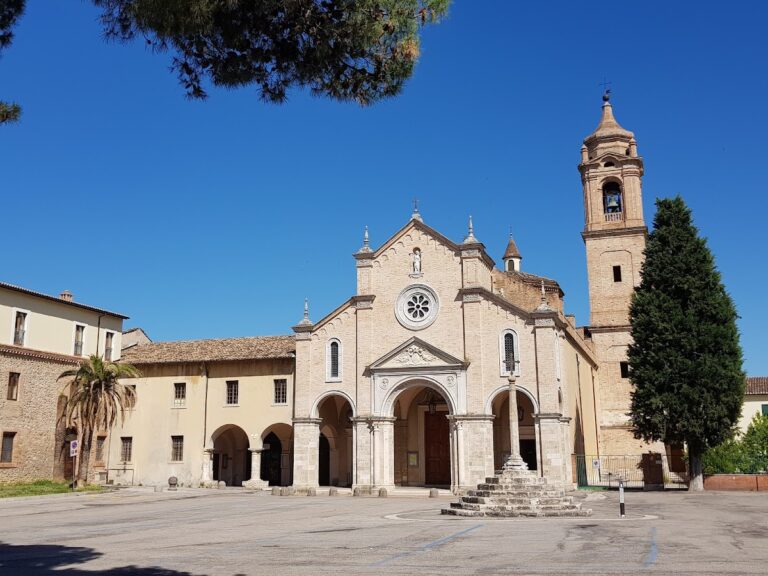
Chiesa del Santo Spirito: A Baroque Sanctuary of Saint Rita in Atri


Site at a Glance
- Rating
- 4.6
- Popularity
- Very Low
- Country
- Italy
- Primary era
- Early Modern
- Eras represented
- Medieval, Early Modern, Modern
- Civilizations
- Kingdom of Naples
- Site type
- Religious
- Remains
- Sanctuary
On this page19 sections
History
Chiesa del Santo Spirito is a Catholic church in Atri, Italy, built by the Augustinians from the late thirteenth century and transformed into its present Baroque form between the eighteenth and early nineteenth centuries. Standing at the edge of the historic center near Rocca di Capo d’Atri, it developed from an Augustinian foundation into the Sanctuary of Saint Rita, one of the principal centers of devotion to the saint after Cascia, traditionally identified as her birthplace.
Augustinian Foundation
Construction began in the late thirteenth century under the Augustinians, a Catholic religious order following the rule associated with Saint Augustine of Hippo. They administered the church until the sixteenth century. The Franciscans then took over for a short period, followed by the Discalced Augustinians, a reformed branch of the order distinguished by stricter observance, who officiated there from 1698.
The church’s early history unfolded beside Rocca di Capo d’Atri. The nearby castle had been built for the Acquaviva family and was partly destroyed during a popular uprising in 1413. The church itself was repeatedly altered as different religious communities shaped its use and appearance.
Baroque Transformation
The Discalced Augustinians introduced changes during the eighteenth century. The church and adjoining convent later passed to Augustinian nuns, who brought with them the cult of Saint Rita of Cascia, an Augustinian nun venerated especially as an intercessor in difficult or seemingly impossible circumstances.
From the second half of the eighteenth century to the beginning of the nineteenth, the nuns radically transformed the building. The present church was completed in the early nineteenth century, and its surviving character reflects those Baroque renovations and reconstructions. The former medieval foundation therefore remains embedded in a later religious and architectural setting.
Abandonment and Devotion to Saint Rita
The church and convent were abandoned at the beginning of the nineteenth century. Local people maintained the church because of their strong devotion to Saint Rita, helping it survive the depredations of the Napoleonic period. The former convent was permanently converted into a home for the elderly dedicated to Saint Liberator, more precisely to Christ the Most Holy Liberator.
Since the nineteenth century, popular tradition in Atri has attributed alleged miracles to Saint Rita. Her feast is held on 22 May, when her statue is carried in procession through the city. The annual procession expresses the continuing strength of the devotion that turned the former Augustinian church into a sanctuary associated with the saint.
Ecclesiastical Privilege and Conservation
In 1901, Giuseppe Maria Morticelli, bishop of Penne and Atri, obtained a special papal privilege for the chapel of Saint Rita. On 16 May that year, Pope Leo XIII granted the chapel a plenary indulgence, meaning the Catholic remission of the temporal punishment associated with sin under prescribed conditions. Pope John Paul II later renewed the privilege in perpetuity.
Chiesa del Santo Spirito belongs to the Diocese of Teramo-Atri and remains dedicated to the Holy Spirit. Its recent conservation has included the restoration of the presbytery and the vault stuccoes with gold leaf, preserving important elements of its eighteenth-century decorative program.
Remains
The surviving church presents a Baroque exterior and a single-nave Baroque interior. Its facade, bell tower, Renaissance portal, altars, chapels, paintings, statues, stucco decoration, and devotional objects form a layered arrangement shaped by changes from the sixteenth century through the twentieth century.
Exterior and Entrance
Facade and Bell Tower
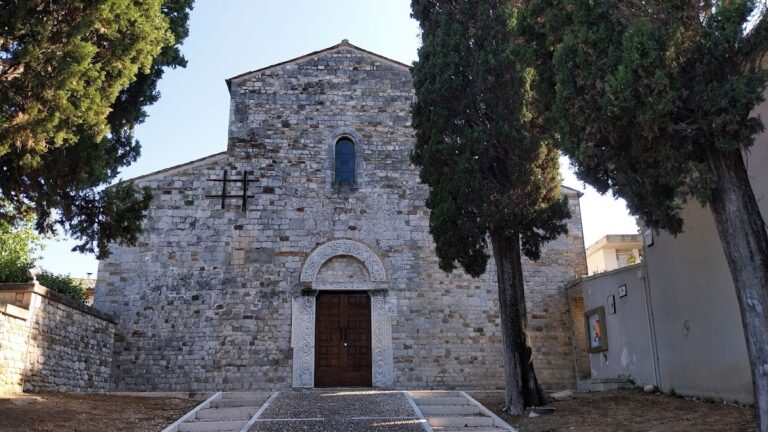
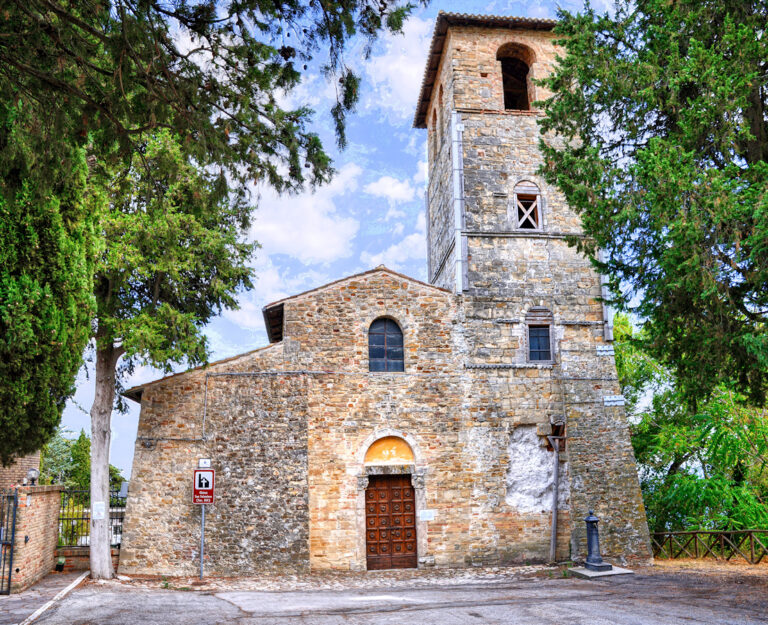
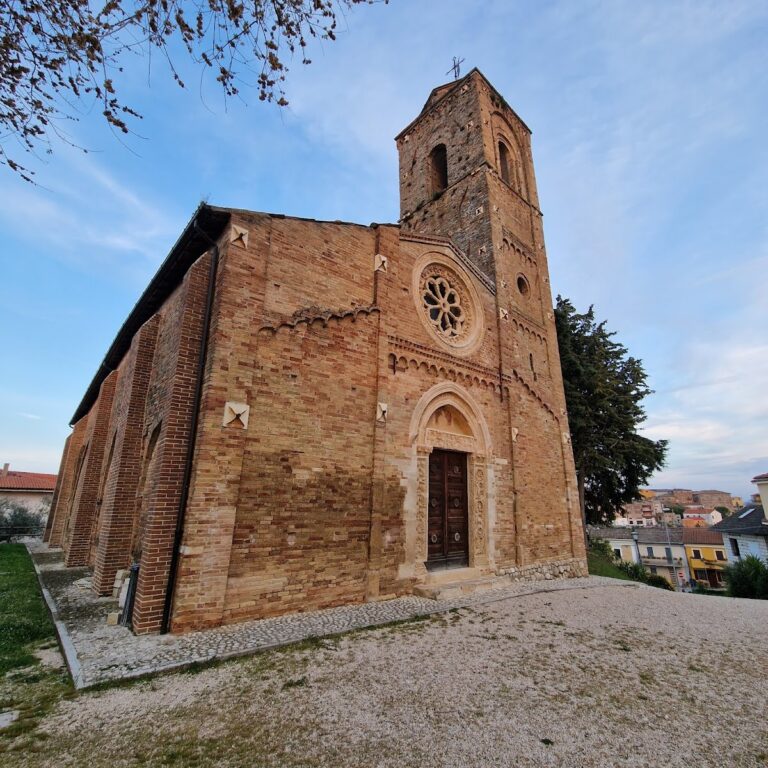
The facade was modified repeatedly until the beginning of the nineteenth century. It bears an emblem of death and the inscription Suffragio, possibly referring to a confraternity, or voluntary religious association, devoted to the Suffrage. Beside the church rises a compact, sail-shaped bell tower. This wall-like bell structure is not built of brick, unlike several other bell towers in Atri, and contains bells dating from the eighteenth and nineteenth centuries.
Renaissance Portal
The entrance portal carries the date 1586 and is executed in pure Renaissance style. It originally belonged to the Church of Sant’Antonio dei Cappuccini. That church was already deteriorating before the Austrian depredations of 1707 and the later depredations of the Napoleonic period, after which the portal was incorporated into Chiesa del Santo Spirito.
Paintings and Altars in the Nave
Nativity Fresco and Altar of the Judgment
On the right-hand wall is a fresco of the Nativity dated 1550–1560. It includes Augustinians, Capuchins, and Observant Minors, distinct branches of the Franciscan religious family. Elements connect the work with artists active locally, although an attribution to the Florentine school is considered more secure.
The Altar of the Judgment dates from the sixteenth or seventeenth century. Its Baroque marble construction was produced by local craftsmen influenced by Venetian culture. The altar takes its name from a distinctive late-sixteenth-century painting generally identified as a Last Judgment, which includes a dead figure covered with insects.
Altars of Saint Anne and Saint Francis of Paola
The Altar of Saint Anne dates from the late eighteenth century and ends in a painted false pediment, a decorative form that imitates a pediment without serving as the actual termination of the roof. A nineteenth-century statue shows Saint Anne holding the hand of the child Mary. Both figures wear robes richly embroidered with gold and silver.
The Baroque Altar of Saint Francis of Paola was made in 1770. It contains an eighteenth-century painting of the Madonna Adoring the Child with Saint Francis of Paola, attributed to the Neapolitan school.
Altars of Our Lady of Sorrows and the Suffrage
The late-eighteenth-century Altar of Our Lady of Sorrows follows a late Baroque design and may have been modified during the nineteenth century. Its star-shaped niche contains a locally produced nineteenth-century statue of Our Lady of Sorrows, made partly from papier-mâché. A nineteenth-century statue of the Dead Christ rests in the altar case.
Two further nineteenth-century papier-mâché statues occupy separate niches, Saint Joseph and Our Lady of the Suffrage. The statue of Saint Joseph is dressed, and both works are attributed to the Avolio school.
Presbytery and Sacred Images
Stucco and Pentecost
The presbytery, the area around the high altar reserved for the clergy, and the vault contain highly realistic stucco decoration from the second half of the eighteenth century. The work has sometimes been attributed to the Neapolitan school and has recently been restored with gold leaf. A cross is associated with the high altar.
Above the high altar hangs Pentecost, a painting from the first half of the seventeenth century attributed to Andrea dell’Asta, an Italian painter active in the late seventeenth and early eighteenth centuries. It depicts the Holy Spirit descending upon Mary and the Apostles. The figures emerge from darkness illuminated by torchlight and by the dove representing the Holy Spirit.
Paintings by Andrea dell’Asta and Giuseppe Prepositi
A late-seventeenth-century Madonna and Child shows the seated Madonna supporting the infant Jesus amid numerous clouds. It is signed by Andrea dell’Asta. Another Madonna and Child with Saints, dated around 1770, reflects the influence of Francesco Solimena, a prominent Neapolitan Baroque painter. The work has been attributed to Giuseppe Prepositi of Atri, who was a pupil of Solimena.
Chapel and Sacristy
Chapel of Saint Rita
The Chapel of Saint Rita of Cascia was built between the eighteenth and nineteenth centuries and decorated with stucco. It contains a valuable statue of Saint Rita from the first half of the twentieth century, dressed in elaborate clothing and placed on a ceremonial canopy. Each 22 May, the statue is carried in procession through Atri.
Modern paintings also hang in the chapel. Newly married women have offered wedding dresses there as ex votos, objects given in fulfillment of a vow or in thanksgiving for perceived divine assistance. These offerings connect the chapel’s physical furnishings with the continuing local practice of seeking Saint Rita’s intercession.
Sacristy Collections
The sacristy, the room used to store sacred vessels, vestments, and other items required for worship, contains a twentieth-century statue of the Risen Christ. Display cases hold nineteenth- and twentieth-century silver ex votos, hair, and everyday objects once kept in the Saint Rita chapel and donated by people from Atri in thanksgiving to the saint.
Two paintings dated 1770, depicting Saint Rita and Saint Augustine, were formerly kept in the sacristy and are now preserved in the Capitular Museum of Atri.