Madonna dell’Orto: A Venetian Gothic Church in Cannaregio


Site at a Glance
- Rating
- 4.6
- Popularity
- Very Low
- Country
- Italy
- Primary era
- Medieval
- Eras represented
- Medieval, Early Modern, Modern
- Civilizations
- Italian, Venetian
- Site type
- Religious
- Remains
- Church
On this page17 sections
History
Madonna dell’Orto is a Roman Catholic church in Venice, Italy, built in the mid-fourteenth century by the Humiliati, a medieval Catholic order devoted to communal religious life, penitence, and charity. It stands in Cannaregio beside the Rio de la Madona de l’Orto and opposite the Rio Brazzo. Formally dedicated to Saint Christopher and the Virgin Mary, it was first known as the church of Saint Christopher and became a major Venetian Gothic complex through successive rebuilding and restoration.
Foundation and the Madonna dell’Orto name
The Humiliati built the church under their superior general, Tiberio da Parma, who was buried inside it. Its dedication to Saint Christopher, the patron of travellers and boatmen, was probably connected with the church’s position near the lagoon and the northern islands. The name Madonna dell’Orto arose from a tender-stone statue of the Virgin and Child made by Giovanni De Santi. Commissioned for Santa Maria Formosa but rejected while unfinished, the statue was placed in the sculptor’s garden.
A tradition tells that the statue emitted unusual lights at night. Miracles attributed to it attracted pilgrims, and the image was moved to the church on 18 June 1377. The friars of San Cristoforo accepted the sculptor’s requests to be buried before the statue and to have a perpetual memorial Mass celebrated there. The Scuola of San Cristoforo, a Venetian religious and charitable confraternity, purchased the statue for 150 ducats.
The first building stood on weak foundations, so major rebuilding began in 1399. On 11 November that year, the Great Council, the principal legislative body of the Venetian Republic, assigned 200 gold ducats to the work. The Council of Ten officially authorized the popular name Madonna dell’Orto in 1414.
Religious communities and changing use
In 1462 the Humiliati were expelled by decree of the Council of Ten, with papal approval, because of what the decree called their “depraved customs.” The church was then given to the Canons Regular of San Giorgio in Alga, a Venetian congregation of clerics living under a religious rule. Their congregation was suppressed in 1668. The following year, the convent passed to Cistercian monks from San Tommaso dei Borgognoni, members of a Catholic monastic order shaped by disciplined communal observance.
The Cistercians ended their activity at the church in 1787. Madonna dell’Orto then came under public administration with a rector and several priests. In 1810 it was designated the oratory of San Marziale. During Austrian rule, a general restoration began in 1841. The facade was restored in 1845, work on the rest of the building began in 1855 but remained unfinished, and restoration resumed in 1864 and ended in 1869. During this period the church was transferred to the military and used as a storehouse for straw and wine.
A patriarchal decree made Madonna dell’Orto a parish church on 12 July 1875, replacing San Marziale, which became a rectory. From 1931 until 2024, the parish was entrusted to the Josephite Fathers of the Congregation of Saint Joseph, founded by Saint Leonardo Murialdo.
Tintoretto and later conservation
Jacopo Robusti, known as Tintoretto, lived and worked nearby and belonged to the parish. A contract dated 14 May 1565 records the commission for his paintings in the church. He was buried in the right apsidal chapel with two of his children, linking the building closely with one of sixteenth-century Venice’s leading painters.
The church and its interior were restored in several campaigns, including work carried out in 1837–1848, 1869, 1892–1893, and 1930–1937. The flood of November 1966 seriously damaged the building and its paintings. Later conservation through the Save Venice programme restored the structure and affected artworks. The work included reroofing the side aisles, replacing deteriorated brickwork, cleaning and repairing sculptures, and restoring the nineteenth-century organ.
Remains
Church complex and setting
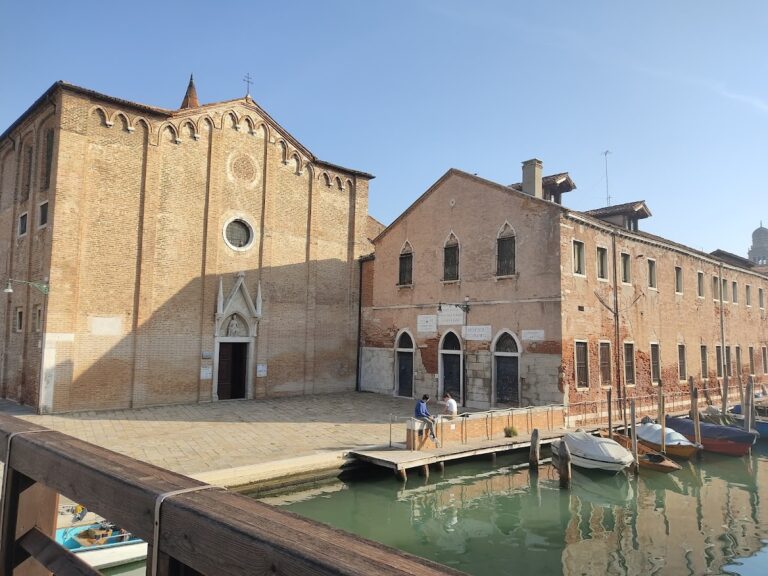
Madonna dell’Orto survives as a Venetian Gothic complex comprising the church, its facade, and the principal surviving portion of the former convent, the cloister. The square in front retains one of Venice’s traditional herringbone pavements, formed from terracotta bricks. Inside, the church follows a rectangular basilical plan with a nave and two aisles, no transept, pointed double-moulded arches, and massive Greek-marble columns, some of them monolithic. The eastern end terminates in a polygonal, usually described as pentagonal, apse.
The interior walls have a regalzier finish, a surface treatment that imitates brick masonry. The present wooden coffered ceiling was installed during the 1931 restoration and was inspired by the nearby cloister. The cloister, which includes a well, is the principal surviving element of the convent.
Facade and portal
The brick facade was built in 1460–1464 as a tripartite composition divided by two strongly projecting pilaster strips. Its three sections correspond to the church’s nave and aisles. Large Gothic traceried windows occupy the side sections, while the central section has two vertically aligned circular openings, including a large rose window. White stone and pink marble appear around the windows, rose windows, and portal.
Courses of niches containing statues of the Apostles give the facade a distinctive sculptural arrangement considered innovative and effectively unique in Venice. Several Tuscan sculptors active at Saint Mark’s are associated with the statues, while the four figures on the left slope have been linked with Nanni di Bartolo. Five high Gothic tabernacle niches on the upper facade were filled in the nineteenth century with eighteenth-century statues of Prudence, Charity, Faith, Hope, and Temperance transferred from the demolished church of Santo Stefano in Murano.
Bartolomeo Bon designed the portal for the Scuola of San Cristoforo in 1460, and it was completed after his death in 1483. Two of its columns were added in 1481. Corinthian-like columns and elaborate mouldings frame twisted-rope and herringbone ornament, repeated symbols of Saint Christopher, a pink-and-white toothed frame, vegetal carving, successive rounded and pointed arches, and a porphyry lunette.
The sculptural group above the portal represents Saint Christopher, the Virgin Annunciate, and the Archangel Gabriel. Saint Christopher and the Virgin are attributed to Niccolò di Giovanni Fiorentino, while the Archangel Gabriel is attributed to Antonio Rizzo. Higher up, a circular relief of the Virgin and Child supported by angels is probably by Giovanni Bon or his workshop. Symbols of Saint Christopher recur across the facade, including the Greek initial chi and palm leaves or a palm branch.
Bell tower and bells
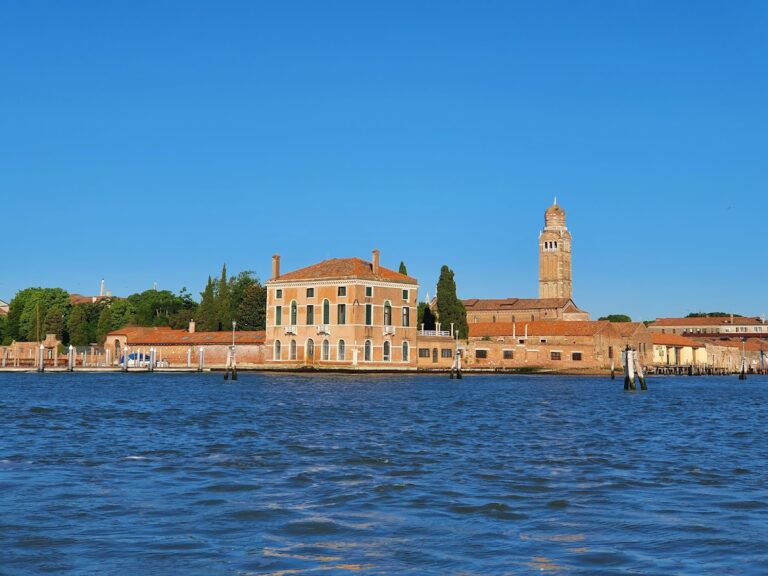
The brick bell tower stands on the left side of the church and rises approximately 56 metres. It has a square plan, with pilaster strips leading to a bell chamber pierced by open, round-headed windows. Four curved pediments separate the chamber from a cylindrical upper drum and an onion dome with an eastern-inspired form. Four statues of the Evangelists from the school of Pietro Lombardo stand at the sides, while a white-marble statue of the Redeemer crowns the dome.
The tower was completed in 1503, a date preserved by an inscription and by a lead container containing relics and an inscription from that year. Jacopo de’ Barbari’s perspective plan of Venice from 1500 shows the tower only as far as the bell chamber, indicating that the upper section was still unfinished at that time. A storm-damaged dome was restored in 1818.
The earlier bells included a largest bell dated 1424. They were replaced in 1883 by three bells cast by Luigi Cavadini and Son of Verona, and a small bell was added in 1931. They use the Venetian “slancio” system, in which bells are swung through a broad arc. The large bell has been cracked for decades, while the small bell strikes only on one side because of its light stocks.
Chapels and funerary monuments
Valier Chapel
The left side of the church contains four funerary chapels belonging to important Venetian patrician families: the Renaissance Valier Chapel, the Gothic Vendramin and Morosini chapels, and the Contarini Chapel. The Valier Chapel formerly housed Giovanni Bellini’s small Madonna and Child, painted about 1480 and measuring 50 by 75 centimetres. It was stolen on the night of 1 March 1993 and has not been recovered.
Vendramin Chapel
The Vendramin Chapel formerly contained Titian’s Archangel Raphael and Tobias, dated 1530 and later transferred to the sacristy of San Marziale. The chapel also contains Jacopo Palma the Elder’s Saint Vincent among Saints Dominic, Lorenzo Giustiniani, Helena, and Pope Eugene IV. Saints Helena and Dominic were inserted during Placido Fabris’s restoration of 1867. Bartolomeo Litterini’s Christ Received by the Father is also associated with the chapel.
Morosini Chapel
The Morosini Chapel contains The Nativity and Saint Dominic and incense-bearing angels by Domenico Tintoretto. It also holds Jacopo Palma the Younger’s Crucifixion, transferred from the demolished church of Santa Ternita.
Contarini Chapel
Dedicated to Saint Agnes, the Contarini Chapel contains Tintoretto’s Miracle of Saint Agnes of 1575, along with funerary monuments and busts of members of the Contarini family. The busts include Gasparo Contarini by Danese Cattaneo and his nephews Tommaso and Gasparo Contarini by Alessandro Vittoria. Set on bases with engraved epitaphs, they occupy small structures framed by Corinthian columns and topped with pediments.
Altars and paintings
San Mauro Chapel
The San Mauro Chapel contains the fourteenth-century statue of the Virgin and Child by Giovanni De Santi that gave the church its popular name. It also holds Antonio Molinari’s Madonna and Child with Saint Maurus, a copy of Gerolamo Savoldo’s Lamentation over the Dead Christ, and numerous funerary slabs formerly set into the church floor. Twenty-eight portraits of Venetian saints and blesseds by various artists, painted around 1622, are associated with the chapel, as is Ernani Costantini’s 1983 painting of Saint Leonardo Murialdo.
Side altars and other works
The right side contains the lateral altars, the Saint Christopher altarpiece, the 1593 Altar of the Immaculate Conception, and Gerolamo Cavazza’s funerary monument, commissioned in 1657. Giuseppe Sardi designed the monument’s architecture, while its sculptures were made by several artists, including Giusto Le Court and Francesco Cavrioli.
Other works include a sculpture of the Madonna and Child attributed to Antonio Rizzo; Cima da Conegliano’s late-fifteenth-century Saint John the Baptist with Saints Peter, Mark, Jerome, and Paul; and a copy of Cima’s Saint Christopher Martyr. The original wooden Saint John the Baptist altarpiece, measuring 305 by 205 centimetres, is now in Venice’s Gallerie dell’Accademia. The church also contains Daniel van den Dyck’s Martyrdom of Saint Lawrence, Matteo Ponzone’s Saint George Killing the Dragon and Flagellation of Christ, and Domenico Tintoretto’s God the Father in Glory.
Further works include Domenico Tintoretto’s The Nativity and Saint Dominic, a sixteenth-century Mystic Marriage of Saint Catherine of Alexandria from the school of Titian, and Girolamo da Santacroce’s Saints Augustine and Jerome. An altarpiece copy of Saint Lorenzo Giustiniani and Saints is based on the original by Giovanni Antonio de’ Sacchis, known as Pordenone.
Apse and organ
The polygonal apse is decorated with large paintings by Tintoretto. The Last Judgment and The Adoration of the Golden Calf, both dated 1563, each measure approximately 580 by 1,450 centimetres. The apse also contains The Vision of the Cross to Saint Peter and The Beheading of Saint Paul, both dated 1550–1553 and measuring approximately 240 by 420 and 240 by 430 centimetres respectively.
The upper apse contains Tintoretto’s allegories of Justice, Temperance, Prudence, and Fortitude, each approximately 240 by 450 centimetres, together with Pietro Ricchi’s later Faith. The central altar has Jacopo Palma the Younger’s Annunciation, dated 1590 and associated with Santa Maria Nuova in Vicenza. Tintoretto’s Presentation of the Virgin in the Temple, dated 1552–1553, is in the right aisle near the San Mauro Chapel.
Above the entrance is the organ built in 1878 by Pietro Bazzani and his nephews, opus 302. It has mechanical action, 38 stops, two manuals, and a pedalboard. Its present neo-Gothic case was made during the 1995 restoration by Pasquale Ferrari of Venice, replacing a case demolished in 1937. Part of the instrument had originally been intended for the Gran Teatro La Fenice. An earlier organ, later damaged during Martino Datis’s restoration, had been considered by Giovanni Battista Morsolino “the best organ in Europe.”
Nearby sites