Fortini della Fame: A Nineteenth-Century Defensive Line in Switzerland


Site at a Glance
- Rating
- 4.4
- Popularity
- Very Low
- Country
- Switzerland
- Primary era
- Modern
- External website
- Open
- Eras represented
- Modern
- Civilizations
- Swiss
- Site type
- Military
- Remains
- Fort
On this page8 sections
History
Fortini della Fame are a nineteenth-century military defense system in Switzerland, extending across the Magadino Plain from Camorino to Sementina and Monte Carasso, now localities within Bellinzona. Built in 1853 and 1854 as part of the Dufour Line, the works responded to the political tensions of the Risorgimento, the movement for Italian unification, and the perceived danger of an Austrian attack from Lombardy.
Political Crisis and Hunger
The need to strengthen Ticino’s defenses was raised in 1844, when the canton’s representative in Bern requested fortifications for the area and the Alpine passes. The danger seemed urgent by 1848, as revolutionary movements and Austrian rule in the neighboring Lombardo-Venetian Kingdom brought Switzerland closer to the conflict surrounding Italian unification.
Ticino had sheltered about 20,000 political refugees and revolutionaries from Lombardy despite widespread poverty. After Giuseppe Mazzini’s failed uprising in Milan on 6 February 1853, Austria imposed a trade blockade on Switzerland, closed the borders, and expelled more than 6,000 Ticinese migrant workers from the Lombardo-Venetian Kingdom. A potato disease spreading through Ticino since 1845 had already caused food shortages and contributed to widespread hunger.
Construction of the Dufour Line
In 1853, the Swiss federal state ordered construction south of Bellinzona within a defense system designed by General Guillaume-Henri Dufour, a Swiss general, engineer, and cartographer. About 500 unemployed Ticinese workers, including people expelled from the Lombardo-Venetian Kingdom, built the fortifications over approximately two years. The project therefore addressed both a military concern and the immediate need to provide employment during extreme hardship.
The system comprised two defensive lines. The Bellinzona line consisted mainly of trenches, while the more complex line around Sementina used the valley’s natural obstacles and the bed of the Morobbia River. Walls on the right bank of the Ticino were intended to delimit the entrance to the Sementina Valley, although they remained unfinished. Local people called the works the “Forts of Hunger” because their construction combined military necessity with relief for impoverished workers. Their military effectiveness was limited.
Later Military Use and Protection
During the First World War, the Bellinzona fortification complex was expanded in its southern key area. In the 1990s, the Swiss Army 61 organizational system equipped the Camorino defensive position with two Centi bunkers for antitank defense. The Fortini della Fame are included in Bellinzona-Camorino’s protected cultural-property inventory under designations A1012, A1013, A1014, and A1021.
Remains
The surviving Fortini della Fame form a military fortification complex at about 350 metres above sea level. The works are built of rubble stone, with parts using rasa pietra, a masonry finish in which mortar is applied flush with the stonework. Their layout combines constructed defenses with the natural obstacles of the Sementina Valley and the bed of the Morobbia River. Additional walls on the Ticino’s right bank were planned to control the entrance to the Sementina Valley but were never completed.
Camorino Towers
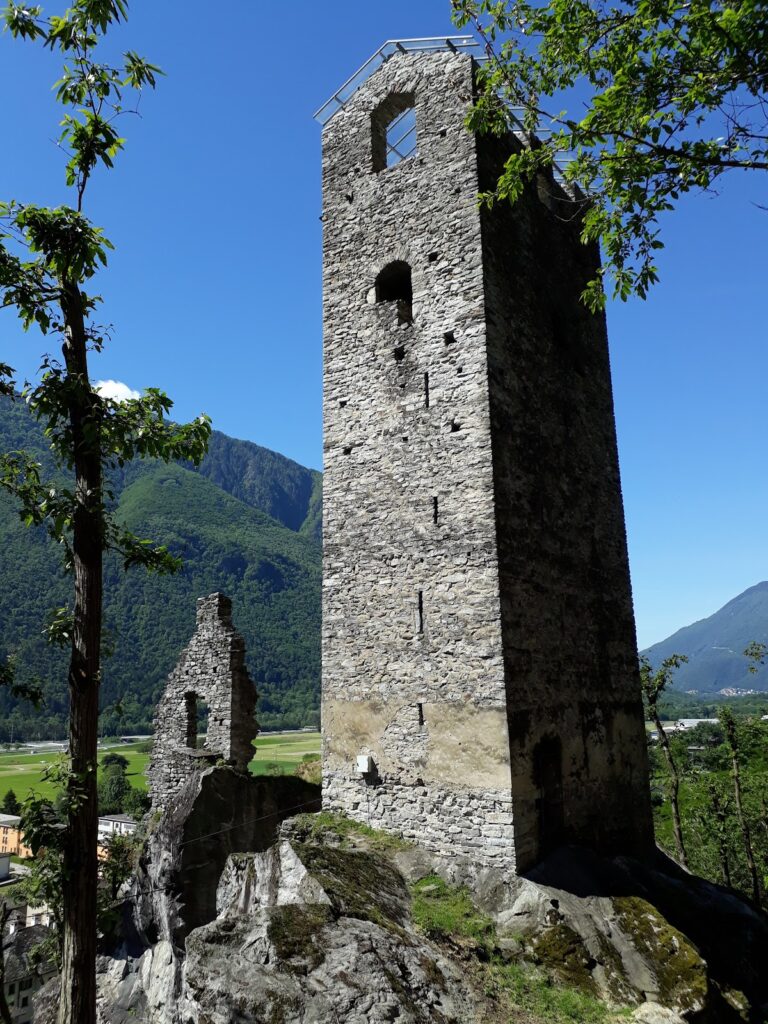
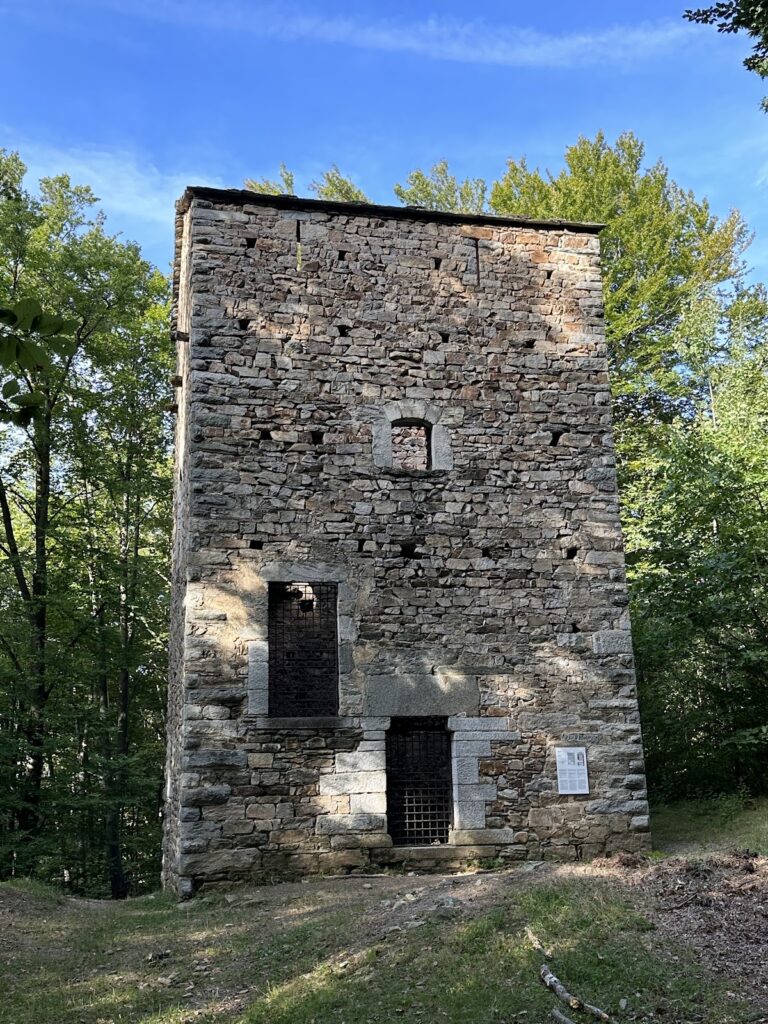
The Camorino section contains five surviving towers: Ai Scarsitt, Ai Munt, Ala Pélera, Sasso Camozzo, and Piano delle Borre. Together they form the tower group of the nineteenth-century defensive position, whose rubble-stone construction belongs to the fortification works built in 1853 and 1854.
Sementina and Monte Carasso
The sections around Sementina and Monte Carasso include the Torre della Murata, an observation tower used to monitor approaching forces, as well as another tower at Sementina. At Monte Carasso, the remains comprise a wall and gate, another tower, and a section of the Dufour Line. These features belong to the connected defensive system that extended across the plain and into the valley approaches.
Twentieth-Century Bunkers
At San Martino in Camorino, two Centi bunkers preserve the later antitank phase of the defenses. San Martino Nord A 8029 and San Martino Süd A 8030 are 10.5 cm antitank bunkers, designed to resist armored vehicles and fire against them. They represent the twentieth-century adaptation of the Camorino position within the Swiss Army 61 system.
Nearby sites