Castellvell de Solsona: A Medieval Hilltop Fortification and Watchtower




Site at a Glance
- Rating
- 4.5
- Popularity
- Low
- Country
- Spain
- Primary era
- Medieval
- External website
- Open
- Eras represented
- Medieval, Modern
- Civilizations
- Crown of Aragon, Spanish
- Site type
- Military
- Remains
- Castle
On this page14 sections
History
Castellvell de Solsona is a medieval hilltop fortification and watchtower in Spain, located northwest of Solsona on the summit of Castellvell hill. Construction began in 957 on the orders of Sunyer, Count of Urgell, and the site helped defend the surrounding region. In the eleventh century it was already called “the old,” a name that distinguished it from a later fortress known as the “new castle.”
Foundation and medieval fortification
Borrell II of the House of Barcelona, a medieval Catalan ruling dynasty whose members held the county of Barcelona and at times the crown of Aragon, strengthened Castellvell in 973. Further works began in the eleventh century under Ecard Miró, then lord of Solsona. After his death, his descendants Bernat and Ramon de Tarroja continued the project.
The long phase of construction ended in 1217. Its completion followed the marriage of Agnès, heiress of the Tarroja family, to Ramon Folc IV of Cardona, Viscount of Cardona. The connection with the Cardona family shaped the later history of the fortress and its role as a seigneurial residence.
The Cardona residence and its destruction
For 69 years, the Cardona family maintained its seigneurial seat at Castellvell before moving to Castell del Camp. That later residence became known as the “new castle,” while the fortress on the ridge was increasingly identified as the “old castle.” Various nobles then held the site in custody as castellans, officials responsible for a castle’s administration and defense. This title continued until the seventeenth century.
In 1389, Hugh II of Cardona, the first Count of Cardona, authorized the first destruction of the castle. Its masonry was dismantled so that the stones could be reused in the new walls of Solsona. The site nevertheless retained its religious buildings and later underwent further architectural changes.
Religious transformation and the Carlist Wars
During the fifteenth century, a Gothic building replaced the earlier Romanesque chapel under the same Marian dedication. It became the Sanctuary of Our Lady of Remedy and has continued in use for worship. The sanctuary preserves a seated image of Mary, identified as a fourteenth-century carving of Our Lady of the Snows or Our Lady of the Milk.
During the First Carlist War, one of a series of nineteenth-century Spanish civil conflicts over the succession to the Spanish throne, Baron de Meer ordered the site to be converted into a modern castle that incorporated the older fortification. This enlarged complex was called the Castle of Solsona.
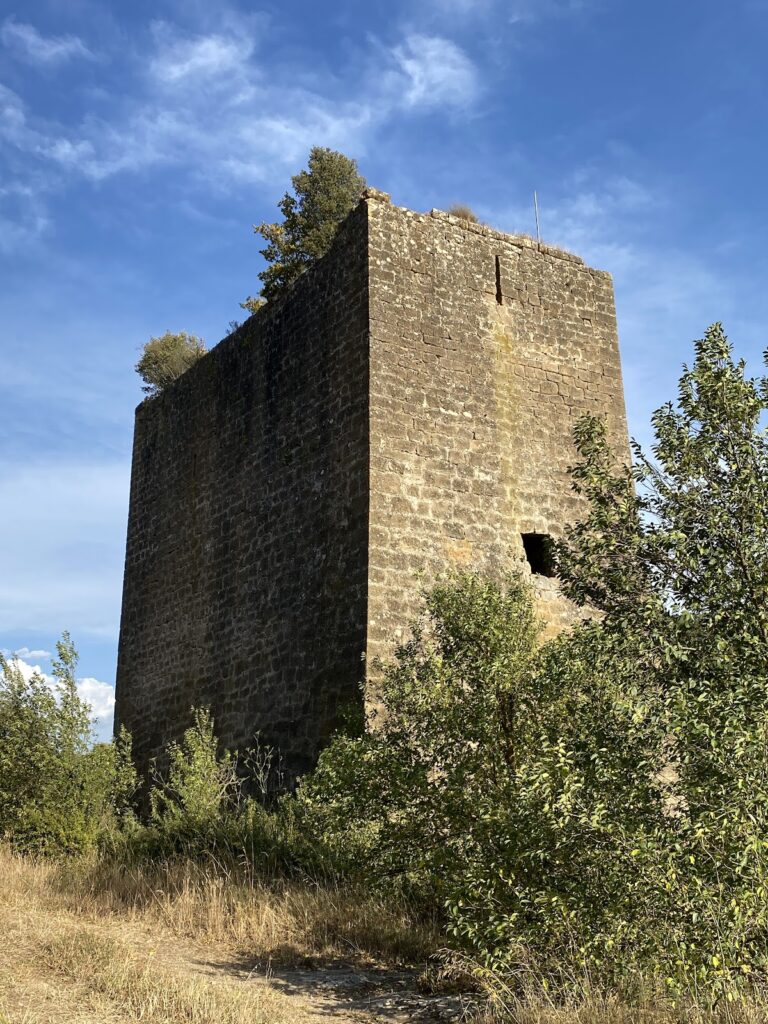
The castle suffered severe damage during the campaigns of the Third Carlist War. In 1872, the Carlist commander Morlans ordered the destruction of three of its four towers. Government forces arrived before the fourth could be demolished, allowing it to survive.
Later history and continuing use
In 1882, the priest of Castellvell mutilated the Marian statue because he regarded its representation as shameful. The head of the Christ Child was separated from the image and is now held by the Diocesan and Regional Museum of Solsona.
Castellvell de Solsona remains inhabited and is described as being in fairly good condition. It is protected as a Cultural Asset of National Interest and as a Spanish Bien de Interés Cultural, meaning an officially designated heritage property, under the category of historical monument. The designation dates from 1988. The site also continues to host the Roseret gatherings and an annual independence-related meeting on 10 September, which includes talks and the display of a large estelada, the Catalan pro-independence flag, on the castle walls.
Remains
Hilltop setting and fortified enclosure
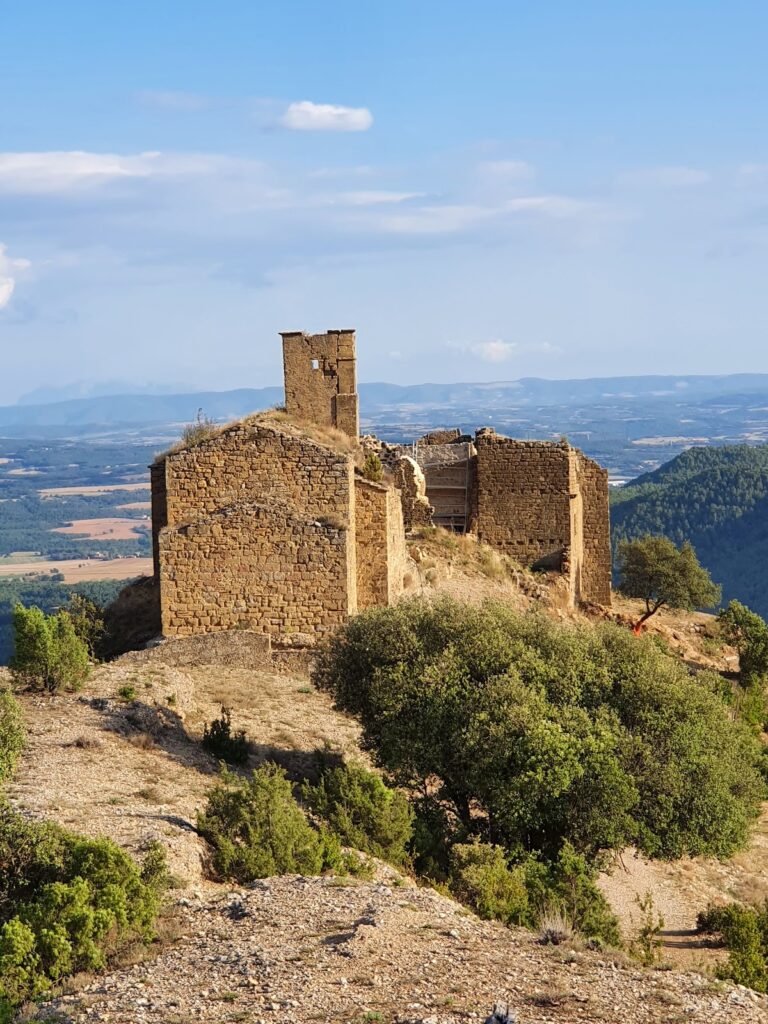
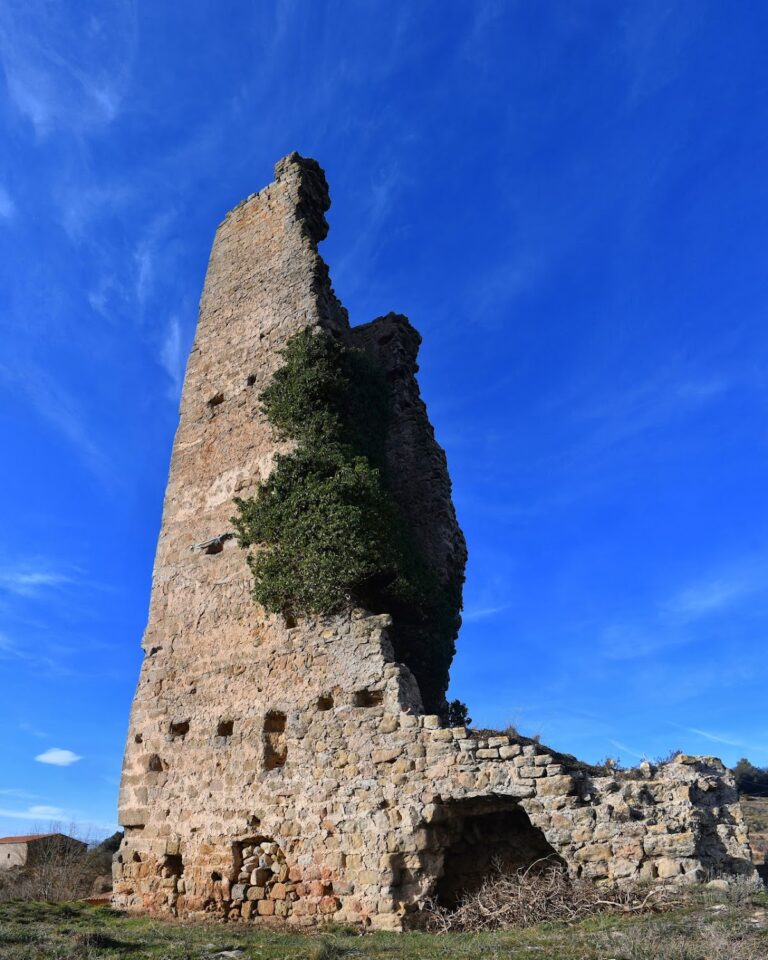
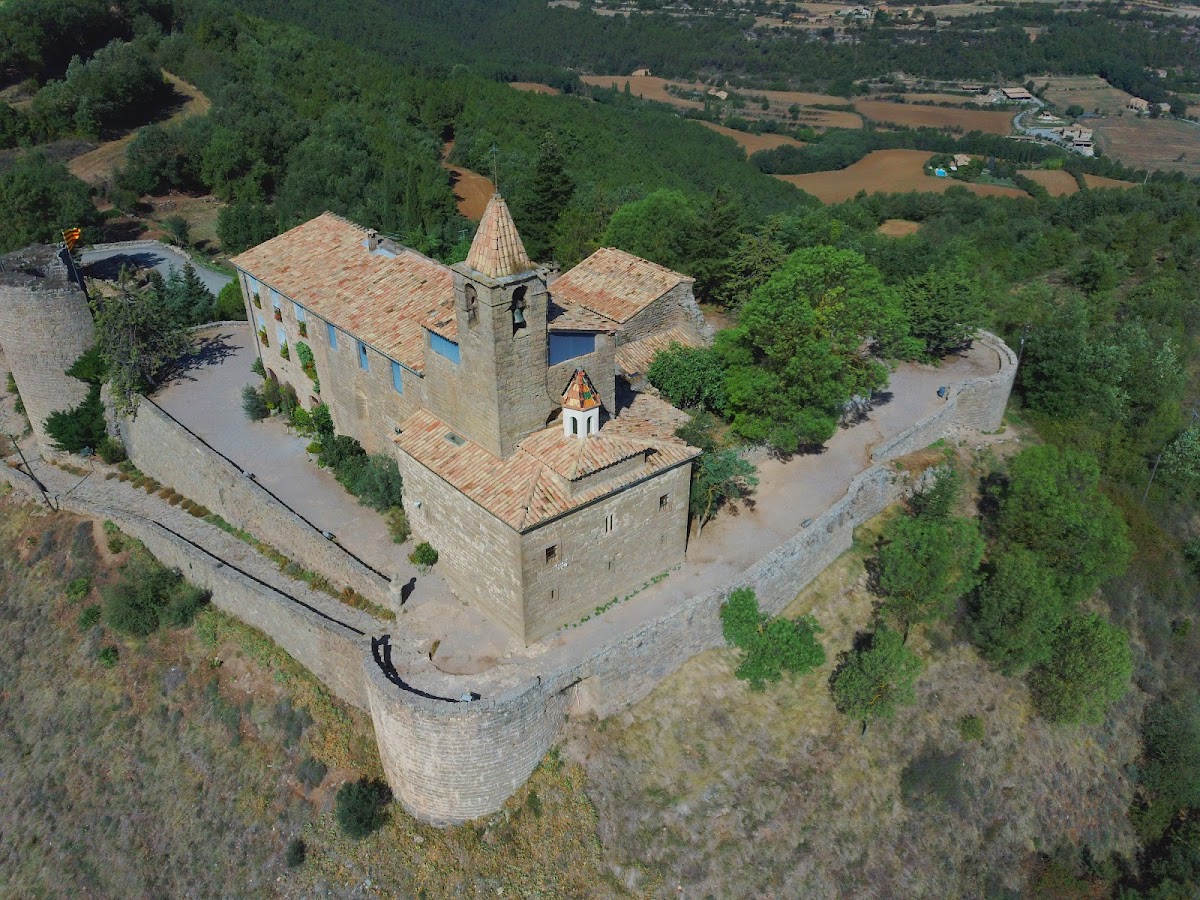
Castellvell occupies the summit of Castellvell hill in Olius, at approximately 838 metres above sea level and about 130 metres above Solsona. The enclosure forms a fortified complex with a square plan and four towers. Three towers were demolished in 1872, leaving their truncated lower sections, while the fourth tower survived. The position provides views across Solsona’s vineyards and much of the Solsonès comarca, a traditional territorial division of Catalonia comparable in broad terms to a county.
The hilltop outlook extends toward the Torregassa ridge to the west. To the south are the Sanctuary of El Miracle and the Pinós range, with Montserrat beyond. The eastern view includes Pi de Sant Just, the Busa cliffs, and distant Montseny, while the northern landscape reaches toward Sant Bartomeu, Port del Comte, the Serra del Verd, Pedraforca, Cadí, and Montsec.
Palace and defensive structures
Gothic palace hall
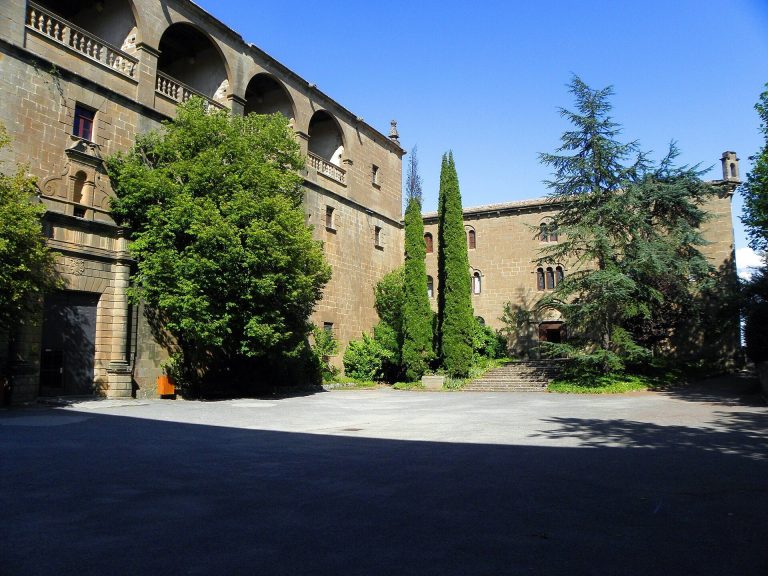
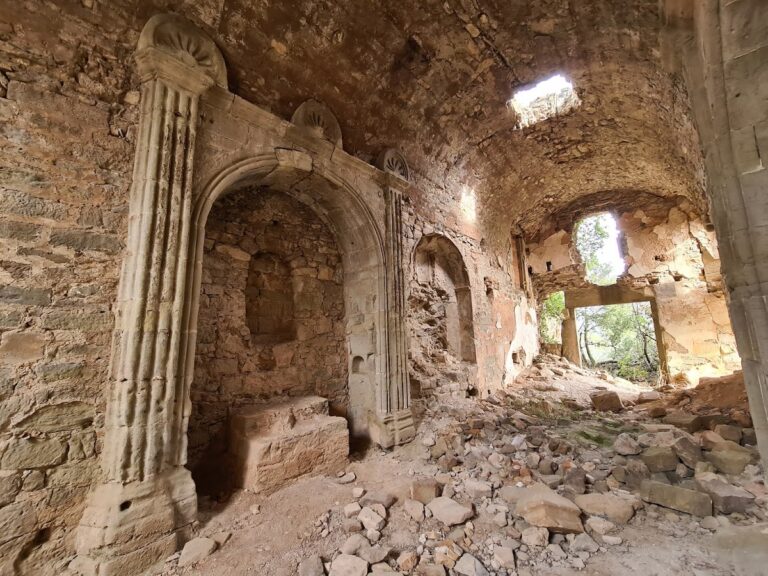
The reforms carried out between 1310 and 1320 adapted the castle-house to the Gothic style and converted it into a palace. On the eastern side of the walled enclosure, the surviving palace complex includes a large square hall. Its structure has transverse pointed arches, formed by two curves meeting at an apex, resting on cylindrical columns with cubic capitals. This arrangement was frequently used in Gothic castles in Catalonia.
Castle towers
The square enclosure was strengthened by four towers. Three now survive only in truncated lower portions because of the destruction ordered in 1872. The fourth tower escaped demolition when government forces reached the site, preserving part of the castle’s defensive arrangement.
Religious buildings and carved remains
Church of Sant Miquel
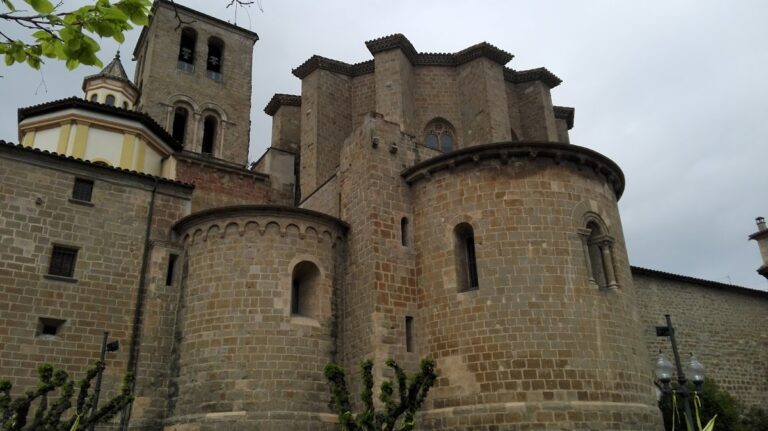
Outside the enclosure, on its western side, stand the remains of the Romanesque parish church of Sant Miquel de Castellvell. Its sanctuary ends in a trilobed apse, a rounded or polygonal church end divided into three lobes. Sant Miquel was later replaced by the parish of Brics, on which it had previously depended as a subordinate church.
Sanctuary of Our Lady of Remedy
Within the enclosure are the remains of the earlier Romanesque chapel. A Gothic sanctuary was built on its site during the fifteenth century under the same Marian dedication. The building remains open for worship and contains a seated image of Mary identified as Our Lady of the Snows or Our Lady of the Milk. The figure of the Christ Child has lost its head, which is preserved in the Diocesan and Regional Museum of Solsona.
Tarroja and Cardona capital
A Romanesque capital is preserved within the wall enclosure. Its carving bears the heraldic emblems of the Tarroja and Cardona families, represented by a tower and a thistle. The same two emblems, together with a cross associated with the monastery and a sun, also appear on Solsona’s coat of arms.