Lyzohub Manor: A Historic Family Estate in Sedniv, Ukraine
Site at a Glance
- Popularity
- Medium
- Country
- Ukraine
- Primary era
- Early Modern
- Eras represented
- Early Modern, Modern
- Civilizations
- Cossack Hetmanate, Russian
- Site type
- Domestic
- Remains
- Manor House
On this page13 sections
History
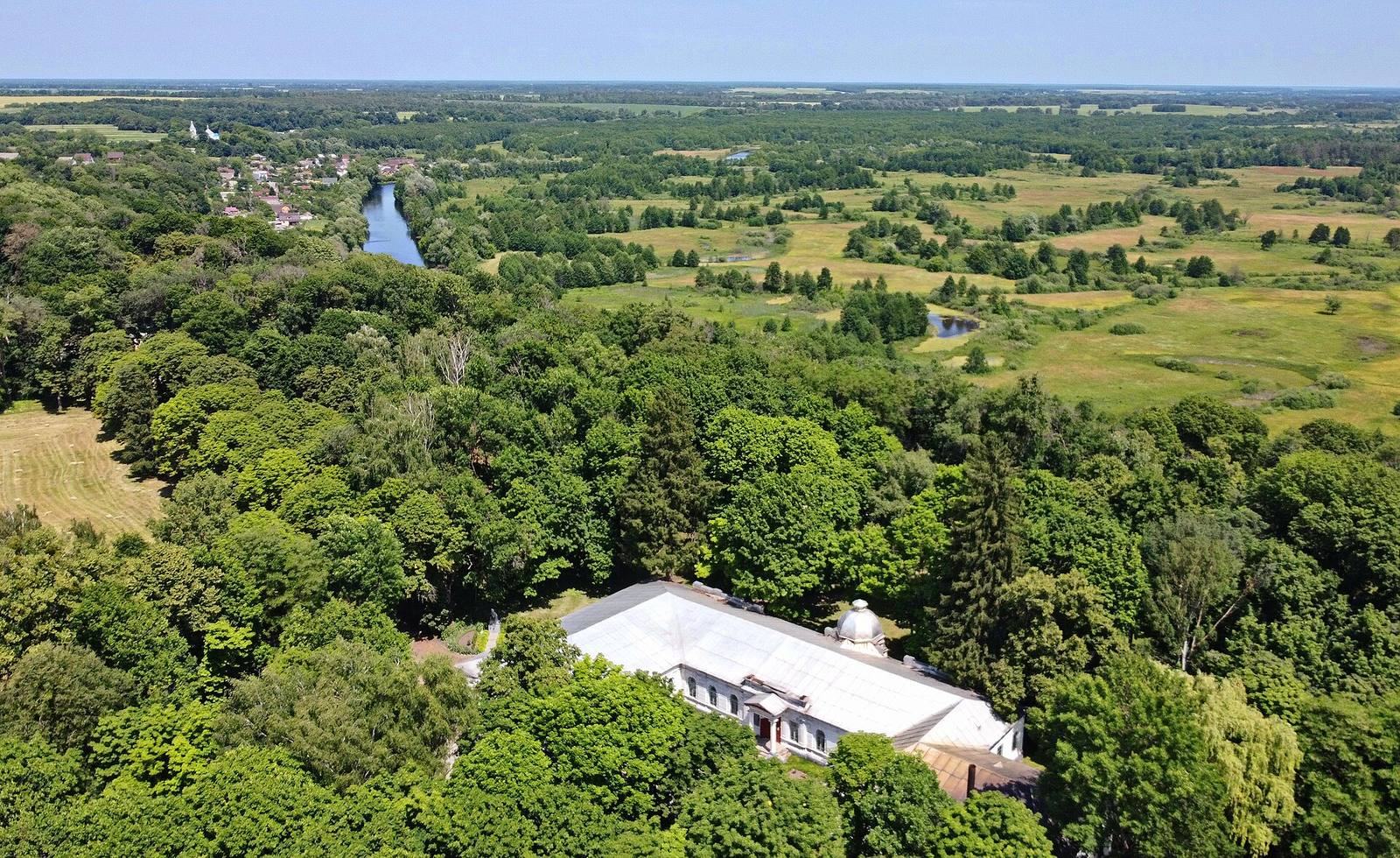
Lyzohub Manor is a historic estate in southern Sedniv, Ukraine, on the high right bank of the Snov River. It began to take shape in the late seventeenth century, when Sedniv became the property of the Lyzohub family, members of the Cossack starshyna, the officer and administrative elite of a Cossack army. The first owner, Yakiv Lyzohub, commissioned residential, religious, and service buildings and began laying out a park. Development continued into the early twentieth century, and by the mid-nineteenth century the estate had become an architectural and park ensemble.
The Lyzohub family and its visitors
In the 1830s, Yakiv’s brother Andrii settled at Sedniv after leaving state service, and their brother Illia also moved there. The estate attracted cultural figures, including the poet and artist Taras Shevchenko, who visited in spring 1846 and again in 1847. Other visitors included painter Lev Zhemchuzhnikov, writer Leonid Hlibov, and writer and educator Borys Hrinchenko. In the 1890s, artist Afanasii Slastion and revolutionary Nikolai Kolodkevich worked at the estate. Revolutionary activists Andrei Zhelyabov and Sofia Perovskaya sometimes stayed there in hiding; Alexander Mikhailov and Valerian Osinsky also visited.
Ownership, nationalization, and later use
The estate passed to Dmytro Lyzohub in the late 1860s and later to Fedir Lyzohub. Fedir headed the Ukrainian government in 1918 under Pavlo Skoropadsky, a Cossack military and political leader who held the title of hetman. The Lyzohub family later emigrated.
After nationalization in 1918, the estate’s central section was assigned to the local school. The main house and wing became classrooms, while part of the park was used for physical education and military training. The stone house and much of the park came under the management of the Chernihivelitkartoplia Scientific Production Association. A tuberculosis sanatorium occupied the middle section, and in 1964 the southern section became a House of Creativity and Recreation of the Ukrainian Artists’ Union. Under Soviet rule, the Lyzohub family burial crypts were plundered; the family’s mummified remains were used as museum exhibits and taken around the country.
The estate complex was designated a monument of architecture of national significance in 1963, and the park received protection as a garden and park monument in 1972. After the school moved to a new building in 2012, the main manor house was restored. Since 2014, the estate has been a branch of the Chernihiv Regional Historical Museum named for Vasyl Tarnovsky, housed in the wing. Russian vandals looted the estate on 27 February 2022.
Remains
The surviving estate brings together religious and residential buildings, parkland, garden structures, and memorials. Its grounds retain features from different stages of the property’s development.
Buildings and park
Resurrection Church
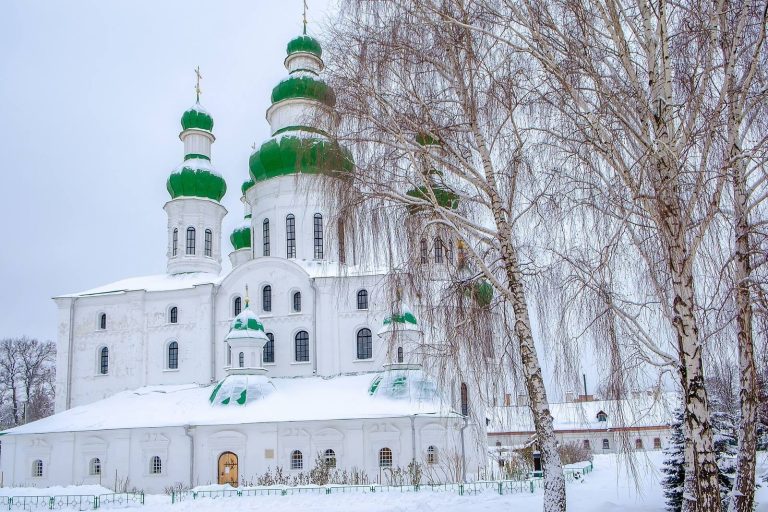
Resurrection Church, originally dedicated to the Nativity of the Virgin, dates to 1690 and served as the Lyzohub family burial place. The family crypts lie beneath the church, and a bell tower is associated with the building.
Stone house and residential building
The Lyzohub stone house also dates to 1690. A separate one-storey brick residential house was built in the nineteenth century on the site of an earlier wooden house.
Wing
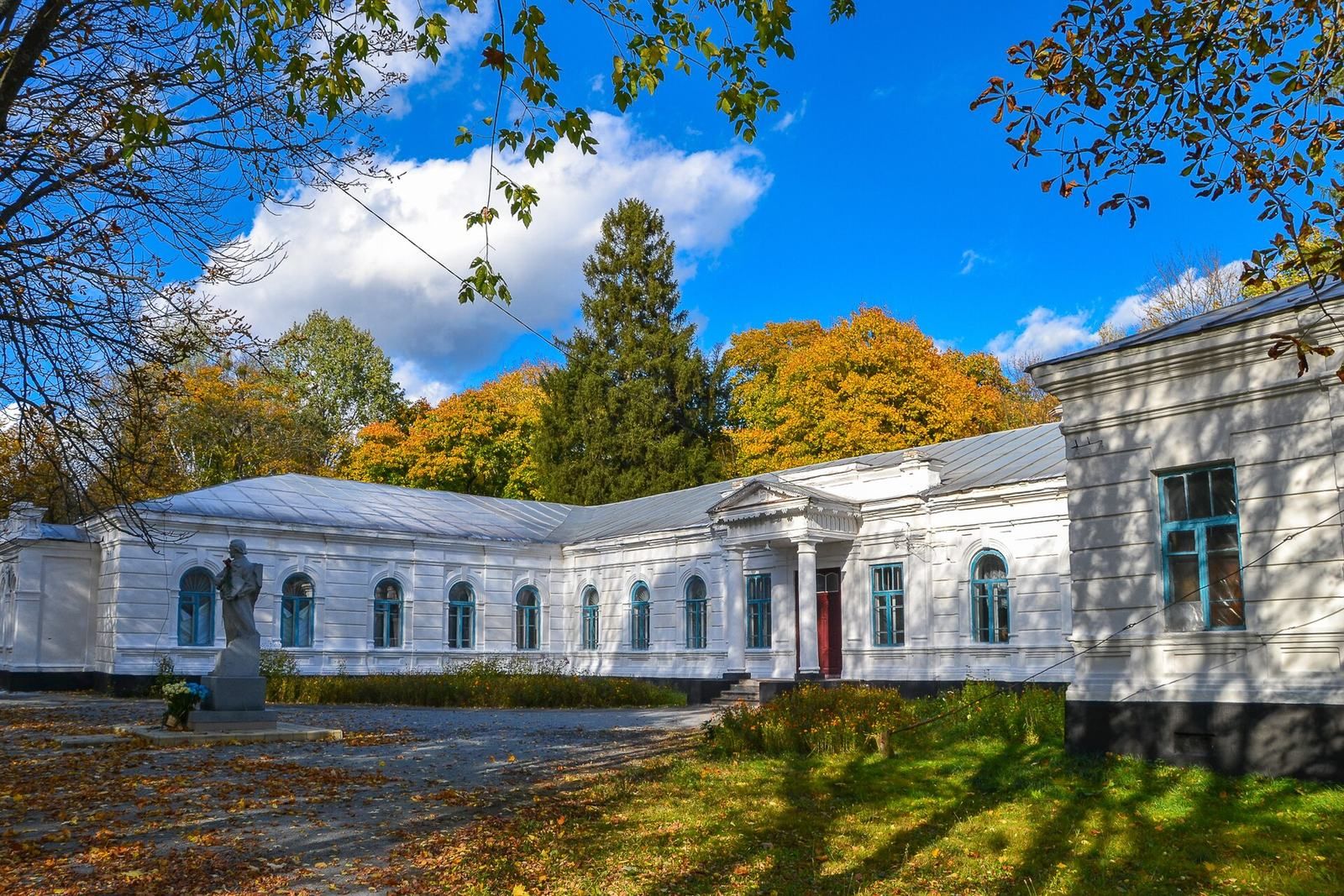
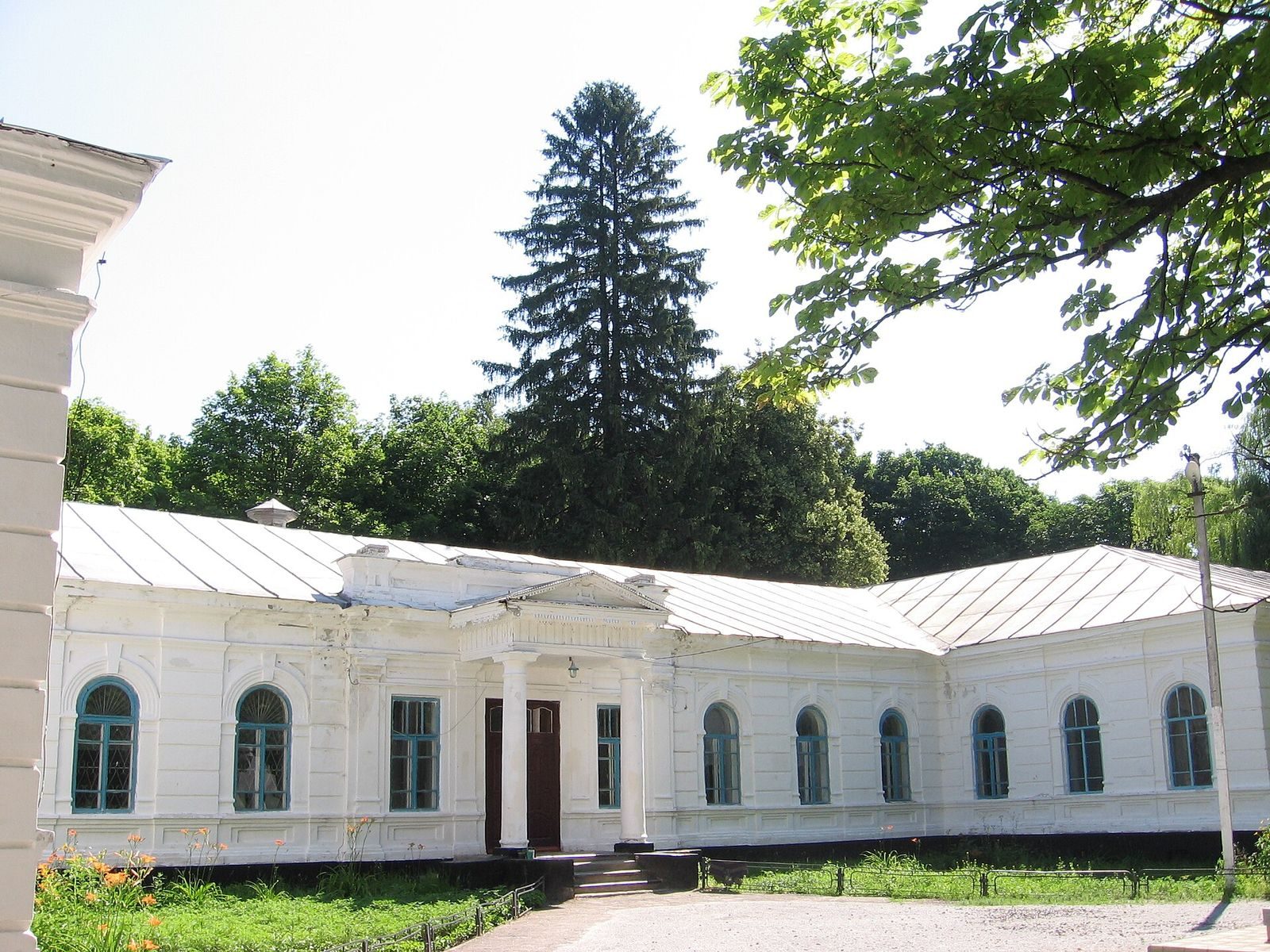
The rebuilt wing is a one-storey stone building with a U-shaped layout. Its northeastern facade has a bay window beneath a dome. On the southwestern side, the entrance is framed by a two-column porch with a triangular upper section. The museum branch is housed in this building.
Park and garden structures
Now called Shevchenko Park, the estate’s park covers 22 hectares. Its informal English-style design is based on an oak grove, with an avenue of old chestnut trees forming the main axis between the principal manor house and the Red Bridge. The stone bridge crosses an old moat. The grounds also retain a small garden grotto, a gazebo associated with Leonid Hlibov and dating to the first half of the nineteenth century, and the foundations and retaining walls of an orangery, or greenhouse for orange trees.
Memorials
The 1904 Shevchenko monument
For the ninetieth anniversary of Taras Shevchenko’s birth, a plaster bust of the poet was erected on the estate in 1904, funded by Fedir Lyzohub and public donations. It stood on a two-metre granite pedestal near the Red Bridge and was among the earliest monuments to Shevchenko in Ukraine. Mykhailo Havrylko was its sculptor, although Soviet reference works tentatively credited Fedir Balavensky instead. The monument was moved to Sedniv’s central square in 1924 and destroyed during the Nazi occupation.
Later Shevchenko memorials
Further Shevchenko memorials were unveiled in the park near Shevchenko’s linden in 1957 and in front of the main house in 1976. Another monument to the poet was erected on the estate in 2010, and a bust of Shevchenko is also among its memorial features. A plaque on the main house facade recalls his stay, while a marble plaque on the estate gate commemorates his residence there. An information board and another memorial plaque are installed at the entrance.
Other memorials
The estate also has monuments to Leonid Hlibov and to the brothers Andrii and Illia Lyzohub. Another monument honors a Cossack song associated with Ukrainian folk singer and bandura player Vasyl Nechepa.