Dormition Cathedral of Eletsky Monastery: Principal Church of a Historic Chernihiv Monastery


Site at a Glance
- Rating
- 4.4
- Popularity
- Very Low
- Country
- Ukraine
- Primary era
- Medieval
- Eras represented
- Medieval, Early Modern
- Civilizations
- Cossack Hetmanate, Kievan Rus
- Site type
- Religious
- Remains
- Cathedral
On this page8 sections
History
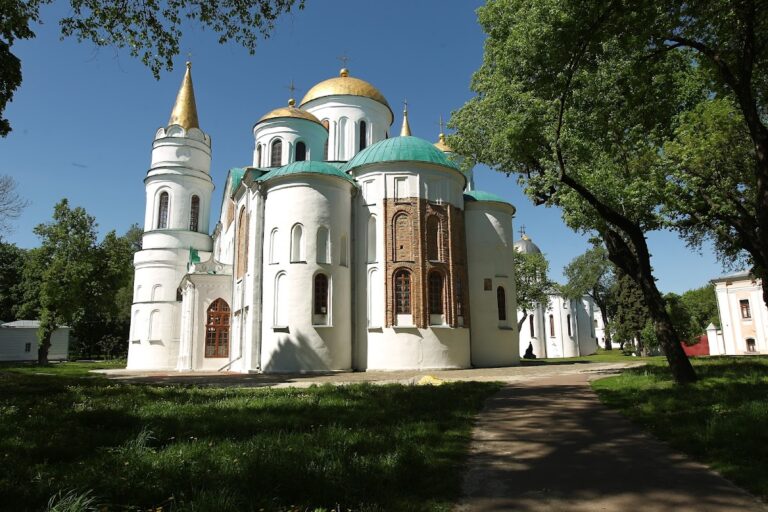
Dormition Cathedral of Eletsky Monastery is the principal church of the historic monastery in Chernihiv, Ukraine. Built in the twelfth century by the Old Rus tradition, at a date that remains uncertain, it was modeled on the Dormition Cathedral of the Monastery of the Caves in Kyiv. The church was among the early Old Rus buildings to employ regular-layer masonry. Its dedication refers to the Dormition, or bodily assumption into heaven, of the Virgin Mary, a major Christian feast.
Foundation and Mongol destruction
The cathedral formed the religious centre of Eletsky Monastery during the medieval history of Chernihiv. In 1239, the Mongol invasion associated with Batu Khan, the ruler and commander whose forces devastated many Rus cities, reached the church. The cathedral was looted, burned, and partly destroyed during the attack.
Restoration and confessional change
Restoration began in 1445 under Prince Ivan Mozhaysky and continued until 1499. The rebuilding followed the medieval destruction and returned the cathedral to use within the monastery. At a later stage, a fire caused the vaults to collapse. The date is given as either 1611 or 1642, and descriptions state that the upper parts and the principal masonry dome fell through.
From 1635 to 1649, the monastery and cathedral belonged to the Greek Catholic Church, which retained Eastern Christian worship while recognizing the authority of the Roman Catholic Church. In 1646, Kyrylo Stavrovetsky may have printed Pearl of Great Price, possibly at the cathedral or elsewhere in the monastery. After the Khmelnytsky Uprising, Orthodox authorities took control of the church.
Rebuilding and the Ukrainian Baroque period
Under Ioanykii Galyatovsky, an Orthodox archimandrite, or senior monastic leader, the cathedral underwent major rebuilding between 1668 and 1670. These works helped give the monastery ensemble Ukrainian Baroque features, a regional tradition that combined elaborate seventeenth- and eighteenth-century decoration with inherited Eastern Christian church plans.
The cathedral also acquired important memorial and decorative works during this period. In the 1670s and 1680s, its interior received a three-tiered gilded carved iconostasis financed by V. A. Dunin-Borkovsky, the monastery’s ktitor, or principal donor and patron. The iconostasis no longer survives. In 1698, Y. Y. Lyzohub commissioned a burial chapel on the south side for Yakiv K. Lyzohub. After its consecration in 1701, the chapel became known as the Church of Saint James.
Several figures connected with the monastery were buried in the cathedral. Ioanykii Galyatovsky was interred there in 1688, followed by L. A. Polubotok, a Cossack official, in 1695. V. A. Dunin-Borkovsky was temporarily buried in the cathedral in 1702. His coffin was probably later moved to his Bobrovytsia estate, where flooding destroyed the grave. A tombstone with an epitaph by Ioann Maksymovych, an Orthodox bishop and writer, remained inside the cathedral until the 1920s.
Wartime damage and modern preservation
Soviet authorities closed the cathedral in 1924 and transferred it to the local museum of local history. It was later recognized as a historical and cultural monument of all-Ukrainian significance and placed under state funding. During the German-Soviet War, an incendiary bomb damaged the cathedral in 1941. During the German occupation from 1941 to 1943, the German army converted it into a stable.
After the war, salt stored in the south chapel damaged walls that contained frescoes. The cathedral was later used as a warehouse for spare parts and scrap metal. Research and restoration took place from 1956 to 1960, followed by further work in 1961 and 1962 by Interregional Specialized Scientific-Restoration Production Workshop No. 3. Substantial repair and restoration work was carried out in 1998.
After the cathedral became part of the Chernihiv Ancient architectural and historical reserve, it continued to function as a museum. In 1992, as part of Eletsky Monastery, it was transferred to an Orthodox community. The building is listed as a monument of architecture of national significance and forms part of the Chernihiv Ancient National Architectural and Historical Reserve.
Remains
The surviving cathedral is a large cross-domed church with three naves, three apses, and six supporting piers. It measures approximately 16.28 by 26.57 metres. The original design called for a single dome, but the building now has four. Its present fabric combines the forms of the Old Rus church with later Ukrainian Baroque additions and alterations, alongside evidence of repeated destruction, rebuilding, fire damage, adaptive reuse, and twentieth-century restoration.
The cathedral building
Small porches or vestibule-like galleries were probably arranged before the entrances on three sides. These three small vestibules distinguish the cathedral from its Kyiv model. A miniature chapel with its own apse is built into the south-west corner. Hidden within the structure and not visible from the exterior, it may originally have served as a baptistery.
The interior was decorated with ceramic and slate tiles, stained glass, and frescoes. Twelfth-century fresco painting was of high artistic quality, but it survives only in fragments over approximately 250 square metres, with other descriptions noting isolated traces. The surviving decoration and masonry belong to a building whose appearance was altered by medieval damage, early modern rebuilding, later fire, wartime destruction, and restoration.
Saint James Chapel and monastery features
The burial chapel attached to the cathedral’s south side was commissioned in 1698 and consecrated as the Church of Saint James in 1701. It forms a distinct early modern addition to the medieval church. A bell tower associated with the cathedral is also part of the monastery complex, which retains the architectural effects of Ukrainian Baroque development during the seventeenth and eighteenth centuries.