Black Grave: A Kievan Rus Burial Mound in Chernihiv
Site at a Glance
- Popularity
- High
- Country
- Ukraine
- Primary era
- Medieval
- Eras represented
- Medieval
- Civilizations
- Kievan Rus
- Site type
- Burial
- Remains
- Burial Mound
On this page9 sections
History
Black Grave is a late tenth-century burial mound in Chernihiv, Ukraine, created during Kievan Rus, the medieval East Slavic polity. It is the largest burial mound in Chernihiv, and its elaborate cremation rite and grave goods have prompted debate about the status and identity of those buried there.
The late tenth-century burial
Archaeologist Dmitry Samokvasov excavated the mound in 1872–1873 and dated the burial to the late tenth century. Charcoal from the funeral pyres gives a date range of 980–1025. The ceremony included the cremation of two warriors, who may have been father and son; enslaved men and women may also have been burned. The rite followed traditions of the Middle Dnieper, the region around the river’s middle course, and differed from the Varangian boat-cremation custom associated with elite burials at Gnyozdovo. Its scale has nevertheless been compared with large barrow burials at that site.
Possible identities and later interpretations
The people buried at Black Grave have been interpreted as figures with exceptional religious and military-administrative authority, perhaps princes or members of a princely family. One proposal suggests an independent Chernihiv dynasty; another places them within a local princely line. Rulers of such a line do not appear in chronicles before Mstislav of Chernihiv, the son of Vladimir I, a ruler of Kievan Rus. Local legend names the grave as that of Prince Chorny, the mythical founder of Chernihiv, but this tradition does not establish the identity of the deceased.
Dmitry Machinsky proposed that the grave might belong to Pretich, comparing its weapons with an episode in the Primary Chronicle, a medieval East Slavic chronicle. In its account of 968, Pretich comes from across the Dnieper and helps save Kyiv from the Pechenegs, a nomadic steppe people. He then makes peace with their khan by exchanging weapons. The identification of the burial with Pretich remains a hypothesis. Comparisons with elite warrior burials in Great Moravia, a medieval Central European polity, have also informed discussion of the occupants’ status and the grave goods’ cultural connections.
Archaeological protection
Black Grave received republic-level archaeological-monument status in 1965. A national-level designation in 2009 replaced earlier listings. The site forms part of the Ancient Chernihiv architectural and historical reserve, together with 34 other buildings.
Remains
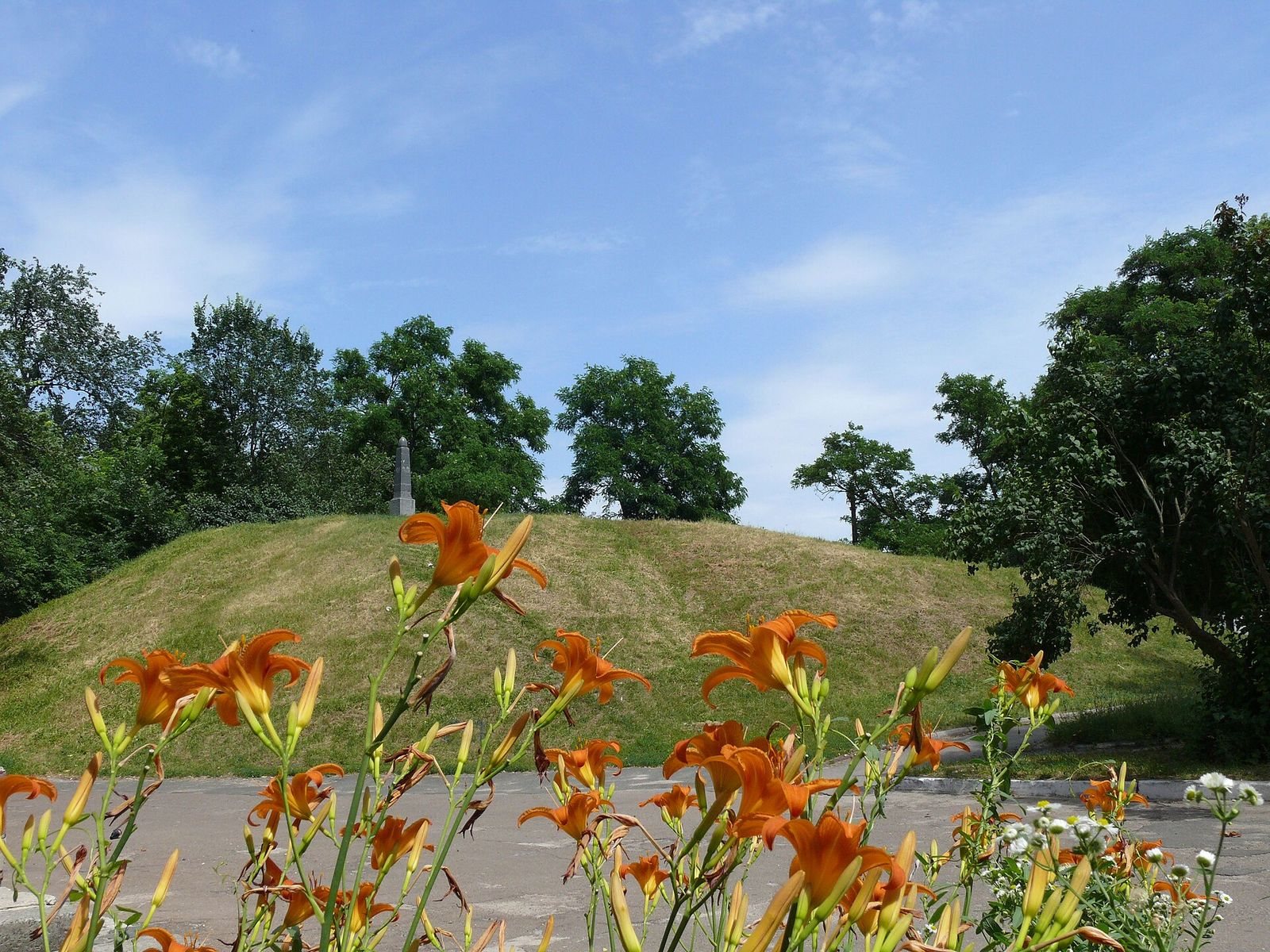
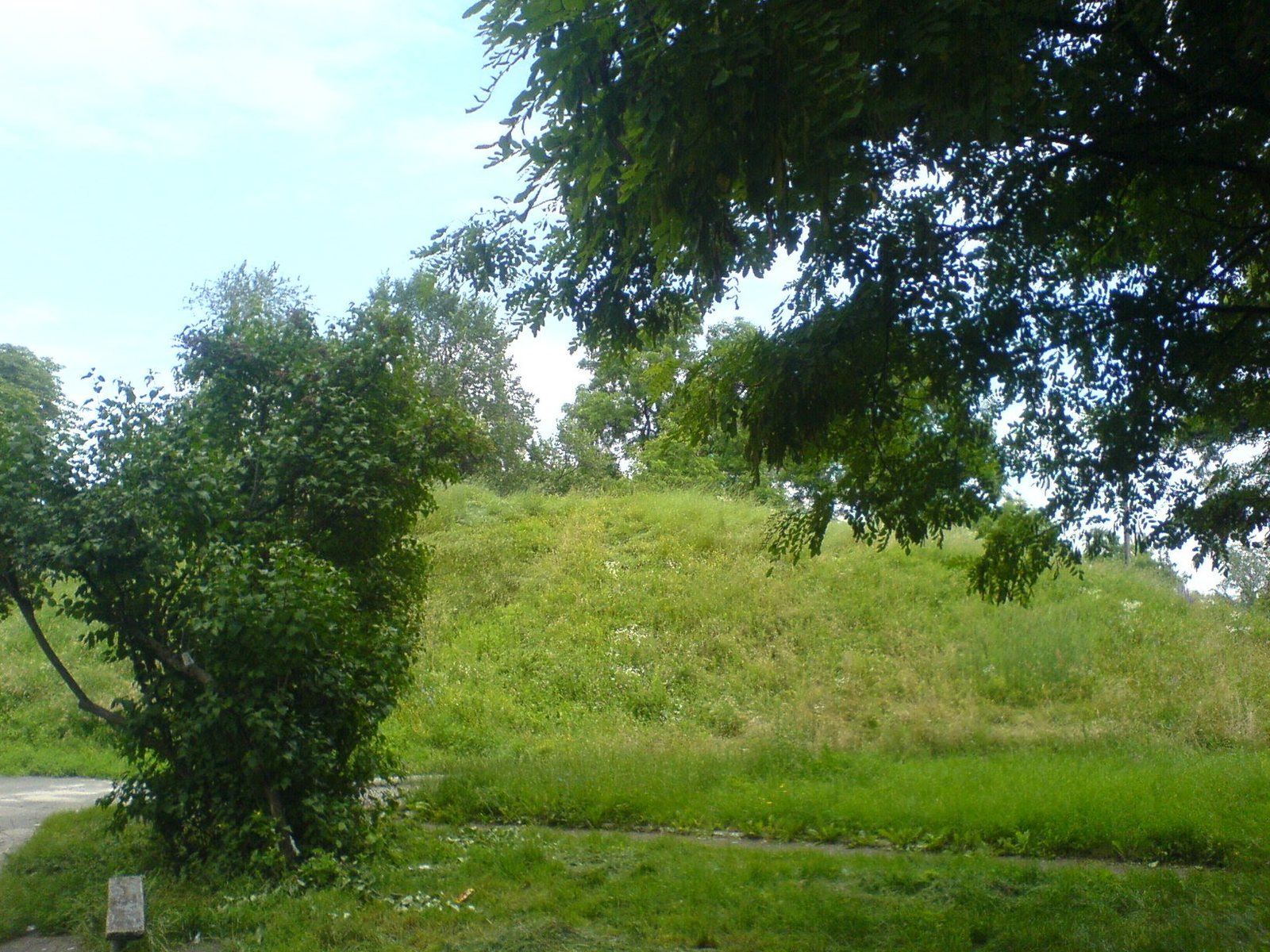
The site is centered on a broad earth mound that rises about 10–11 metres above the surrounding ground and measures 170 metres around its circumference. A ditch, formerly as much as seven metres wide, once encircled it.
Pyre and funeral deposits
Excavation revealed the remains of a large funeral pyre beneath the mound. During the funeral feast, a further deposit was placed about seven metres above the mound’s base; the earthwork was then enlarged, and a stele, an upright stone marker, was set at its summit. The deposit included helmets and chain mail, two gold Byzantine coins attributed to the reign of Basil I (867–886), an iron cauldron containing ram bones, and two sacrificial knives. Two vessels made from aurochs horns, an extinct kind of wild cattle, were also placed there. An obelisk is also associated with the site.
Weapons and other objects
Finds from the pyre included tools, women’s ornaments, metal vessels and pottery, as well as two swords, a sabre, chain mail, spearheads and arrowheads. The two swords and sabre are unusual among Rus retinue burials of this period. A separate Byzantine coin dates to the 960s. After its hilt was cleaned, a large sword was classified as a Wallingford type, a category based on sword form developed from Type L. It has also been compared with group VI in Mortimer Wheeler’s classification of Anglo-Saxon swords; the closest English examples date to the late tenth or eleventh century. One arrowhead fragment has holes holding inlaid copper-alloy wire, arranged as two half-palmettes, or half-forms of a stylized palm-leaf design, spreading from a central three-lobed figure. A spearhead bears crosses inlaid on both sides with coloured metal set into a finely scored surface.
Silver-mounted horns
The two aurochs-horn vessels have silver mounts decorated in repoussé, relief made by hammering metal from its reverse. The larger horn’s image includes a man and a figure identified as a woman, both armed with bows and aiming at a prophetic bird, alongside fantastic animals. Carving on the horn itself came to light during restoration but was later concealed by the mount. Interpretations of the scene differ: Boris Rybakov connected it to the epic of Ivan Godinovich and considered the vessel local work; Ruslan Orlov read it as a secular story about the heroic origins of Slavic princes; D. Laszlo proposed a sacred hunt. O. A. Shcheglova viewed the image as a local copy of a model resembling a Byzantine oliphant, a carved horn used as a ceremonial or prestige object. She suggested as a possible prototype an oliphant bearing a Byzantine eagle and attributed to Lehel, a Hungarian military commander who may have ruled the Principality of Nitra in present-day Slovakia before 955. The mounts’ patterns have parallels on belt fittings and arrowheads from Mikulčice, Pohansko, Staré Město and Želénky, and especially on Great Moravian buttons called gombiki. Related designs from southern Moravia, central Bohemia and southwestern Slovakia have been associated with influences from the Black Sea region and Iran.
Bronze figurine
A small bronze figurine from the mound shows a seated man holding either his beard or his tongue. Its purpose is uncertain: it may have served as a game piece, perhaps a king in a Viking Age tafl board game, or as an amulet associated with Thor. Comparisons include a figure from Rällinge in Sweden, identified as Freyr, and one from Eyrarland in northern Iceland, often identified as Thor. Samokvasov compared it with a seated god and questioned whether it might represent Buddha. Restoration in 2010 revealed details considered eastern in appearance. The figure is made of copper with no more than one percent impurities; its features were worked cold with punches, and it was fire-gilded by amalgamation, a heat-based gilding process. It sits with bare legs crossed and toes clearly marked. Its long-sleeved caftan, a robe-like garment, has dotted decoration at the cuffs and down the legs, perhaps representing trousers or leg coverings. Knots appear on both sides of its belt where weapons are often shown on comparable figures. An eastern European place of manufacture has been proposed. The excavated finds are held at the State Historical Museum in Moscow, where the figurine has been exhibited.