Chernihiv Val: The Fortified Medieval Center of Chernihiv


Site at a Glance
- Rating
- 4.9
- Popularity
- Medium
- Country
- Ukraine
- Primary era
- Medieval
- Eras represented
- Medieval, Early Modern, Modern
- Civilizations
- Grand Duchy of Lithuania, Kievan Rus, Russian
- Site type
- Military
- Remains
- Citadel
On this page18 sections
History
Chernihiv Val is the historic fortified center of Chernihiv, Ukraine, developed by the early medieval East Slavic civilization from the seventh or eighth century onward. Also known as the Chernihiv Detinets, a detinets was the fortified central district of a medieval East Slavic city, usually containing the ruler’s residence, principal churches, administrative buildings, and main defenses. The site occupies a high promontory above the Desna valley, bounded by the Desna and its tributary, the Stryzhen. It became the political and religious heart of one of the leading centers of Kyivan Rus, the medieval East Slavic polity centered on Kyiv.
Early settlement and the medieval principality
The promontory was inhabited by the beginning of the Common Era. Zarubintsy pottery and Roman coins indicate this early occupation, while fortifications developed on the site of an earlier settlement during the seventh and eighth centuries. Archaeological research places the establishment of Chernihiv as a city in the late seventh or early eighth century.
Chernihiv appears in the Primary Chronicle in 907. A treaty between Prince Oleg and Byzantium described it as the second most important city after Kyiv. By the eleventh century, the Detinets was the principal political and religious center of the city and the seat of the Chernihiv-Siverian principality.
The medieval development of the Detinets was closely connected with Mstislav Volodymyrovich, a prince of Kyivan Rus and son of Vladimir the Great. After defeating his brother Yaroslav the Wise at the Battle of Listven in 1024, Mstislav became prince of Chernihiv. Construction of the Spaso-Preobrazhensky Cathedral began during his rule, and he was buried there after his death in 1036.
Chernihiv reached its greatest medieval prosperity during the twelfth and thirteenth centuries. Its population grew to about 20,000, and the principality extended north-east to Murom and south to Tmutarakan. It also competed with the Galician-Volhynian principality for the throne of Kyiv.
During the twelfth century, the Detinets expanded eastward after an earlier ditch, situated about 70 metres east of the Spaso-Preobrazhensky Cathedral, was filled. The fortified area grew from about 11 to 16 hectares, and the princely court moved toward the Stryzhen. Other urban districts, including the Okolny City, Tretyak, Peredhoroddia, and Podil, developed around the central enclosure as separate or partly fortified areas.
Destruction and renewed fortification
In October 1239, forces led by Khan Mengu captured and burned Chernihiv after a seven-day siege. The destruction began a long period of decline and abandonment for the Detinets and the wider city.
Chernihiv’s defenses were renewed in the fourteenth century under Vitovt, the grand duke of Lithuania. Crimean Tatar attacks caused major destruction in 1482 and 1497. In 1500, the Seversk land, including Chernihiv, passed to the Russian state. During the sixteenth century, the city repeatedly resisted Lithuanian and Polish attacks.
Because the older defenses had deteriorated, a new wooden castle was completed in 1531 by order of Vasily III, grand prince of Moscow. The castle withstood a Lithuanian siege three years later. Damage sustained during the Livonian War, a sixteenth-century conflict over territories in the eastern Baltic region, led to another rebuilding and strengthening campaign between 1584 and 1592. The road from the Pohorila, or Northern Gate, became the main street, with administrative buildings, barracks, and an artillery yard constructed along it.
From fortress to park
In 1610, Chernihiv was completely burned during the Polish devastation of the Time of Troubles, a period of political crisis and warfare in the Russian state from the late sixteenth to the early seventeenth century. Forces led by the Kyiv subchamberlain Samuil Hornostai entered the city by deception.
During the Left-Bank uprising of 1668, a revolt in the Cossack-administered lands east of the Dnieper, a tsarist garrison held the Detinets against Cossack forces for seven months. The Chernihiv Fortress subsequently became the administrative and political center of the Chernihiv Regiment, a major Cossack administrative and military unit of the Hetmanate, while continuing to serve a military purpose.
New buildings were added during the eighteenth century, and the Chernihiv Collegium with its bell tower became the principal landmark of the fortress area. The fortress was abolished in 1799. In the early nineteenth century, parts of its ramparts were excavated as a new urban plan was implemented and replaced by a boulevard. After 1845, a park called Val was laid out over the former Detinets and fortress grounds, including Gymnasium Square and Cathedral Square.
In 1964, the park was named the Central Park of Culture and Recreation after M. M. Kotsiubynsky, a Ukrainian writer of the late nineteenth and early twentieth centuries. The monuments within the grounds became part of the National Chernihiv Ancient architectural and historical reserve. Chernihiv Val was recognized in 1965 as a monument of history of republican significance. In 2009, it received national archaeological-monument status as the Detinets of the chronicle city of Chernihiv, protected under number 250001-N.
Archaeological investigation
Archaeological investigation began in the 1670s under I. Haliatovsky, archimandrite of the Chernihiv Elets Monastery. Systematic research followed the establishment of the Chernihiv Archaeological Expedition at the Chernihiv Historical Museum in 1979. In 1981, a museum department devoted to the protection and study of archaeological monuments was created under the direction of V. P. Kovalenko.
More than 10,000 square metres have been excavated. The investigations clarified the historical topography and developmental phases of the Detinets, identified new architectural complexes from the eleventh and twelfth centuries, and recovered substantial archaeological material, including seven jewellery hoards.
Remains
The present park occupies a roughly triangular tract on the former fortified promontory. It is bounded by Prospekt Myru to the west, Yeletska and Preobrazhenska Streets to the north, Muzeina Street to the east, and Podvalna Street to the south. The medieval Detinets stood in the south-western part of this elevation. Its defenses consisted of a high earthen rampart, wooden walls, and a deep ditch, while the elevated ground looks toward the Desna floodplain and the Boldin Hills, where the Elets Dormition and Trinity-Ilyinsky monasteries are located.
Medieval defenses and courts
Gates and fortifications
The medieval enclosure had three gates: the Kyiv Gate, the Water Gate, and the Pohorila, or Burned, Gate. The road from the Kyiv Gate led toward Kyiv, Liubech, and the Elets Monastery. The sixteenth-century wooden castle had five high towers, a deep ditch, and an underground passage to the Stryzhen. Its armament included 27 cannon, and its garrison numbered about 1,000 men.
Princely and episcopal courts
The early medieval Detinets contained the princely court, elite residences, principal churches and cathedrals, and the episcopal court, the residence and administrative compound of a bishop. Remains of a tenth-century princely court include two stone residences, each two or three storeys high. The twelfth-century episcopal court had a stone wall and a gateway church.
Excavations have also revealed residential, production, and service buildings, together with parts of the defensive system. Structures associated with the twelfth- and thirteenth-century princely court include a facility for producing mead and a mill.
Cathedrals and churches
Spaso-Preobrazhensky Cathedral
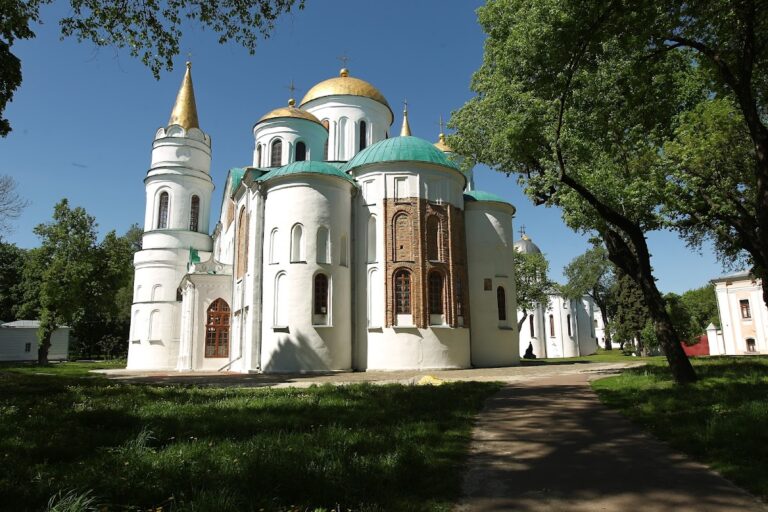
The Spaso-Preobrazhensky Cathedral dates from the mid-eleventh century. It was the first masonry church in Chernihiv and is among the earliest masonry churches of Kyivan Rus. Its construction began under Mstislav Volodymyrovich, whose burial in the cathedral linked the building directly with the princely history of the Detinets.
Boris and Gleb Cathedral
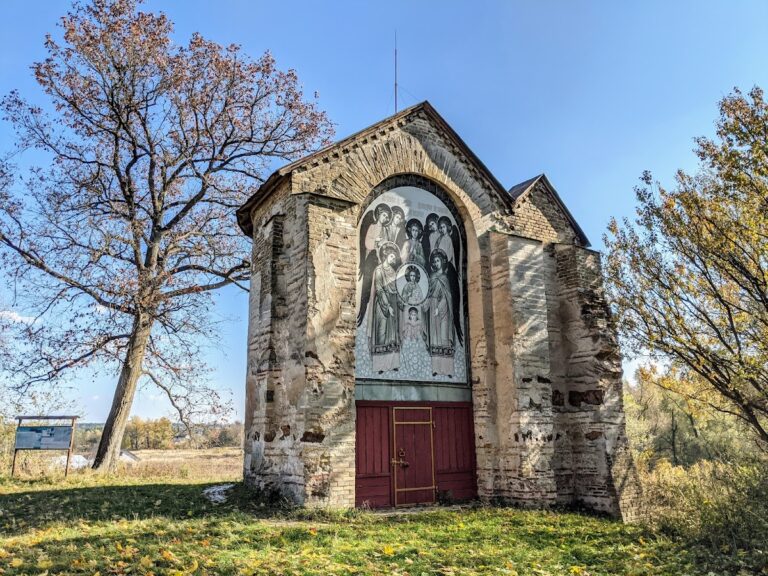
The Boris and Gleb Cathedral dates from the beginning of the twelfth century. It was founded during the rule of Davyd Sviatoslavovych, prince of Chernihiv. The remains of this church form part of the group of four churches exposed through archaeological excavation within the former fortified center.
Catherine Church
Catherine Church stands in the Tretyak area beside the Detinets. Dating from the beginning of the eighteenth century, it was built in the Ukrainian Baroque style and belongs to the later religious and architectural landscape surrounding the former fortress.
Later civic and military buildings
Chernihiv Collegium
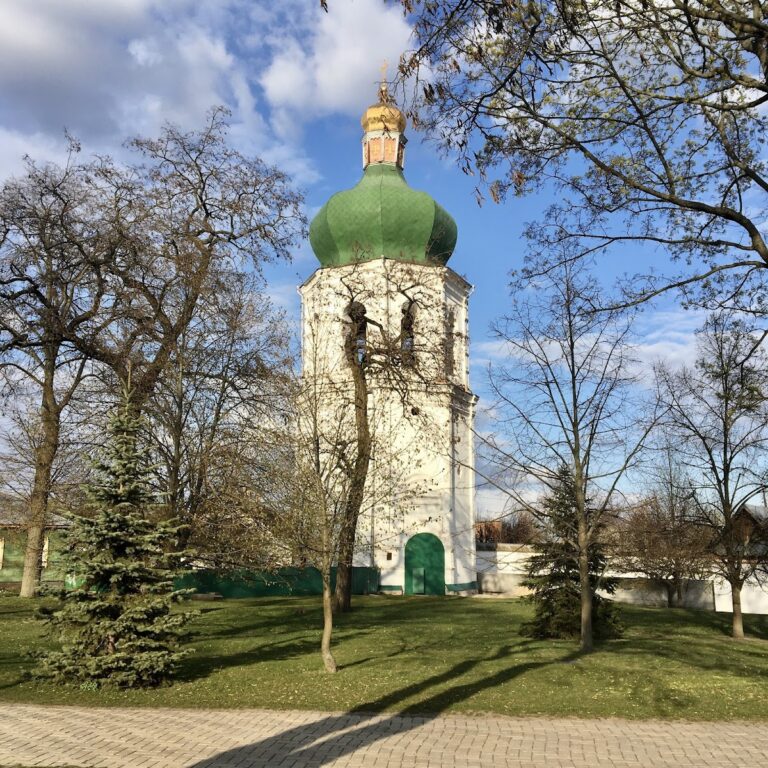
The Chernihiv Collegium was built in 1700 and includes a bell tower. It became the dominant element of the historic ensemble during the eighteenth century. Its construction was directed by Ivan Maksymovych, an early-eighteenth-century Orthodox archbishop and educational patron, with financial support from Ivan Mazepa, a Cossack hetman associated with the political and cultural building activity of the period.
Administrative and educational buildings
The late-seventeenth-century Mazepa House, also called the Lizohub House, later housed the Regimental Chancellery, the administrative office of the Chernihiv Regiment. The Archbishop’s House, built in 1780, is described as the city’s first Classical-style building. The Governor’s House, dating from 1804, now houses a historical museum. A separate Chernihiv Women’s Gymnasium building from the late nineteenth century accommodates an art museum, while the Chernihiv Men’s Gymnasium building, also constructed in 1804, is one of the city’s earliest educational buildings.
Fortress artillery
Twelve cast-iron cannon from the Chernihiv Fortress stand on carriages along the southern slope of the elevation, on the site of a former defensive rampart. They are associated with artillery from the sixteenth to eighteenth centuries and were mounted on carriages in 1911. Tradition holds that Peter I presented them to Chernihiv in recognition of the bravery of its Cossacks during the war with Sweden. The artillery yard may have produced most of the cannon.
Monuments and commemorative features
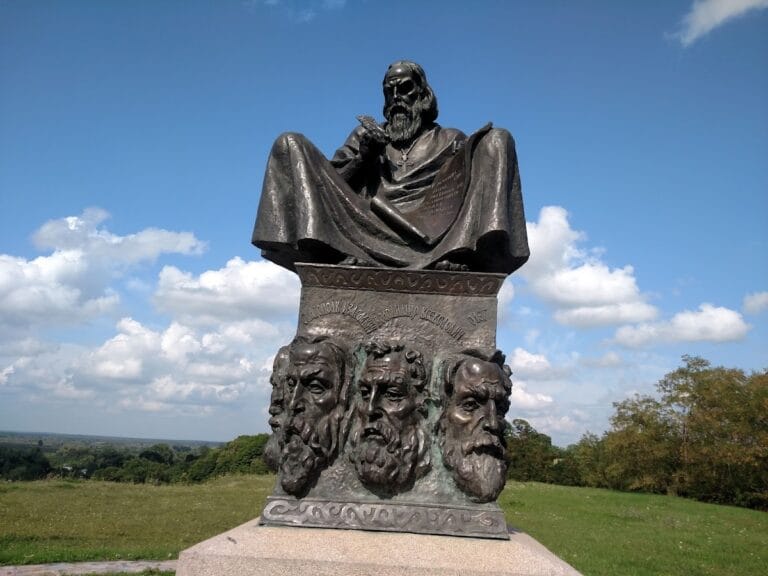
The former citadel site contains a monument to Taras Shevchenko, the nineteenth-century Ukrainian poet, writer, and artist. Other commemorative features include monuments to Alexander Pushkin, Ivan Mazepa, and Saint Ihor Olhovych, a twelfth-century prince of Kyiv venerated as an Orthodox Christian saint. A monument marks the mass grave of soldiers who liberated the city in 1943, while a partisan stone marks the site of the Communist Party city committee building burned by the Nazis in the same year. A memorial stone titled To the Fighters for the Freedom of Ukraine was installed in October 1992. The grounds also contain a fountain and the Central Park of Culture and Recreation named after M. M. Kotsiubynsky.
Nearby sites