Luxor: The Ancient Theban Capital of Egypt


Site at a Glance
- Rating
- 4.8
- Popularity
- Very High
- Country
- Egypt
- Primary era
- Bronze Age
- External website
- Open
- Eras represented
- Bronze Age, Iron Age
- Civilizations
- Egyptian, Kushite
- Site type
- City
On this page21 sections
History
Luxor is a city in Egypt that contains the remains of ancient Thebes, the great political and religious centre of Upper Egypt. Known in ancient Egyptian as Waset and later as the City of Amun, Thebes served as Egypt’s capital for long periods during the Middle and New Kingdoms. Its earliest settlement layers date to before 3200 BCE, although the city’s beginnings remain uncertain.
Early settlement and the rise of Thebes
During the Old Kingdom, Thebes was a small settlement and administrative centre in the fourth Upper Egyptian nome, an ancient Egyptian province governed locally by a nomarch. Early evidence includes the lower part of a statue of the Fifth-Dynasty king Nyuserre, found at Karnak, and a statue linked with the Twelfth Dynasty that may have been reused. Stone tools in the Theban area, probably 400,000 to 300,000 years old, were redeposited by the Nile and do not establish local habitation at that time. Earlier settlement evidence was also buried beneath later river deposits.
During the First Intermediate Period, a time of weakened central authority between the Old and Middle Kingdoms, Thebes became the centre of a southern kingdom. Its rulers descended from the local leader Intef the Elder and formed the Theban line of the Eleventh Dynasty. They competed with the rulers of Herakleopolis for control of Egypt. Around 2050 BCE, Mentuhotep II defeated his northern rivals and reunited the country, beginning the Middle Kingdom. Thebes then became the capital, and Mentuhotep built the first royal mortuary temple at Deir el-Bahari. A mortuary temple was dedicated to the cult and commemoration of a deceased ruler.
Middle Kingdom and Second Intermediate Period
Amenemhat I, founder of the Twelfth Dynasty, later moved the government north to Itjtawy because Thebes lay too far south for efficient control of the divided regions. The city nevertheless remained an important religious and economic centre. The cult of Amun, a major Egyptian god whose worship was centred at Thebes, expanded throughout Egypt. Amun was later joined with the sun god Ra as Amun-Ra, while Mut and Khonsu were regarded as his consort and son, forming the Theban triad.
During the Second Intermediate Period, Thebes controlled southern Egypt while the Hyksos ruled much of the north. The Theban rulers Seqenenre Tao, Kamose, and Ahmose I fought against them. Ahmose captured Avaris and expelled the Hyksos from Egypt and the Levant. He then founded the Eighteenth Dynasty and established the New Kingdom, Egypt’s imperial phase, with Thebes as its capital.
New Kingdom prominence
Thebes remained the capital during most of the Eighteenth Dynasty and became a major administrative centre. Among its functions was the training of Egyptianized Nubian officials. The city reached its greatest political, religious, and economic prominence during the New Kingdom. Its prosperity was connected with Egyptian expansion, trade with Nubia and the Red Sea region, mineral resources, and the growing influence of Amun’s cult.
Hatshepsut, the female pharaoh of the Eighteenth Dynasty, strengthened the city’s economy by renewing Red Sea trade, including links with Punt. Thutmose III brought war booty to Thebes, while Amenhotep III expanded its building programme on an unprecedented scale. During Akhenaten’s reign, the court abandoned Thebes, the worship of Amun was prohibited, and the capital moved to Akhetaten. After Akhenaten’s death, the capital was restored to Memphis, but building and religious activity continued at Thebes.
Under the Nineteenth Dynasty, the principal seat of government moved to the Nile Delta. Thebes retained substantial revenues, prestige, and religious importance, and Seti I and Ramesses II continued to reside there for part of each year. Ramesses II also undertook extensive building projects in the city.
Priestly rule and political decline
By the end of the New Kingdom, the High Priests of Amun had gained control over southern Egypt. Around the beginning of the eleventh century BCE, Herihor, a high priest as well as a military and civil official, accumulated religious, military, administrative, and gubernatorial offices. He established a virtually independent Theban theocracy. This priestly state continued alongside northern dynasties during the Third Intermediate Period, the era that followed the weakening of centralized royal authority.
Kushite rulers later took control of Thebes and Upper Egypt. Piye, a ruler of the Twenty-Fifth Dynasty, reunified much of Egypt, while Taharqa carried out major building projects at Thebes. Assyrian campaigns brought a decisive political disaster. After Taharqa’s defeat, forces of the Assyrian king Ashurbanipal captured and plundered Thebes in 663 BCE. The city remained inhabited and religiously important, but it did not regain its earlier political position.
The Persian conquest under Cambyses II in 525 BCE ended Egypt’s remaining political autonomy. Under the Ptolemies, Thebes continued to support important sanctuaries but repeatedly became a centre of revolt. After further rebellions in 132 and 91 BCE, the city was besieged, plundered, and heavily damaged.
Roman, Christian, and Islamic periods
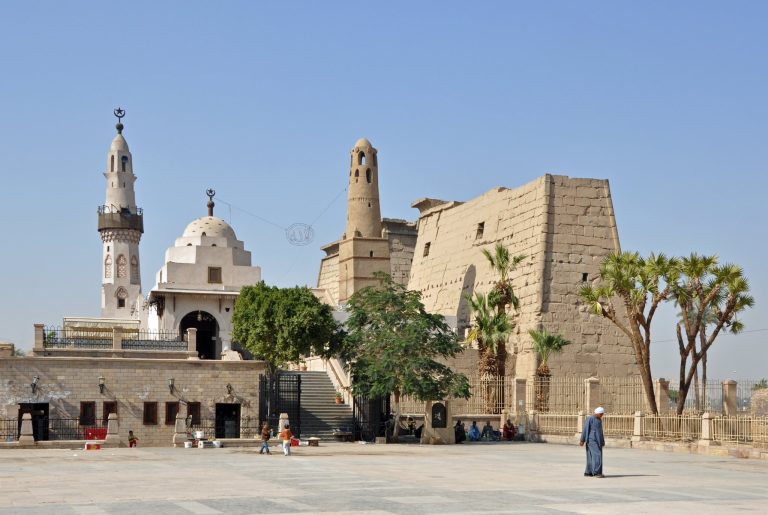
During Roman rule, beginning in 30 BCE, much of the remaining population gathered around the pylon of Luxor Temple. Thebes became part of the province of Thebais, later divided into Thebais Superior and Thebais Inferior. A Roman legion used Luxor Temple as a headquarters during campaigns in Nubia. In the first century CE, Strabo described the reduced city as a village.
Christianity brought the decline of the ancient cults. Temples were adapted as churches and monasteries, including a monastery at Deir el-Bahari, and tombs were reused as dwellings. Luxor Temple became a church in 395 CE and was later converted into a mosque in the thirteenth century. After the Arab conquest, the settlement acquired the name Luxor, derived from a term meaning “palaces” or “fortresses.” Ancient monuments were later buried or neglected, while tombs continued to serve as homes and stables.
Rediscovery and heritage protection
Modern scholarly interest in Thebes revived with the scholars who accompanied Napoleon’s expedition. Archaeological work continued through the nineteenth and twentieth centuries, and excavations remain ongoing. The ancient city, its temples, and its necropolis were inscribed by UNESCO in 1979 as the cultural World Heritage Site “Ancient Thebes with its Necropolis,” under criteria I, III, and VI.
Remains
The Theban remains extend along both banks of the Nile, across the alluvial plain around a great bend in the river and onto parts of the western Theban Hills. The ancient site covered approximately 93 square kilometres and followed a broad northeast to southwest axis parallel to the Nile. The western hills rise to the sacred peak of al-Qurn, about 420 metres high. The eastern bank held the principal urban and temple districts, while the western bank contained royal and private cemeteries, mortuary temples, and funerary settlements.
Eastern urban and temple districts
Karnak
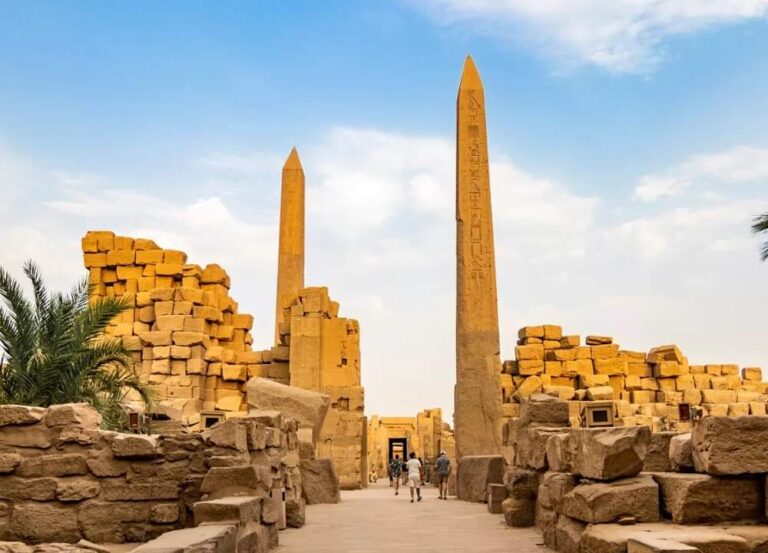
Karnak was a large religious complex devoted chiefly to the Theban triad of Amun, Mut, and Khonsu, with additional temples dedicated to Montu and other deities. Its Middle Kingdom remains include a planned settlement around the temple, covering about 250 hectares, with two palatial buildings identified through excavation. The complex was repeatedly enlarged. Thutmose I began a major New Kingdom expansion, Ramesses II added statues, obelisks, and a third enclosure wall, Shoshenq I added an outer court and pylon, and Taharqa constructed further elements, including a kiosk.
The oldest surviving remains at Thebes are no earlier than parts of the Karnak complex that may date to the Middle Kingdom. The Nyuserre statue fragment and a possibly reused statue of Senusret are among the finds associated with the complex.
Luxor Temple
Luxor Temple stood on the eastern bank and remained a focus of settlement during the Roman period. The eastern temple zone included both Luxor and Karnak, which were linked by avenues lined with sphinxes. Together, the surviving ruins of these two major temples extend for roughly 260 metres. A monumental temple gateway, or pylon, consisted of two massive sloping towers. The population that remained in the Roman period clustered around Luxor Temple’s entrance pylon, and the building was later adapted first for Christian and then for Islamic use.
Royal and private necropolises
Valley of the Kings
The Valley of the Kings was selected by Thutmose I and his court architect Ineni for concealed royal burials in the limestone cliffs. Its tombs generally consist of sloping corridors, sometimes reaching 200 metres in length and descending as much as 100 metres, followed by three or four chambers. Decorated walls and ceilings carry painted scenes relating to the deceased ruler’s life, achievements, and afterlife. Entrances could be concealed beneath earth, rubble, or large stones, and some tombs included secret falling doors.
More than sixty tombs have been discovered in the valley, most associated with pharaohs. Burials include those of Thutmose III, Amenhotep II, Tutankhamun, Horemheb, Ramesses I, Seti I, Merenptah, Ramesses III, Ramesses VI, and Ramesses IX. Tutankhamun’s tomb, known as KV62, was found intact by Howard Carter in 1922. Its contents included gold, jewellery, and other objects, unlike the other royal tombs, which had been robbed in antiquity.
Valley of the Queens
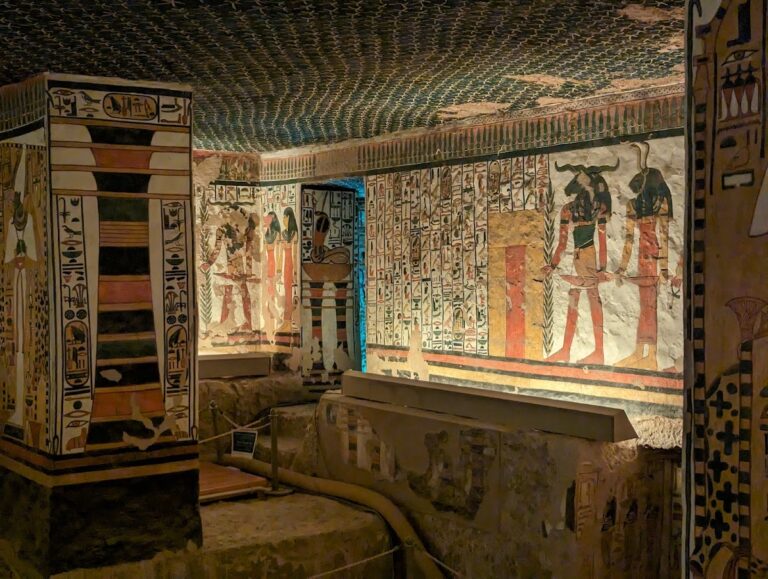
The Valley of the Queens contains more than seventy tombs, including burials of queens, royal mothers, and princes who died young. The tomb of Nefertari, the wife of Ramesses II, retains wall paintings illustrating the Book of the Dead and a ceiling patterned with stars. Painted decoration also survives in tombs belonging to sons of Ramesses III.
Private tombs
Private tombs developed from small chambers with painted walls or relief decoration into larger and more elaborate complexes. They were especially large during the reign of Amenhotep III and became smaller toward the end of the Nineteenth Dynasty and during the Twentieth Dynasty. Earlier decoration combined scenes of daily life with funerary subjects. By the middle of the Nineteenth Dynasty, such scenes were increasingly replaced by imagery focused exclusively on the afterlife.
Mortuary temples and western-bank settlements
Deir el-Bahari
Deir el-Bahari contains the mortuary temple of Mentuhotep II, the later and larger temple of Hatshepsut, and a temple of Thutmose III. Hatshepsut’s complex was partly modelled on Mentuhotep’s earlier monument. It included the Red Chapel, which housed the ceremonial barque of Amun, and monumental granite obelisks stood before the temple.
Ramesseum
The Ramesseum was the mortuary temple of Ramesses II. Granaries around the complex concentrated taxes from Upper Egypt and held resources obtained from Nubia and the Eastern Desert, supporting the temple’s construction and operation.
Medinet Habu
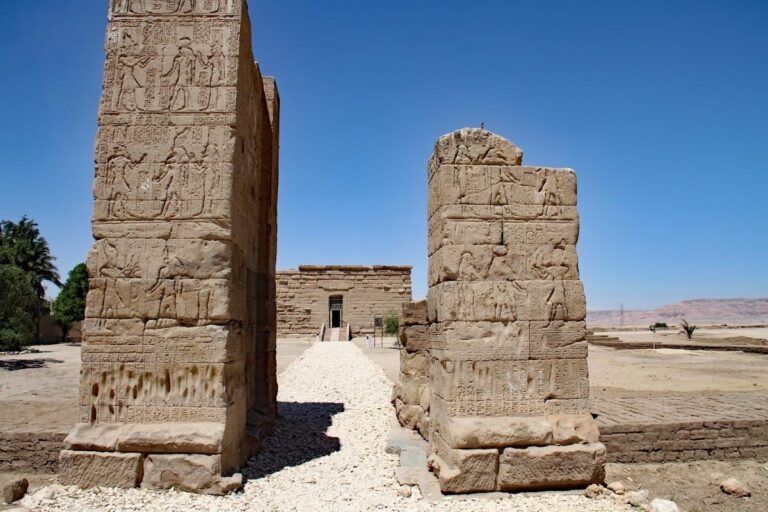
Medinet Habu contains the mortuary temple of Ramesses III, built partly as an architectural model of the Ramesseum. Victory scenes appear on its entrance pylons. Inside the enclosure are a temple dedicated to older deities and tombs associated with the God’s Wives of Amun, a powerful female religious office whose holders could possess substantial property and political influence in Thebes.
Other western-bank complexes
Near Qurna are the ruins of the mortuary temple of Seti I, intended for Seti and his father, Ramesses I. Amenhotep III built a large mortuary temple and the palace-city of Malkata on the western bank. Malkata faced an artificial lake of approximately 364 hectares.
The Colossi of Memnon are two seated statues of Amenhotep III, each about 18 metres high. They once stood at the entrance to his now-vanished mortuary temple. Greek and Roman graffiti remain on the statues, including inscriptions from the time of Hadrian. In antiquity, one colossus was believed to produce a sound at dawn, which Greek and Roman visitors associated with the mythical Memnon. The sound stopped after restoration in 199 CE.
The western funerary landscape also includes the Valley of the Nobles at Sheikh Abd el-Qurna, Deir el-Medina, the workers’ settlement serving the royal tombs, Qurna, Kurnet Murai, and at-Tarif. These areas formed part of the network of royal, elite, and non-elite burial grounds and settlements distributed across the western bank.
Burial traditions and later reuse
Royal burial practices at Thebes shifted between rock-cut chambers and pyramidal forms. Elite rock-cut tombs were used early at the site, while rulers of the Twelfth Dynasty returned to pyramid burial. During the Seventeenth Dynasty and afterward, royal burials again took the form of chambers cut into the rock.
During the Twenty-First Dynasty, some royal tombs were repaired and reused for reburials. Earlier rulers, princes, queens, and princesses were moved into reused tombs, and original burial goods were removed. The wrappings of Ramesses III and Seti I were replaced, while the tombs of Thutmose II and Amenhotep I were repaired. The ancient city is now represented chiefly by ruins, temples, tombs, archaeological remains, and reused monuments distributed across modern Luxor.