Lure Abbey: A Monastery and Imperial Principality in France
Site at a Glance
- Popularity
- Medium
- Country
- France
- Primary era
- Early Modern
- Eras represented
- Early Modern
- Civilizations
- French, Habsburg, Holy Roman Empire
- Site type
- Religious
- Remains
- Palace
On this page16 sections
History
Lure Abbey is a former monastery in France, traditionally founded in 611 by the Irish monk Saint Desle. It later became an autonomous principality within the Holy Roman Empire, a political union of central European territories. Another tradition credits its foundation to Desle’s mentor, Columbanus, and 959 is the first certain written mention of the abbey.
Foundation and early community
Desle, also called Deicole or Diel, came from Ireland around 570 with Columbanus and a group of companions. After Columbanus left Luxeuil in 610, King Chlothar II, a Merovingian ruler of the Franks and Burgundy, is said to have granted Desle land for a monastery. One account of the foundation describes the king meeting Desle while hunting and assigning forests, meadows, fisheries, pastures, vineyards, and a church to the new community. The land belonged to the noble Weishar, while his wife, Berthilde, gave property that enabled Desle to establish two places of prayer. Duke Attic held the abbey’s lay protectorship, a lord’s responsibility for its protection and certain secular affairs. By 727, that role had passed through Attic’s grandson Eberhard of Eguisheim to the Counts of Ferrette.
Desle died on 18 January 625 after withdrawing to a hermitage. Columbanus the Younger, a different monk from Columbanus, later succeeded him as head of the abbey. During the Carolingian era, rulers Pepin the Short, Charlemagne, and Louis the Pious granted the community revenues and rights over about ten villages. Its lands included Passavant-la-Rochère and its castle, as well as property at Éboulet, Frahier, Errevet, Châlonvillars, and Mandrevillars.
In 817, the Council of Aachen required Lure to follow the Rule of Saint Benedict in place of Columbanus’s stricter monastic rule. The council also assigned the abbey to a group of monasteries whose duty was to pray, rather than supply troops or financial contributions.
Disruption and rebuilding
In the second half of the ninth century, Lothair II gave the monastery to Waldrada, who expelled its monks. After Lothair died in 869, she withdrew to Remiremont and transferred the lay protectorship to her relative Eberhard III. The role then passed to Eberhard’s son Hugues and grandson Gontran. Hugues had persecuted the monks, but vowed to restore the abbey’s rights if he recovered from a serious illness. After his recovery, he and his relatives performed penance there, and Hugues restored the community. He died at the abbey in 940.
Hungarian invasions brought further damage, with the abbey pillaged and burned between 926 and 937. Its revival began in 967 under Abbot Baudran, also known as Baltran, who came from Laversberg. Otto I, a king and emperor of the Holy Roman Empire, authorized him to rebuild and develop the monastery. Otto had obtained rights over Lure in 959 from Eberhard IV of Alsace and Hugues I, and his charter made the abbey an imperial fief, meaning territory held under the emperor’s authority. It gave the community the right to choose its abbot and exemption from local bishops, placing it directly under the Holy See, the Catholic Church’s central governing authority. Baudran and the monks received churches and other property on the condition that they rebuild the church and monastery. Lure nevertheless remained under the sovereignty of the Kings of Burgundy.
Imperial authority and regional power
Henry II confirmed the abbey’s privileges in 1016 for Abbot Milon, adding authority to make laws, appoint officials, make peace or war, mint coins, grant privileges, and use the title “by the grace of God.” Popes recognized Lure’s autonomy in 1054 and 1179, although the archbishop of Besançon continued to demand homage. After Rudolph III of Burgundy transferred his possessions to Conrad II and Henry III in 1032, Lure’s abbots exercised broad public powers. These included raising taxes and military forces, issuing commands, granting safe-conducts and pardons, legitimizing children, and exercising rights over treasure, mines, and gemstones. The abbots held the rank of princes of the Holy Roman Empire and a deliberative vote in its representative assembly, the Imperial Diet.
Emperors repeatedly upheld Lure’s privileges. Frederick I Barbarossa confirmed them in 1157, Henry VI reaffirmed them, and in 1218 Frederick II placed the abbey under his personal protection. He granted Abbot Thiébaud the titles of Imperial Chaplain and Prince of the Empire. Further confirmation followed in 1290. The abbey came under Austrian rule in 1392 and regained political influence during the fifteenth century.
Its authority was contested by regional lords. In the twelfth century, Thierry II, Count of Montbéliard, acquired the lay protectorship and made demands on the abbey. The abbot sought his excommunication and appealed to church authorities, strengthening Lure’s ties with Murbach Abbey in Upper Alsace. In the thirteenth century, Lure owned the Saulnot saltworks, granted by Thierry III, but lost them after his death around 1282. The abbey’s fief and lay protectorship were also entrusted to outside lords, including the Counts of Ferrette. Around 1324, Albert II of Austria refused to perform homage for Lure to Eudes IV, Duke of Burgundy, leading to conflict. Lure’s standing as an imperial principality helped Albert avoid that feudal obligation.
Coinage and union with Murbach
On 7 March 1544, Charles V authorized Jean Rodolphe Stoer, an ecclesiastical assistant appointed by Georges de Masmünster, to establish a mint for Lure and Murbach. It operated at Guebwiller and issued silver coins in one-, half-, and quarter-écu denominations, equal in weight and value to other currencies of the Empire. One face carried a spread eagle and the inscription Carolus V, Romanorum imperator, meaning “Charles V, emperor of the Romans.” The other displayed the abbot’s arms alongside those of the abbey, with his name and the year of issue. The coins remained in circulation until the region came under French rule.
The union between Lure and Murbach was formally decreed on 12 March 1556 by Cardinal Giovanni Morone and confirmed by Pope Pius IV in 1560. Thereafter, their abbots used the titles and arms of both institutions, and the abbot held two votes in the Imperial Diet.
French rule and dissolution
During the Thirty Years’ War, the major European conflict of 1618–1648, Murbach placed Lure under French protection in 1634 and entrusted it to Marshal Jacques Nompar de Caumont, duc de La Force. The Treaty of Münster in 1648 confirmed the principality’s autonomy. French forces occupied the territory in 1674 and bombarded the abbey for six hours on 3 July. In 1679, Louis XIV incorporated it into the County of Burgundy. The French Crown took over the abbots’ sovereign authority, while their other church and administrative rights remained. A ruling in 1749 confirmed the county’s superior authority over the territory.
A concession issued on 21 April 1757 allowed the Prince-Abbot to mine coal in the Champagney area. During the French Revolution, the mines became national property and were later operated by state authorities and private companies. A papal bull of 3 August 1764 converted Lure and Murbach from monasteries into non-monastic church chapters. Lure’s chapter had six members, while Murbach’s had eight, each led by a Prince-Abbot. Members had to demonstrate noble ancestry across four generations, also described as sixteen quarters of nobility on their parents’ sides. Royal documents of 1759 and 1765 affirmed the abbot’s rank and titles, including Prince of the Holy Roman Empire and Grand Provost and Treasurer of Lure. The abbey was dissolved after the French Revolution. Portions of its abbatial palace received historic-monument designations in 1968, 1977, and 1998.
Remains
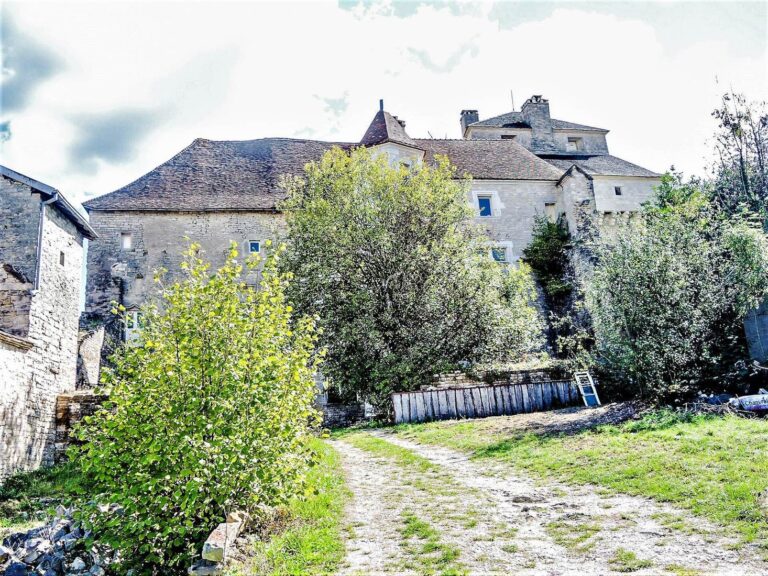
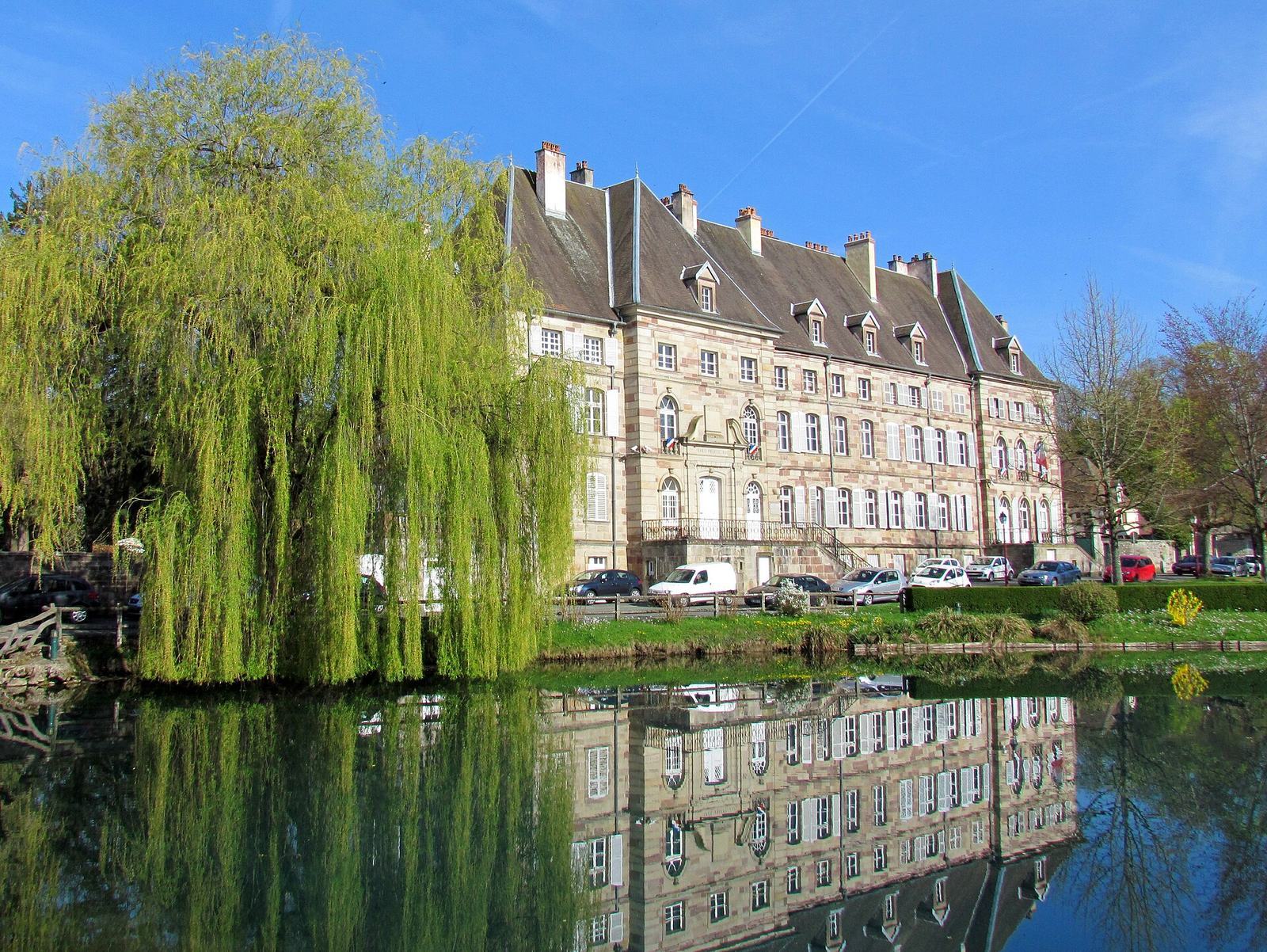
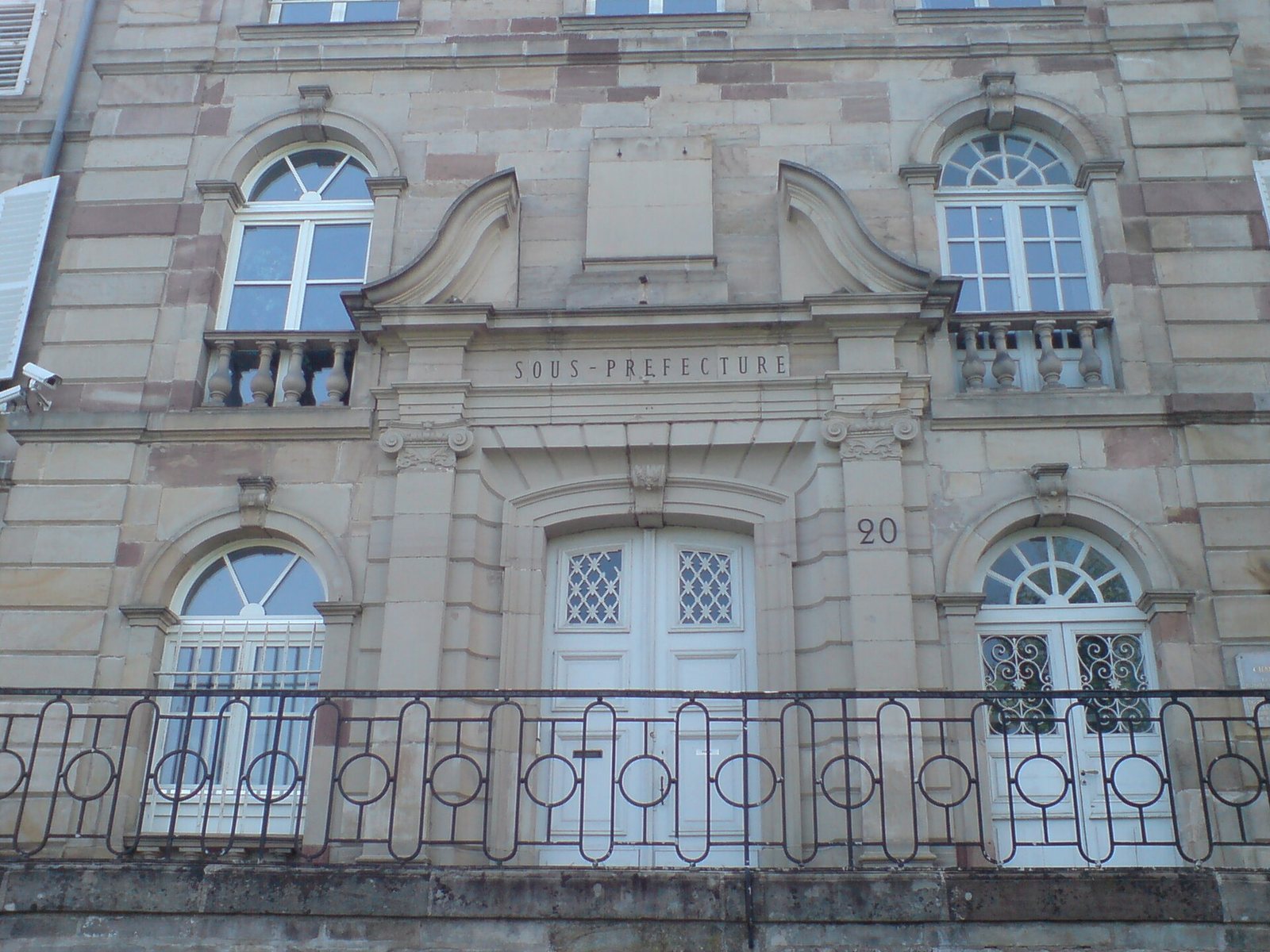
The surviving complex comprises the building now used as a district administrative office and several nearby houses once occupied by canons, clergy serving a church chapter. The abbey stood beside the Font pond, a resurgence of the Ognon River, in an area that was marshland. The site lay on the route between Mandeure and Luxeuil. It may have had earlier habitation, and excavations in the area uncovered numerous Roman antiquities. Desle established two oratories, or small places of prayer, dedicated to Saints Peter and Paul. Late in his life, he withdrew to a hermitage where he had built a small chapel dedicated to the Holy Trinity.
Abbey church
The last abbey church was built between 1750 and 1755. After the French Revolution it was sold and demolished in 1797, and stones from the abbey church were reused in other construction.
Surviving monastic buildings
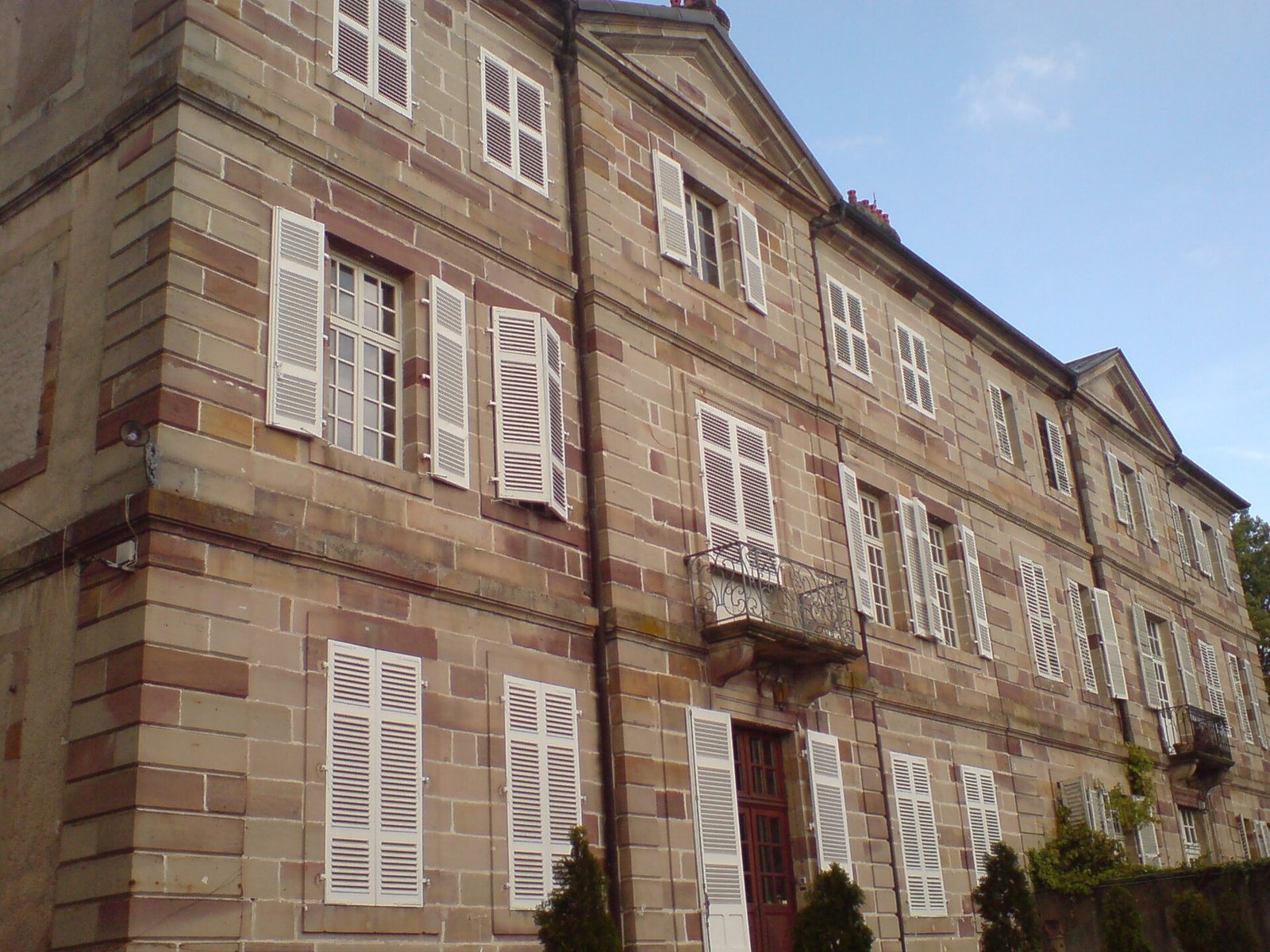
Abbatial palace
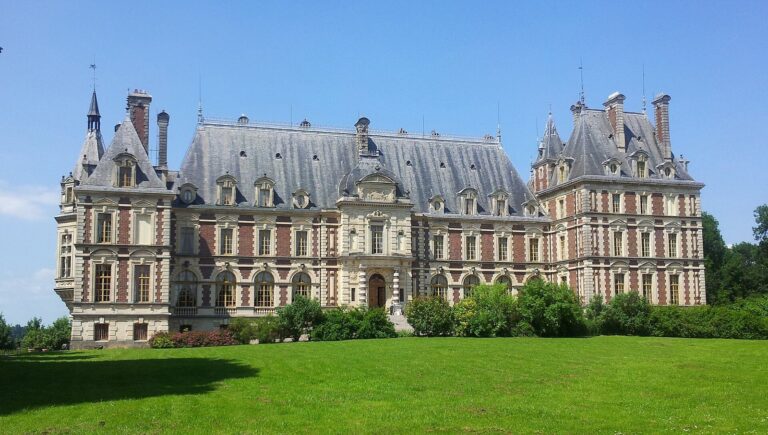
The abbatial palace dates to the seventeenth and eighteenth centuries. Its surviving building now serves as the district administrative office.
Monks’ dormitory
A surviving wing of the monks’ dormitory dates to 1519. In the second half of the eighteenth century, the dormitories were extensively altered and converted into apartments for canons. The wing’s southeastern portion was later demolished after it became structurally unsound.
Canonical houses and garden
Several eighteenth-century houses for canons remain on Rue Kléber. A botanical garden was laid out behind the palace in the 1990s.
Heraldry and chapter insignia
Arms of Lure and Murbach
The joint arms combine the emblems of the two abbeys. Murbach is represented by a black rearing greyhound, with a gold collar and red buckle, on a silver shield. Lure’s side shows a flesh-colored arm emerging from an ash-gray sleeve and raising two fingers in blessing against a red background.
Arms of Lure
Lure’s own arms show a gold figure of Saint Benedict on a blue shield.
Insignia of the united chapters
The united chapters used an eight-pointed gold cross covered with enamel, with a lily emblem between each pair of points. One face showed Saints Desle and Louis with an inscription; the other depicted Saints Léger and Louis with a separate inscription.