Dragalevtsi Monastery: A Royal Bulgarian Orthodox Monastery near Sofia


Site at a Glance
- Rating
- 4.8
- Popularity
- Medium
- Country
- Bulgaria
- Primary era
- Medieval
- Eras represented
- Medieval, Early Modern, Modern
- Civilizations
- Ottoman, Second Bulgarian Empire
- Site type
- Religious
- Remains
- Monastery
On this page10 sections
History
Dragalevtsi Monastery is a Bulgarian Orthodox monastery in Bulgaria, near Sofia, founded in 1345 by Tsar Ivan Alexander during the Second Bulgarian Empire. Also known as the Monastery of the Dormition of the Mother of God, it was established as a stavropegic monastery, meaning that it answered directly to the patriarch rather than to local civic or episcopal authorities. Its royal foundation and extensive privileges made it known as the “Royal Monastery.”
Royal foundation and privileges
The monastery received exemption from taxes and other obligations. The Vitosha Charter of Tsar Ivan Shishman, issued before 1382, records these privileges and confirms the monastery’s ownership of the village of Novachene. Dragalevtsi was regarded as the most prominent of the fourteen monasteries forming the Sofia Holy Mountain, a group of monasteries around Sofia that constituted an important religious and cultural landscape. It was not, however, a central lavra.
Abandonment and restoration
After the Ottoman conquest of Sofia in 1382, Dragalevtsi Monastery was abandoned. It was rebuilt later in the fifteenth century with financial support from Radoslav Mavar, a Sofia boyar. The church was restored and frescoed in 1476, a phase associated with the renewed life of the monastery and the preservation of its medieval artistic heritage.
Literary and educational centre
From the fourteenth to the sixteenth century, the monastery was associated with the Sofia Literary School, where Bulgarian Christian books were copied and produced. Its scriptorium and educational work continued in later centuries. A monastic school with a permanent teacher was established in the seventeenth century.
Between 1562 and 1612, Job Kasinets, a grammarian from Timișoara, produced the Boyana Beadroll at the monastery. The manuscript was found in Boyana Church in 1854 by the Ukrainian philologist Viktor Grigorovich. The monastery’s written heritage also includes several Gospels, a psalter, a collection of homilies, and other church books, some of which are preserved in monasteries and museums on Mount Athos.
Revolutionary activity
Dragalevtsi Monastery participated in Bulgaria’s nineteenth-century national-liberation movement, the struggle to end Ottoman rule and establish Bulgarian independence. During 1871 and 1872, Vasil Levski, a leading organizer of clandestine revolutionary committees, repeatedly stayed at the monastery and used it as a centre for revolutionary activity.
The abbot, Hieromonk Genadii Skitnik, helped Levski establish committees in Sofia and nearby villages and carried their correspondence. Revolutionary meetings also took place at the monastery. After Levski’s arrest, Genadii temporarily left monastic life, travelled to Serbia, met Panayot Hitov, and planned the dispatch of armed bands and an uprising in Bulgaria. He later withdrew to a monastery on Mount Athos. His successor, Deacon Ignatii of Rila, renewed the secret revolutionary committee in Sofia in 1873 while continuing his monastic duties.
Twentieth-century changes and religious continuity
In 1932, the church was enlarged by adding a new naos, the principal worship space in an Eastern Orthodox church. The older and newer parts were subsequently treated as one church, which is designated a cultural monument of national importance. Bulgarian Exarch Stefan established a residence of the Holy Synod at the monastery, and the complex was visited by Tsar Boris III and Prince Kyril.
Dragalevtsi Monastery remains an active Bulgarian Orthodox nunnery under the Bulgarian Patriarchate and the Sofia Diocese.
Remains
The monastery lies on the lower slopes of Vitosha Mountain above Sofia, among beech forests beside the Dragalevska River. Its historic complex consisted of a church with residential and service buildings. The surrounding buildings now include newer structures in the Bulgarian national style and monastic-cell buildings of two and four storeys, constructed during the second quarter of the twentieth century.
Monastery church
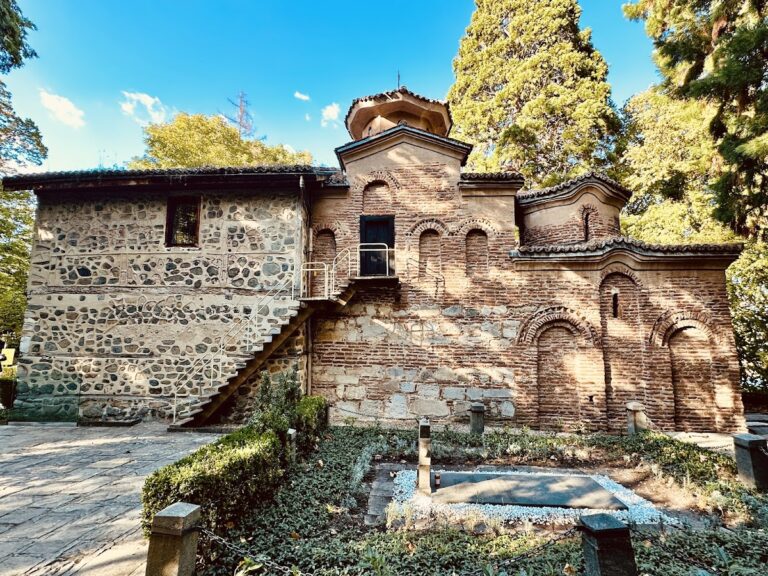
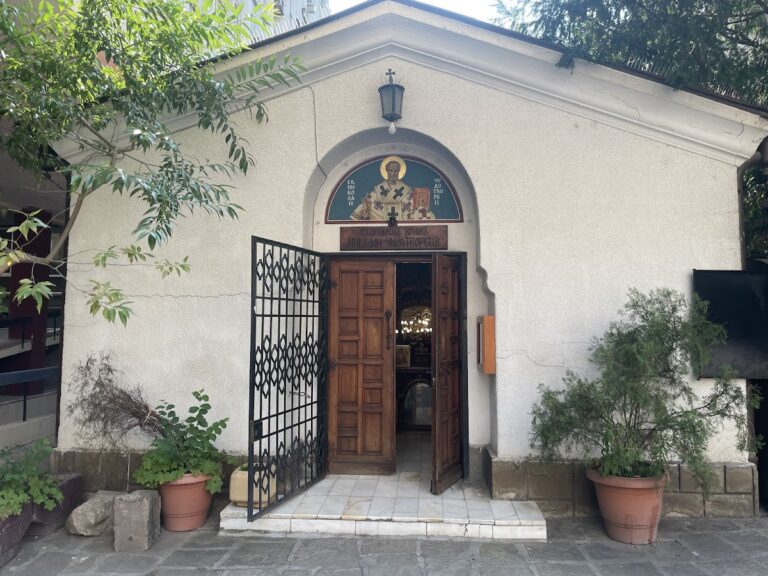
Dedicated to the Holy Mother of God, the monastery church combines the earlier katholikon, the principal church of a monastery, with the northern addition built in 1932. The older church measures approximately 12 by 5 metres and has a single nave and one apse. The enlarged building brought the two sections into a single ecclesiastical structure.
The church’s medieval decoration belongs chiefly to the restoration of 1476. An inscription above the entrance survives, as do donor portraits of Radoslav Mavar, his wife Vida, and their sons Nikola and Strahil. These portraits commemorate the patron whose financial support helped restore the monastery after its earlier abandonment.
Frescoes and interior decoration
Frescoes in the upper parts of the western facade show the warrior saints Demetrius of Thessaloniki, George, and Mercurius. Dated to 1475–1476, the paintings depict the saints in realistically rendered full knightly armour, with Demetrius and Mercurius wearing spurs. One scene shows Saint Demetrius fighting Tsar Kaloyan, who is represented as an enemy of the faith.
Other fifteenth-century frescoes survive alongside paintings from the sixteenth and seventeenth centuries. The central part of the church was repainted in the seventeenth century, while the narthex, an entrance or vestibule area, received compositions of the Last Judgment and the Baptism of Christ. Additional wall paintings were added in the eighteenth century.
A carved wooden iconostasis with gilding was made and installed in the late eighteenth century. Several icons were painted by Nikola Obrazopisov, a nineteenth-century artist associated with the Samokov Art School, a major Bulgarian tradition of icon painting and ecclesiastical art.
Manuscripts and church books
The monastery’s surviving written heritage reflects its long literary activity. A Gospel dated 1469 describes Dragalevtsi as a royal monastery. Another Gospel, commissioned in 1534 by the Sofia tailor Milich and his wife Vela, belongs to the monastery’s later manuscript tradition. A Gospel from 1648 was bound in silver by the goldsmith Velko, who decorated it with three biblical scenes.
Other works connected with Dragalevtsi include a sixteenth-century psalter completed in 1598 by the scholar-monks Danail, Stoyan, and Vladko, an eighteenth-century collection of homilies, and numerous other church books. Some of these books are preserved in monasteries and museums on Mount Athos.
Nearby sites