Seven Saints Church: A Bulgarian Orthodox Church in Sofia


Site at a Glance
- Rating
- 4.6
- Popularity
- Medium
- Country
- Bulgaria
- Primary era
- Early Modern
- External website
- Open
- Eras represented
- Classical, Early Modern, Modern
- Civilizations
- Ottoman, Roman
- Site type
- Religious
- Remains
- Church
On this page11 sections
History
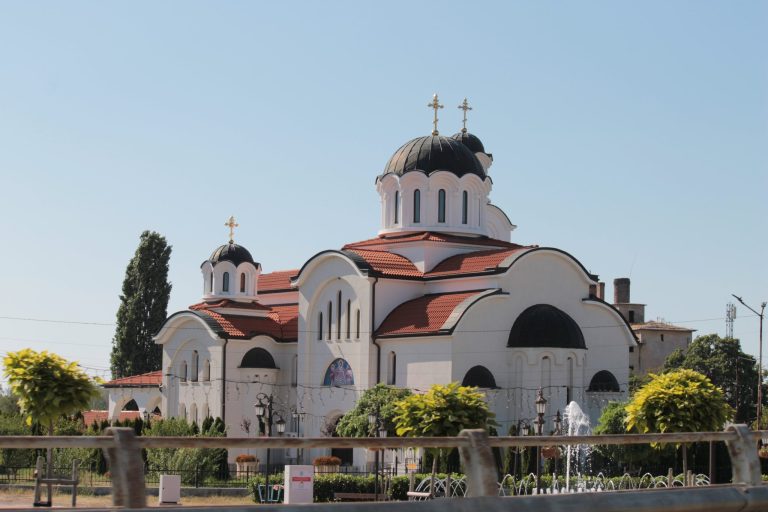
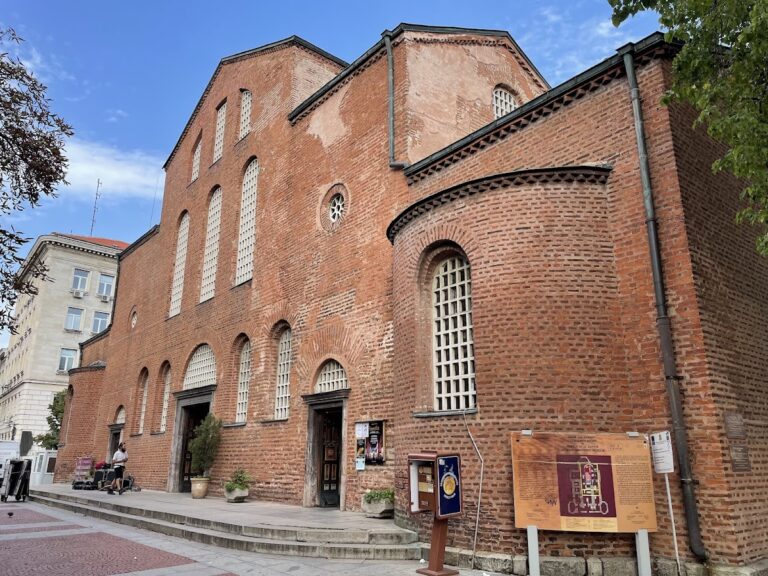
Seven Saints Church is a Bulgarian Orthodox church in Sofia, Bulgaria, converted from an Ottoman mosque completed around 1547. Dedicated to Cyril, Methodius, and their five disciples, it belongs to the Bulgarian Orthodox Church and is administered within the Bulgarian Patriarchate and the Sofia Eparchy. The church combines the preserved monumentality of the Ottoman building with Bulgarian national Romantic and Neo-Byzantine design.
From Roman Serdica to the Ottoman mosque
The mosque was built on a site with several earlier religious phases. Its foundations contained the remains of a pagan temple dedicated to Asclepius, the ancient Greco-Roman god associated with healing. The site also held an early Christian temple dated to the fourth or fifth century and later a nunnery belonging to Rila Monastery. Ruins of the early Christian building were excavated in 1901. Roman Serdica, the settlement that developed at the site of present-day Sofia, therefore formed part of the deeper history of the ground on which the mosque and church stand.
The Ottoman mosque was commissioned by Sofu Mehmed Pasha, formerly governor-general of Rumelia. It was designed by Mimar Sinan, the chief imperial architect of the Ottoman Empire during the reign of Sultan Suleiman the Magnificent. By the time of the mosque’s inauguration, Sofu Mehmed Pasha had become a vizier under Suleiman. The building was popularly called the Black Mosque because its minaret was made of dark granite. It was also known as the Imaret Mosque, after a nearby charitable kitchen for the poor.
The minaret collapsed during a nineteenth-century earthquake. The surrounding complex included a madrasah, an Islamic religious school, as well as a caravanserai for travelers and traders and a hammam, or public bath. After Bulgaria’s liberation in 1878, the madrasah was used as a prison, while the mosque itself was abandoned by the Ottoman authorities. The former mosque later served nonreligious purposes, including as a military warehouse and a prison. Ruins of the imaret were found in 1912.
Conversion into Seven Saints Church
After 1878, local residents initially proposed demolishing the mosque and constructing a church dedicated to Cyril and Methodius in the surrounding park. Petko Karavelov argued instead for converting the existing building, which he regarded as one of the finest Ottoman-period structures in Bulgaria. His proposal also carried a personal connection to the site, since he had been imprisoned in the mosque compound from 1891 to 1894.
The Ottoman High Porte, under Sultan Abdülhamid II, first opposed the conversion but later accepted it as preferable to demolishing the mosque. Local residents approved the plan and supported dedicating the new church to all Seven Saints rather than only to Cyril and Methodius. In Bulgarian Orthodox tradition, the Seven Saints are Cyril, Methodius, and their disciples Gorazd, Clement of Ohrid, Naum, Angelarius, and Sava. They have been venerated collectively since the Christianization of Bulgaria and are associated with the creation and spread of Glagolitic and Cyrillic writing.
A Bulgarian ministerial committee approved the conversion in 1896. On 5 April 1901, the church construction commission formally confirmed the name Seven Saints Church. Work began on 27 May 1901 and was completed on 6 May 1902. Alexander Pomerantsev proposed the conversion, while Yordan Milanov and Petko Momchilov designed the principal new elements under his direction. The project cost 112,300 Bulgarian leva of the period and received support from donors including Tsar Ferdinand, recognized as the church’s principal donor in 1905, and the statesman Ivan Evstratiev Geshov.
The church was consecrated on 27 July 1903, the feast day of the Seven Saints. Petko Karavelov made a major contribution to its construction and was buried near the building in January 1903. His grave, shared with his wife Ekaterina, fulfilled his wish to be buried in the churchyard. The church’s principal feast continues to be celebrated on 27 July.
Decoration and later recognition
Interior fresco painting began in 1926 and continued until 1996. The building received local cultural-monument status in 1955 for its architectural and construction value, while its artistic value was additionally recognized from 1988. These recognitions reflect both the importance of the converted Ottoman structure and the artistic program added after its transformation into an Orthodox church.
Remains
Church structure and surrounding complex
Central hall and dome
The church stands in a park in central Sofia between Graf Ignatiev Street, 6 September Street, Tsar Shishman Street, and General Parentsov Street. Its central hall and dome preserve the medieval monumentality of the former mosque’s main space. The mosque was approximately 25 metres long, square in plan, and covered by a large lead-covered dome. The present central dome has a diameter of 18 metres and reaches 22 metres at its highest point. Granite and brick are among the materials used in the building.
The conversion radically altered the exterior while retaining the central naos, the principal space of an Eastern Orthodox church. An apse, the projecting rounded sanctuary end, was added on the east side. Porticos with entrances and decorative colonnades were placed on the north and south facades. A narthex, or entrance vestibule, and a bell tower were attached to the west facade. The narthex reflects the influence of Alexander Nevsky Cathedral. Together, these additions interpret Byzantine building traditions through Bulgarian national Romanticism and Bulgarian Neo-Byzantine design.
Clock and former Ottoman structures
An electric clock and clock face made by the watchmaker Georgi Hadzhinikolov were installed on the western facade in the 1930s. The clock remains in use, and its position on the building is unusual for a Bulgarian Orthodox church. The former mosque’s dark-granite minaret, which gave rise to the popular name Black Mosque, collapsed in a nineteenth-century earthquake.
The former complex extended beyond the mosque itself. A madrasah stood between the present church and the Count Ignatiev School, in the area of the small garden, and was later used as a prison. Nearby were a caravanserai and a hammam. The charitable kitchen that gave the mosque its other name was also part of the historical setting, and its ruins were discovered in 1912. The small garden and adjacent square were developed around the church during the establishment of the park, approximately around 1930, following a design by the gardening master Josif Fraja.
Interior and sacred furnishings
Frescoes and iconostasis
The frescoes cover the interior with images of the Seven Saints, Tsar Boris, and angels. Nikola Marinov and Gospodin Zhelyazkov were the principal fresco painters, while Charalampi Tachev produced the ornamental paintings. Anton Mitov, Stefan Badzhov, Nikolay Rostovtsev, Dimitar Bakalski, Nikolay Stoin, and Angel Radushev also participated, with Radushev working in the narthex. Stefan Badzhov painted the frescoes in the dome area. At the end of the twentieth century, Asen Gichov added new frescoes that supplemented the earlier decoration.
The brick iconostasis, the screen separating the sanctuary from the main worship space, is richly covered with plaster ornament. Craftsmen from the Filipov family of the Debar region made it. Avram Avramov and Petar Yosifov produced the royal doors and the cross of the iconostasis. In 1902, Stefan Ivanov painted four icons in the royal tier: the Seven Saints, Christ Pantocrator, the Virgin and Child, and John the Baptist. Anton Mitov painted the remaining royal-tier icons, which were presented on 1 April 1903. They depict Nicholas the Wonderworker, the Archdeacon Stephen, Tsar Boris, and the Archangel Michael.
Relics, candlesticks, and memorials
Portions of the relics of Saint Clement, Saint Gorazd, and the Great Martyr Charalampus are preserved in the church. Large candlesticks in front of the altar were cast in 1903 from obsolete police badges originating from Eastern Rumelia and the Principality of Bulgaria, before the Bulgarian Unification of 1885. A mosaic icon was installed above the main entrance in 2002.
Petko Karavelov and Ekaterina Karavelova are buried in the space between the apse and the building’s northeastern corner. Their burial place remains physically connected to the churchyard and to Karavelov’s role in preserving the former mosque through its conversion into Seven Saints Church.