Loughcrew: A Prehistoric Passage-Tomb Cemetery in County Meath
Site at a Glance
- Popularity
- High
- Country
- Ireland
- Primary era
- Bronze Age
- Eras represented
- Stone Age, Bronze Age
- Civilizations
- Unclassified
- Site type
- Burial
- Remains
- Necropolis
On this page14 sections
History
Loughcrew is a complex of prehistoric passage tombs in County Meath, Ireland. A passage tomb is a burial monument whose chamber lies beneath a mound and is reached by a passage. Loughcrew is one of Ireland’s four principal passage-tomb cemeteries. Its monuments are generally dated to the fourth millennium BC, often to around 3300 BC.
Prehistoric dating and traditions
The dates remain estimates because no comprehensive dating programme has been carried out at Loughcrew. Archaeologist Jean Mary McMann proposed that most tombs were built between about 3500 and 3000 BC. Her estimate drew on comparisons with Newgrange and Knowth, prehistoric passage-tomb monuments in the Boyne Valley, and radiocarbon dates from those sites.
Irish legend says a giant hag strode across the land carrying stones in her apron, dropping them as she went. The hill range’s name, Slieve na Calliagh, means mountain of the Cailleach, a divine hag in Irish mythology.
Plunkett and Napier estates
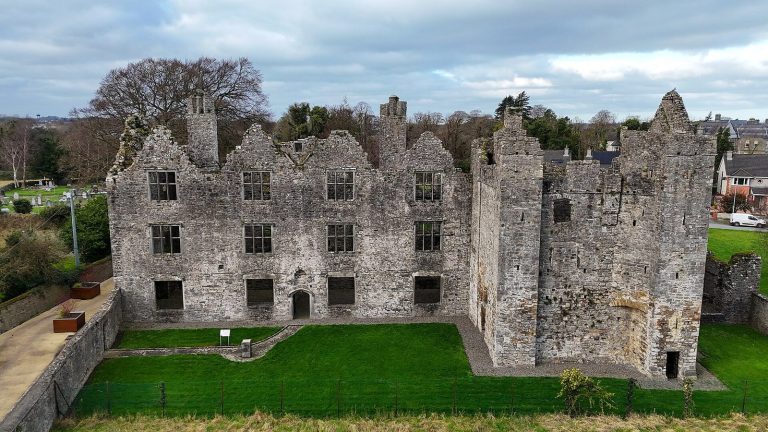
In later centuries, Loughcrew became the seat of a branch of the Plunkett family, descendants of Norman settlers who had become established in Irish society. Its best-known member was Oliver Plunkett, a Catholic archbishop who was executed and later venerated as a martyr. During the Penal Laws, restrictions on Roman Catholics and other groups, the isolated hill of Sliabh na Caillí became an important meeting place for Catholics.
The Plunketts helped run the Irish Confederacy, a political and military association formed by Irish Catholics in the 1640s. They lost their property in 1652 during the Cromwellian Settlement, the redistribution of land that followed the English conquest of Ireland. Around 1655, Sir William Petty assigned the Loughcrew estate to the Napier family.
Over subsequent centuries, the Napiers developed an estate of about 180,000 acres (730 square kilometres) in north Meath, alongside the neighbouring Taylor estate at Headfort. The family descended from Sir Robert Napier, who in 1593 held the senior judgeship of Ireland’s Court of Exchequer, a royal court concerned with revenue and financial matters. After a third devastating fire in 1964, three Napier sons sought court permission to dissolve the family trust and divide the estate. Charles and Emily Napier later restored the house and gardens. Loughcrew is protected as a National Monument under the name Loughcrew Megalithic Cemetery.
Remains
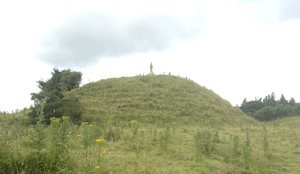
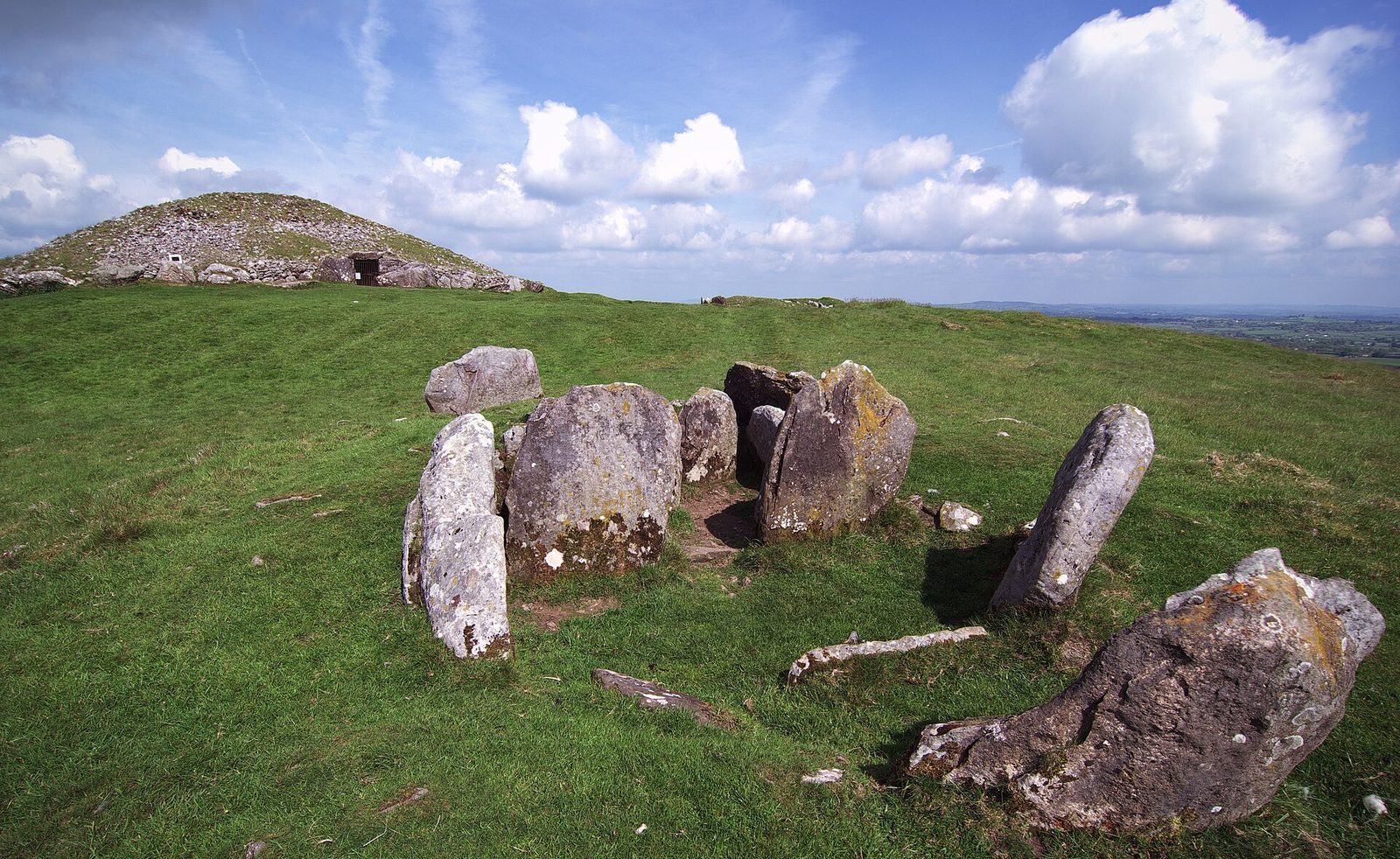
The cemetery occupies a range of hills, with tombs formed chiefly from stone-covered mounds enclosing chambers and passages. Some chambers have a cross-shaped plan. The hills provide a varied setting for the groups of monuments, which extend across Carnbane West, Carnbane East, Carrickbrack and Patrickstown Hill.
Distribution across the hills
About 30 tombs remain on the hills, some badly damaged. Carnbane West has roughly 13, including Cairns G, K and L; Carnbane East has ten, including Cairn T; and Patrickstown has five. The central summit of Carnbane East reaches 329 metres, the highest point in County Meath. A separate passage tomb in the neighbouring area of Thomastown is badly disturbed.
Chambers and passages
Cairn T
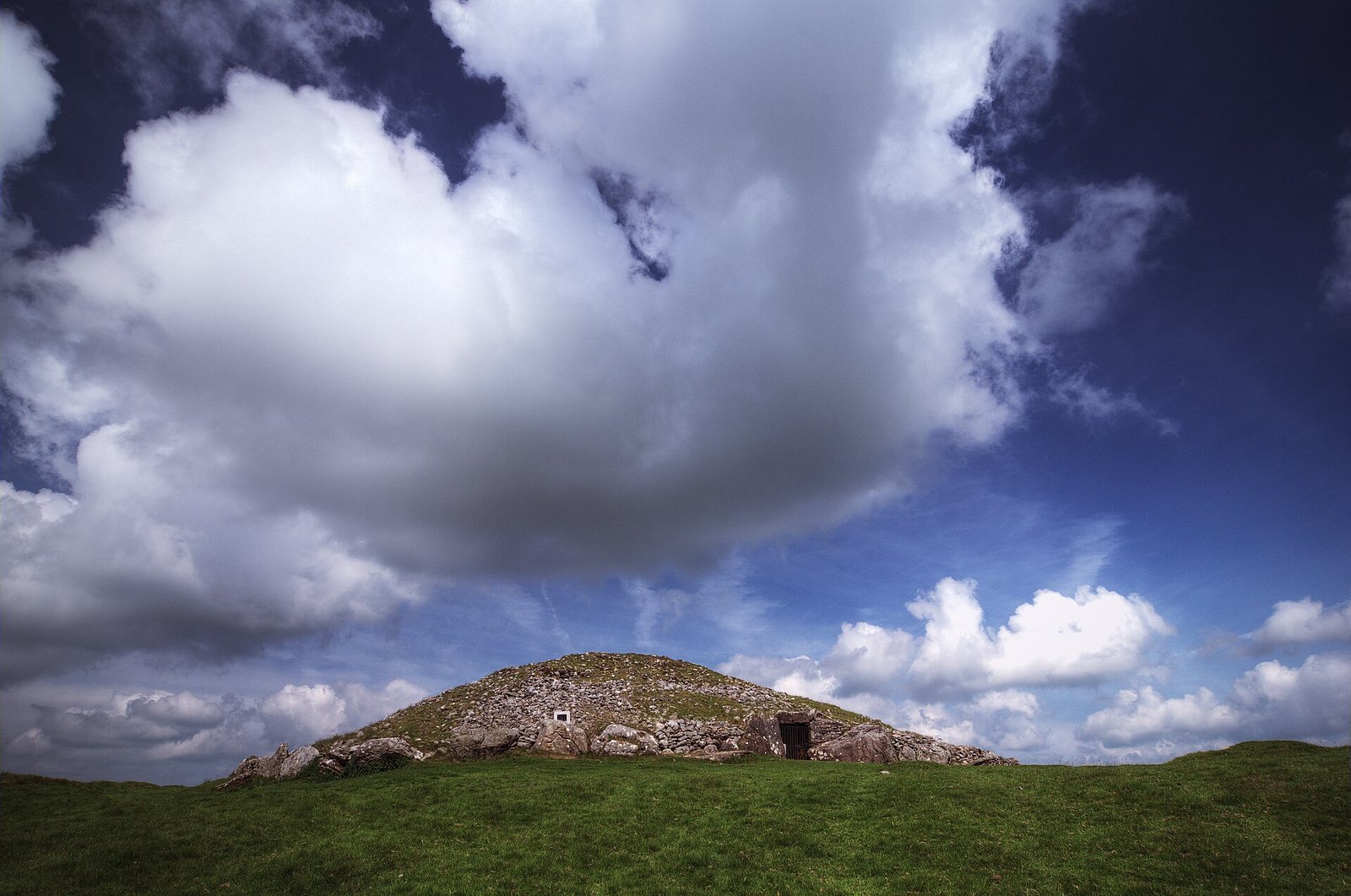
Cairn T is the best-preserved monument. It is a dolmen, a megalithic burial structure formed by upright stones supporting a capstone, with side chambers arranged along a central passage. The straight passage retains four pairs of side stones. A crosswise stone before the final pair marks the division between the passage and an antechamber formed by two side stones. Beyond it, the main chamber has eight sides, a head niche and two side niches, each built from three supporting stones.
At the spring and autumn equinoxes, sunrise travels along the passage and illuminates a carved stone in the head niche. Researcher Martin Brennan identified the alignment in 1980. The effect can be compared with the winter-solstice sunrise at Newgrange, where sunlight also enters a passage tomb.
Cairn L
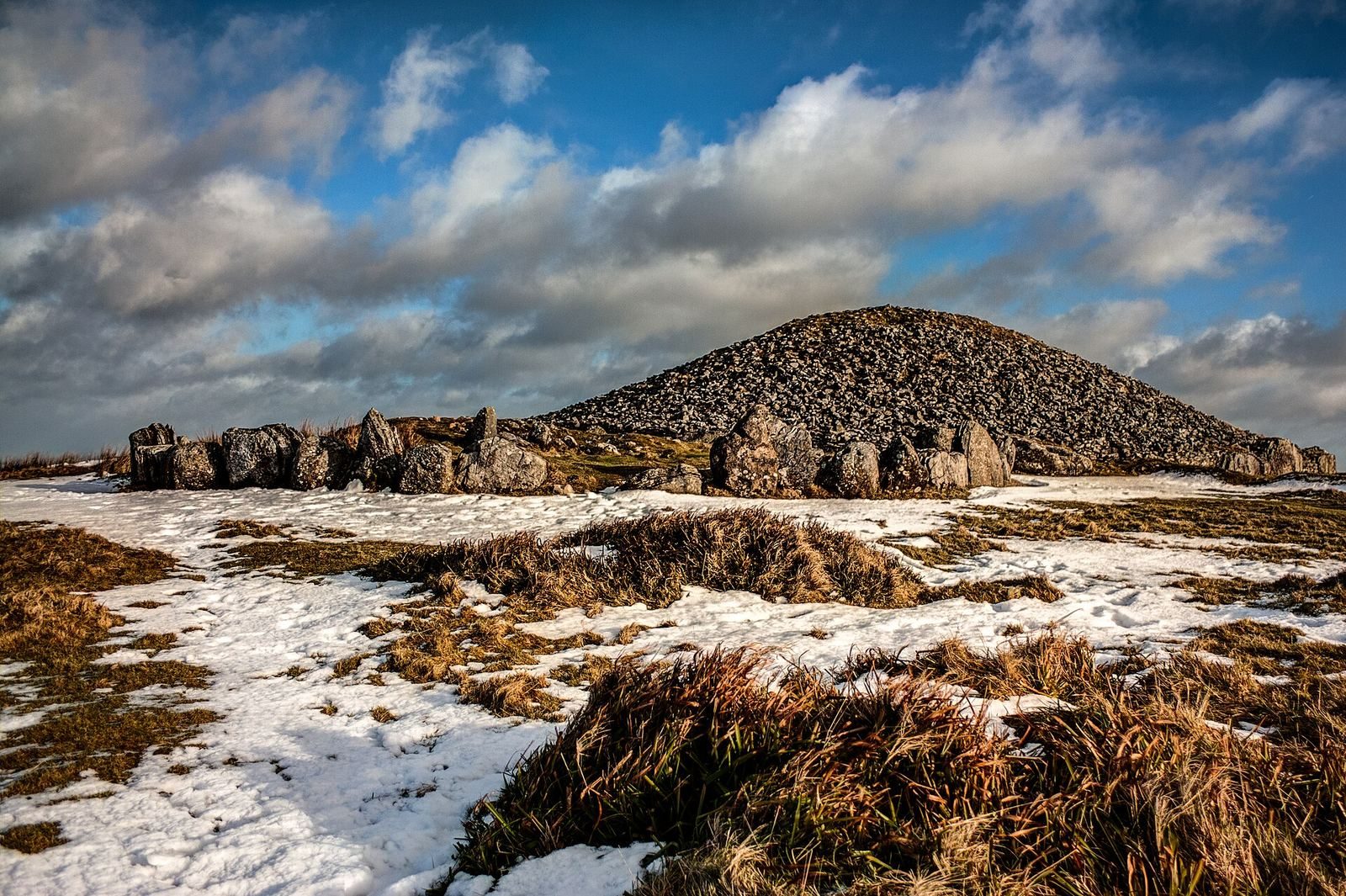
Cairn L is the easternmost and dominant tomb in the Carnbane West group. Its chamber resembles a stalled cairn, a tomb chamber divided into compartments by upright slabs. Twenty supporting stones are associated with the chamber, ten still in place, and it has eight niches. An axial passage is formed by eight supporting stones, six of which remain in place. Two niches hold stone basins. The larger basin, on the right, draws attention to the decorated stone at the rear of the chamber.
Cairn K
Cairn K is also a dolmen with side chambers along a central passage. Two, four or six partly enclosed chambers are arranged at the passage’s head and symmetrically on either side. The central chamber has a corbelled roof, built from courses of stone projecting inward toward the centre.
Stonework and surface features
The upright and supporting stones are generally made of local green gritstone, which is soft enough to carve. Cairns L and K each contain a standing stone. Cairns L, T, S, H and U retain stone kerb circles, rings around the outer edges of the mounds, to varying degrees. Cairn T’s unusually shaped kerb stone is known as the Hag’s Chair and is associated with Irish folklore. Carvings include lozenge and leaf shapes, as well as circles surrounded by radiating lines. Cairns L and T preserve important examples; gates with grilles secure both monuments. Rain erosion has worn carvings on exposed cairns, making many difficult to discern.
Finds and religious features
Excavated objects
Excavation of Cairn H in 1943 recovered bone objects in the La Tène style, an Iron Age artistic tradition associated with Celtic Europe.
Family church
The family church stands within the grounds of Loughcrew Gardens.
Mass Rock
A Mass Rock, a stone altar used for Catholic worship, remains at the summit of Sliabh na Caillí. It formerly served as an altar for the Eucharist.