Loggia di Frà Giocondo: Verona’s Renaissance Council Loggia


Site at a Glance
- Rating
- 4.6
- Popularity
- Low
- Country
- Italy
- Primary era
- Medieval
- Eras represented
- Medieval
- Civilizations
- Venetian
- Site type
- Civic
On this page8 sections
History
Loggia di Frà Giocondo is a Renaissance civic building in Verona, Italy, constructed for sessions of the city Council between 1476 and 1493. Also called the Loggia del Consiglio, it formed part of Verona’s humanist revival and helped give Piazza dei Signori a more regular Renaissance design.
Foundation and civic purpose
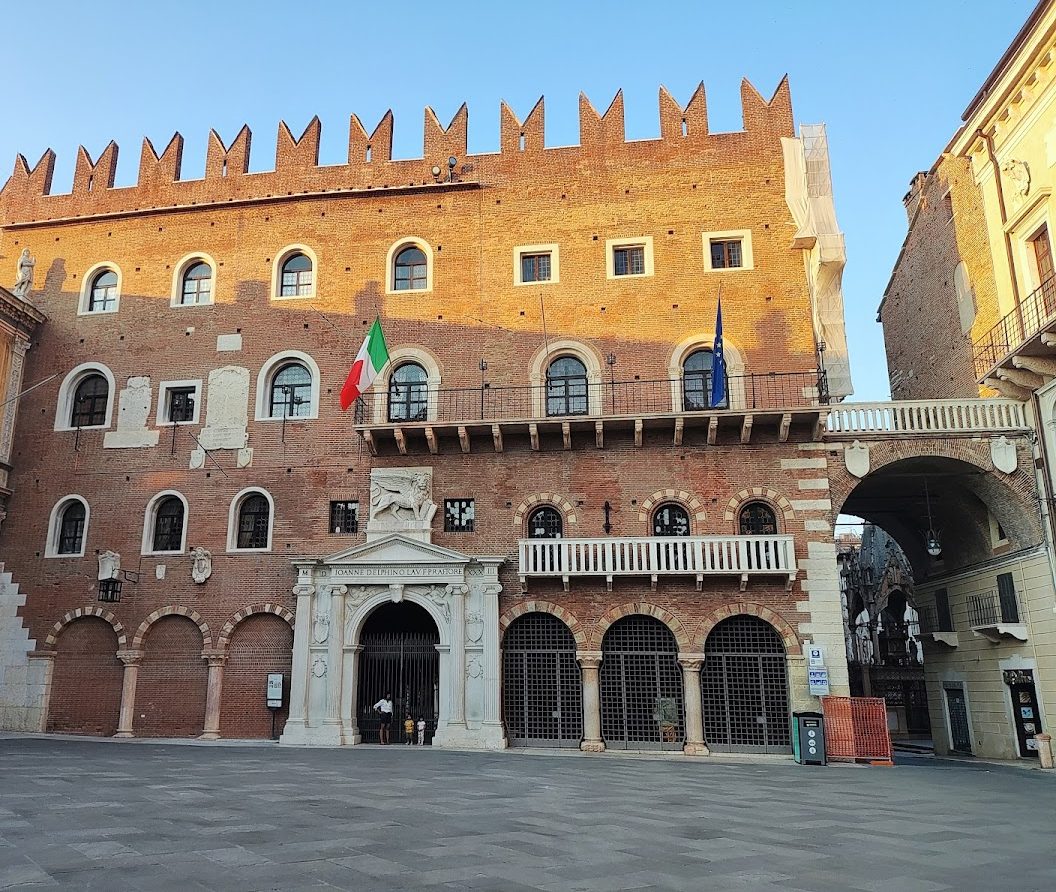
In 1451, Verona’s municipality began looking for a suitable site for a new council building. Construction was approved in 1476 and commissioned by the Municipality of Verona. The loggia replaced a crenellated palace that had fallen into poor condition and projected into the square without aligning with the neighboring building. Its facade was placed farther back, regularizing the shape of Piazza dei Signori according to Renaissance principles.
The design and construction were a collective achievement of Veronese humanists and builders, with Daniele Banda particularly prominent. Once completed, the building served as a representative civic setting for the Council. Its creation expressed the period’s revival of classical forms and humanist learning, which also influenced Verona’s painted civic architecture and urban spaces.
The name of Frà Giocondo
During the nineteenth century, the building was mistakenly attributed to Giovanni Giocondo, a Veronese humanist friar and architect whose work took place mainly in Paris, Venice, and Rome. This attribution established the long-standing name Loggia di Frà Giocondo, while the building’s actual creation remained a collective undertaking associated particularly with Verona’s civic and artistic community.
Decoration and changing use
The structure remained substantially unchanged in later centuries, although local artists were commissioned to decorate its interiors. In 1566, Bernardino India and Orlando Flacco painted The Blessed Virgin and Child between Saints Zeno and Peter Martyr, the first painting commissioned for the Council halls. The scene shows Verona paying homage to the Virgin in the presence of Girolamo Verità, Onofrio Panvinio, Giovanni Battista da Monte, known as Montano, and Girolamo Fracastoro. The painting remains in the building.
At a Council session on 8 April 1595, paintings depicting notable events in Verona’s history were approved. Jacopo Ligozzi painted Dedication of Verona to Venice in 1405, while Sante Creara painted Handing Over of the City Keys to Provveditor Emo. A provveditor was a Venetian administrative official, and Emo is identified by that office in the painting.
Other commissions represented the Veronese victory over Frederick Barbarossa at Vacaldo in 1164, painted by Paolo Farinati in 1598; the victory over Mantua at Ponte Molino in 1199, painted by Orazio Farinati in 1603; and the night battle on Ponte delle Navi between Cangrande II and the rebel Fregnano in 1354, painted by Pasquale Ottino. Some of these works later moved to the Gran Guardia and Palazzo Barbieri, while others became dispersed.
In 1606, the Council commissioned Girolamo Campagna to make two bronze reliefs, one of the Announcing Angel and the other of the Announced Virgin. They were removed during the nineteenth-century restoration, transferred first to the music room of the Castelvecchio Museum, and later displayed at the San Francesco al Corso Museum near Juliet’s tomb.
In 1750, the Nogarola Company commissioned Giambettino Cignaroli’s Pomponius Triumphant for the Council antechamber. During the eighteenth century, Felice Boscaratti also painted The Eruption of Vesuvius, showing Pliny the Elder witnessing the eruption. That work was later deposited in the storerooms of the Castelvecchio Museum.
Nineteenth- and twentieth-century interventions
At the beginning of the nineteenth century, the building became Verona’s municipal art gallery, a function it retained until 1837. A Council report from that year described its condition as resembling a storage facility more than a gallery. Interior restoration took place particularly between 1820 and 1838, followed by a more extensive campaign from 1870 to 1874.
The later nineteenth-century work included the relocation of Campagna’s bronze reliefs and the creation of a protomoteca by architect Giacomo Franco. A protomoteca is an architectural display or collection of portrait heads, busts, herms, or medallions commemorating notable people. Franco’s design was planned to contain 110 stone medallions, herms, and busts of celebrated Veronese figures.
Restoration and structural-consolidation campaigns continued at fairly regular intervals during the twentieth century. One major intervention moved the protomoteca to the Civic Library of Verona. The Loggia di Frà Giocondo now houses offices of the Province of Verona.
Remains
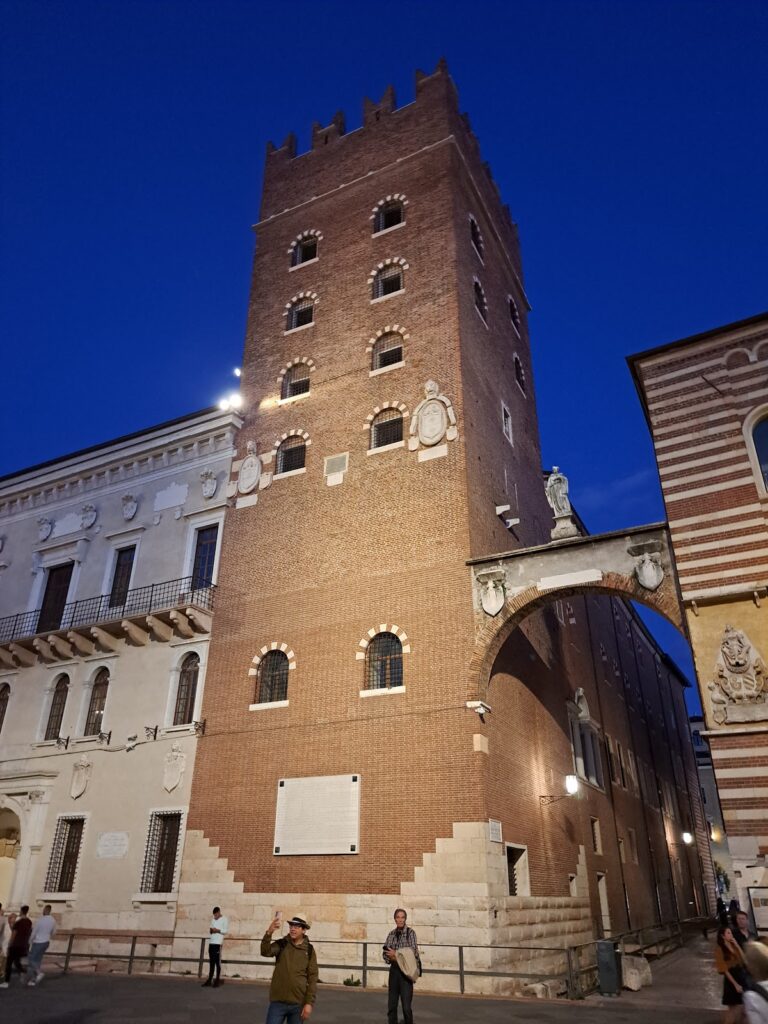
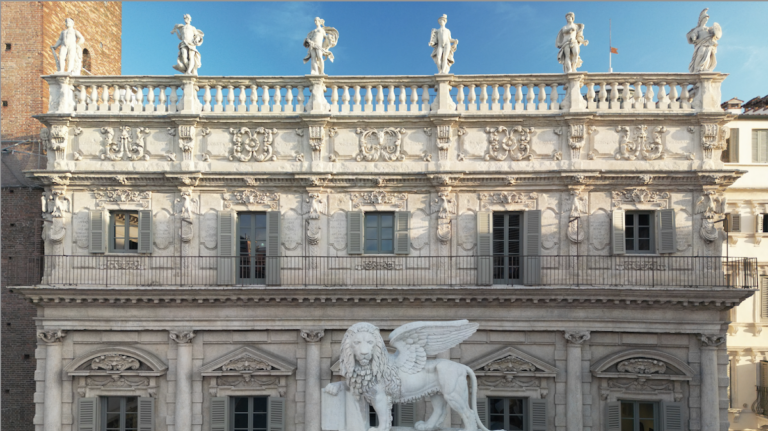
The surviving building is a Renaissance loggia in Piazza dei Signori, within Verona’s historic center. Its principal facade is set back from the square and organized with marble columns. This recessed position formed part of the building’s original urban intervention, replacing the irregular projection of the earlier palace and helping regularize the piazza.
Facade and sculpture
The facade was decorated with frescoes, following the painted exteriors characteristic of contemporary Veronese civic architecture. It was crowned by statues of five celebrated ancient figures associated with Verona: Catullus, Vitruvius Cerdone, Emilio Macro, Pliny the Elder, and Cornelius Nepos. Catullus, Emilio Macro, Pliny the Elder, and Cornelius Nepos were ancient Latin writers, while Vitruvius Cerdone was associated with Verona’s classical intellectual heritage.
Artists from the Como area produced the sculptural and painted decoration. They included Alberto da Milano, Domenico da Lugo, Matteo Panteo, known as Mazola, Maestro Modesto, and Beltramo da Valsolda. At the center of the facade, Girolamo Campagna’s two bronze high-reliefs represented the Announcing Angel and the Announced Virgin. Their later relocation means that the reliefs are now preserved away from the loggia, first in the Castelvecchio Museum’s music room and later at the San Francesco al Corso Museum.
Interior paintings and portrait display
The interior was progressively embellished with paintings for the Council halls and antechamber. Their subjects included civic ceremonies, military victories, historical battles, and figures connected with Verona. The Blessed Virgin and Child between Saints Zeno and Peter Martyr remains in the building, while Pomponius Triumphant remains associated with the Council antechamber.
The historical canvases were later redistributed. Dedication of Verona to Venice in 1405 and Handing Over of the City Keys to Provveditor Emo were among the works connected with the Council’s historical program, alongside paintings of the victories at Vacaldo and Ponte Molino and the battle on Ponte delle Navi. Some were moved to the Gran Guardia or Palazzo Barbieri, and Boscaratti’s The Eruption of Vesuvius was transferred to the Castelvecchio Museum storerooms.
Giacomo Franco’s protomoteca formed another interior feature associated with the building. Its planned arrangement of 110 stone medallions, herms, and busts presented celebrated Veronese figures through portrait sculpture. The collection was later relocated to the Civic Library of Verona.
Nearby sites