Linnep Castle: A Water Castle and Manorial Center in Ratingen, Germany


Site at a Glance
- Rating
- 4.5
- Popularity
- Low
- Country
- Germany
- Primary era
- Early Modern
- External website
- Open
- Eras represented
- Medieval, Early Modern, Modern
- Civilizations
- Duchy of Berg, Holy Roman Empire
- Site type
- Military
- Remains
- Castle
On this page7 sections
History
Linnep Castle, also called Haus Linnep, is a water castle in Ratingen, Germany, with surviving twelfth-century elements in the Romanesque style. It was a major manorial center and the core of the Lordship of Linnep, a territorial jurisdiction governed by a lord and centered on a manor or castle, until 1802.
Medieval Lordship
The site appears in written records from around 1090 to 1120 in a document associated with Kaiserswerth Abbey. A document from Werden Abbey dated 1093 mentions Wernherus de Linepe. The knightly lords of Linnep held the castle and its lordship until 1461.
On 29 September 1461, Eva, the heiress of Dietrich von Linnep and Elisabeth von Sayn, married into the Counts of Limburg. Through this marriage, the lordship passed by inheritance to the Counts of Limburg. An illegitimate branch of the Linnep family later developed into the Dutch noble family Van Lennep.
Protestant Residence and Noble Estate
From 1582, Linnep Castle was occupied by the Protestant baronial family von Isselstein, of the House of Egmond. The family first held the property as a pledge and acquired it by purchase in 1643.
During the Reformation, the Protestant congregation of Linnep worshipped at the castle, where the lord served as its protector. This continued until 1684, when Baron Vincent Schott von Isselstein gave the congregation land near the castle for its own church.
Ownership changed repeatedly from 1731 onward. In 1855, Ferdinand Imperial Count von Spee, the younger brother of the owner of Heltorf Castle, bought the estate. He enlarged its woodland, bringing the property to more than 300 hectares.
Modern Use and Preservation
Until the 1990s, the newest wing housed the archive of the Mettmann district. The castle later became the private home of the farmer and long-serving Christian Democratic local politician Clemens Count von Spee (1929–2011) and his family. Isabella and Wilderich Baron von Ketteler took over the property in 2008, and civil marriages have been held there since 2010.
Severe storms in 2008 and 2014 led to restoration work on the castle and its surroundings. Linnep Castle remains privately owned and is protected as built heritage under North Rhine-Westphalia’s monument protection system.
Remains
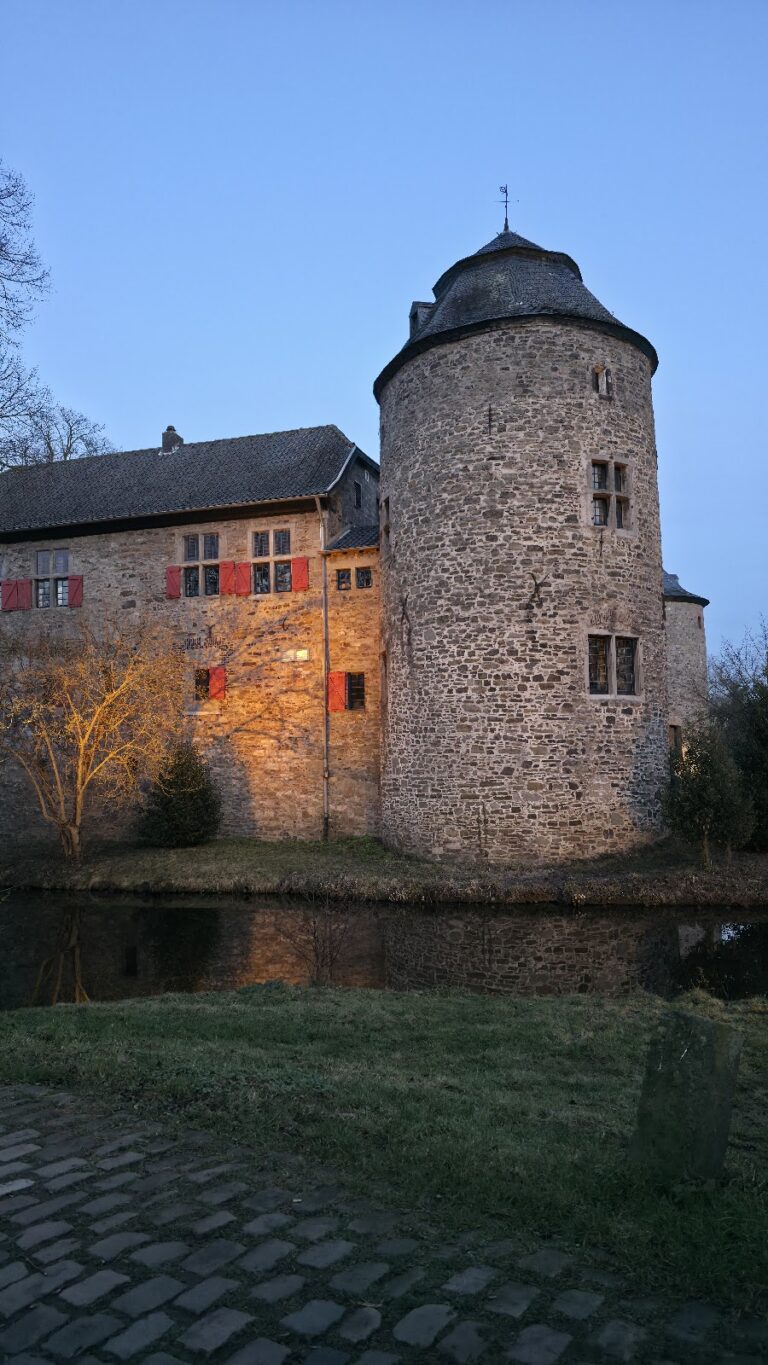
Linnep Castle is a compact water castle in the valley of the Hummelsbach stream, in Ratingen’s Breitscheid district. A large moat surrounds the complex, with the stream flowing through it. Some sections of the moat have been converted into separate ponds.
The Castle Complex
The oldest surviving parts are a Romanesque central round tower and sections of the ring wall, a defensive wall enclosing the central castle complex. These elements date from the twelfth century, while the tower is also described as probably about 1,000 years old.
A new castle building was erected in 1769 on the site of the older castle. It incorporated the medieval round tower, including its pointed roof, as well as the ring wall. After 1855, the complex underwent extensive repairs and was partly rebuilt.
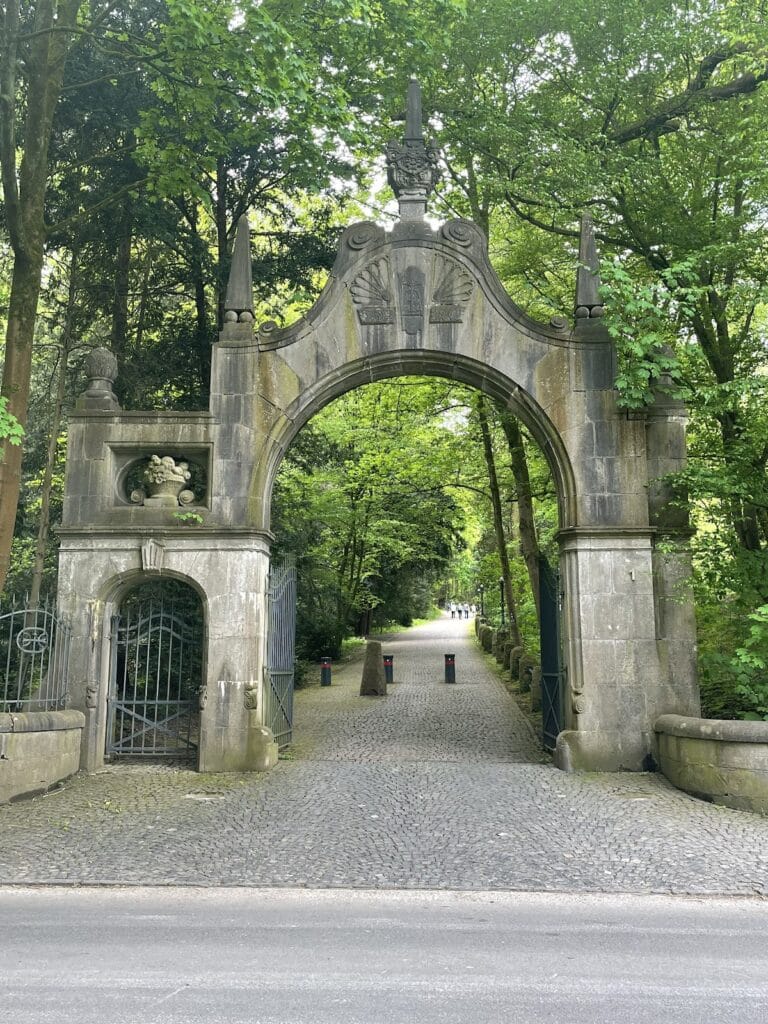
The present approach crosses the moat by a broad entrance stairway. In front of the main façade, a decorated staircase rises above the building’s tall plinth to the first floor. The approach courtyard forms a fortified forecourt, or enclosed outer part of a castle complex, with a gate complex and service buildings. Residential and service buildings enclose the inner courtyard, which has three exits in different directions.
Forest Church and Former Mill
About 100 metres southwest of the castle stands Linnep Forest Church, a simple hall church consecrated in 1684. It is described as one of the oldest Reformed churches in the Rhineland. The Reformed tradition is a Protestant branch of Christianity that emerged during the sixteenth-century Reformation.
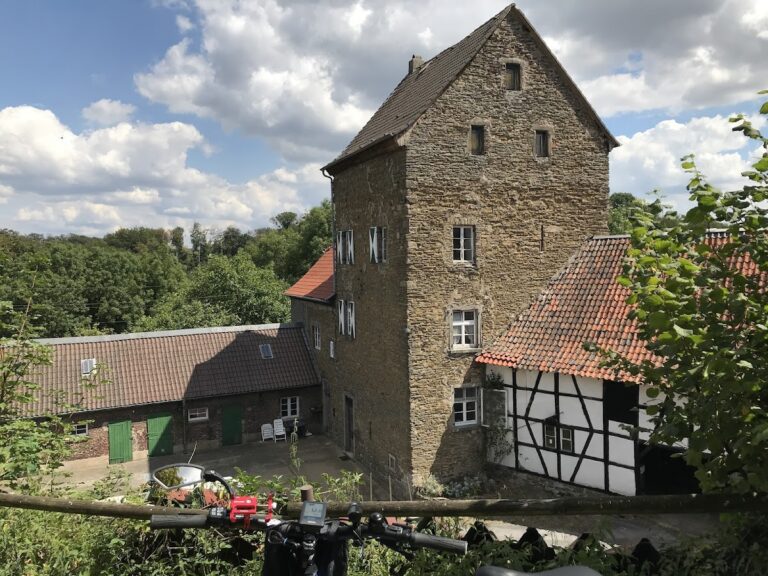
Beside the church is the half-timbered former castle mill, built on the Hummelsbach. The mill later served for many years as an inn and now forms part of an equestrian-stable complex.