Lindstedt Castle: A Late-Classical Royal Residence in Potsdam


Site at a Glance
- Rating
- 4.3
- Popularity
- Low
- Country
- Germany
- Primary era
- Modern
- Eras represented
- Modern
- Civilizations
- Kingdom of Prussia
- Site type
- Domestic
- Remains
- Palace
On this page8 sections
History
Lindstedt Castle is a former royal residence in Potsdam, Germany, built for King Frederick William IV of Prussia between 1858 and 1861 in a late-Classical style. Frederick William IV imagined it as an antique-inspired villa where he might spend his final years, making the estate part of his wider architectural vision for western Potsdam.
From Rural Estate to Royal Project
The Lindstedt estate belonged to the von Bülow family from 1803 until 1828, when King Frederick William III acquired it as a small rural property. Carp farming formed part of its use, and installations connected with the estate’s ponds survived into later periods.
Frederick William IV began considering a residence at Lindstedt around 1832. For decades he developed plans to transform an existing Baroque outbuilding into a grand villa modeled on antiquity. He produced more than 100 drawings, yet the completed project represented only a limited version of his original idea. The long planning process delayed construction, which finally took place from 1858 to 1861.
Royal Completion and Later Imperial Uses
The planning involved the Prussian architects Ludwig Persius, Ludwig Ferdinand Hesse, Friedrich August Stüler, and Ferdinand von Arnim, who had been a pupil of Karl Friedrich Schinkel. The residence was intended as Frederick William IV’s retirement home, although it remains uncertain whether he ever lived there. After his death, the property entered the inheritance of the dowager queen, and his brother and successor, King Wilhelm I, completed the building.
The estate was subsequently leased to government employees. During the reign of Emperor Wilhelm II, who was German emperor and King of Prussia from 1888 to 1918, Lindstedt was used as a quarantine station during epidemics of cholera and tuberculosis. Children of the imperial family were also sometimes educated there.
Residents and Institutional Occupation
After the end of the monarchy in 1918, Paul von Hindenburg arranged a hereditary lease of Lindstedt Castle for Erich von Falkenhayn, the former Chief of the German General Staff during the First World War. Falkenhayn died at the castle in 1922, and his family remained there until 1944. He was buried in the nearby Bornstedt Cemetery.
From 1934, Wilhelm Groener lived at Lindstedt with his family. He had served as a Reichswehr leader and as Germany’s minister of transport and interior. Groener died at the castle on 3 May 1939 and was buried at the Southwest Cemetery in Stahnsdorf. Private residents continued to occupy the property into the 1950s.
In the 1950s, the castle was used by the Botanical Institute of the Potsdam University of Education. From the 1980s, it was occupied by the Potsdam Institute of Forensic Medicine. Since autumn 2025, it has again been assigned to the Brandenburg State Institute of Forensic Medicine.
Heritage Administration
Since 1996, Lindstedt Castle has been administered by the Prussian Palaces and Gardens Foundation Berlin-Brandenburg. It forms part of the Palaces and Parks of Potsdam and Berlin cultural landscape, which entered the UNESCO World Heritage List in 1990 and was expanded in 1992 and 1999. Lindstedt Castle was included in the 1999 expansion.
The property also became the subject of a public inheritance-related claim in 2019, when Georg Friedrich, Prince of Prussia and great-great-grandson of Wilhelm II, sought a permanent rent-free residence secured in the land register at Cecilienhof Palace, Lindstedt Castle, or Villa Liegnitz.
Remains
Castle Complex
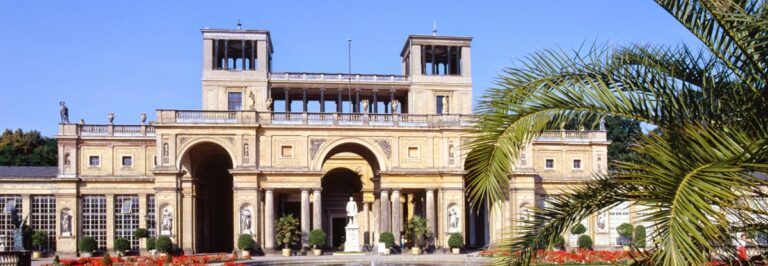
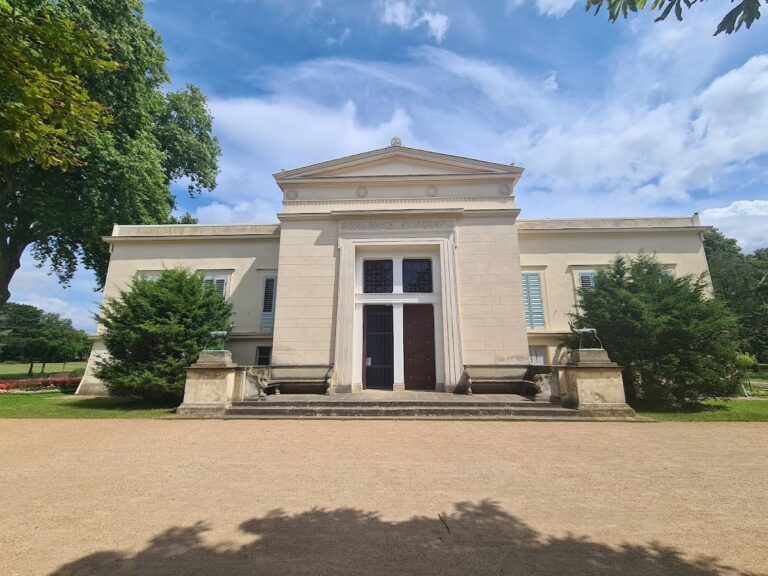
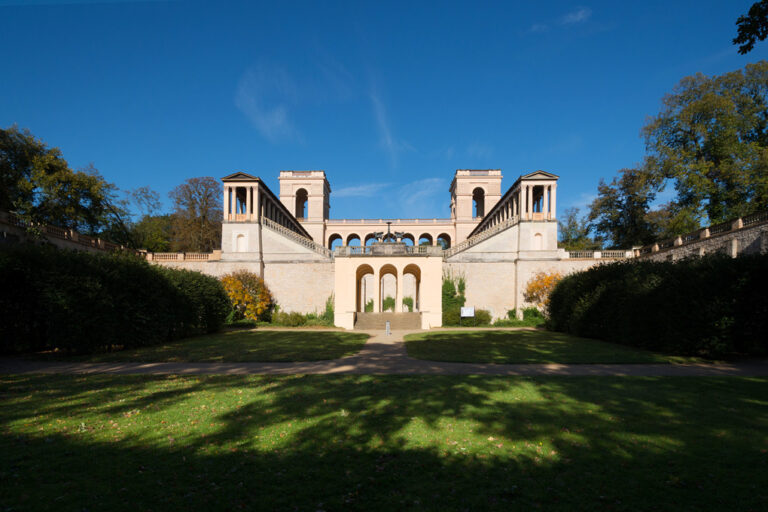
Lindstedt Castle is a heterogeneous late-Classical complex composed of a main building, a tower with a belvedere, and a temple-like extension reached by a high external staircase. A belvedere is an elevated architectural feature designed to provide views over the surrounding landscape. The separate elements do not form a wholly unified composition, reflecting the project’s aspiration toward Italian Classicism.
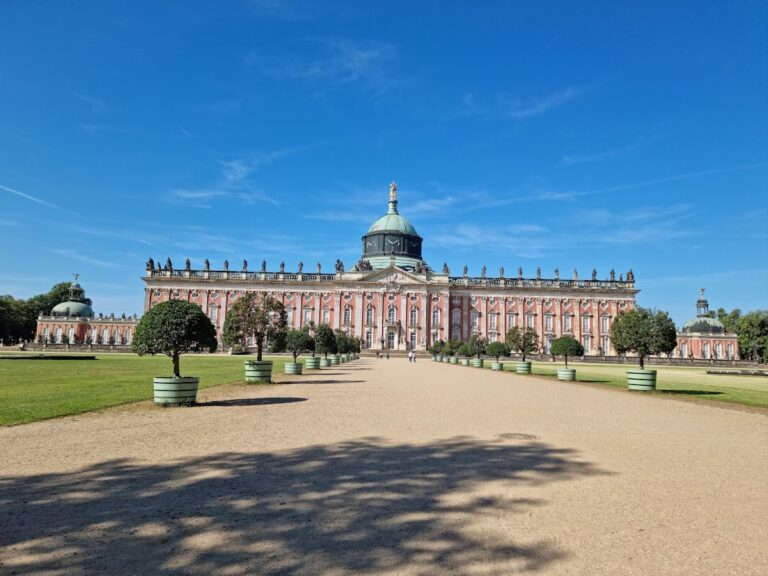
A colonnade links the main building with Lindstedter Chaussee and creates a visual connection between the architecture and the surrounding landscape. The estate stands directly on the road, about 800 metres northwest of the New Palace, and its elevated position provides views toward the domes of the New Palace architectural ensemble.
Garden and Water Features
Peter Joseph Lenné designed the regular garden with planned perspectives toward the castle and views across the surrounding landscape. The estate also retains remains of the ponds associated with its earlier use for carp farming, linking the surviving garden setting with the property’s rural history.
Nearby sites