Letohrádek Kinských: A Neoclassical Summer Residence and Ethnographic Museum in Prague


Site at a Glance
- Rating
- 4.4
- Popularity
- Very Low
- Country
- Czechia
- Primary era
- Modern
- Eras represented
- Modern
- Civilizations
- Habsburg
- Site type
- Domestic
- Remains
- Elite Residence
On this page9 sections
History
Letohrádek Kinských, also known as Musaion, is a summer villa in Prague, Czechia, built by the prominent Bohemian Kinský family between 1827 and 1831. Located in the Smíchov district, it belongs to the first half of the nineteenth century and combines late Neoclassical architecture with Empire elements. The building was created as the centrepiece of a fashionable suburban estate and later became an important museum site.
The Kinský Estate
In 1799, Marie Rosa Kinská, born Harrachová and widowed by Josef Arnošt Kinský, purchased abandoned vineyard plots on Petřín Hill that had belonged to Plasy Abbey, a Cistercian monastery in Bohemia. Her grandson, Prince Rudolf Kinský, began transforming the land into a romantic garden in 1823. The Viennese architect Heinrich Koch designed the summer residence and planned several other buildings within the grounds.
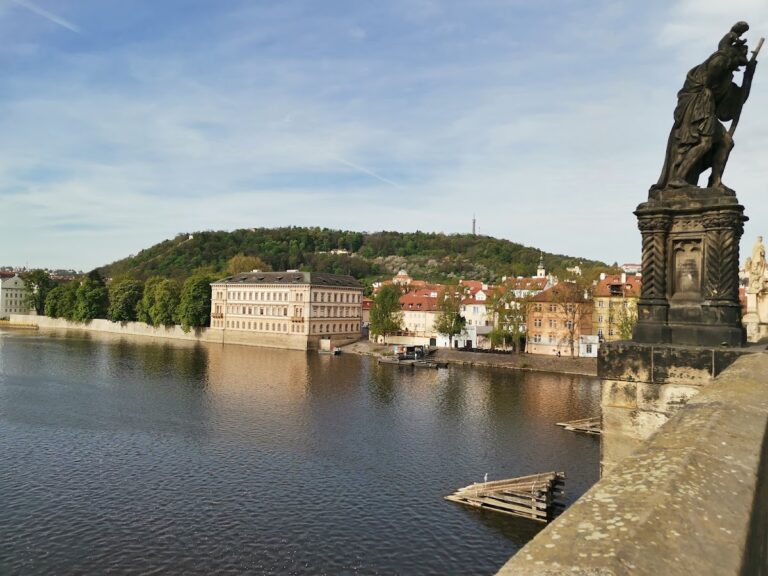
The villa occupied a prominent position in the park, with views across Prague from the Old Town through Vyšehrad to Zlíchov. The garden was designed by František Höhnel, the family’s financial director, and its modifications were completed in 1849. In 1860, the garden architect Friedrich Wünscher proposed enlarging the park.
Decline of Private Use
From the 1840s, expanding factories and the rapid growth of a workers’ district in Smíchov brought severe air pollution to the area. After Vilemína Kinská died in 1871, the family gradually stopped using the summer residence.
Urban changes also affected the estate. The walls of Malá Strana and the Újezd Gate were demolished in 1891, while Holečkova Street was closed. Ferdinand Bonaventura Kinský sought to subdivide the land for apartment buildings, but Prague refused the proposal. The City of Prague purchased the property in 1901 and opened the garden to the public. An entrance was later cut through the Hunger Wall, the historic defensive wall on Petřín Hill, improving the connection between Kinský Garden and the gardens of Petřín.
From Exhibition Building to Museum
Objects from the Prague Exhibition Grounds were transferred to the park between 1896 and 1920. In 1902, collections acquired at the 1891 Prague Jubilee Provincial Exhibition, particularly those from the 1895 Czechoslovak Ethnographic Exhibition, were assembled in the summer residence. The Czechoslovak Ethnographic Museum had been established in 1901.
Since 1922, the villa has housed the ethnographic exhibition of the National Museum, the principal state museum institution of the Czech Republic. Its collections cover popular art and culture from the seventeenth to the twentieth centuries, while the present exhibition focuses on the folk culture of regions across the Czech Republic. The name Musaion derives from the Greek term for a place associated with the Muses.
The building was listed as a cultural monument in 1964. From the 1980s, the National Heritage Institute included it among the endangered immovable monuments in the Czech Republic. In 1993, ownership was transferred to the City of Prague, which arranged cleaning and rehabilitation. The building returned to the National Museum in 1999, and a complete reconstruction carried out from 2003 to 2005 was followed by its designation as Musaion in 2005.
Remains
The Villa
The two-storey villa has a symmetrical, restrained exterior. Its eastern principal facade is arranged in three bays. A projecting portico supports a terrace on four Doric columns, while the projecting centre is divided by four pilasters with Composite capitals and finished with a triangular pediment. French windows open onto the facade.
A broad axial staircase rises from a double-flight landing with top lighting to the first-floor salon. The interior retains wooden gilded chandeliers, paired wall sconces, door frames, much of the gilding, and the staircase railings. Two white Carrara-marble sculptures originally stood on the staircase. One was Psyche, made by the Italian Neoclassical sculptor Antonio Canova. The Kinský family later moved it to the veranda of their palace in Vienna before selling the villa. The second work was named Patrie.
The sculpture Vlasta was made by the Czech sculptor Emanuel Max. Rudolf Kinský’s widow, Vilemína, purchased it from Max in 1842. It is now held in the collections of Prague Castle.
The Landscape Garden
Kinský Garden covers approximately 17 hectares and was formed as a romantic landscape around the villa. Its features include a pond, a waterfall, a stream, a bridge, a lake, rare trees, and a looping network of paths. Several tunnels carried water from the upper parts of Petřín towards the building.
Sala Terrena
Heinrich Koch also designed an open garden pavilion in the form of a sala terrena, a transitional space between a building and its landscaped grounds. The pavilion was later used as a restaurant and was abandoned after 1975.
Swiss House and Service Buildings
The garden included a classical ground-floor carriage house known as the Swiss House. Adjoining stables served the estate, while greenhouses accommodated tropical and subtropical plants. The greenhouses were demolished in 1965. A classical house for employees stood on the slope near them.
Nearby sites