Lescar Cathedral: A Romanesque Co-Cathedral in France


Site at a Glance
- Rating
- 4.6
- Popularity
- Low
- Country
- France
- Primary era
- Medieval
- Eras represented
- Medieval, Early Modern
- Civilizations
- Duchy of Aquitaine
- Site type
- Religious
- Remains
- Cathedral
On this page14 sections
History
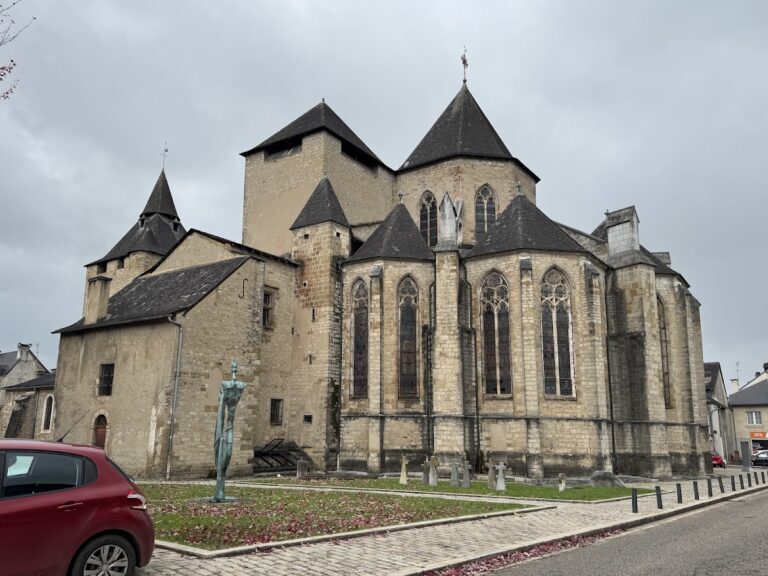
Lescar Cathedral is a Roman Catholic church in Lescar, France, built under the direction of Bishop Guy de Lons in the Romanesque period during the twelfth century. Dedicated to the Assumption of the Virgin Mary, it became the cathedral of the Bishopric of Lescar and is now a co-cathedral, a cathedral sharing the title of a diocese with another cathedral, in the Diocese of Bayonne, Lescar and Oloron.
From Beneharnum to Lescar
The Bishopric of Beneharnum, founded by Saint Julian, existed by the fifth century. Its cathedral stood in the lower town until the settlement was destroyed by the Normans in 841. The population then moved to the more defensible hill under Guillaume Sanche, Duke of Gascony. A baptistery dedicated to Saint John the Baptist remained on the hill, where a repentant soldier known as Loup-Fort later replaced it with a chapel and monastery dedicated to Sainte-Marie.
The Bishopric of Lescar replaced that of Beneharnum in 980. In 1062, the chapel was consecrated as a cathedral, and the bishops developed an episcopal complex around it. Bishop Guy de Lons began construction of the present cathedral in 1120. The Bishop of Auch consecrated it as a cathedral in 1145.
A royal burial church
From the end of the fifteenth century, Lescar Cathedral served as the burial place of the Albret family after its members became kings of Navarre. It thereby replaced the Cathedral of Sainte-Marie in Pamplona as the dynasty’s principal burial church. François Phébus was buried at Lescar in 1483, followed by Catherine of Navarre, her husband Jean d’Albret, and several of their children, including Henri II d’Albret and Marguerite of Angoulême. Henri II and Marguerite were the maternal grandparents of Henri IV, the king of France. Because of these royal burials, the cathedral became known as the “Saint-Denis” of the rulers of Béarn.
Reformation and destruction
The Reformation, the sixteenth-century movement that produced Protestant churches and challenged Catholic institutions, brought major changes to the cathedral. Jeanne d’Albret, queen regnant of Navarre and a leading supporter of the Reformed faith in Béarn, ordered the images and altars removed, seized the cathedral furnishings, and assigned the building to Reformed worship.
The church briefly returned to Catholic use during Terride’s occupation of Béarn. On 21 August 1569, however, Protestant troops led by Gabriel I de Montgomery sacked the cathedral. The shrine of Saint Galactoire was destroyed, his bones were burned, and the tomb of Guy de Lons was desecrated. The bishop’s and Chapter’s property was then confiscated and sold between 1570 and 1573. The canons, the members of the cathedral Chapter responsible for assisting with worship and administration, were expelled. Some withdrew to Louvigny in Chalosse, where they remained until 1610.
The bishops of Oloron and Lescar were restored to their sees, and Catholic worship returned to twelve parishes in Béarn. Repairs took place in 1572, but inadequate maintenance probably contributed to the collapse of part of the vault in 1599 or 1600, and possibly of a bell tower as well. The exterior ornamental elements of the Navarrese royal tombs were probably lost during the same period.
Royal incorporation and Catholic restoration
Louis XIII attended Mass in the cathedral on 18 October 1620 during ceremonies that marked the incorporation of Béarn into the French Crown. Under Bishop Jean-Henri de Salette, the vault was rebuilt and the choir restored between 1628 and 1632.
The poverty of the diocese and clergy limited major building work during the eighteenth century. The Bishopric of Lescar was suppressed during the French Revolution in 1791. The bishop’s and Chapter’s archives were seized and later disappeared, while most of the cathedral treasury was melted down. In 1793 the church was deconsecrated and converted into a Temple of Reason, a Revolutionary building used for the civic cult promoted during the de-Christianization campaigns. Its interior, furnishings, altars, and tombs appear to have suffered damage during this period.
Excavation and restoration
Lescar Cathedral was classified as a French historic monument in 1840, and an important restoration campaign began that year. Work addressed the murals of the small apses, selected capitals and modillions, the Romanesque mosaic, and the floor, which was relaid with Maubeuge tiles. The mosaic was restored again during the 1880s, including work by Jean-Dominique Facchina’s Paris workshop in 1886.
Excavations in 1928 and 1929 recovered the royal burial vault and the remains of its occupants. The discovery took place on 6 April 1929. Anthropologists, surgeons, and professors of anatomy were consulted in attempts to identify the bones. The remains were placed in six small wooden coffins, with the sixth containing royal bones that could not be identified, and returned to the restored burial place.
A further restoration campaign began in 2006. It focused particularly on the twelfth-century mosaic, which had been affected by the change from a humid to a dry environment after alterations to the drainage system. Several paintings were also restored, including the Coronation of the Virgin behind the altar.
Remains
The cathedral building
Built of sandstone from Lasseube, the cathedral preserves a Romanesque chevet, the eastern end of a church containing the choir and apse. The interior is approximately 61 metres long, 22.5 metres wide, and 15 metres high. Its nave has a full semicircular barrel vault, while the side aisles have transverse barrel vaults. Windows with Flamboyant Gothic tracery, an elaborate later Gothic pattern of flame-like shapes, were installed in the sixteenth century.
Sculpted capitals
The Romanesque capitals provide a series of carved biblical narratives. Their subjects include episodes from the cycle of Daniel, the Nativity of Christ, the Sacrifice of Abraham, Christ surrounded by the four Evangelists, the Adoration of the Magi, Christ in Majesty, Adam and Eve with Cain and Abel, the Beheading of Saint John the Baptist at Herod’s feast, and Christ with the Apostles. These capitals are among the cathedral’s principal artistic features and hold an important place in the Romanesque art of the region.
Choir mosaic
The choir floor contains a twelfth-century mosaic showing a Moorish hunting scene. Moorish is a historical term for the Muslim peoples and cultures of medieval Iberia and North Africa. The one-legged hunter has been interpreted as referring to Spanish prostheses admired by Guy de Lons, who took part in the Christian reconquest of Muslim territories in the Iberian Peninsula. Tiles concealed the mosaic until its rediscovery in 1838, and restoration continued during the 1880s and again from 2006.
Paintings, stalls, and organ
Frescoes from the mid-seventeenth century have been restored or brought back into view. Sixteenth-century choir stalls depict Christ, the twelve Apostles, the four Evangelists, and saints popular in Béarn. The stalls formerly enclosed the canons’ choir and were moved into the cathedral in 1836 and again in 1859.
The cathedral also houses a Romantic organ built by Georges Wenner in 1869. It has three 54-note keyboards, a 30-note pedalboard, and 32 stops.
The former chapter complex
The former claustral complex formed an enclosed settlement for the cathedral Chapter. The cathedral bounded it to the north, the town walls to the south, and the area extended west beyond the cathedral facade toward the parvis, the open forecourt in front of a church. The Porte de l’Ormeau opened onto the parvis, while the Porte de Baliracq stood to the east near the present presbytery.
Courtyards and chapter buildings
The Porte de l’Ormeau led to a lower courtyard west of the cloister. The complex contained houses for the canons, a sacristy, a chapter house where the Chapter met, a library, chapels dedicated to Saint Augustine and Saint Galactoire, and the cloister. Most of this arrangement disappeared during the eighteenth century. During the Revolution, market halls were installed along the church wall on the site of the cloister, and the surviving Chapter houses were sold as national property between 1791 and 1793.
Cloister foundations and burials
The cloister was attached to the cathedral’s south facade. Excavations in 1888 revealed its foundations, ten sarcophagi, and fourteenth-century coins. Its central open court measured approximately 21 by 17 metres, while the covered galleries were about 4 metres wide.
Probably built in the fourteenth century, the cloister also served for burials. Two apparently contemporary funerary inscriptions remain visible on the church wall, and burials continued there until 1738. In 1722, the Chapter made the cloister a public and secular place. It then probably fell rapidly into ruin and had disappeared by the second half of the eighteenth century.
Nearby sites