Taranto Cathedral: A Byzantine Foundation and Basilica in Italy


Site at a Glance
- Rating
- 4.8
- Popularity
- Low
- Country
- Italy
- Primary era
- Medieval
- External website
- Open
- Eras represented
- Medieval, Early Modern, Modern
- Civilizations
- Byzantine, Norman
- Site type
- Religious
- Remains
- Cathedral
On this page15 sections
History
Taranto Cathedral, also known as the Cathedral Basilica of San Cataldo, is a historic cathedral in Italy dedicated to Saint Cataldo, the traditional medieval bishop and patron saint of Taranto. Begun by the Byzantines in the second half of the tenth century, it became a basilical church through Norman remodelling and later acquired Romanesque, Baroque, and Rococo elements. It is the cathedral of the Archdiocese of Taranto, the diocese headed by the city’s archbishop, and is an Italian national monument.
Early Christian and Byzantine Origins
An earlier Christian church dedicated to Saint Mary may have stood outside Taranto’s walls during the sixth or seventh century. Its existence is associated with a letter written by Pope Gregory I, also known as Gregory the Great, who was bishop of Rome from 590 to 604. The building may have been a monastic sanctuary dedicated to Saint Cataldo rather than the cathedral itself, and the location of the early cathedral remains uncertain. The area of the present Church of Carmine has been proposed as one possibility.
The present cathedral formed part of the rebuilding of Taranto after the Saracen sack of 927, which destroyed the surviving parts of the ancient Greek-Roman city. In 967, about forty years after the attack, the Byzantine emperor Nikephoros II Phokas ordered the city’s reconstruction. The Byzantine Empire was the medieval continuation of the Eastern Roman Empire, and Nikephoros was regarded in Taranto as the city’s “second founder.” The cathedral was built within the new Old Town, whose creation also led to the disappearance of the last remains of the ancient city and acropolis.
Norman Transformation and the Cult of Saint Cataldo
During the late eleventh century, under Norman rule in southern Italy, the Byzantine church was substantially remodelled into the basilical cathedral seen in later centuries. The earlier structure was not entirely discarded. Its central nave and deep apse were incorporated into the enlarged and lowered longitudinal arm, while the former nave became the transept, the cross-arm that intersects a church’s main axis.
Enlargement work in 1094 uncovered a marble sarcophagus containing a small gold cross inscribed with the name Cataldus. The cross entered the cathedral treasury, and the discovery encouraged the development of a dedicated cult space. The crypt was rebuilt, and a chapel for the bones of Saint Cataldo was created beside the north transept. Tradition also connects the saint’s remains with an earlier Chapel of Saint John in Galilee. A chapel erected by Angelo de Budaliciis in 1432 as the Chapel of Saint Martha was converted into a baptistery in 1600.
Chapels, Fire, and Baroque Renewal
The side aisles received altars and family chapels during the thirteenth century. These chapels were repeatedly demolished and rebuilt. The Chapel of Saint Agnes, beside the southern arm of the transept, later became the Chapel of the Blessed Sacrament. The Chapel of Saint James was built in 1568 through the work of Giacomo Protontino. Its altar was first dedicated to Saint Lawrence, and the chapel later became associated with the Confraternity of the Most Holy Crucifix and Purgatory.
A fire on Christmas night in 1635 destroyed the original ceiling of the central nave. A replacement walnut ceiling was begun under Archbishop Cardinal Egidio Albornoz and completed by Archbishop Caracciolo. Archbishop Gian Battista Stella had it gilded in 1713. Caracciolo also ordered the Baroque remodelling of the Chapel of the Blessed Sacrament in 1657. Work on the present Chapel of Saint Cataldo began in the same year and was completed about fifty years later under Archbishop Pignatelli.
The Baroque facade was added in 1713 to a design by the Lecce architect Mauro Manieri. In the same period, Paolo De Matteis frescoed the dome of the Chapel of Saint Cataldo with scenes from the saint’s life and miracles. The Norman bell tower had been erected in the twelfth century, but its upper section was dismantled after the earthquake of 1456 because it had become unsafe. During Schettini’s restorations in 1952, the remaining tower was demolished and replaced by the present bell tower.
Cathedral and Basilica
Taranto Cathedral was elevated to the status of a minor basilica by Pope Paul VI in October 1964. A basilica minor is an honorary papal title granted to a church because of particular religious or historical importance. The church continues to serve as the cathedral of the Archdiocese of Taranto, whose official seat is located within the cathedral.
The building contains the tombs of several archbishops of Taranto. Those in the crypt include Francesco Saverio Mastrilli, Pietro Alfonso Iorio, Giuseppe Cecchini, Ferdinando Bernardi, and Benigno Luigi Papa. Juan De Castro is buried in the Chapel of Saint Cataldo, while Tommaso Capecelatro lies in the presbytery. Gian Battista Stella and the Orsini princes of Taranto are listed as buried in the pronaos, the entrance hall before the main body of the church.
Remains
Plan, Exterior, and Nave
Taranto Cathedral measures approximately 84 metres in length and 24 metres in width. Its basilical plan has a central nave, two side aisles, and a single-aisled transept. Two rows of eight columns divide the nave. Their capitals differ in workmanship, and the columns vary in size and material because many were assembled from reused Greek and Roman architectural elements. This reuse, known as spolia, also appears in other parts of the church and crypt.
The exterior walls have a restrained treatment of blind-arch panels, whose two-coloured masonry blocks form geometric designs. The earlier facade probably used comparable decoration and may have had three Romanesque portals, with two additional entrances in the side walls. The present eighteenth-century facade is divided horizontally by a broken Baroque entablature. Angels rest on its sections and face the central rectangular window. Above the window stands a stone statue of Saint Cataldo, flanked by two angels and framed by floral ornament and twisted columns.
Facade and Pronaos
The lower facade contains a broad portal with the coat of arms of Archbishop Gian Battista Stella on its entablature. Four niches hold statues of Saint Peter and Saint Mark below, and Saint Roch and Saint Irene above. Shell-shaped medallions surmount the niches. Behind the facade, the rectangular pronaos occupies the area before the former Romanesque front and is covered by a flat vault. It was later incorporated into the cathedral, while the Baroque facade was placed outside it. Paintings on its walls show episodes from the life of Saint Cataldo, including his entry into Taranto, painted by Giovanni Stefano Caramia in 1675, and his resurrection of a dead person, painted by Michele Lenti of Gallipoli in 1773.
Ceilings, Altar, and Apse
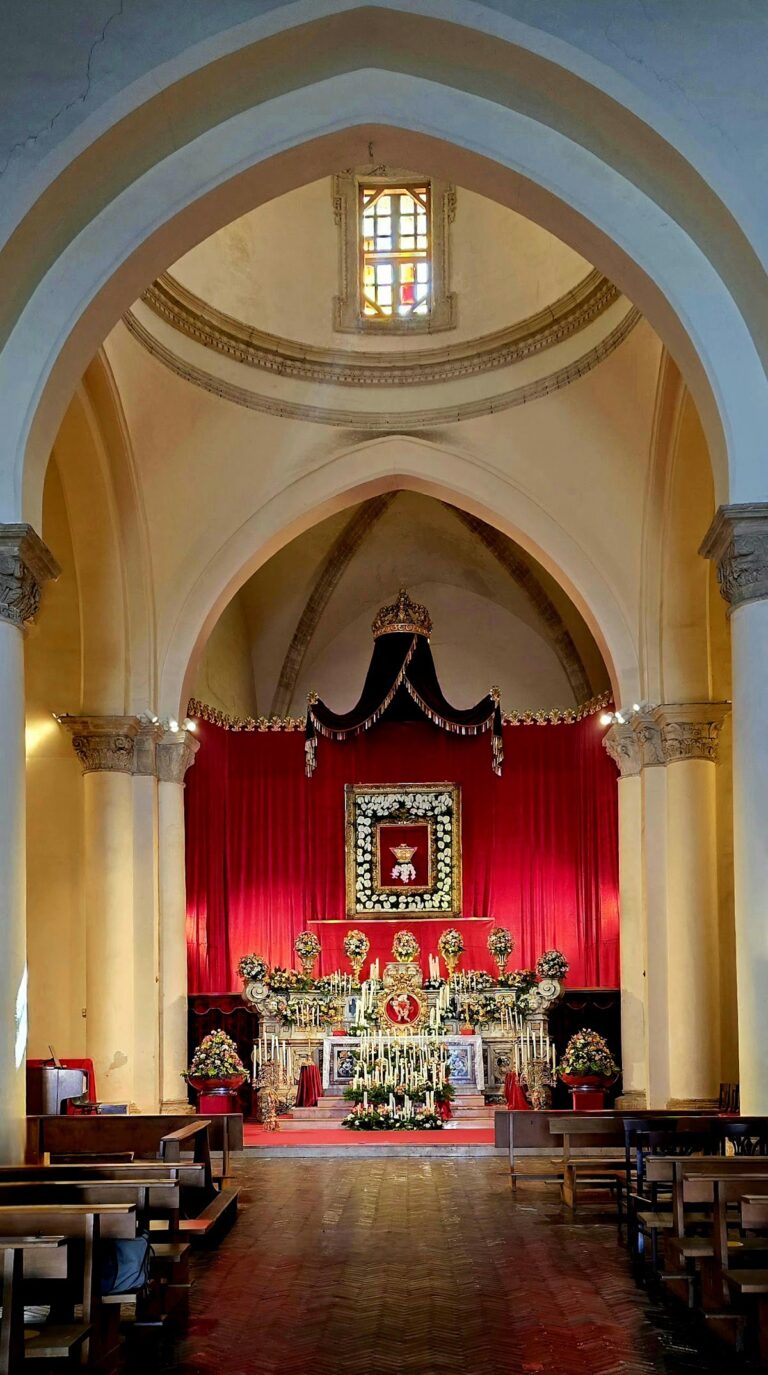
The side aisles have trussed roofs. Above the central nave is a coffered walnut ceiling, a ceiling formed from recessed panels, known as the “Golden Sky of the Cathedral.” It contains forty-eight panels and two wooden statues, one of Saint Cataldo and one of the Immaculate Mary. The high altar carries a ciborium, or canopy over an altar, dated 1652 and supported by four cylindrical reused porphyry columns. The dome above it has frescoes by Domenico Torti of Rome.
The apse contains a fifteenth-century choir and three paintings by unidentified artists. They comprise an early eighteenth-century Adoration of the Magi, an eighteenth-century Assumption, and a Rest in Egypt from the second half of the seventeenth century.
Medieval Mosaic
Fragments survive from a floor mosaic made in 1160 by the mosaicist Petroius for Archbishop Giraldo. A drawing from 1844 preserves its three-part arrangement, with a central section along the main nave and lateral sections in the two aisles. Inscriptions identify the date, patron, and maker. The central sequence began with the legend of Alexander the Great’s aerial flight, presented as an image of punished pride, and continued with ten circular pictorial fields. Each side aisle had a band of nine such fields arranged in the opposite direction, allowing them to be viewed correctly when moving back through the aisle.
The roundels include animals derived from Oriental textiles. Their function was generally decorative, although some may have represented vices or virtues. The mosaic’s figures and forms have notable connections with the contemporary mosaic at Otranto, dated to 1163–1165 and associated with the presbyter Pantaleon.
Chapel of Saint Cataldo
The Chapel of Saint Cataldo is formed by a quadrangular vestibule and a later elliptical chapel. The vestibule corresponds to the older chapel built in 1151 by Archbishop Giraldo to house the saint’s relics. Its polychrome marble decoration includes a marble floor, and it contains statues of Saint John Gualbert by the Neapolitan sculptor Giuseppe Sanmartino and of Saint Joseph.
Relics and Marble Decoration
The later chapel is smaller than the older vestibule and contains the former tombs of the princes of Taranto, members of the prominent Orsini family who held that princely title. Its walls are faced with coloured marble inlay reused from ancient buildings. Saint Cataldo’s tomb lies within the marble altar and can be seen through a marble grille and side windows. Lombardelli, a marble worker from Massa Carrara, made the altar, which is decorated with mother-of-pearl and lapis lazuli. Above it is a niche with the patron saint’s silver statue, modelled in clay before being cast in silver by Orazio Del Monaco.
Dome and Statues
Paolo De Matteis’s frescoes of 1713 cover the dome with scenes from Saint Cataldo’s life and miracles. The central image shows the saint kneeling before the Virgin, with the Trinity above and other saints below. Seven scenes on the drum, the structure supporting the dome, show further miracles, including the resurrection of a worker, the restoration of sight to a blind person during baptism, the saint receiving the command to go to Taranto, the recovery of a shepherd girl’s voice, and the liberation of a possessed girl.
Ten wall niches contain Carrara-marble statues attributed to Giuseppe Sanmartino. They depict Saint Mark, Saint Teresa of Avila, Saint Dominic of Guzman, Saint Philip Neri, Saint Peter, Saint Sebastian, Saint Irene, Saint Francis of Assisi, Saint Francis of Paola, and Saint John the Baptist.
Chapel of the Blessed Sacrament and Baptistery
The Chapel of the Blessed Sacrament stands to the left of the altar and was formerly dedicated to Saint Agnes. Its Baroque portal carries eighteenth-century paintings of angels and symbols of the Passion, set in marble frames and accompanied by inscribed scrolls. Three paintings by Giovanni Molinari, made around 1657, show the Multiplication of the Loaves and Fishes, the Gathering of the Manna, and the Last Supper.
The cathedral’s baptistery contains a circular, concave font carved from a single block of marble. A canopy supported by four polygonal columns and a central cupola rises above it.
Crypt and Chapel of Candlemas
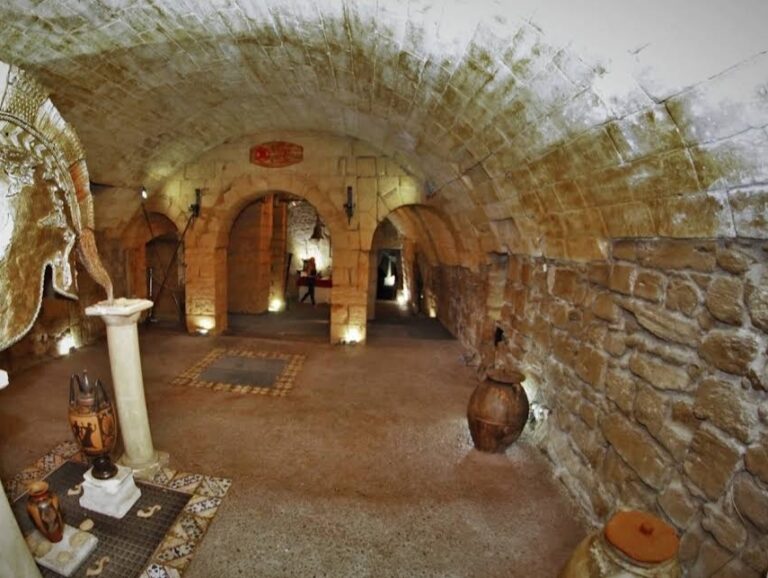
The crypt probably belongs to the Byzantine phase and has a cruciform plan. Low columns divide it into two aisles, while slabs serving as capitals support later pointed cross-vaults. Small windows around the chamber are now obstructed by external construction. Fragments of thirteenth- and fourteenth-century frescoes remain on the walls. A major surviving group forms a triptych of Saint Cataldo, Saint Mary Magdalene, and Saint Mary of Egypt, with images from different periods superimposed.
Against the eastern wall stands a late thirteenth-century sarcophagus. Its relief shows a deceased person, probably a young girl, being carried upward by two angels. The crypt also contains the tombs of several archbishops of Taranto. Its eastern arm is believed to have disappeared to make room for the present staircase, which leads to the small Chapel of Candlemas. That chapel’s altar bears a Florentine-school stucco relief from the second half of the fifteenth century showing the Madonna enthroned with the Child on her knees.
Nearby sites