Leontini: A Greek City-State in Sicily
Site at a Glance
- Popularity
- Medium
- Country
- Italy
- Primary era
- Iron Age
- Eras represented
- Iron Age
- Civilizations
- Ancient Greek
- Site type
- Settlement
- Remains
- City
On this page16 sections
History
Leontini was an ancient Greek city-state in Sicily, Italy, immediately south and southeast of modern Lentini. Founded around 729 BCE by Greeks from Naxos, it grew from a settlement with earlier Sicel occupation into a city repeatedly drawn into conflicts among Sicilian powers and, later, Rome and Carthage.
Sicel settlement and Greek foundation
Before the Greek colony, Sicels lived on Metapiccola, one of the hills occupied by the later city. Local tradition identified this earlier settlement with Xouthia. Greek colonists from Naxos, a settlement founded by Greeks from Euboea, arrived under the leadership of the Athenian Theocles. The newcomers initially lived alongside local people. Later, supported by Megarians, they drove them from San Mauro; the displaced population settled on nearby hills and was gradually absorbed into the Greek community.
The name Leontinoi, in its Greek plural form, seems originally to have meant the inhabitants rather than the city. The ancient writer Ptolemy also gives the singular name Leontion. Local stories associated the plain with the first cultivation of wild wheat. Other traditions credited Demeter, goddess of agriculture, with introducing farming and placed the abduction of her daughter Persephone by Hades near Lake Biviere. The Laestrygonians, figures from Greek myth, were also said to have been the area’s earliest inhabitants.
Growth and early rule
Leontinoi expanded from San Mauro onto nearby hills and established the colony of Euboia. Agriculture and trade supported its prosperity, with barley growing and horse breeding among its important activities. Wealthy horse owners belonged to an elite group. The city was governed by an oligarchy for an extended period, until Panaitios seized power during a border conflict with Megara Hyblaea in the late seventh century BCE. He is described as Sicily’s first tyrant, a sole ruler who held power outside the established political system.
Struggles between Syracuse and Athens
In 494 BCE, Hippocrates of Gela captured Leontinoi, ending its independence. The city first fell under Gela, which installed Enesidemus, and subsequently came under Syracuse. In 476 BCE, Hieron I of Syracuse moved the inhabitants of Naxos and Katane to Leontinoi. The city regained independence after the fall of the Deinomenid dynasty and the expulsion of Thrasybulus in 466 BCE. Soon afterward, the growing power of the Sicel leader Ducetius around Palici renewed the pressure on Leontinoi.
Leontinoi allied with Athens around the middle of the fifth century BCE and renewed the agreement in 433 BCE, as Syracuse sought to extend its power in Sicily. In 427 BCE, an embassy led by the orator Gorgias asked Athens to support its allies, including Camarina and Rhegium, against Syracuse. Athens sent troops, but their operations focused near the Strait of Messina rather than on Leontinoi. The peace made at Gela in 424 BCE temporarily restored the city’s independence.
Political conflict followed between democrats, who sought wider political rights and redistribution of land, and aristocrats aligned with Syracuse. At the aristocrats’ request, Syracuse intervened. The democrats were expelled, while aristocratic families received Syracusan citizenship and many moved to Syracuse. Leontinoi’s fortifications were dismantled, and its territory became part of Syracuse’s hinterland. Some aristocrats later returned and joined the democrats, who mounted raids from Foceas and the stronghold of Brikinnia. Leontinians were expelled again in 422 BCE.
Exiles appealed once more to Athens, alongside representatives from Segesta. Their appeals contributed to the Sicilian expedition of 415–413 BCE, which aimed in part to restore Leontinoi. Athens’ defeat left the city under Syracusan control.
Renewed settlements and changing rulers
People displaced from Akragas settled at Leontinoi in 406 BCE, followed by refugees from Gela and Camarina. Returning Leontinian exiles declared the city independent, a status recognized in the 405 BCE peace between Dionysius I of Syracuse and the Carthaginian commander Himilco. When the Carthaginian threat subsided, Dionysius captured Leontinoi in 403 BCE and transferred its population to Syracuse. The city then served as a storehouse for wartime provisions. In 396 BCE, Dionysius assigned Leontinoi and its territory to mercenaries instead of paying them; their numbers may have reached 10,000.
Leontinoi later became involved in further Syracusan power struggles. It supported Dion against Dionysius II, while the general Philistus occupied part of the city. During the conflict between Timoleon and Hicetas, Leontinoi backed Hicetas. After his defeat, Syracuse took the city back and deported prominent citizens there. Under Agathocles, Leontinoi shifted from supporting the Syracusan ruler to an alliance with Carthage. When Agathocles returned from Africa, he had the city’s political leaders and their followers killed.
In 278 BCE, during the campaign in Sicily by Pyrrhus, king of Epirus, Leontinoi’s ruler Heraclides offered him the city, its strongholds, and a force of 4,000 soldiers and 500 horses. After Pyrrhus left the island, Syracuse again took control. During the First Punic War, the city remained within the alliance imposed by Hieron II of Syracuse, who retained it under an agreement with Rome in 263 BCE.
Roman rule and later settlement
During the Second Punic War, one of the conflicts between Rome and Carthage, Hieronymus, ruler of Syracuse, brought his army and treasury to Leontinoi as he prepared for war. A pro-Roman conspiracy killed him in a narrow street as he walked toward the public square. Leontinoi then became a base for Carthaginian supporters expelled from Syracuse. After they attacked and destroyed a Roman detachment, Rome demanded their removal. The Leontinians refused, hoping for help from Hannibal. Roman forces captured the city in 214 BCE and demolished its walls. Leontinoi never regained its independence.
Under Roman rule, the urban center declined as people increasingly lived on farms and in rural settlements. The territory was first subject to a tithe on its produce and later leased to citizens of other cities. In the late first century BCE, land there was also assigned to allies of Rome’s three-man ruling alliance. Roman accounts describe Leontinoi as a municipium, a community incorporated into the Roman state with recognized civic status. Its fertile plain remained part of Sicily’s grain-producing region, although farmers from other cities, especially Centuripa, cultivated much of the land.
Later traditions connected Leontinoi with the Christian martyrs Alfio, Filadelfo, and Cirino. One held that the local church affirmed Mary as Mother of God before the Council of Ephesus formally proclaimed that teaching in 431 CE. Settlement continued into the Middle Ages, and modern Lentini inherited the ancient city’s name.
Scholarly interest in Leontinoi grew from the sixteenth century onward. In the eighteenth century, Vito Amico identified the San Mauro valley as the ancient civic gathering place and marketplace, and associated the San Eligio valley with the Lissos River. In 1874 Julius Schubring used the historian Polybius to interpret the city’s layout and identify a road linked by Livy to Hieronymus’s death. Archaeological investigations expanded from the late nineteenth century, with Paolo Orsi’s work and advocacy helping encourage further excavation. Surveys and excavations continued through 1993, adding to knowledge of the city’s successive occupations and layout.
Remains
City layout
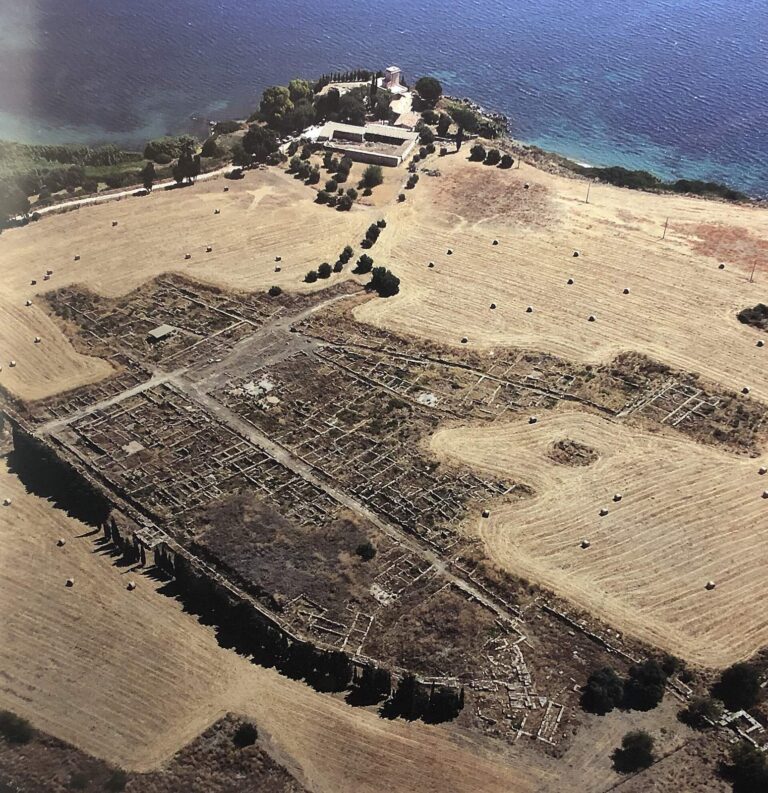
The ancient city occupied two high points separated by a depression, with the central valley holding the agora and lower town. Metapiccola rises to the southeast, San Mauro to the southwest, and Castellaccio lies to the north. The site extends between modern Lentini and Carlentini. Its fertile plain reaches toward the Simeto River, while the Lissos, now called the Fiume Ruina, flowed west of the city toward a nearby lake.
Early settlements and houses
Pre-Greek remains
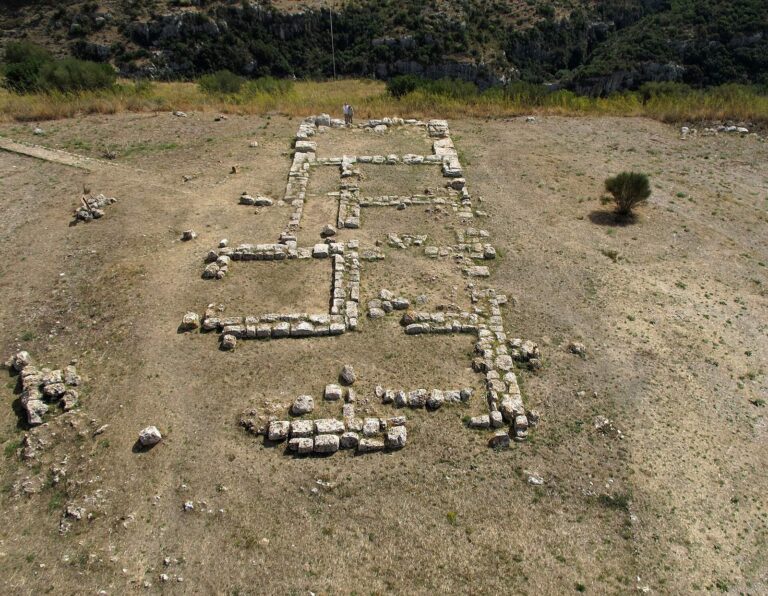
Walled caves and huts of an Italic type belong to the earliest remains. On Metapiccola, a prehistoric settlement had rectangular huts with sunken bases. The structures were wooden, and their postholes remain visible in the ground. A Sicel Iron Age settlement and a temple have been found on one of the acropolis hills. Terracotta architectural decorations from another temple came from the other hill.
Greek houses
Remains of Archaic Greek houses lie within the walled area. A house excavated in the Crocifisso district in 1980 was identified with the house described by Polybius.
Fortifications
Early wall circuits
The city’s defensive walls followed a complex plan and were built in four phases. A seventh-century BCE circuit enclosed only the acropolis. Sections survive on the eastern side of San Mauro, where cuttings also mark the stone quarry. Another major circuit, dating to the early sixth century BCE, climbed from the valley toward Metapiccola. It was built of small blocks and included a circular tower.
Gates and later defenses
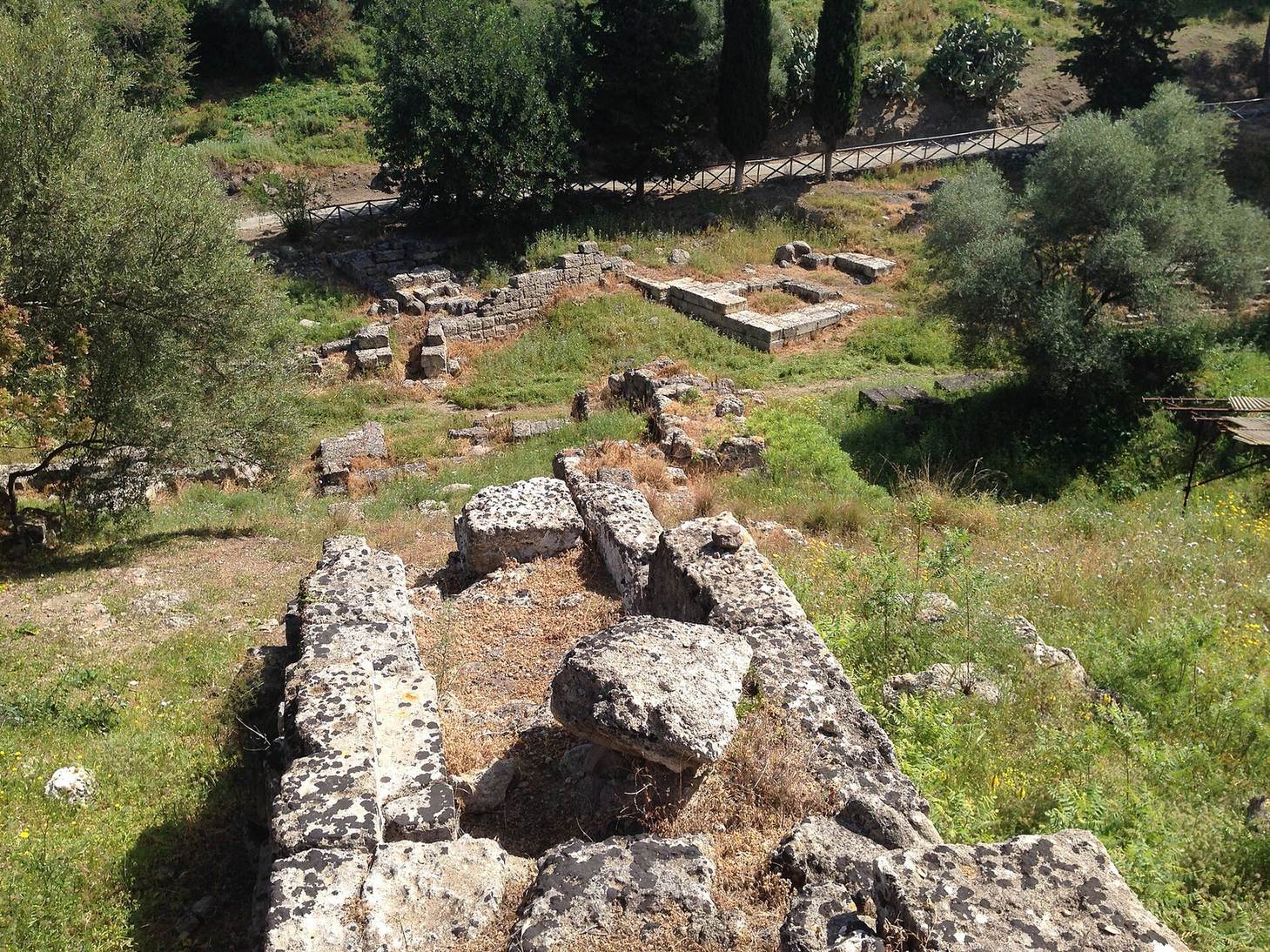
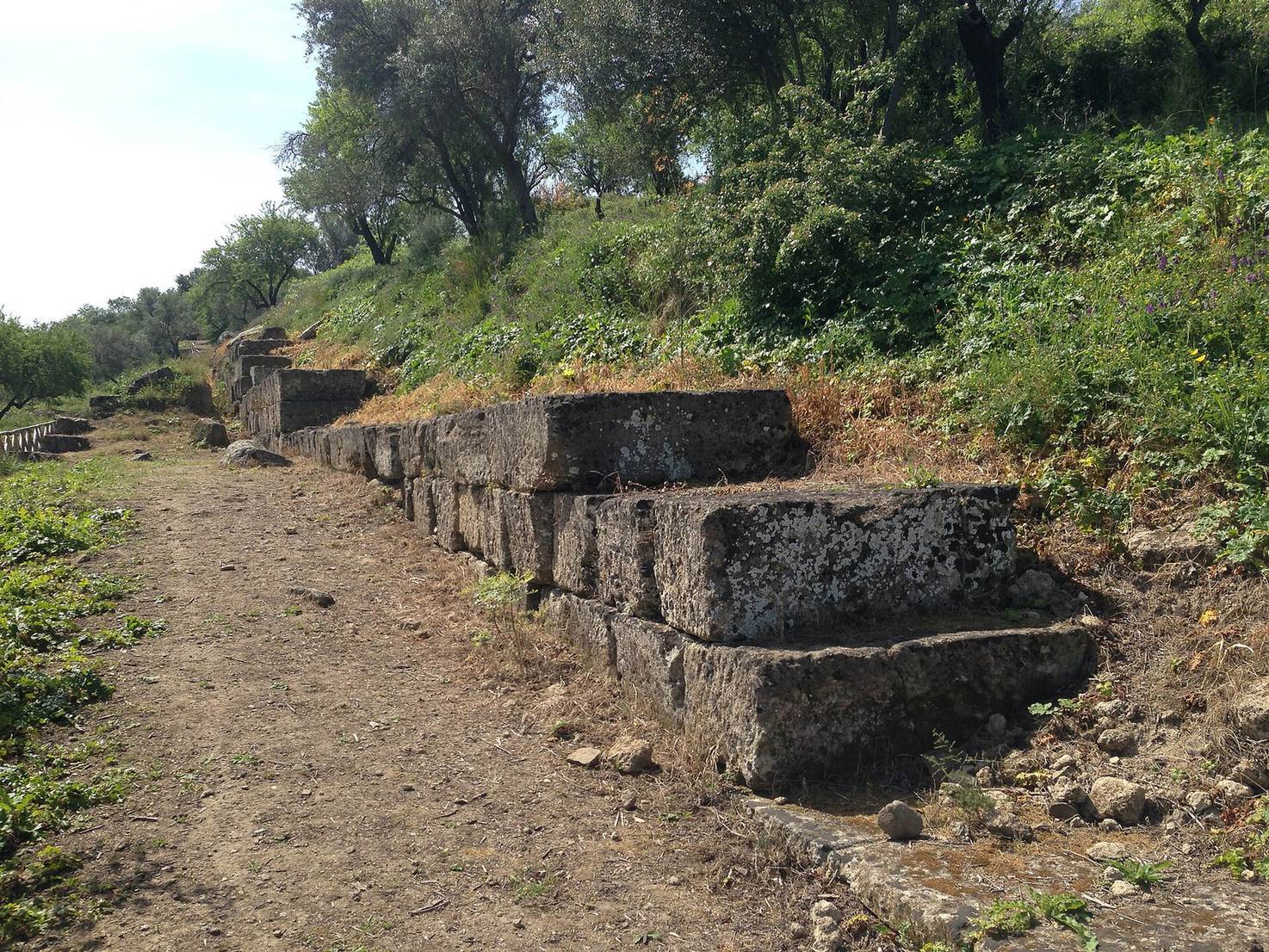
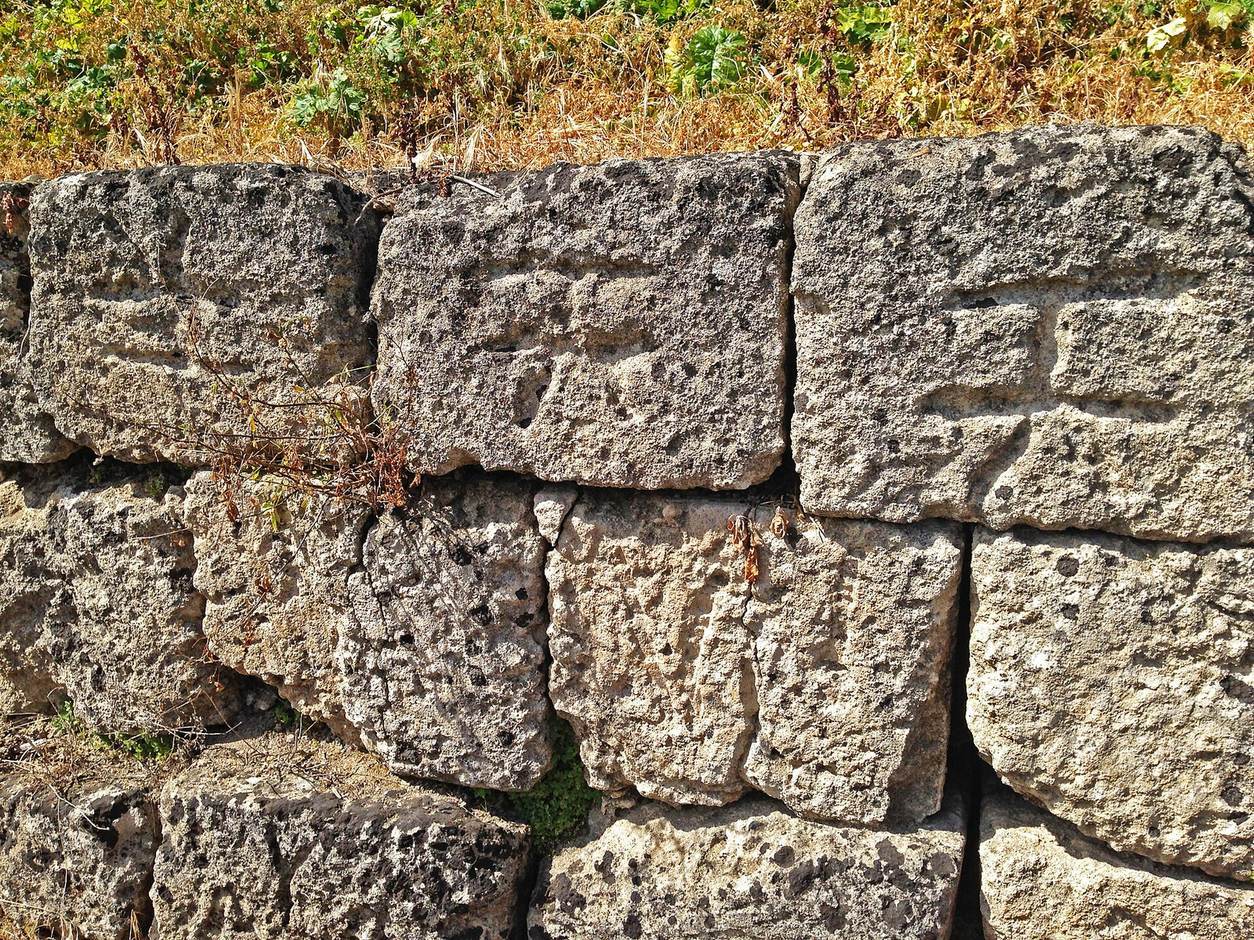
The wall circuit had a northern gate facing the Leontinoi plain and a southern entrance facing Syracuse. The southern, or Syracusan, Gate has a pincer-shaped entrance, with masonry still visible; remains of the northern gate have been identified at Castellaccio. Wall sections survive for several hundred metres. The defenses were restored in the third century BCE during the war between Rome and Syracuse. Fortifications built in the late third century BCE covered ground previously used largely for burials and incorporated earlier remains.
Burial areas
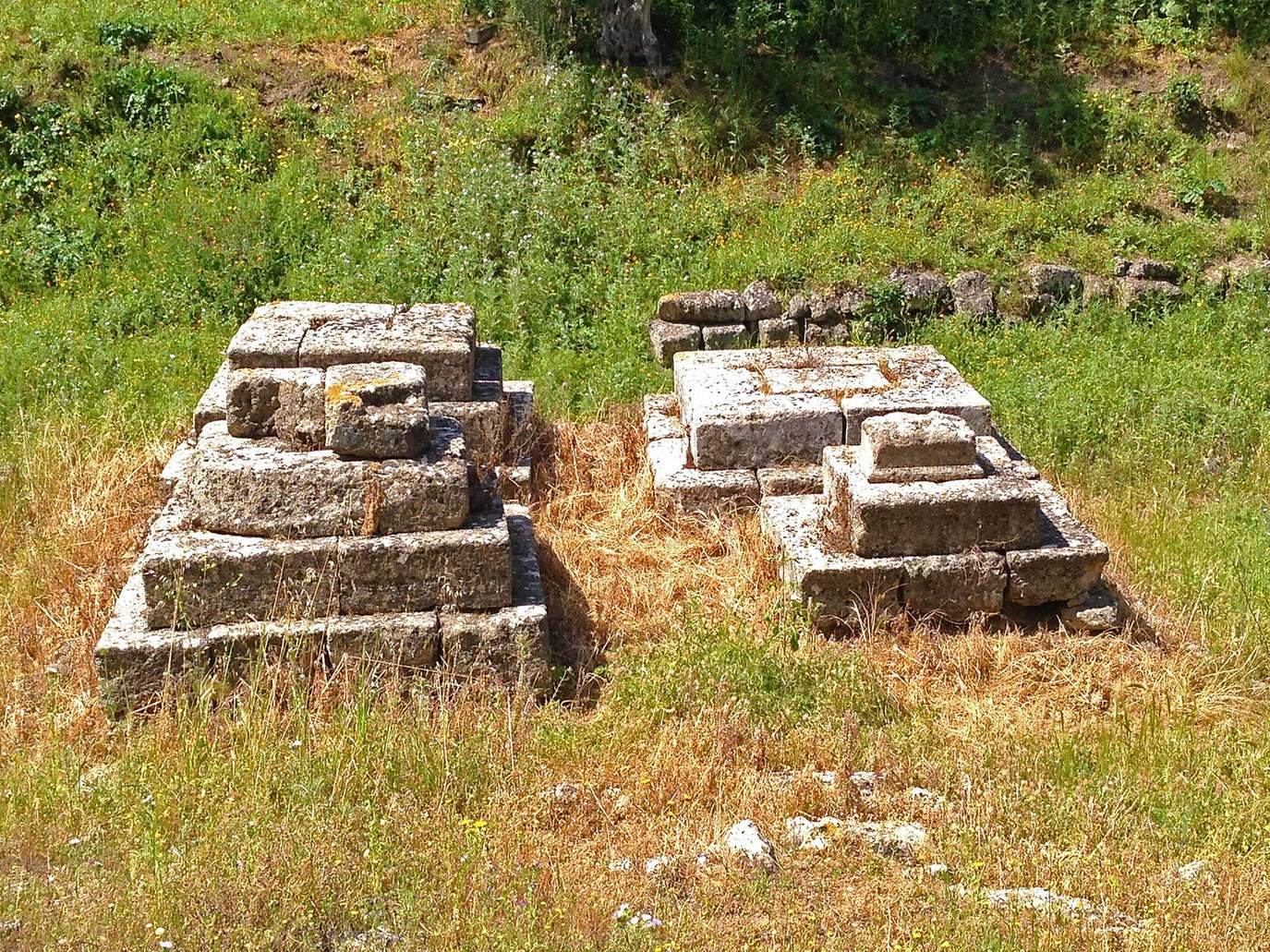
Burials near the southern entrance include sixth-century BCE tombs, along with funerary monuments and nearby burial grounds dating to the fourth and third centuries BCE. Other excavated cemeteries lie outside the walls, in the San Eligio valley and Piscitello district, and south of the southern gate. At Piazza Umberto, a Muslim cemetery overlies an Archaic Greek burial ground.
Finds
A votive deposit, a group of offerings dedicated in a religious setting, was found west of Metapiccola in 1960. A kouros, an ancient Greek statue of a young man, was discovered in 1902 and is now in the Paolo Orsi Regional Archaeological Museum in Syracuse. A head from the Biscari collection has been associated with it. Finds from Leontinoi are also held in the archaeological museum at Lentini, with other objects in the Syracuse museum.