Megara Hyblaea: An Ancient Greek Colony on Sicily
Site at a Glance
- Popularity
- High
- Country
- Italy
- Primary era
- Iron Age
- Eras represented
- Iron Age, Classical
- Civilizations
- Ancient Greek
- Site type
- City
On this page17 sections
History
Megara Hyblaea was a Greek colony on Sicily’s eastern coast near present-day Augusta, Italy, founded around 728 BC by emigrants from the Greek city of Megara. The date is traditional; Thucydides placed 245 years between the foundation and Gelon’s expulsion of the inhabitants. Its early colonial remains and unusually well-preserved archaic plan have made it an important site for studying Greek settlement in the western Mediterranean.
Foundation and early city
The foundation tradition recounts a series of moves led by Lamis. The settlers first went from Trotilon, near the mouth of the Pantagias River, to Leontini, where they lived alongside Chalcidian colonists before being driven out. They then reached Thapsos. After Lamis died there, Hyblon, a local Sicel ruler, offered them land on which to establish the city. Its name combined that of the settlers’ Greek homeland with a reference to the local territory.
About a century later, Megara Hyblaea sent colonists to establish Selinus on Sicily’s southwestern coast. Selinus eventually became more powerful than its parent city. Megara Hyblaea itself appears to have remained less prominent than nearby Syracuse and Leontini.
Expulsion and renewed occupation
Around 483 BC, Gelon, the ruler of Syracuse, captured Megara Hyblaea after a long siege and expelled its population. Most inhabitants were sold into slavery, while wealthier and more prominent citizens were moved to Syracuse. The city’s walls may also have been demolished. Some people returned after roughly a generation, so occupation did not end immediately.
During Athens’ expedition against Syracuse in 415–413 BC, the Athenian general Lamachus proposed turning the largely deserted site into a naval base. The proposal was rejected, and the Syracusans fortified the place the following spring.
Timoleon, a Corinthian military and political leader active in Sicily, is traditionally credited with helping rebuild Megara Hyblaea around 340 BC, after restoring order at Syracuse and encouraging the resettlement of its territory. Occupation resumed on a limited scale, initially spread across the earlier town before activity gathered around the former agora, the city’s central public space, from the beginning of the fourth century BC.
Hellenistic rule and Roman destruction
The city’s main Hellenistic phase fell within the reign of Hieron II of Syracuse, from 270 to 215 BC. Megara Hyblaea remained under Syracuse’s influence during this period. Around 213 BC, Roman forces commanded by Marcus Claudius Marcellus destroyed it during the Second Punic War, the conflict between Rome and Carthage fought from 218 to 201 BC. The settlement never recovered its former urban importance. Isolated farms later occupied the territory, and the site was abandoned by late antiquity.
Rediscovery and archaeological investigation
The Sicilian historian and antiquarian Tommaso Fazello identified the site in the mid-sixteenth century. Systematic investigations began only in the late nineteenth century, amid repeated looting. Francesco Cavallari and Paolo Orsi led early work on the western cemetery and archaic defenses in 1879, 1889, and 1891–92. Orsi later investigated a sanctuary in the northwest from 1917 to 1928, while the town itself initially received only limited trial excavations.
Excavation resumed in 1949 through an agreement between Sicilian archaeological authorities and the French School of Rome, a French research institution. François Villard began the work, later joined by Georges Vallet, Paul Auberson, and Italian archaeologists including Luigi Bernabò Brea. Investigations eventually covered about 60 hectares. Early work examined settlement layers to establish the chronology of pottery associated with Corinth, before expanding to broader questions about the city.
Industrial development prompted excavation of a previously unknown Hellenistic fortress in 1952–57. In 1958, work along a street from the western Hellenistic gate brought the later agora to light and drew attention to the earlier settlement beneath it. Fieldwork on the southern plateau in 1977–83 and further campaigns in the 1980s and 1990s, including a major excavation south of the agora in 1990–92, extended the investigation of the ancient town.
Modern construction also affected the site. The Catania–Syracuse railway, built in 1867, cut through parts of the settlement and its defenses. Refinery construction beginning in 1949 covered part of the northern cemetery; later archaeological work recovered finds and protected a portion within the Hellenistic walls. Industrial expansion has also affected the surrounding area.
Remains
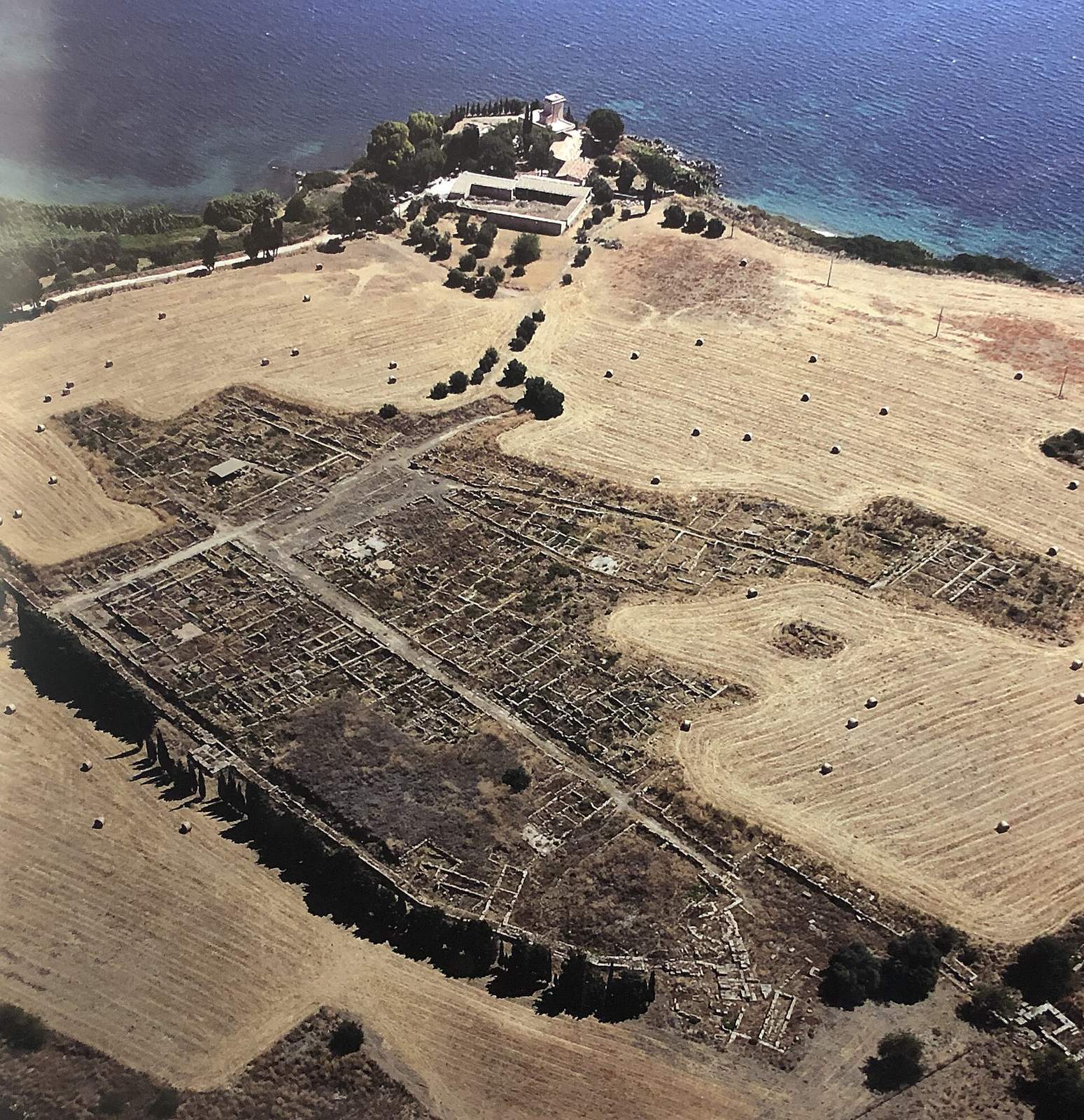
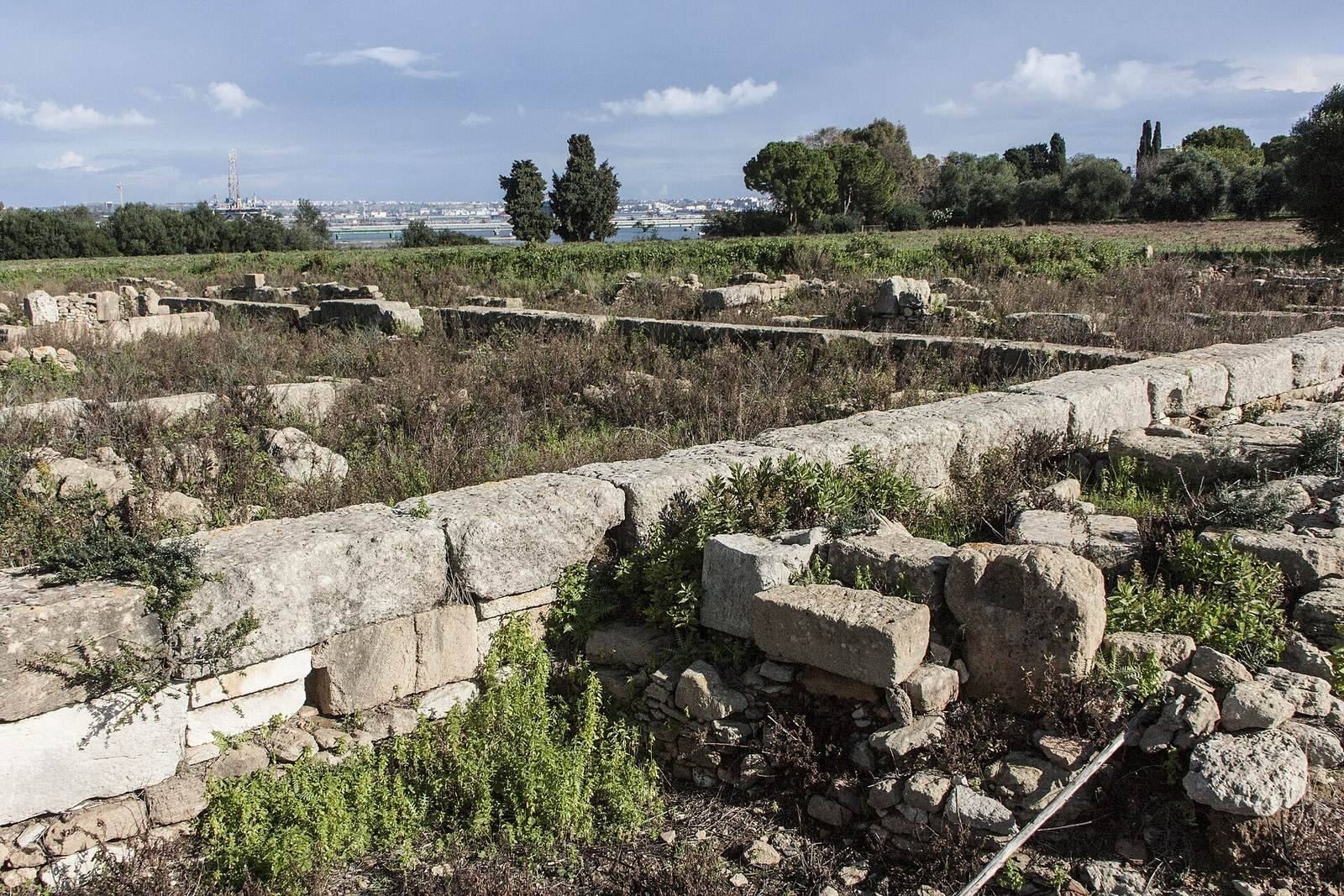
The ancient town stood beside the deep bay formed by the Xiphonian promontory, with its harbor to the north. The site lies about 20 to 22 km north of Syracuse. Its remains include a planned street layout, successive public centers, temples, defenses, houses, workshops, and cemeteries around the settlement.
Town plan and defenses
Streets and blocks
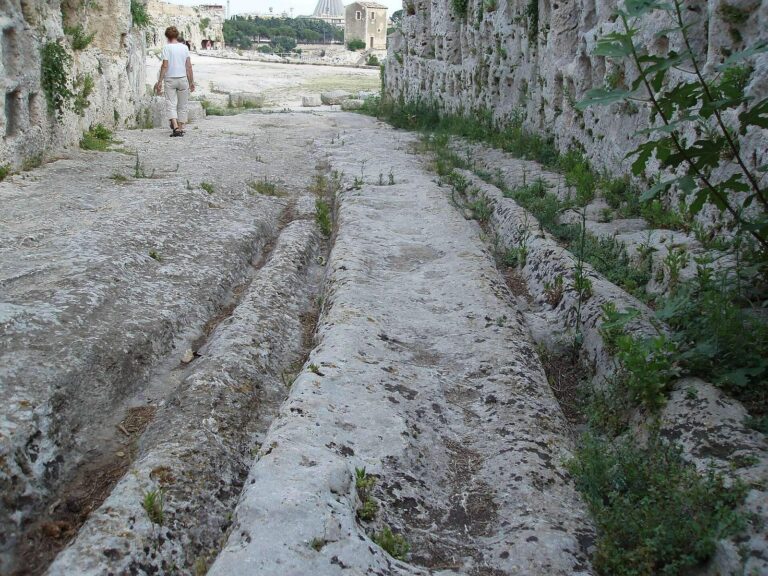
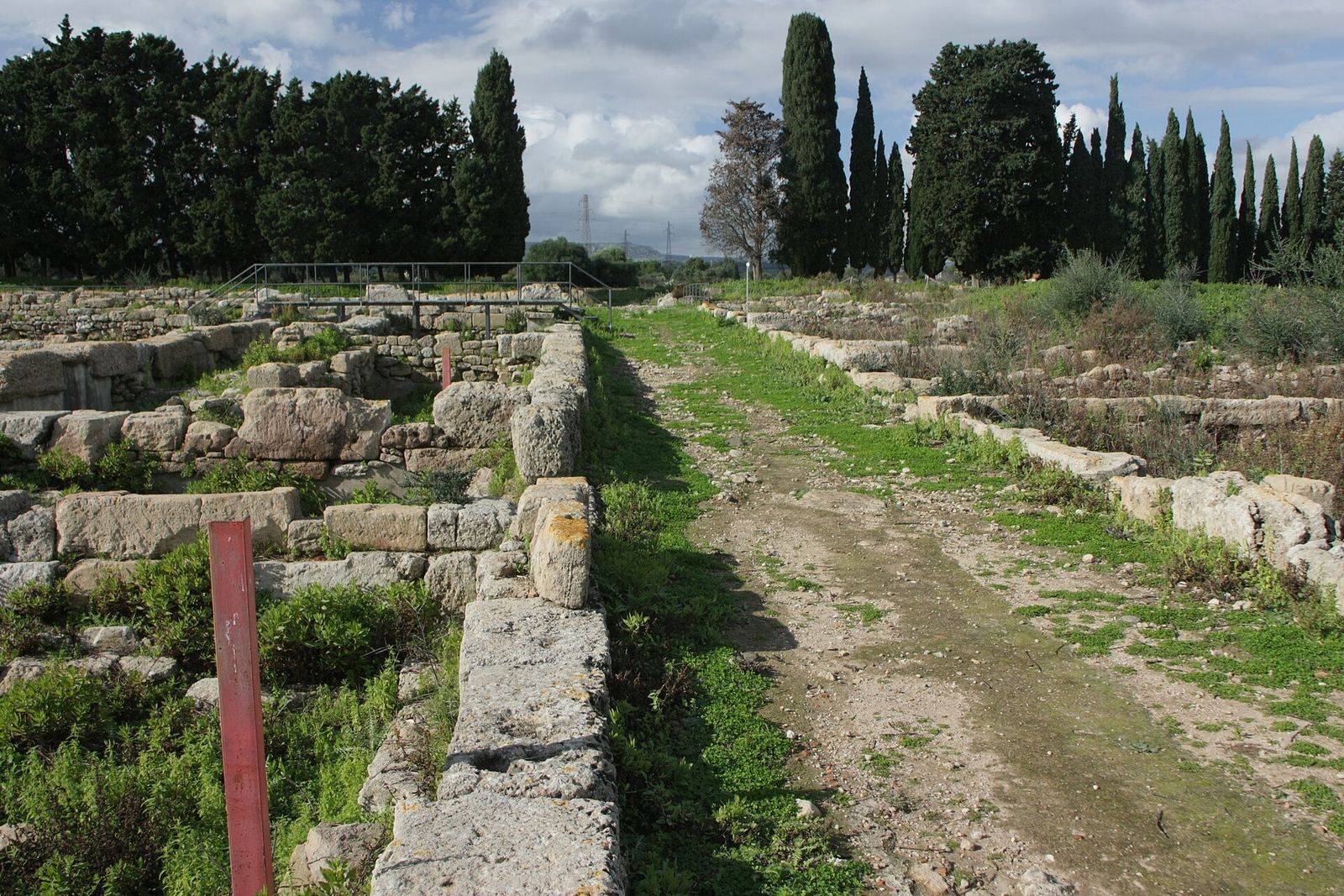
The earliest urban arrangement dates to the late eighth century BC, becoming more regular during the seventh century. Blocks were about 25 m wide, divided by straight, parallel streets spaced roughly 28 m apart from center line to center line. This broadly regular layout came centuries before the more fully ordered Greek planning associated with the Hippodamian system.
Fortifications
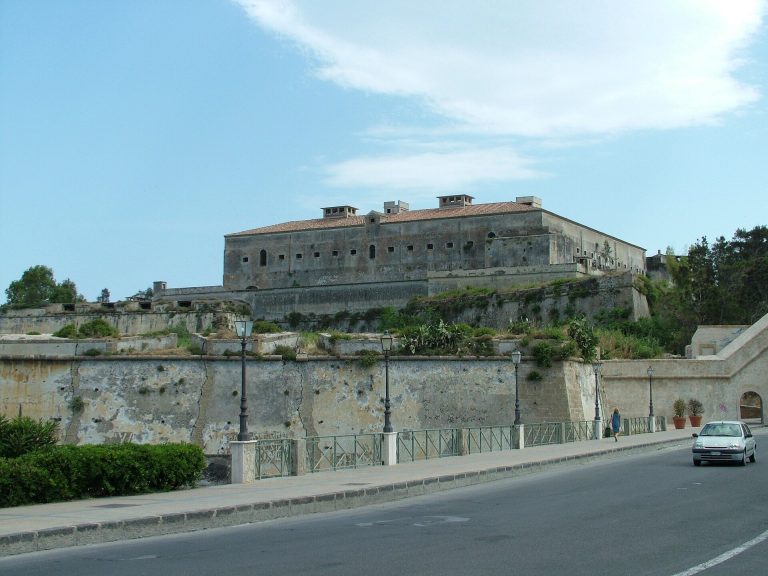
Archaic defenses were built from squared blocks and included semicircular towers and a gate. Excavated sections of the western town wall include a northern stretch, with one part also serving as a barrier against flooding. The southern defenses predate the middle of the seventh century BC. The earliest Hellenistic fortification may date to the early fourth century BC; the final form of the city wall belongs to the Hellenistic period under Hieron II. A Hellenistic fortress is also among the site’s remains.
Public and religious buildings
Agoras and porticoes
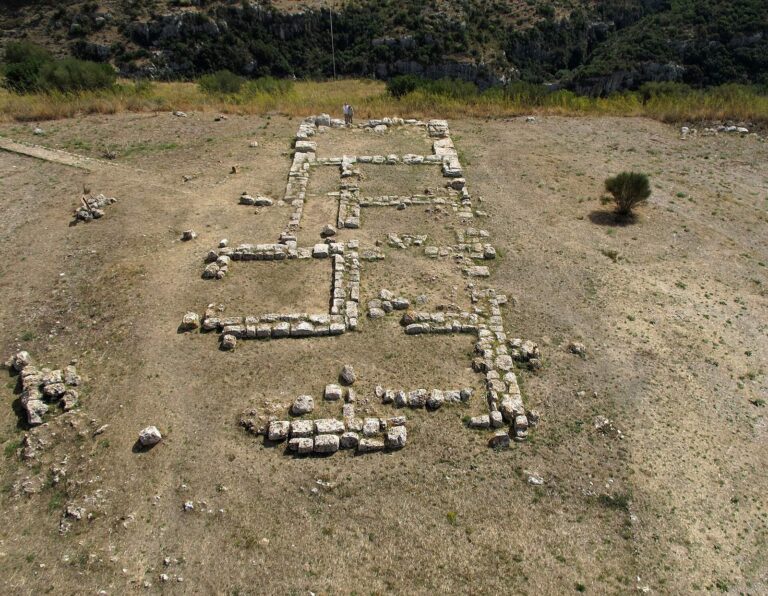
The archaic agora was a trapezoid measuring about 74 by 63 m. The later Hellenistic public square partly covered the earlier one. Porticoes stood along the north and east sides of the agora, while the Hellenistic square was also bordered by a portico, a temple, and baths. The public center thus developed through successive building phases.
Temples
South of the agora are the foundations of two temples dating to the sixth century BC, both in the Doric order, a principal style of ancient Greek architecture. Each had a porch and an inner sanctuary; the western temple also had a row of columns along its central axis. Votive objects from the temples are now held in the museum in Syracuse.
Civic and other buildings
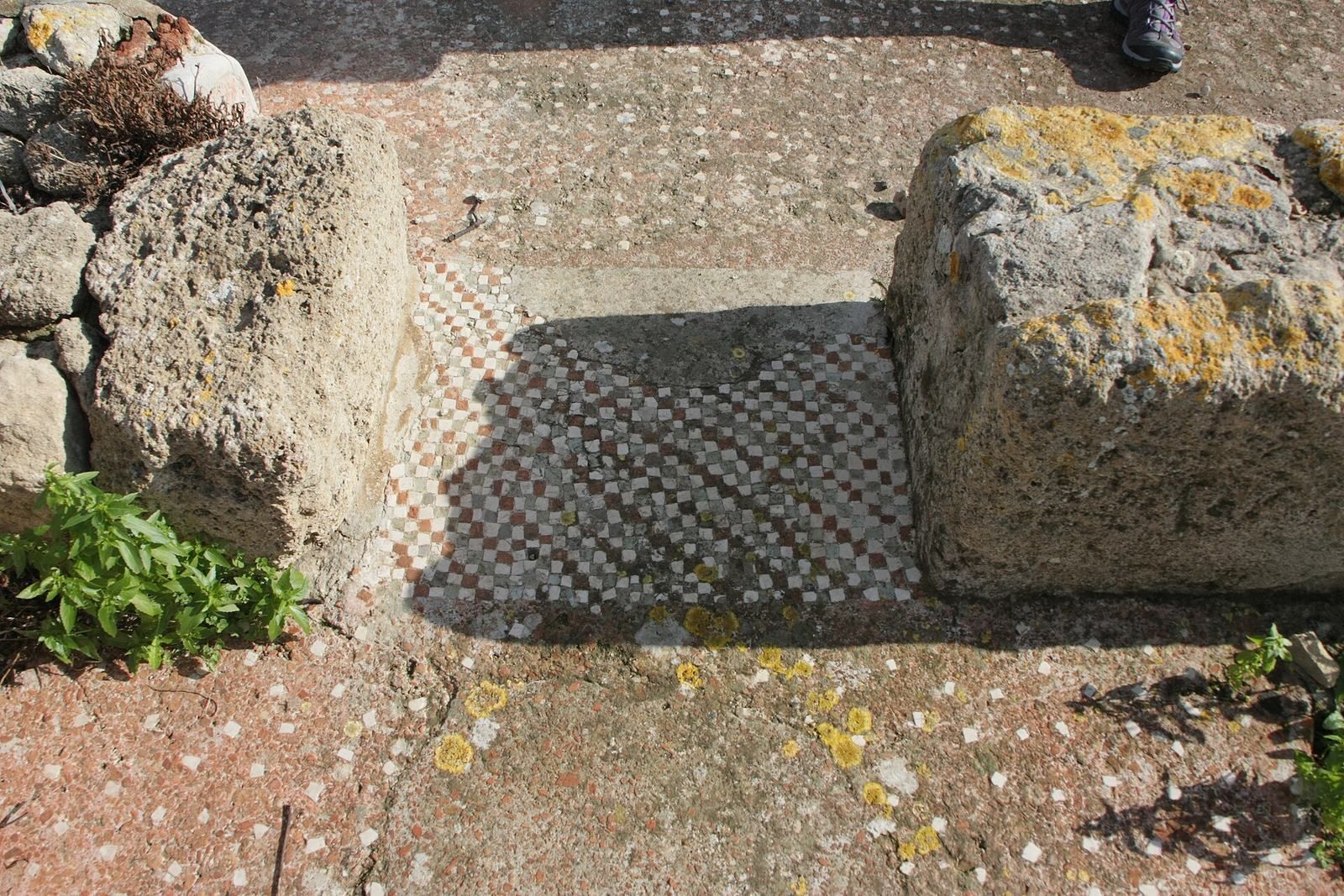
Other identified structures include a Hellenistic temple, Greek baths, a shrine associated with a hero, and a civic building linked to the city’s governing institutions. Remains of houses, shops, and a metalworking workshop have also been found. A house near the western gate had floor mosaics.
Cemeteries and burial practices
Cemetery layout and graves
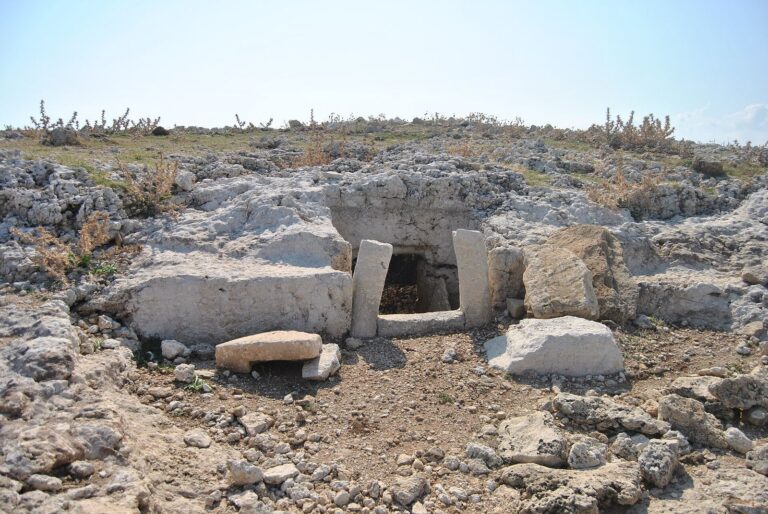
Archaic cemeteries lay north, south, and west of the town. More than 2,000 tombs have been excavated and studied. Their forms include single-block stone coffins, graves lined with upright slabs, burials covered with tiles, and built tomb chambers. Both burial of the body and cremation were practiced. Some graves held successive burials, with earlier bones moved aside to make room. Cemetery arrangements also provide evidence for the organization of nearby farmland and may reflect an early land survey.
Funerary sculpture
A sixth-century BC limestone sculpture from a cemetery depicts a seated woman nursing twins, a nurturing figure type called a kourotrophos. Found in fragments during refinery work on 30 October 1952, it was reconstructed from 936 pieces and is now in the Paolo Orsi Regional Archaeological Museum in Syracuse. The southern cemetery also yielded a funerary statue of a young man, known as a kouros, carved from Parian marble from the Greek island of Paros. Dating to the middle of the sixth century BC, it is described as being in the Doric style. An inscription on its thigh names the deceased as Sombrotidas, a physician and son of Mandrokles. This statue is also in the Syracuse museum.
Other finds
A fragment of a sixth-century BC theatrical mask came from the agora district. The site has also yielded polychrome Megarian pottery and further objects from its cemeteries; finds from both the cemeteries and temples are displayed in the Syracuse museum. Neolithic remains have also been identified in the area.