Santa Maria la Cava e Sant’Alfio: Lentini’s Baroque Cathedral Church
Site at a Glance
- Popularity
- Medium
- Country
- Italy
- Primary era
- Early Modern
- Eras represented
- Classical, Early Modern
- Civilizations
- Kingdom of Sicily, Roman
- Site type
- Religious
- Remains
- Cathedral
On this page11 sections
History
Santa Maria la Cava e Sant’Alfio is the principal Catholic church in Lentini, Sicily, Italy, and retains the title of cathedral. Lentini was a bishop’s seat in the Byzantine period, and in 1968 it became a titular episcopal see, retaining a bishop’s title without a resident diocese. The present Baroque church was rebuilt after the earthquake of 1693, with work beginning around the turn of the eighteenth century and finishing around its middle.
Early church and bishopric
Tradition places the foundation of Lentini’s early diocesan church around AD 253, in connection with the martyrdom of Alfio and his brothers. Dedicated to the Virgin Mary as Santa Maria la Cava, it was said to have been consecrated on 4 September 261. That date is considered implausibly early, and the church’s beginnings remain uncertain. It stood near the old fortress, also called the Castellaccio, and the house of Isidora, mother of Tecla. The church reused a pre-existing pagan building known as the Basilica of the Astronomers.
Christian tradition connects the church’s origins with the deaths of Alfio, Filadelfo, and Cirino during persecutions under the Roman emperors Decius and Valerian. The prefect Tertullus is also named in the story. Tecla and her companions recovered the brothers’ bodies for Christian burial, and Tecla initiated a basilica at their burial place. Other martyrs were buried there as well.
Alessandro, who took the Christian name Neofito after converting from paganism, is named as the first bishop. Bishop Lucido appears in letters from Pope Gregory the Great dated 602 and 603. A list from the late ninth century still identifies Lentini as a Sicilian episcopal see.
Relics and medieval changes
Between 785 and 787, the diocese’s last known bishop, Costantino, secretly moved the brothers’ relics to the Basilian Abbey of San Filippo di Fragalà, fearing a Saracen invasion. He also transferred relics associated with Tecla, Giustina, Eutralia, Epifania, Eutropia, Isidora, Onesimo, Erasmo, Cleonico, Caritone, Neofito, and Mercurio, as well as those of seven people described as mute witnesses to Christ and twenty Roman soldiers who had converted to Christianity.
The brothers’ relics became associated with Mirto, San Fratello, and San Marco d’Alunzio, where their veneration took root. Their movement between places reflected efforts to protect them from raids and vandalism. In 1516, rebuilding at Fragalà uncovered a box of human bones and a Greek manuscript whose translation identified the remains as those of the three brothers. After attempts to obtain the relics peacefully failed, a group from Lentini seized them by surprise and brought them home on 2 September 1517. The people of Lentini later reported the seizure to the pope and compensated the institutions whose rights had been breached.
In 1124, the Norman king Roger II gave the Church of Catania, then led by Bishop Maurice, temporal authority over territories belonging to Lentini’s suppressed diocese. The old church and the Basilica of Sant’Alfio suffered severe damage during Arab raids and earthquakes, including one in 1140 and another known as the earthquake of Saint Agatha.
Devotion and collegiate churches
A local tradition tells of a painted panel of the Virgin found at the nearby port of Agnone Bagni, prompting a dispute between fishermen from Lentini and Catania over its destination. Although the nearby Cistercian Basilica of Murgo was proposed, a team of oxen drawing the panel’s cart, without anyone guiding them, headed to Lentini and stopped near the fortress. The image was placed in a chapel in the old castle on Mount Latina, now called Tirone, under the title Santa Maria Maggiore del Castello. Annual processions and growing veneration led to its transfer to Santa Maria la Cava, where it remained until 1675. An association called Queen of Heaven, founded on 20 March 1683, promoted devotion to the image and was later re-established as the Confraternity of the Whites, which assisted people condemned to death.
The church received privileges from Peter II of Sicily and later from Maria of Sicily and Martin I in 1399. A separate church dedicated to Alfio, Filadelfo, and Cirino was rebuilt by Sebastiano Scalambro in 1518 on their earlier burial site, with permission from Pope Leo X. A papal brief made that church a collegiate church on 30 September 1633. In 1668, Pope Clement IX raised the old cathedral to collegiate status, meaning it was served by a chapter of clergy traditionally known as canons.
Earthquake and rebuilding
The earthquake of 1693 destroyed both the cathedral and the church of the three martyrs. A small church was erected over the tombs while reconstruction was pending. Ruins of the old sacristy on the outskirts were adapted as the Church of the Bell and used as an oratory. Lack of funds and disagreement over which collegiate church to rebuild first delayed the work. In 1696, Bishop Asdrubale Termini mediated the dispute and selected the site of the sixteenth-century collegiate church on the customs plain. The rebuilding brought the former cathedral together with the chapter of the collegiate church dedicated to the martyrs.
The church became unusable after the earthquake of 13 December 1990. Lentini’s annual feast of Saint Alfio, its patron saint, takes place from 9 to 11 May, when a silver reliquary float is carried in procession. A further observance on 2 September recalls the return of the brothers’ relics in 1517.
Remains
Plan and exterior
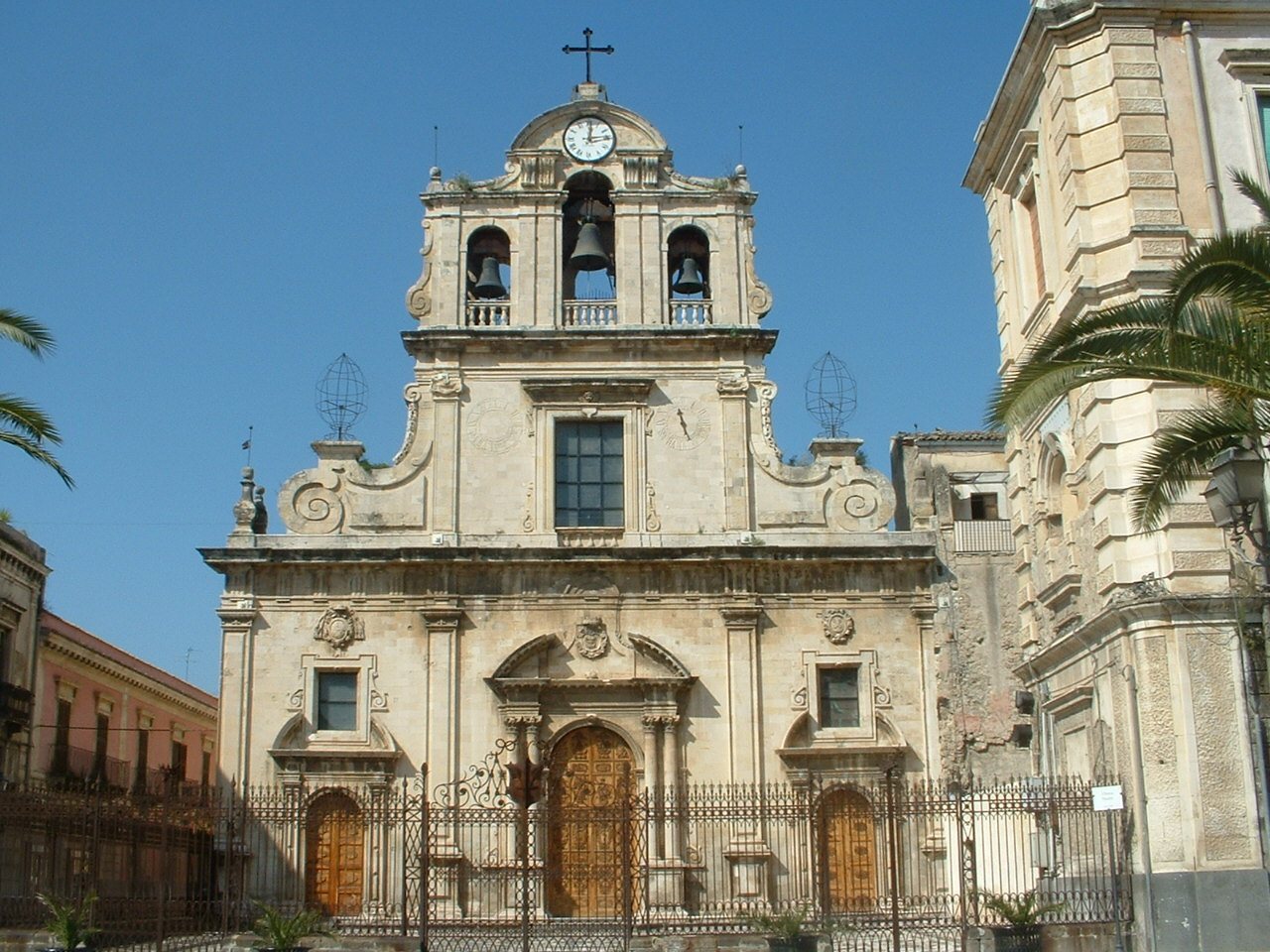
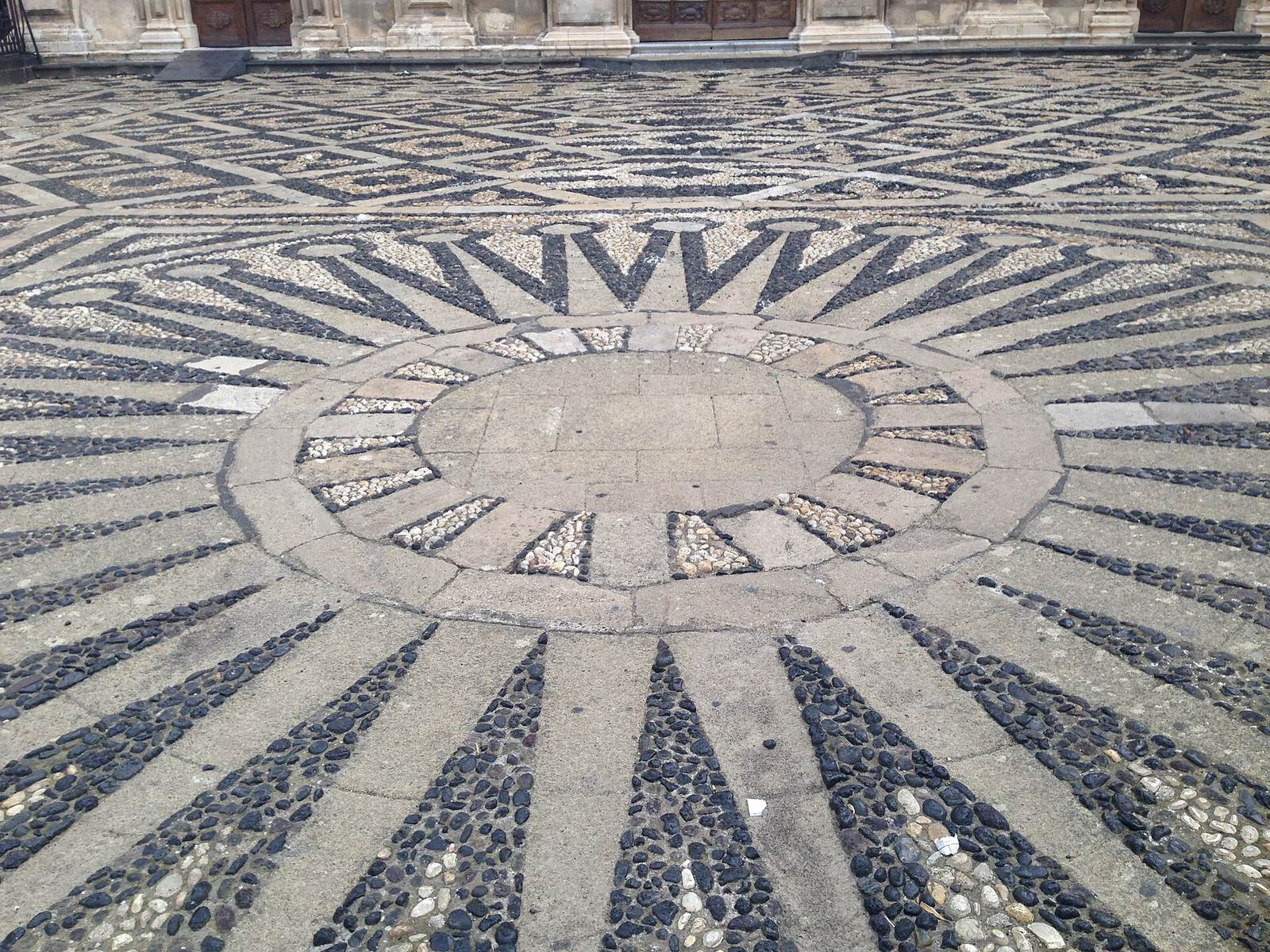
The present Baroque church has a basilica plan shaped as a Latin cross. Its eighteenth-century facade rises in three levels. In front, an ornamental iron railing encloses a forecourt paved with black and white pebbles in geometric designs. A central star with 32 points is framed by three concentric bands of diamond patterns.
Interior
Naves, dome, and frescoes
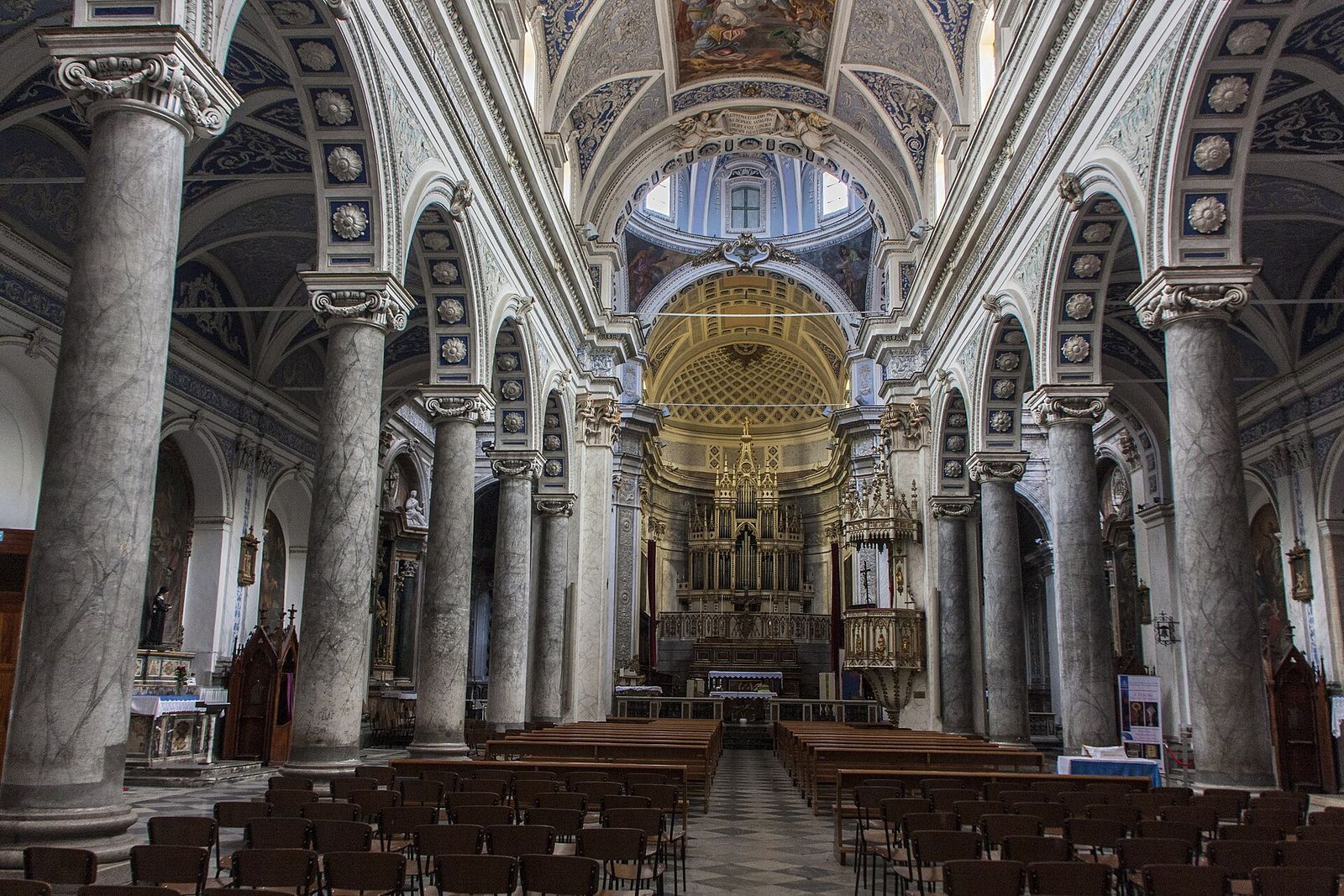
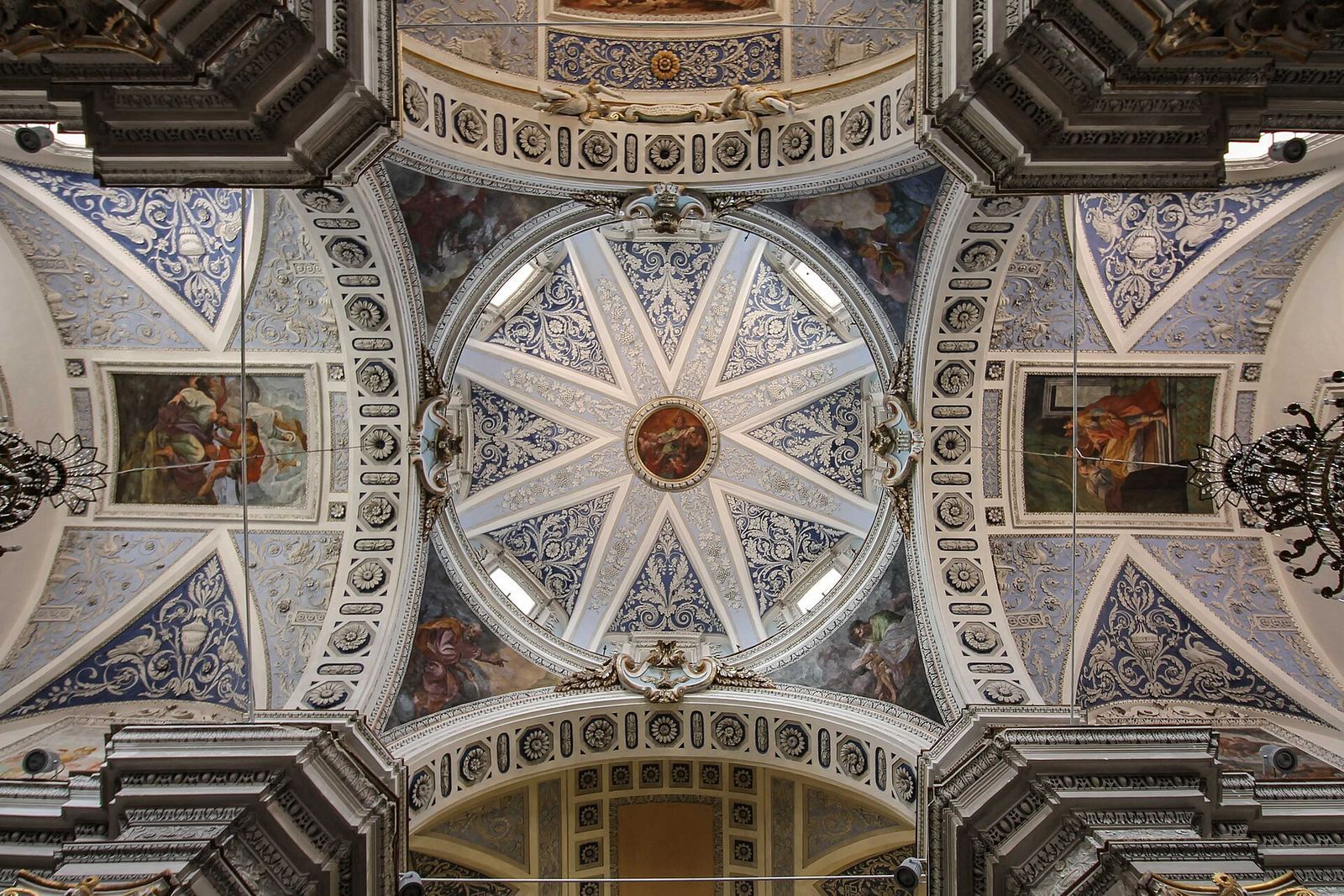
Twelve columns and piers at the crossing divide the interior into three naves. The side naves have six bays, and three large spaces open from the right nave. Raised stucco decorates the dome’s curved sections and ribs, while frescoes of the four Evangelists occupy its pendentives, the curved supports beneath the dome. Three large painted panels cover the central nave’s vaulted ceiling. They show Neofito’s consecration as bishop of Lentini by the apostle Andrew, the three martyrs ascending to heaven with the Virgin, and the baptism of the first catechumens.
Chapels and sacred objects
The right apsidiole, a small recess beside the apse, contains the Chapel of the Sacred Heart. Another chapel with a painting lies in the right arm of the transept. In the left apsidiole, the Chapel of Our Lady of the Chain has a raised shrine framed by twisted columns. It holds an alabaster statue attributed to the Gagini school of sculptors. The Chapel of the Holy Crucifix occupies the left transept arm; its shrine has columns and a pediment and contains a crucifix with a statue of Our Lady of Sorrows at its foot. The sacristy holds reliquaries of the True Cross. The church also houses a twelfth-century Byzantine icon of the Virgin Hodegetria, an image type in which Mary points toward Christ.
Burial spaces and reliquary float
The burial complex associated with the Basilica of Sant’Alfio includes three rock-cut arcosolia, or arched burial recesses, together with a well, a cave, and narrow underground passages. The arcosolia are now incorporated into chapels in the right nave, where the tombs of Alfio, Filadelfo, and Cirino are also located. The crypt contains underground rooms used in preparing and burying the dead, including through mummification, skeletonization, and removal of flesh. These chambers, called a putridarium, allowed bodies to decompose before their bones were collected. A silver reliquary float of Saint Alfio is kept in the left nave.